
Review · SPLIT HISTORY TOURS
Walking Tour of Split with a ‘Magister’ of History
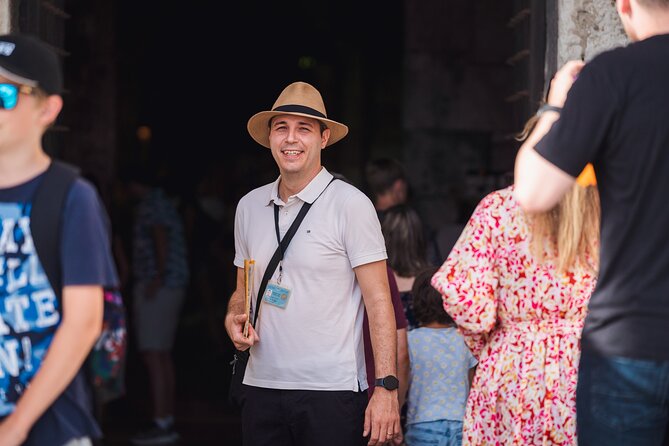
Diocletian’s Palace is not a museum behind ropes. It is Split’s living town center, with homes, cafés, shops, churches, and laundry tucked into Roman walls. This walk helps you read that jumble of old and new, led by Toni Šare, a Split-born historian who uses his own 3D reconstructions to show what the palace looked like before centuries of change.
I like the tour’s attention to small details, from Roman construction errors at the Temple of Jupiter to the medieval reuse of the palace walls. I also like the broad time span: you get Roman, medieval, Renaissance, Venetian, and modern Croatian history instead of hearing only about Emperor Diocletian. The main consideration is that paid interiors are not included, so you’ll see the Cathedral and Temple of Jupiter from outside.
Key points to know before booking
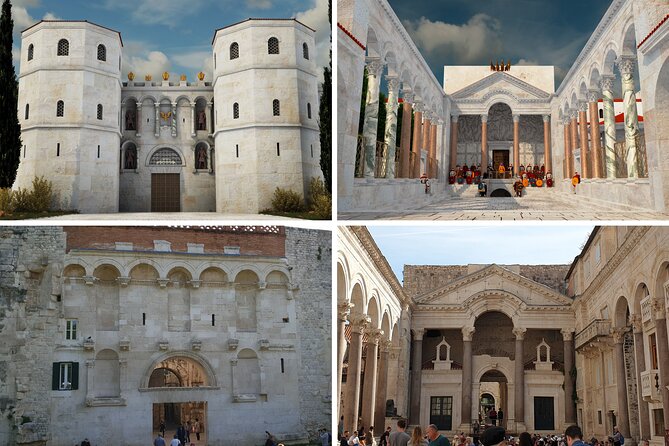
- Toni’s 3D reconstructions make it easier to picture Diocletian’s Palace as a working imperial residence, not just a collection of ruins.
- The route covers more than Roman Split, including medieval gates, Renaissance noble palaces, Venetian influence, Croatian culture, and recent local history.
- The tour lasts about 1 hour 40 minutes to 1 hour 50 minutes, with a maximum of 18 people.
- No museum or paid-site admissions are included, though Toni explains the Cathedral, bell tower, and Temple of Jupiter from outside.
- The tour begins at the Brass Gate and ends at Pjaca, Split’s main square, a useful place to continue exploring.
- An evening departure can help with summer heat, while a morning walk gives you a useful map of the old town before you explore alone.
Why this Split history walk is more than a Roman ruins tour
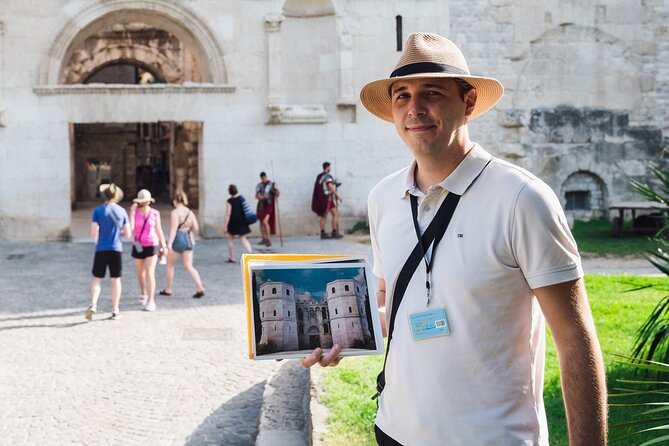
The big strength here is context. You will not simply hear the names of Diocletian, Jupiter, and Saint Domnius, then move on. Toni explains how the palace changed purpose over time and how later residents built their lives into an imperial structure.
That matters because Split can seem confusing at first. A Roman column may sit beside a medieval wall. A Renaissance courtyard may open off a narrow street. A former imperial entrance may now feel like an ordinary passage through town. Toni’s job is to connect those layers so you understand what you are seeing.
He also brings a local point of view. Toni was born and raised in Split, studied and taught history, and brings knowledge of local culture, politics, religion, and architecture to the walk. The result is more than a list of dates. You get a sense of how Split developed from an emperor’s retirement residence into a modern Croatian city.
The tour is offered in English and costs $34.83 per person. That is a fair price for a focused introduction, especially if you are staying in Split for only a short time or want an expert orientation before visiting on your own. A group discount may help families or larger parties, and you can choose a private version if you want a more personal pace.
The group option has a maximum of 18 people. That is not an intimate private walk, but it is small enough for questions and for the guide to lead people into narrower parts of the old town. If you prefer complete control over timing, ask about the private upgrade.
More History Walking Tours in Croatia
- Dubrovnik Old Town History Walking Tour
★ 5.0 · 1,684 reviews - Dubrovnik: Ancient City Walls & Wars Walking Tour
★ 5.0 · 1,270 reviews - Zagreb: City & History Walking Tour & WW2 Tunnels
★ 4.9 · 1,202 reviews
Starting beside the Brass Gate at Riva Harbor
The walk begins at the Brass Gate, also called Porta Aenea, beside Riva Harbor. This is a practical meeting point because the waterfront is easy to find and the southern wall of Diocletian’s Palace is clearly visible from there.
Riva is more than a pretty promenade. It is one of the main social spaces in Split, a place where local life and the old palace meet. Toni uses the harbor as an opening lesson, showing graphic material and models that explain what you will see inside the palace.
I like this start because it gives you a broad view before you enter the tight lanes. You can first understand the palace as a planned structure, then watch the plan break into real streets, courtyards, and buildings.
The stop lasts about 15 minutes, and there is no admission charge. Stay alert for the transition from open waterfront to enclosed old-town streets. Once the group moves inside, the route becomes more detailed and the footing can feel less even in historic areas.
The Peristyle and the shape of Roman power
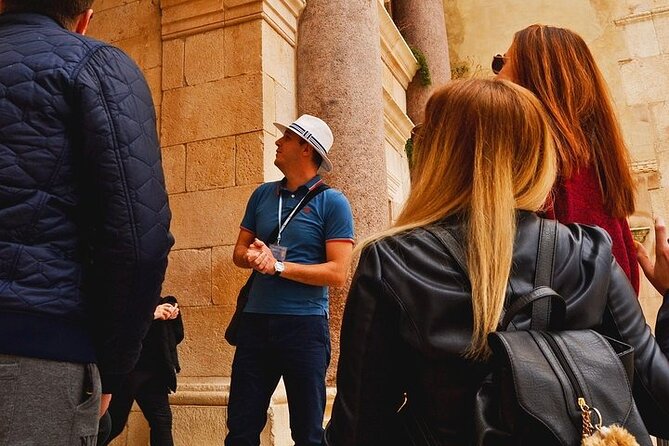
The Peristyle is the central square of Diocletian’s Palace and one of the clearest places to grasp the scale of the Roman complex. Here, you will see well-preserved Roman structures still woven into the city around them.
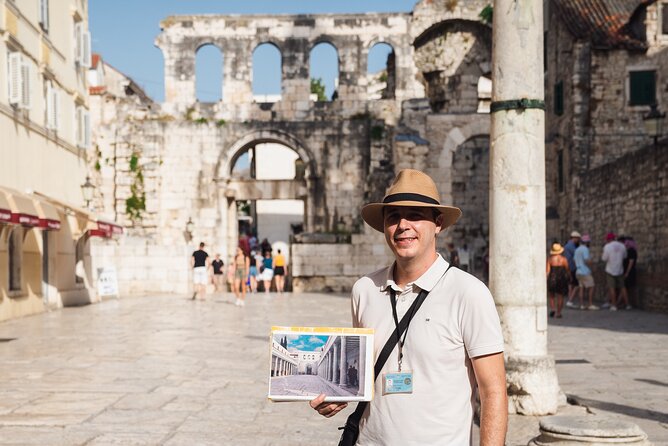
Toni uses 3D reconstructions to show how the square and its buildings appeared in their original setting. These images are useful because surviving columns and walls can be impressive but incomplete. A reconstruction helps you picture decoration, height, and the relationship between different parts of the palace.
The stop is planned for about 10 minutes. That may sound short, but the tour continues through nearby structures, so the Peristyle is not treated as a single isolated sight. You will get the main explanation, then keep moving through the imperial center.
This is one of the best places to listen closely. The square can be busy, and the open space carries sound in unpredictable ways. Stay near Toni so you can follow the explanation and see the visual material he brings.
Saint Domnius, Diocletian’s mausoleum, and a major omission
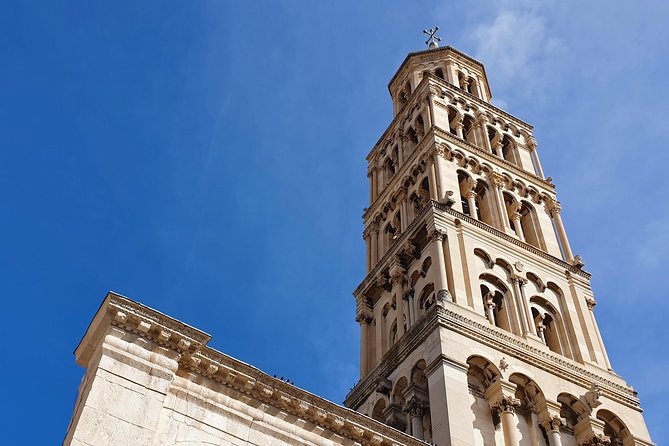
The Cathedral of Saint Domnius occupies what was originally Diocletian’s mausoleum. That change tells a powerful story about Split: a structure built for an emperor’s burial became a Christian cathedral and remains in use today.
Toni explains the original function of the building, its conversion by Christians, and the role of the bell tower. You will also learn why this is considered one of the best-preserved Roman structures in the city.
The tour does not enter the cathedral, and the admission fee is not included. That is the clearest limitation for visitors who want to see the interior, religious art, or climb the bell tower. You can use the walk as an introduction, then decide if an interior visit deserves a separate stop later.
I find the outside explanation valuable even without entry. It helps you understand why the building looks unusual, with Roman form and Christian use sharing the same site. If seeing the inside is important to you, allow extra time in your own schedule.
Same streets, a different century:
- Dubrovnik Combo: Old Town & Ancient City Walls
★ 5.0 · 1,019 reviews - Split Walking Tour with Professor of History
★ 5.0 · 926 reviews - Split: History and Heritage Walking Tour
★ 4.9 · 650 reviews - Game of Thrones & History of Dubrovnik Tour
★ 5.0 · 628 reviews
The Temple of Jupiter and the Roman mistakes
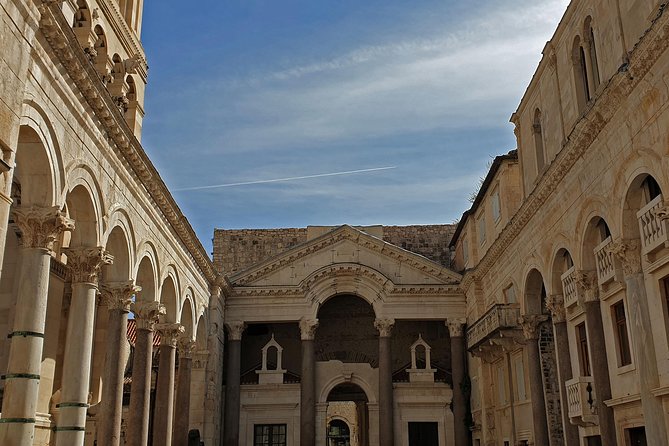
The Temple of Jupiter is another stop where Toni focuses on close observation rather than only grand statements. It is regarded as one of the best-preserved late Roman temples in the world, but the interesting part of the explanation is that the builders made mistakes and left behind anomalies.
You will examine the temple from outside. The tour does not enter, and the admission fee is not included. That keeps the walk moving and avoids adding ticket costs, but it also means you will not inspect the interior directly.
This stop suits curious visitors who enjoy the practical side of ancient construction. Roman buildings are often presented as perfectly engineered monuments. Seeing evidence of errors makes the past feel more human and gives you something specific to look for instead of simply admiring the stonework.
The visit lasts about 15 minutes. It is a good place to ask questions, especially if you want to understand how the temple fits into the palace plan.
The Silver Gate and the road beneath your feet
At the Eastern, or Silver, Gate, the route gives you one of its best views of the palace. From here, you can see the Cathedral on one side, the gate on the other, and the only preserved section of the original road below.
This is a compact stop of about five minutes, but it connects several ideas at once. You see the defensive structure, the religious building, and the ancient road system in one view.
The Silver Gate also helps you understand how the palace functioned as a fortified settlement. The walls were not simply decorative. Later residents continued to use Roman structures, adapting them for medieval city life.
Because the stop is brief, the guide’s position matters. Keep close enough to see the road and the view Toni is pointing out. This is also a useful moment to take a photograph, though the historical explanation is the real reason to pause.
Grgur Ninski and the meaning of Croatian language
The statue of Grgur Ninski, or Gregory of Nin, is one of Split’s most recognizable landmarks. Toni explains what the figure represents and how he relates to Croatian language and early medieval culture.
This adds a needed Croatian chapter to a walk that could otherwise remain focused on Rome. You begin to see Split not only as an ancient imperial site but also as a place shaped by medieval religious and cultural change.
The stop takes about five minutes. It is short, but the subject reaches beyond the statue itself. If you have wondered why this figure matters locally, Toni provides the background.
The statue is also a useful orientation point for later independent walks. You will pass through several parts of the old town during this tour, so landmarks like this help you build a mental map.
The Vestibule and Diocletian’s private residence
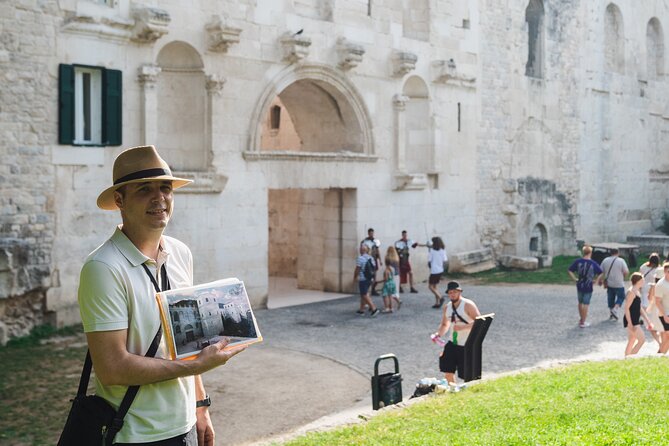
The Vestibule was an ancient entrance to Diocletian’s private residence. From here, Toni leads you around the remains connected with the emperor’s personal quarters.
This is where the 3D reconstructions become especially useful. Ruins alone can make it hard to understand the difference between public ceremonial areas and private residential space. The visual material helps explain how the emperor’s home related to the larger palace.
The stop lasts about 10 minutes. You will also pass noble family palaces along the way, seeing how later residents inserted their own homes into the former imperial complex.
That mixture is one of the tour’s most useful lessons. You are not walking through a sealed Roman site. You are moving through a city where ancient walls were reused, altered, and occupied for centuries.
Renaissance palaces, Venetian influence, and Game of Thrones locations
As you continue, Toni points out noble palaces from later periods, including Renaissance buildings. The City Museum of Split occupies one of the best-preserved Renaissance noble palaces, and the tour visits its courtyard without entering the museum.
The courtyard gives Toni a chance to explain Venetian influence and the kinds of palaces that appeared during that period. Again, the tour does not include museum admission. You get the architectural setting and historical explanation, then can return later if you want the full museum visit.
For fans of Game of Thrones, Toni can also point out filming locations along the route if the group is interested. You pass the fan shop as well. This is an optional layer rather than the main purpose of the walk, which is helpful if some members of your group care about the show and others do not.
I like that the pop-culture material is handled as an addition. The tour keeps its focus on Split’s history, but you can add a few recognizable locations without booking a separate themed walk.
The Golden Gate and the medieval reuse of Rome
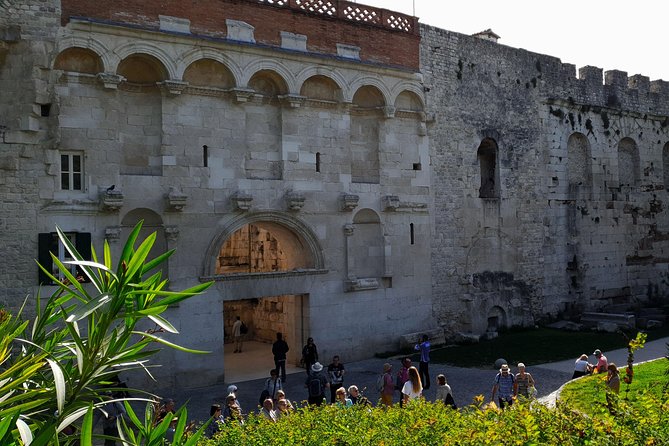
The Golden Gate is the main entrance to Diocletian’s Palace and the best-preserved of the four gates. It is also the most decorated and memorable entrance, with the northern wall visible from the outside.
This stop lasts about 15 minutes. Toni explains how the medieval city used the Roman walls for defense and how residents removed or changed parts they no longer needed. That is a simple idea, but it explains why the palace feels both ancient and altered.
The Golden Gate is a strong visual stop because it gives you a sense of the palace as a fortified enclosure. It also shows that preservation was not always the goal. People kept what was useful, changed what was not, and built new life around old structures.
If you are taking photographs, this is one of the route’s obvious opportunities. Still, do not rush away after the picture. The story of adaptation is more useful than the façade alone.
Finishing at Pjaca, Split’s practical center
The walk ends at Narodni trg, commonly called Pjaca or Piazza Square. This has been the city’s main square since medieval times and includes the 14th-century Town Hall and other historic buildings.
Ending here is smart. You are not left beside an isolated monument or at an awkward edge of town. From Pjaca, you can continue exploring, find a café, return to a hotel, or visit another part of the old center.
The final stop lasts about five minutes. By then, you have moved from the Roman palace to the medieval city and into later civic life. The ending gives you a useful sense of how Split’s public center changed over time.
I would schedule this walk early in your stay if possible. Several people who took it early used the information to decide which places deserved a closer look later. A morning tour can help you plan the afternoon, while an evening departure can be a good choice during hot summer weather.
Price, group size, and the real value
At $34.83 per person, the tour offers solid value if you want explanation rather than a quick photo circuit. The price includes Toni as your guide and his 3D reconstruction material, but not museums or paid interiors.
The tour is about 1 hour 40 minutes to 1 hour 50 minutes long. That is enough time for a structured introduction without taking over an entire day. You can still return to the Cathedral, Temple of Jupiter, City Museum, or bell tower afterward if you choose.
The maximum group size is 18 people. That keeps the cost below a private tour while allowing room for questions. A private upgrade is available if your group wants more control over the pace or more direct time with Toni.
The experience is also popular enough that it is booked about 31 days ahead on average. That is a useful warning for peak summer dates. If your schedule is fixed, book early rather than assuming you can decide at the last minute.
Confirmation arrives at booking, and free cancellation is available up to 24 hours before the start time. The tour needs good weather. If poor weather causes cancellation, you are offered another date or a full refund.
Who will get the most from this tour?
I would choose this walk if you want the story behind what you are seeing. It fits first-time visitors, history fans, families with older children, and anyone who finds ancient ruins hard to picture without a clear explanation.
It also suits visitors who want a local perspective. Toni’s connection to Split gives the tour a personal quality, and his explanations extend into Croatian culture and more recent history.
You may want a different plan if your main goal is to enter every major monument during one outing. No museums or paid sites are included, and the Cathedral and Temple of Jupiter are explained from outside.
The tour is offered in English, service animals are allowed, and most people can participate. Public transportation is nearby. You should still expect a walking route through an old historic center, with some tight spaces and changing surfaces.
Should you book the Walking Tour of Split with a Magister of History?
I would book it if you want Split to make sense, not just look old. Toni’s 3D images, local background, and attention to Roman construction details give you tools for exploring the palace on your own afterward.
Book the morning option if you want a useful orientation for the rest of the day. Choose an evening time if summer heat concerns you. If you need museum entry, plan those visits separately, and if you dislike larger groups, consider the private upgrade.
At $34.83, this is a sensible first-day purchase for a history-minded visitor. It is less useful for someone seeking a fast highlights walk with lots of interior admissions, but for understanding how Roman, medieval, Renaissance, and modern Split occupy the same streets, it is a strong choice.
FAQ
Where does the tour begin?
The tour begins at the Brass Gate, also called Porta Aenea, at Obala Hrvatskog narodnog preporoda 22 in Split.
Where does the tour end?
It ends at Narodni trg, known as Pjaca or Piazza Square, in the center of Split.
How long does the walking tour last?
The tour lasts approximately 1 hour 40 minutes to 1 hour 50 minutes.
What language is the tour offered in?
The tour is offered in English.
How much does the tour cost?
The listed price is $34.83 per person. Group discounts are available.
What is included in the tour?
The experience includes Toni Šare as your guide and demonstrations using 3D reconstructions of some sites.
Are museum and monument admission fees included?
No. The tour does not enter museums or paid sites. The Cathedral of Saint Domnius and Temple of Jupiter are explained from outside.
How many people can join the group?
The tour accepts a maximum of 18 travelers.
Can I cancel the booking?
You can cancel up to 24 hours before the experience begins for a full refund. If poor weather cancels the tour, you are offered a different date or a full refund.
Newest history tours we have reviewed in Croatia
- Split History and Gastro Small-Group Tour with Food and Drinks★ 5.0 · 375 reviews
- Dubrovnik: Game of Thrones and History Small Group Tour★ 5.0 · 76 reviews
- Dubrovnik Old Town: Small-Group Walking Tour With A Local★ 5.0 · 123 reviews
- History Split Walking Tour in French -Small group★ 5.0 · 41 reviews
- Private History Split Walking Tour in English★ 5.0 · 159 reviews
- Dubrovnik Jewish Heritage Private Walking Tour★ 5.0 · 121 reviews
- Split: Historical Tour of Salona, Klis Fortress and Trogir★ 4.1 · 108 reviews
- History & Cultural Walking Tour of Split and Diocletian’s Palace★ 5.0 · 104 reviews
History Walking Tours, compared.

History and Hauntings of Salem Guided Walking Tour
Read our review →

Freedom Trail History Small Group Walking Tour
Read our review →
Historic Charleston Guided Sightseeing Walking Tour
Read our review →
Tapas Walking Tour with Food, Wine, and History
Read our review →
Savannah History and Haunts Candlelit Ghost Walking Tour
Read our review →
A History of Terror – Belfast City Centre Walking Tour
Read our review →Browse the lists this tour appears in