
Review · SPLIT HISTORY TOURS
Experience Split History Walking Tour With Local Historian
Split’s old center is not a museum behind a rope. People live, work, worship, eat, and walk through Diocletian’s Palace, a Roman complex that became the heart of modern Split. This two-hour walk helps you read that layered city instead of simply photographing its stones.
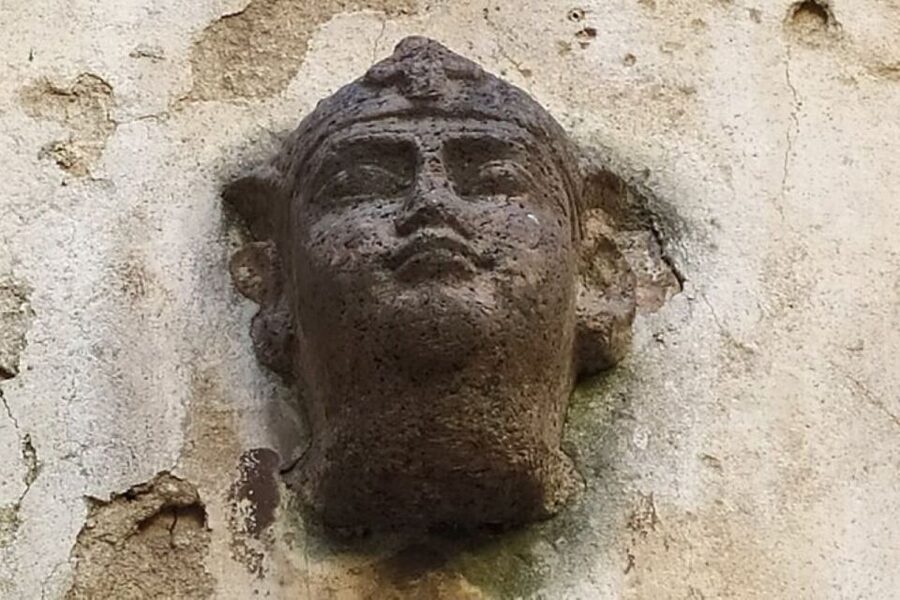
I like the small group, capped at 12, and the guide’s use of 3D reconstruction images to show how damaged or altered buildings once looked. I also like the balance between major sights and odd little details, from the lost sphinx head to the narrowest street. The main drawback is the pace: two hours covers a lot, so some sites receive only a brief look.
Key points at a glance
- Roman palace, living city: Enter through the Golden Gate and see how Diocletian’s retirement palace became Split’s working center.
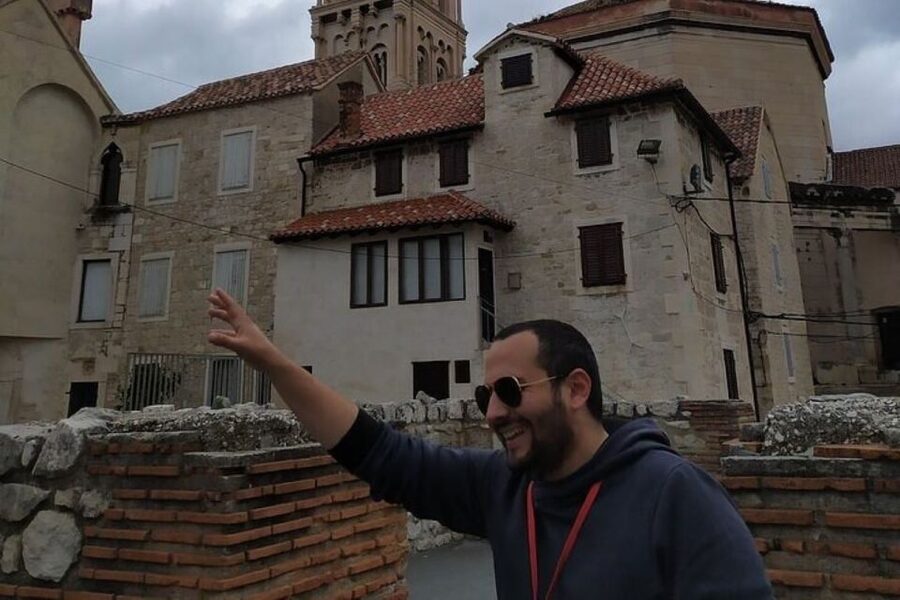
- Historian-led context: Guide Boris brings a master’s degree in history and explains Roman, medieval, modern, and local life in clear terms.
- Small-group format: A maximum of 12 people allows room for questions and a more personal feel.
- Theater of the past: Peristil, the cathedral, Jupiter’s Temple, the Vestibule, and the cellars each reveal a different stage of Split’s story.
- Beyond the main monuments: Look for the narrowest church, narrowest street, lost sphinx head, secret garden, and the character of two medieval squares.
- Useful follow-up advice: The tour can point you toward places worth revisiting, including the palace substructures, the cathedral, and local food stops.
Why Split makes a strong walking tour
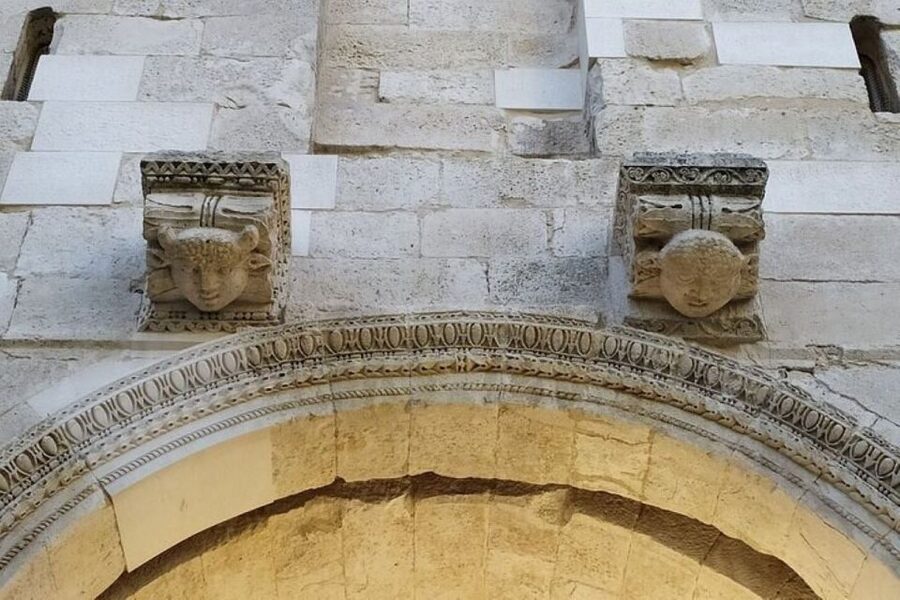
Split is easy to underestimate. You may arrive expecting a tidy Roman ruin, but the old center is a working maze of apartments, shops, cafés, churches, laundry, stone lanes, and busy public spaces. The walls of Diocletian’s Palace provide the frame, but centuries of local life supply the detail.
That is why a guide matters here. Without context, a column may be just a column and a Roman arch may look like part of a modern building. With a historian beside you, you can see how the palace changed from an imperial residence into a medieval town and then into the center of present-day Split.
The tour is built around seeing, hearing, and feeling the city. That does not mean a staged performance. It means you get architectural facts, stories and legends, and a little explanation of how local people use the center today. The guide also introduces the pomalo way of life, a relaxed local attitude that helps explain Split’s daily rhythm.
The format suits people who want a useful first orientation. You will not spend half a day on one museum or hear every date in Croatian history. Instead, you get a broad, connected picture, then can return to the places that interest you most.
More History Walking Tours in Croatia
- Walking Tour of Split with a ‘Magister’ of History
★ 5.0 · 1,122 reviews - Split Walking Tour with Professor of History
★ 5.0 · 926 reviews - Split: History and Heritage Walking Tour
★ 4.9 · 650 reviews
Meeting Diocletian at the Golden Gate
The walk begins at the Golden Gate, the northern entrance to the palace. This is a sensible meeting point because it is easy to recognize and immediately places you beside two of Split’s most important symbols.
Here, the guide explains the gate’s name, purpose, and position in the original palace. You enter through the same broad passage used by Roman imperial visitors, though the surrounding city has changed greatly since Diocletian’s time.
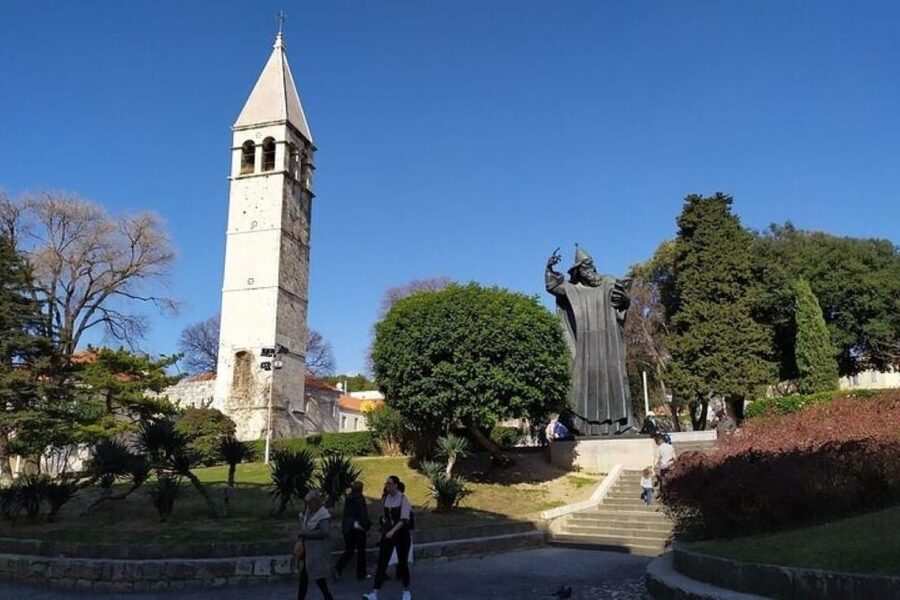
Across from the gate is the eight-meter statue of Gregory of Nin. The large bronze figure represents an important Croatian church figure, and its scale makes it hard to miss. The guide uses the statue to introduce Split beyond the Roman period, helping you understand that the city’s story did not stop when the emperor’s palace was completed.
This opening section lasts about 15 minutes at the Golden Gate, followed by a short stop at Gregory of Nin. It is a good way to get your bearings before the group moves into the palace itself.
Diocletian’s Palace, from imperial retreat to city center
Diocletian built his palace as a retirement residence, but the site did not remain an isolated imperial home. Over time, people adapted its courtyards, walls, temples, cellars, and passageways for new uses. That process is the key to understanding Split.
The tour introduces the palace as a UNESCO World Heritage site and living historic monument. You will see why the label matters, but the guide also keeps the focus on ordinary urban life. The palace is not simply a preserved Roman shell. It is part of the city’s daily bloodstream.
A short stop at a less obvious location follows the general palace introduction. The exact secret stop is not specified in the tour details, so expect a small discovery rather than a major landmark. This is part of the appeal for anyone who likes details that are easy to miss when walking alone.
The use of a display book with 3D reconstructions and historic pictures is especially useful here. Buildings inside the palace have been altered, repaired, and absorbed into later streets. A visual comparison can make the original Roman plan much easier to understand.
Peristil and the ceremonial heart of Split
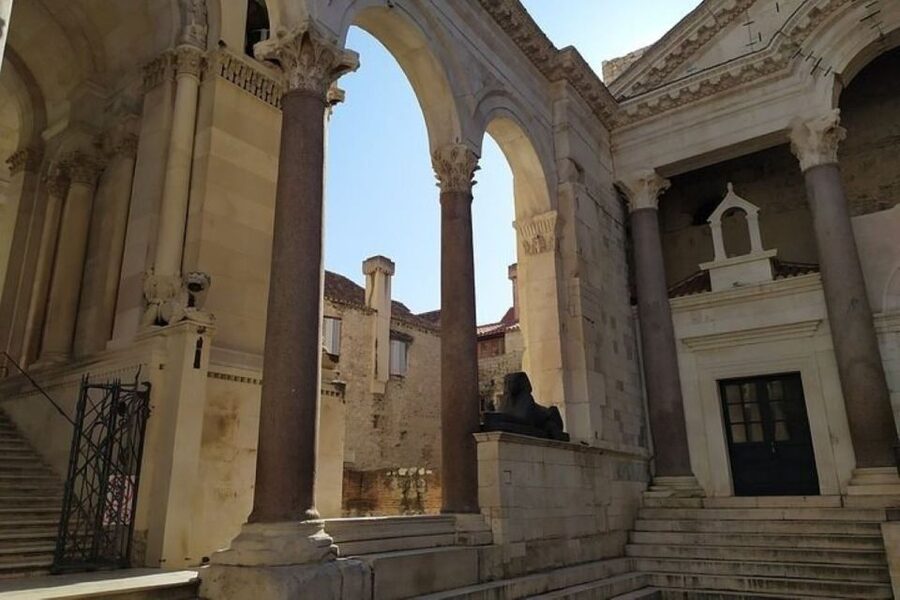
The Peristil is the main palace square and one of the tour’s longest stops, at about 15 minutes. Its surrounding columns and monumental stonework create a dramatic setting, but the real value comes from learning how the space functioned.
This was not a casual neighborhood square in Diocletian’s day. It formed part of the palace’s ceremonial approach, linking the emperor’s world with the religious and administrative spaces around it. The guide explains how the square relates to the rest of the complex and how later generations gave it new meaning.
Peristil can be crowded and visually overwhelming, especially in the middle of the day. A guide helps you focus on the layout rather than merely searching for a clear photograph. It is also a place where the tour’s historical pictures can help you compare the square’s earlier appearance with what you see now.
More History Walking Tours in Split:
- SPLIT-PRIVATE Walking Tour of Diocletian’s Palace & Old Town
★ 5.0 · 467 reviews - Split: Local History and Culture 90-Minute Walking Tour
★ 5.0 · 194 reviews - Private History Split Walking Tour in English
★ 5.0 · 159 reviews - Split: Walking tour of Split with a ‘Magister’ of History
★ 5.0 · 110 reviews
Jupiter’s Temple and the cathedral’s changing identity
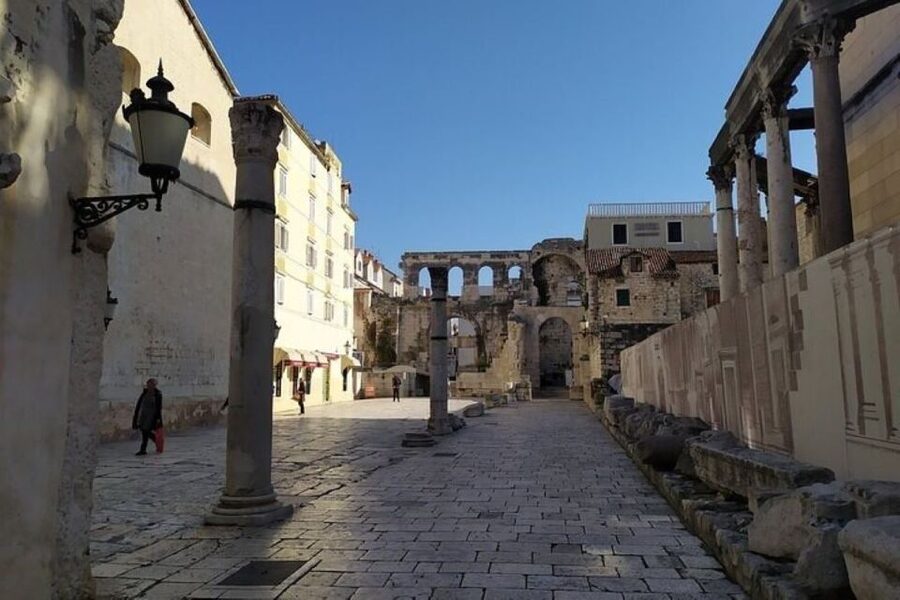
The visit to Jupiter’s Temple lasts about 10 minutes. The stop shows how Roman religious architecture fitted into the palace plan and how the site was later understood and reused.
The nearby Cathedral of Saint Domnius adds another layer. The cathedral occupies what was originally Diocletian’s mausoleum, a striking example of how Split’s religious and political identity changed across the centuries. The guide connects the Roman emperor’s burial place with the Christian cathedral that followed.
You should note that this tour explains and visits these sights, but the details provided do not promise interior admission to every paid monument. If you want a longer look inside the cathedral or the palace cellars, ask the guide for advice about returning after the walk.
The stop at the cathedral lasts about 10 minutes. That is enough for a clear explanation and an introduction, but not for a slow architectural study. I would treat it as a framework for a later visit, especially if religious art or Roman masonry interests you.
The Vestibule and the palace’s central spaces
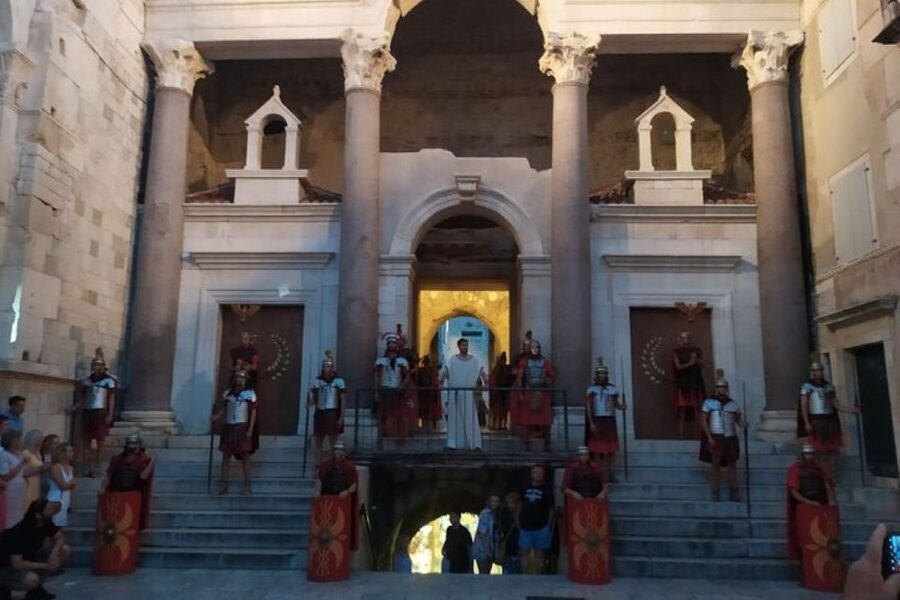
The Vestibule receives another 10-minute visit. This round chamber once formed part of the route into the emperor’s residential area. Its shape and acoustics help you picture the controlled movement through the palace, from public and ceremonial areas toward more private rooms.
Nearby palace spaces include the former triclinium and the central substructures, also called the cellars. Some are seen or explained during the walk, while the exact amount of time in each can vary with the group and conditions.
The tour treats the palace as a connected system rather than a string of unrelated stops. That is important. The Golden Gate, Peristil, temple, mausoleum, vestibule, and cellars make more sense when you understand how they related to one another.
The central cellars are particularly useful for understanding the original palace plan. They preserve the outlines of rooms above and show how Roman construction supported the imperial residence. The stop is listed at about 10 minutes, so do not expect a full archaeological visit. Still, it gives you a strong reason to return for a closer look.
Riva, where Roman and modern Split meet
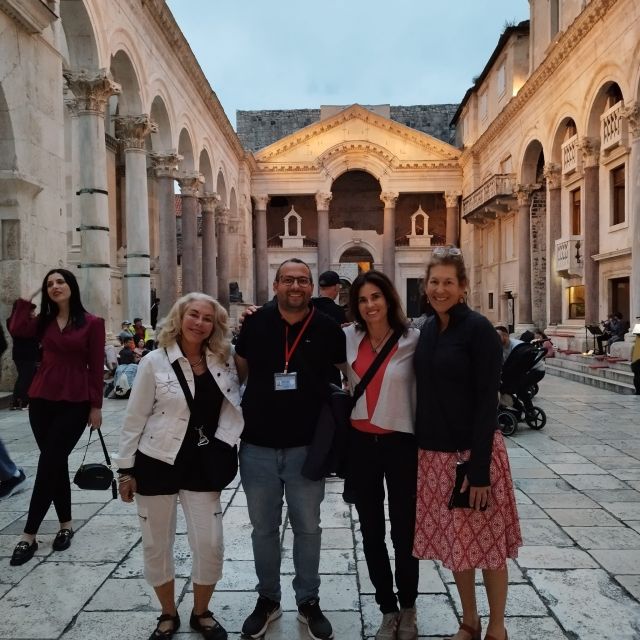
After the palace, the walk reaches Riva, Split’s waterfront promenade. The stop is short, about five minutes, but its purpose is larger than its timing suggests.
Riva helps connect the enclosed Roman complex with the modern city. Here the guide explains the shift from Roman and medieval Split to the waterfront life you see today. You also hear about local habits and the pomalo attitude, which is less a formal attraction than a way of understanding how people use public space.
Do not expect a long promenade stroll during this tour. The point is orientation and context. If you want time for coffee, people-watching, or a waterfront walk, return later on your own.
Fruit Square and People’s Square
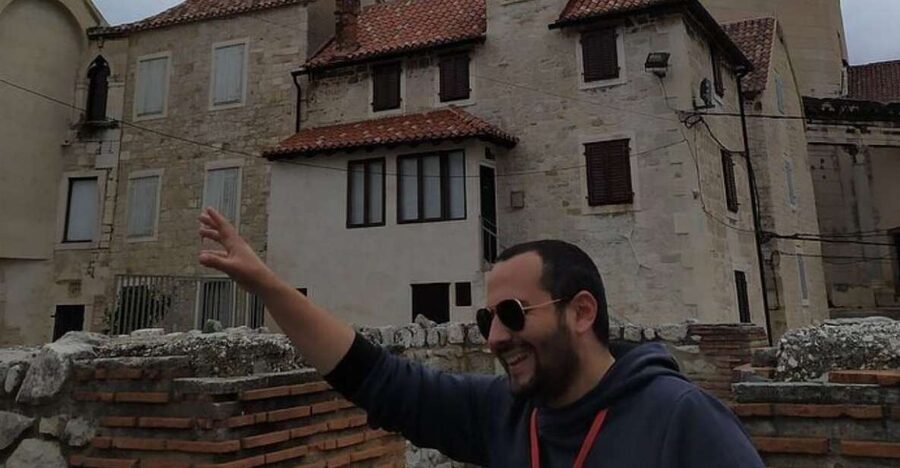
The tour then moves to two medieval centers, Fruit Square and People’s Square. Each receives about 10 minutes, giving the medieval and later city enough attention to balance the Roman material.
Fruit Square is known for the way later buildings fill and frame an older urban space. The guide explains the square’s name, architecture, and changes through time. It is a good reminder that Split is not only Diocletian’s city. Medieval residents reshaped the old palace and created their own public centers.
People’s Square offers another view of the city’s civic life. Its buildings and layout help explain how Split functioned beyond the emperor’s residence. The stories attached to these squares bring out the practical side of history: trade, movement, public life, and the gradual growth of a town inside Roman walls.
These stops are among the best parts of the walk for anyone who wants more than ancient history. They also provide a useful bridge to modern Split, where older architecture remains part of normal city life.
Small discoveries that reward careful looking
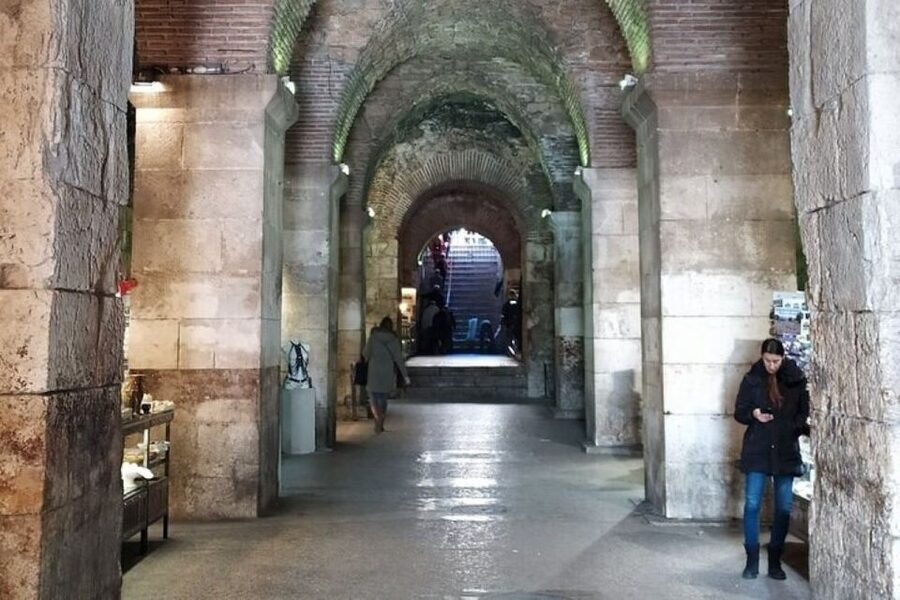
The tour saves several of its more unusual details for short stops. These include the narrowest church, the narrowest street, a lost sphinx head, and a secret garden.
The exact locations are not spelled out in advance, which is part of the fun. They are not major attractions requiring a long visit. Instead, they train you to look up, turn into side passages, and notice how much of Split is tucked into small spaces.
The lost sphinx head is tied to the palace’s ancient connections and later changes, while the narrow church and street show how tightly the old center is built. The secret garden adds a quieter note to a tour that otherwise moves through major public spaces.
These short discoveries are also where a small group helps. Twelve people is not truly private, but it is manageable in tight lanes. If the group reaches the upper limit, stay close to the guide so you do not miss a brief explanation.
A guide who teaches, not just points
Guide Boris is praised for answering questions, explaining Croatian culture and religion, and connecting palace history with the city’s sense of community. His background as a professional guide with a master’s degree in history fits the tour’s focus.
That matters because Split has plenty of facts to memorize, but facts alone do not explain how a Roman palace became a Croatian city. You need someone who can connect construction, religion, politics, local customs, and everyday use of the streets.
The 3D images and pictures add another useful tool. They can show missing structures, earlier forms, or changes that are hard to grasp from stonework alone. This is especially helpful at the palace, where ancient and later construction overlap.
The style is interactive rather than purely scripted. You can ask questions, and the tour gives enough room for practical advice. A good example is the recommendation for a local ice cream stop, along with suggestions to revisit the substructures and cathedral after the walk.
Price, group size, and practical value
At $37 per person, this is not the cheapest way to wander Split, but it is a fair price for a two-hour small-group tour led by a historian. You are paying for structure, explanation, and the ability to ask questions, not just for a walk between landmarks.
The maximum group size of 12 is important. In a place as crowded and narrow as the palace, a large group can turn a thoughtful visit into a procession. A smaller group makes it easier to hear the guide and ask about details.
The activity includes the local professional guide and the 3D reconstruction material. Food and drinks are not included, and hotel pickup and drop-off are not provided. You meet at the Golden Gate and finish at Narodni trg, also called People’s Square, so plan to walk to and from the old center yourself.
Comfortable shoes are essential. Water and a hat or cap are sensible on sunny days, since much of the route is outdoors and stone streets can be hard on your feet. The tour is not suitable for wheelchair users or people with mobility impairments.
English and Croatian are available. You can cancel up to 24 hours before the start for a full refund, and the reserve-now, pay-later option keeps your plans flexible.
Who should book this Split history walk?
I would choose this tour for a first visit to Split, especially if you want the old center to make sense before exploring it alone. It suits history fans, couples, solo visitors, and families with older children who can manage two hours of walking.
It is also a good choice if you enjoy local details as much as grand monuments. The medieval squares, narrow lanes, everyday customs, and small architectural surprises keep the walk from becoming a basic Roman-palace lecture.
I would think twice if you want a slow museum-style visit with long interior stops. The route covers many places in two hours, and several stops are only a few minutes. It is best used as an orientation, followed by independent visits to the cathedral, cellars, or other sites that catch your interest.
The experience has a 5 out of 5 rating from 28 bookings, with especially strong praise for Boris’s answers, historical explanations, cultural context, and practical recommendations. That matches the tour’s main strength: it gives you a clearer way to see Split, then leaves you with good ideas for the rest of your stay.
Should you book it?
Book it if you want a compact, personal introduction to Split led by a real history specialist. The combination of Diocletian’s Palace, Peristil, the cathedral, the cellars, Riva, the medieval squares, and small local details offers a strong first look at the city.
Skip it if you prefer to explore without a schedule or need a fully accessible route. For most visitors who want history, local context, and useful follow-up advice in two hours, the $37 price is justified.
FAQ
How long does the Split History Walking Tour last?
The tour lasts two hours.
Where does the tour begin?
It begins at the Golden Gate, the northern gate of Diocletian’s Palace, opposite the statue of Gregory of Nin.
Where does the tour finish?
It finishes at Narodni trg, also known as People’s Square.
What language is the tour offered in?
The live guide is available in English and Croatian.
How many people can join the tour?
The group has a maximum of 12 participants.
Who leads the walking tour?
The tour is led by a local professional guide with a master’s degree in history. The guide identified in the supplied booking information is Boris.
Which major sights are included?
The route includes the Golden Gate, Gregory of Nin, Diocletian’s Palace, Peristil, Jupiter’s Temple, the Cathedral of Saint Domnius, the Vestibule, the palace cellars, Riva, Fruit Square, and People’s Square.
Are food and drinks included?
No. Food and drinks are not included.
Is hotel pickup and drop-off provided?
No. You make your own way to the Golden Gate and leave from People’s Square at the end.
Is the tour suitable for wheelchair users?
No. The activity is not suitable for wheelchair users or people with mobility impairments.
What should I wear or bring?
Wear comfortable shoes. On sunny days, bring water and a hat or cap.
Can I cancel the booking?
You can cancel up to 24 hours in advance for a full refund. Reserve-now, pay-later booking is also available.
Newest history tours we have reviewed in Split
- Split: Historical & Gastro Treasures Tour with Green Market★ 4.9 · 144 reviews
- Split: Private Walking Tour in the Historical Town Center★ 5.0 · 25 reviews
- Split Walking Tour with History Professor★ 5.0 · 23 reviews
- Split: Walking tour of Split with a ‘Magister’ of History★ 5.0 · 110 reviews
- Split: Local History and Culture 90-Minute Walking Tour★ 5.0 · 194 reviews
- Split History and Gastro Small-Group Tour with Food and Drinks★ 5.0 · 375 reviews
- History Split Walking Tour in French -Small group★ 5.0 · 41 reviews
- Private History Split Walking Tour in English★ 5.0 · 159 reviews
History Walking Tours, compared.

History and Hauntings of Salem Guided Walking Tour
Read our review →

Freedom Trail History Small Group Walking Tour
Read our review →
Historic Charleston Guided Sightseeing Walking Tour
Read our review →
Tapas Walking Tour with Food, Wine, and History
Read our review →
Savannah History and Haunts Candlelit Ghost Walking Tour
Read our review →
A History of Terror – Belfast City Centre Walking Tour
Read our review →Browse the lists this tour appears in