
Review · BOSTON HISTORY TOURS
Boston: Freedom Trail History Small Group Walking Tour
Boston’s Freedom Trail makes the American Revolution feel close at hand. On this 2.5-hour walk, you follow the red-brick route from Boston Common through the old center and North End, tracing the years when arguments over taxes, troops, and political power turned into open revolt.
I like the full route and the small group limit of 16. You see all 16 official landmarks instead of picking through the trail on your own, and the guide has room to answer questions. I also like the strong storytelling from guides such as Jon, Maura, Mark, and Alejandro, who are praised for making dates and speeches feel human.
The main drawback is simple: this is a long outdoor walk, and the tour does not include admission inside museums or churches. You’ll see the buildings from the street, so plan extra time if you want to enter Old South Meeting House, Old North Church, King’s Chapel, or another historic site.
Key points to know before you book
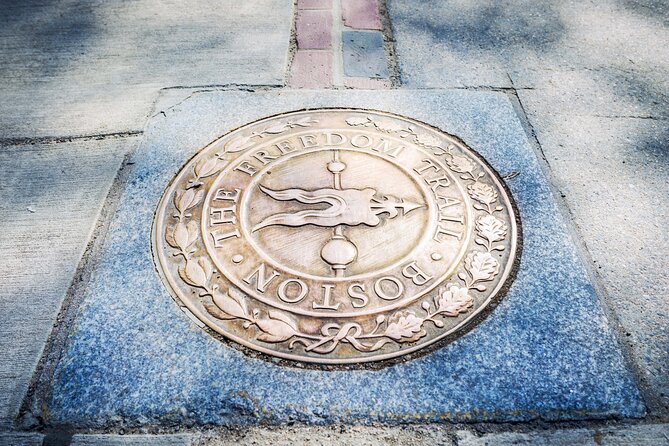
- All 16 Freedom Trail landmarks: Follow the complete official route from Boston Common to Copp’s Hill Terrace.
- A focused Revolutionary period: The guide concentrates on the years from 1760 to 1775, when Boston moved toward rebellion.
- Small groups up to 16 people: This makes it easier to hear the guide and ask questions.
- A North End finish: The tour ends near Hanover Street restaurants, bakeries, and pizza shops.
- Outside visits only: Museum and church admission is not included, though some sites may offer ticket discounts connected with the tour.
- Weather matters: Winter walks can be very cold and windy, though guides may use indoor or covered spaces for short warm-up breaks.
Starting beside Boston Common
Meet at the Boston Foundation Monument inside Boston Common, near the northern edge of the park and opposite 50 Beacon Street. Give yourself enough time to find the monument. The starting point is in a large public park, not inside a shop or museum.
The monument recalls the Puritan arrival in 1630 with a bronze relief of two men shaking hands. It is a fitting place to begin because the tour first sets the colonial stage before moving into the conflict that led to independence.
Your guide checks in the group, then begins with Boston Common. Founded as communal grazing land in 1634, it is often described as the oldest public land in the Americas. The stop helps you see Boston as an old town with shared civic spaces, not just a collection of Revolutionary War monuments.
Expect to spend about 20 minutes here. The park is open and exposed, so winter visitors should wear a warm coat, hat, and gloves. Several recent tours took place in freezing conditions. Guides worked to keep the group moving and used indoor spots when possible, but this remains an outdoor walking tour.
More History Walking Tours in Boston
- Boston: Freedom Trail History Small Group Walking Tour
★ 4.9 · 1,590 reviews - Boston Pizza Lovers Food and History Walking Food Tour
★ 4.5 · 1,082 reviews - Boston History Tour: Scenic Walk Through Time & Landmarks
★ 5.0 · 627 reviews
Granary Burying Ground and Boston’s early civic center
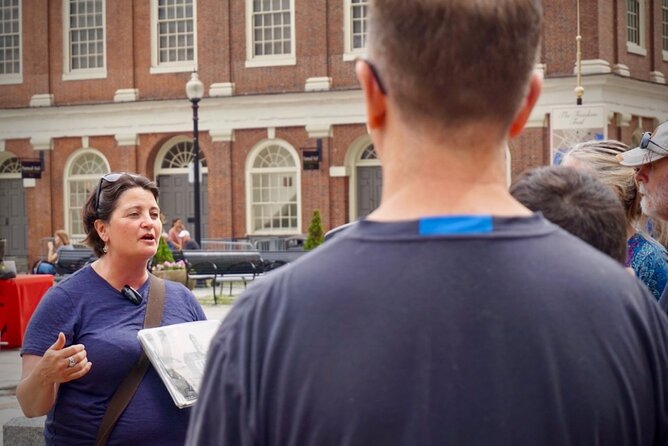
From Boston Common, the route moves toward Granary Burying Ground, Boston’s third-oldest burial ground. About 20 minutes here gives the guide time to explain the people and political forces behind Revolutionary Boston.
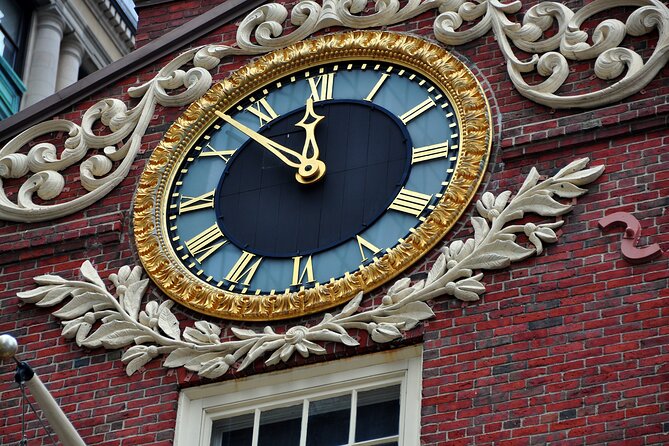
The tour also passes King’s Chapel, the first Church of England in Puritan Boston, and Boston’s oldest burying ground. You’ll see the Old State House, the former colonial capitol of Massachusetts Bay Colony and the oldest public building in Boston.
These stops are valuable because they show the tension between religion, government, and public life. You are not simply looking at old stone and brick. You are following the places where colonial authority operated, where citizens worshipped, and where Boston’s public arguments took shape.
The guide also points out the building associated with the Ticknor & Fields publishing house and the Massachusetts State House, whose gold dome is tied to Boston’s famous nickname, the Hub of the Solar System. These stops broaden the walk beyond the best-known Revolutionary incidents.
Benjamin Franklin, Boston Latin School, and the path to protest
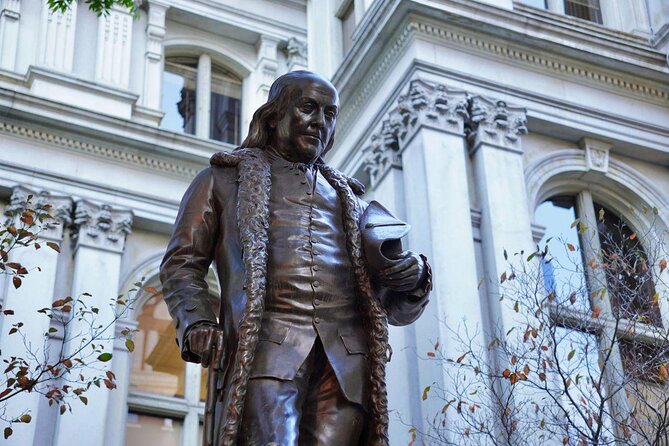
The statue of Benjamin Franklin marks the site of Boston Latin School, founded in 1635 and recognized as the oldest public school in the Americas. The stop lasts about 10 minutes.
Franklin’s statue gives the guide a chance to discuss education, public life, and the people who shaped Boston’s political culture. The route then continues past the Old South Meeting House, a Congregationalist meeting house dating from 1729 and the gathering place connected with the Boston Tea Party in 1773.
You’ll see the meeting house from outside on this tour. If you want to enter, admission is separate. A useful detail is that Old South Meeting House and Old North Church offer discounted admission with a Hub Town Tour ticket, either booked ahead or shown on site. King’s Chapel is expected to offer the same discount in the future, but confirm current arrangements before planning around it.
This is one point where the tour’s format matters. The guide gives you the story and the setting without pausing for interior visits. That keeps the group on schedule, but anyone who loves historic interiors should return later.
The Boston Massacre Site and the force of a single event
The Boston Massacre Site is one of the most important stops on the walk. In 1770, British soldiers killed five Bostonians here. The guide spends about 20 minutes explaining what happened and how the event was used in the political struggle between Boston residents and British authority.
This is where a historian guide adds real value. The site itself is easy to miss. It sits in a busy part of downtown, and without context you might walk past the marker in seconds. A good guide slows down the moment, explains the competing accounts, and connects the incident to the wider campaign against British rule.
The route also passes the former center of Boston politics, a renowned political leader associated with the Sons of Liberty, and Faneuil Hall. Faneuil Hall has hosted Boston town meetings since 1742 and carries the nickname the Cradle of Liberty.
Faneuil Hall Marketplace is both historic and commercial today. The tour spends about 10 minutes here, so you’ll see the setting without turning the stop into a shopping break. The contrast is useful: modern Boston surrounds places that once carried enormous political weight.
More History Walking Tours in the USA
- History and Hauntings of Salem Guided Walking Tour
★ 5.0 · 14,564 reviews - Historic Charleston Guided Sightseeing Walking Tour
★ 5.0 · 6,216 reviews - Savannah History and Haunts Candlelit Ghost Walking Tour
★ 5.0 · 3,235 reviews - Historic Savannah Guided Walking Tour
★ 5.0 · 2,918 reviews
North Square and the Paul Revere story
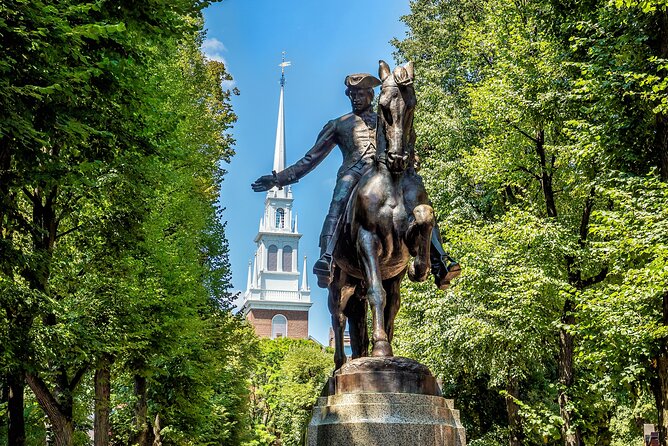
The tour reaches North Square Park in Boston’s North End, a public square dating to 1634. You’ll spend around 20 minutes in this part of the route, which feels more intimate than the broad spaces near Boston Common.
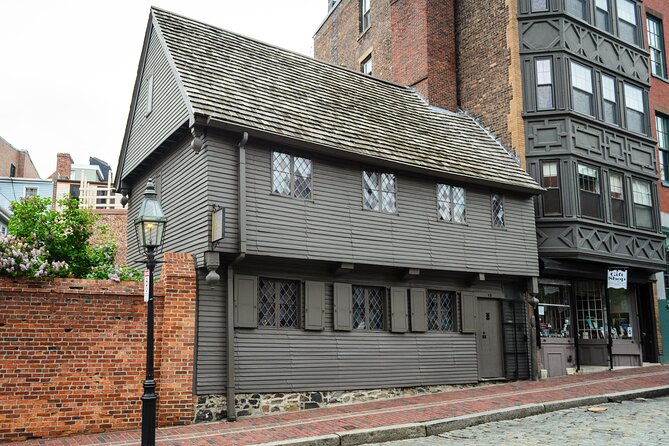
The Paul Revere House is here, the oldest structure in downtown Boston and the former home of Paul Revere. The guide explains Revere’s place in the events of 1775, while also putting his famous midnight ride into the wider political and military story.
The nearby Paul Revere Statue and pedestrian area honor that ride. You’ll also pass Old North Church, where signal lanterns were displayed, and Copp’s Hill Burying Ground, Boston’s second-oldest burial ground.
The route through the North End is one of the best parts of the experience because it links famous names with real streets and buildings. It also gives you a useful place to pause after the tour. Hanover Street is only steps from the ending area, with Italian restaurants, pastry shops, pizza, and other food options.
Ending at Copp’s Hill Terrace
The tour ends at Copp’s Hill Terrace on Commercial Street after about 2.5 hours. From here, you look across the Charles River toward the USS Constitution and Bunker Hill Monument.
The finish is scenic and practical. You are not returned to Boston Common, so keep the ending point in mind when planning the rest of your day. The North End is a good place for lunch or dinner, and public transportation is nearby, but the exact onward route is up to you.
Charlestown is not included. You can see the USS Constitution and Bunker Hill Monument from the terrace, but visiting them requires a separate trip. This limitation is worth noting if those sites are high on your list.
How much walking and standing should you expect?
You should have a moderate level of fitness for this tour. The route covers the full Freedom Trail, includes long periods on your feet, and takes place outdoors. One review described it as an easy walk, but the total time still adds up, especially in cold or windy weather.
The tour is wheelchair and stroller accessible, and service animals are allowed. Still, the practical experience can depend on weather, crowds, and the condition of city sidewalks. If standing for extended periods is difficult, this may not be the best choice.
Families can do well here if children enjoy stories and walking. A group with children aged 11 and 14 completed the tour successfully in cold conditions, but the guide’s long historical explanations will not suit every child. Ask yourself if your group can listen and walk for two and a half hours.
What the guides add to the route
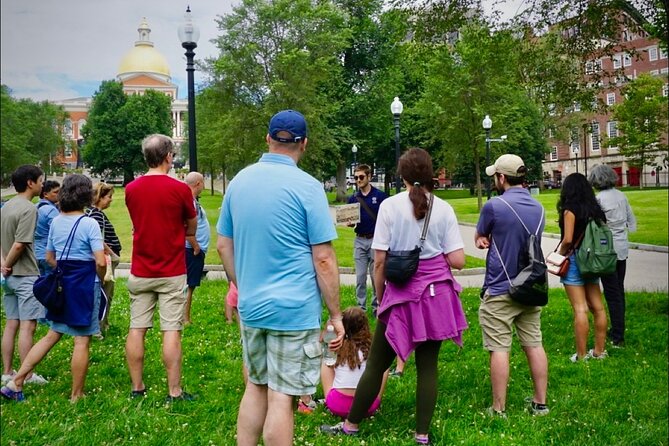
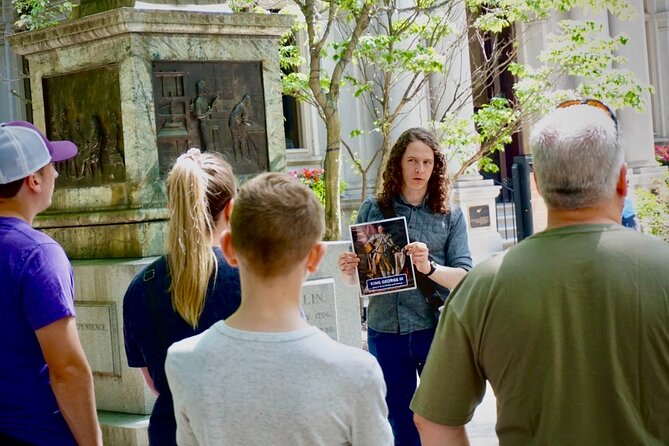
The strongest feature is the guide. Names frequently associated with this tour include Jon, Maura, Mark, Alejandro, Maz, Nick, Kiera, Amelia, Cal, Miles, and Meaghan, though you cannot count on a particular person for your departure.
The most useful guide traits are clear chronology, strong delivery, and a willingness to answer questions. Jon is noted for moving through the history in order and ending with a powerful speech. Maura is praised for painting a vivid picture of Revolutionary Boston. Mark is known for his teaching background, while Alejandro has been especially considerate about finding indoor or covered places during cold weather.
That range matters. The tour covers many sites quickly, so a guide who can connect one stop to the next makes the walk easier to follow. You should expect information, stories, quotations, and questions rather than a quiet stroll with occasional dates.
Price, group size, and overall value
At $35.10 per person, the tour is a fair buy if you want the full trail explained in one sitting. You are paying for a live historian guide, a maximum group of 16, and a route that covers the entire official trail.
The value is strongest for a first visit. You get your bearings, learn the basic sequence of events, and finish in the North End, where you can continue exploring. The tour also helps you identify which buildings deserve a second visit.
The price is less attractive if you only want to see the landmarks quickly or plan to enter several sites. Museum and church admission costs extra, and the tour does not include Charlestown. In that case, compare the walking tour with exploring the trail at your own pace and paying only for the interiors you want.
The tour is often booked about 22 days ahead, so reserve early for a specific date. Free cancellation is available up to 24 hours before the start time. Poor weather or failure to meet the minimum group size can lead to a different date or a full refund.
Who should book this Freedom Trail walk?
I would choose this tour for a first-time Boston visit, a history-focused weekend, or anyone who wants a clear introduction before exploring alone. It is also a good fit if you enjoy asking questions and prefer a small group to a large crowd.
You will get the most from it if you treat the walk as an introduction, not the entire Boston history experience. Afterward, return to the buildings that caught your attention. Old South Meeting House, Old North Church, King’s Chapel, the Paul Revere House, and the Old State House all deserve more time than an outside stop allows.
I would hesitate only if you dislike standing, have limited walking ability, or are visiting during severe weather. Winter can be especially demanding. Bring warm clothing, and remember that even the best storyteller cannot remove the wind.
Should you book it?
Book this tour if you want the full Freedom Trail, a strong historical narrative, and a manageable group size for $35.10. Its biggest strength is not any single monument. It is the way the guide links Boston Common, burial grounds, meeting houses, political sites, and the North End into one understandable story.
Skip it if you mainly want indoor visits or a short overview. For everyone else, this is a useful first-day activity that gives you both Boston history and a practical sense of the old city.
FAQ
How long is the Boston Freedom Trail tour?
The tour lasts approximately 2 hours and 30 minutes.
Where does the tour begin?
It begins at the Boston Foundation Monument inside Boston Common, near the park’s northern boundary and opposite 50 Beacon Street.
Where does the tour end?
It ends at Copp’s Hill Terrace at 520 Commercial Street in Boston’s North End.
Does the tour visit all 16 Freedom Trail landmarks?
Yes. The tour is designed to cover all 16 official historic landmarks on the Freedom Trail.
Is admission to historic buildings included?
No. Admission inside museums, churches, and other historic buildings is not included.
Is Charlestown included?
No. Charlestown is not part of this tour.
How large is the group?
The group can include a maximum of 16 travelers.
Is the tour wheelchair and stroller accessible?
Yes. The experience is listed as wheelchair and stroller accessible.
Is the tour suitable for people who have trouble standing?
It is not recommended for people who have difficulty standing for extended periods. A moderate level of physical fitness is advised.
Can I cancel for a refund?
You can cancel at least 24 hours before the start time for a full refund. Cancellations or changes made within 24 hours are not refunded or accepted. If poor weather or an insufficient number of bookings cancels the tour, you are offered another date or a full refund.
More Small-Group History Tours in the USA
- Hidden Alleyways and Historic Sites Small-Group Walking Tour
★ 5.0 · 2,335 reviews - New Orleans Small-Group Haunted History Carriage Tour
★ 4.5 · 2,289 reviews - Pearl Harbor & USS Arizona Small-Group Tour [Early Access]
★ 4.5 · 492 reviews - Carmel Small Group Walking Food & Cultural Tour
★ 5.0 · 392 reviews
More Small-Group History Tours in Boston
- Boston Freedom Trail History Pub Crawl Small-Group Tour
★ 5.0 · 996 reviews - Beacon Hill Boston History + Photo Walking Tour (SMALL Group)
★ 5.0 · 163 reviews
Newest history tours we have reviewed in the USA
- Nashville: Belle Meade Historic Mansion Tour★ 4.8 · 63 reviews
- Beaufort: Local History and Film Sites Tour by golf cart★ 4.9 · 102 reviews
- Boston: Guided Seafood Tasting and History Tour★ 4.9 · 90 reviews
- Beaufort: Gullah Heritage Tour★ 4.8 · 26 reviews
- Beaufort: Historic City Tour by Bus★ 4.9 · 228 reviews
- Austin: Downtown Austin Haunted History Tour★ 4.4 · 31 reviews
- Austin: Morning History Walking Tour of Downtown Austin★ 4.9 · 71 reviews
- Atlanta: Beltline Food, Street Art, and History Walking Tour★ 5.0 · 47 reviews
Small-Group History Tours, compared.

Madrid Tapas & Taverns Small Group Food & History Tour
Read our review →
Hidden Alleyways and Historic Sites Small-Group Walking Tour
Read our review →
New Orleans Small-Group Haunted History Carriage Tour
Read our review →
Half Day Dominican Republic Cultural Tour : Small Group
Read our review →
Ultimate Seville Tapas, Wine & History Small Group Tour
Read our review →
Vienna Historic Center Small Group Walking Tour
Read our review →
Freedom Trail History Small Group Walking Tour
Read our review →Browse the lists this tour appears in