
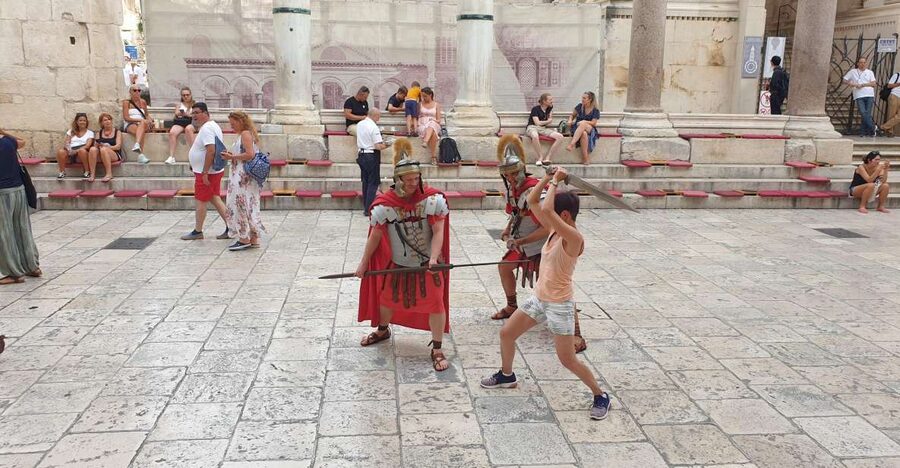
Review · SPLIT HISTORY TOURS
Split: History and Heritage Walking Tour
Split’s old center is not a museum behind glass. It is a living city built inside a 1,700-year-old Roman palace, where ancient columns share space with cafés, shops, churches, and apartment doors. This walking tour gives that jumble a clear story, from Emperor Diocletian’s rise to power through Roman, medieval, Venetian, and modern Split.
I like the guides’ strong storytelling, especially the way Antonella, Antonela, Nikolas, and others connect big political events to the stones under your feet. I also like the practical route through the palace’s free public areas, with Roman architecture, medieval buildings, Gothic details, and a few Game of Thrones connections folded into the walk.
The main caution is group size. It is sold as a small-group tour, but one reported group reached nearly 30 people, which meant waiting for stragglers in crowded lanes. If you want a quiet, highly personal tour, that is worth considering.
Key points to know before you book

- Peristil Square is your starting classroom: Meet under the old Roman arch beside the Tourist Information Office and look for the yellow shirt or yellow umbrella.
- Diocletian’s Palace is still a real neighborhood: You see ancient Roman remains beside working shops, homes, churches, and cafés.
- The guides make the difference: Antonella and Antonela receive especially strong praise for clear, lively explanations, while Nikolas is noted for connecting Split’s Roman and Venetian past.
- The history runs from Rome to today: Expect stories about Diocletian, the arrival of the Croats, Venetian influence, medieval defenses, and later city life.
- The $18 price is easy to justify: You get a guided introduction to the city without paying for an included attraction ticket, and the route helps you use your own time in Split better.
- Prepare for weather and uneven walking: The tour runs in rain or sun, so wear good shoes, bring a hat, and dress for the forecast.
Why Diocletian’s Palace is the right place to begin
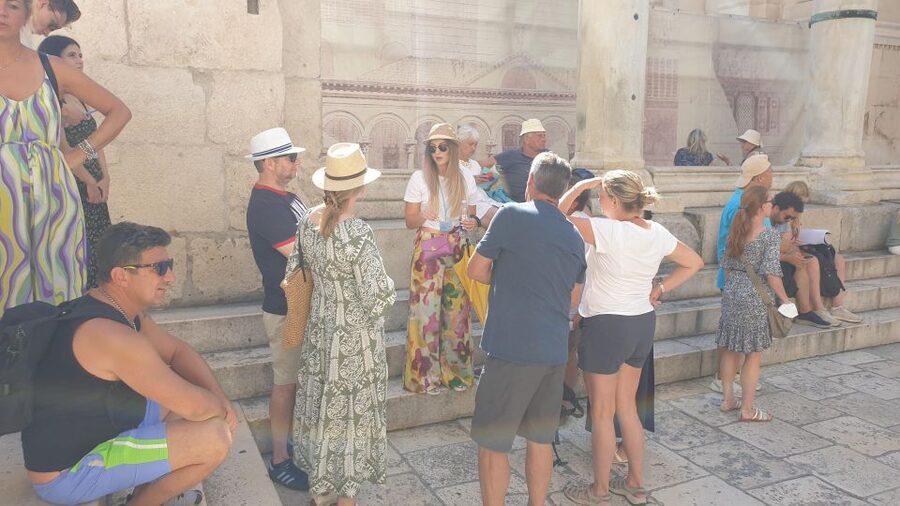
The name palace can mislead you. This is not simply one grand building waiting to be entered. Diocletian’s Palace forms the core of Split, and the old city has grown through and around its Roman structure.
That makes a guided walk useful. Without context, you may see a column, a stone wall, or a narrow passage and move on. With a good guide, those pieces become part of a larger explanation: why the palace was built, how Diocletian went from a relatively obscure soldier to Rome’s most powerful man, and how later residents adapted the complex instead of abandoning it.
The tour focuses on the main public parts of the palace and the surrounding historic center. You can expect Roman remains, later churches, defensive walls, Gothic palaces, and ordinary modern businesses sharing the same compact area.
I especially like this format for a first visit. Split’s old center is small enough to walk, but its layers are easy to miss. A guide gives you a map in your head before you return on your own for photos, shopping, a meal, or a closer look at a building that caught your eye.
More History Walking Tours in Croatia
- Dubrovnik Old Town History Walking Tour
★ 5.0 · 1,684 reviews - Dubrovnik: Ancient City Walls & Wars Walking Tour
★ 5.0 · 1,270 reviews - Zagreb: City & History Walking Tour & WW2 Tunnels
★ 4.9 · 1,202 reviews
Meeting under the Roman arch on Peristil Square
The meeting point is on Peristil Square, under the old Roman arch at the north side of the square, next to the Tourist Information Office. Look for the guide’s yellow T-shirt or yellow umbrella.
Peristil is a smart place to begin because it puts you directly in the palace’s most recognizable ceremonial space. The square helps you understand the scale and ambition of the Roman project before the tour turns into smaller lanes and later city streets.
Arrive with enough time to locate the arch and guide. This is a busy part of Split, and a few minutes spent finding the exact meeting point is better than trying to spot a yellow umbrella while the group is already moving.
The tour ends back at the meeting point. That is handy if you want to continue exploring from the same central spot, return to your hotel, or use the walk as an orientation before dinner.
Reading 1,700 years of building work
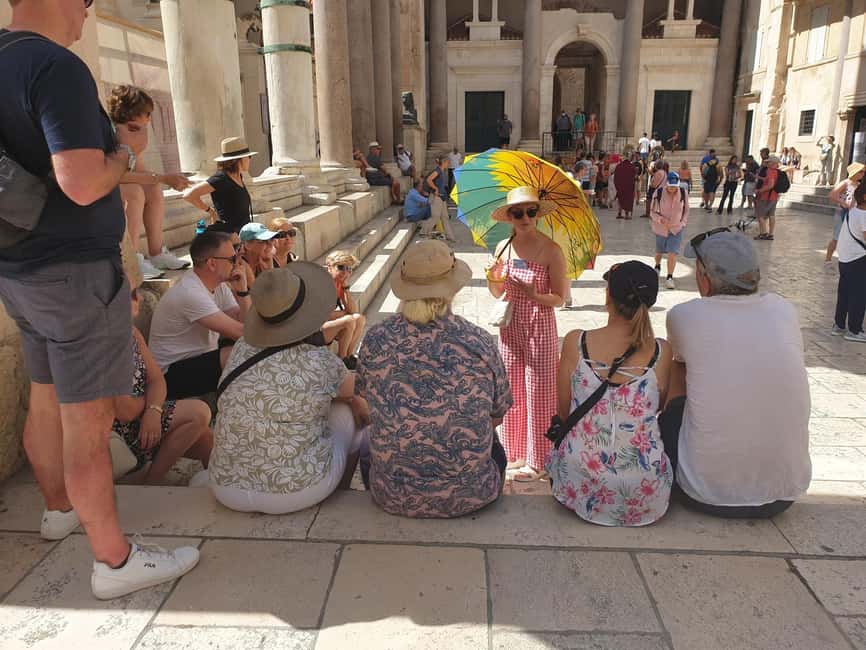
The most interesting part of the route is the contrast between what Diocletian built and what later generations changed. The palace was constructed for a Roman emperor, but Split’s old center was not preserved as a frozen relic. It was reused, divided, altered, and absorbed into daily life.
Your guide explains what remains of the Roman plan and points out the parts that are easiest to overlook. Ancient walls and arches appear beside medieval structures. Romanesque churches and Gothic palaces show how the city changed long after Diocletian’s time.
That mix gives the walk its value. You are not looking at one period in isolation. You are following the city’s changes through stone, layout, and architecture.
The guides also connect Roman rule with later Croatian and Venetian influence. The political story can be complicated, but the tour presents it in a way that keeps the main thread clear. Several reviews single out Antonella or Antonela for making difficult history easy to follow, with a lively pace and plenty of useful details.
One particularly appealing feature is the local viewpoint. The guides are from the area or closely connected to Split, and their explanations bring the past into present-day city life rather than treating it as a list of dates.
Roman architecture beside modern Split
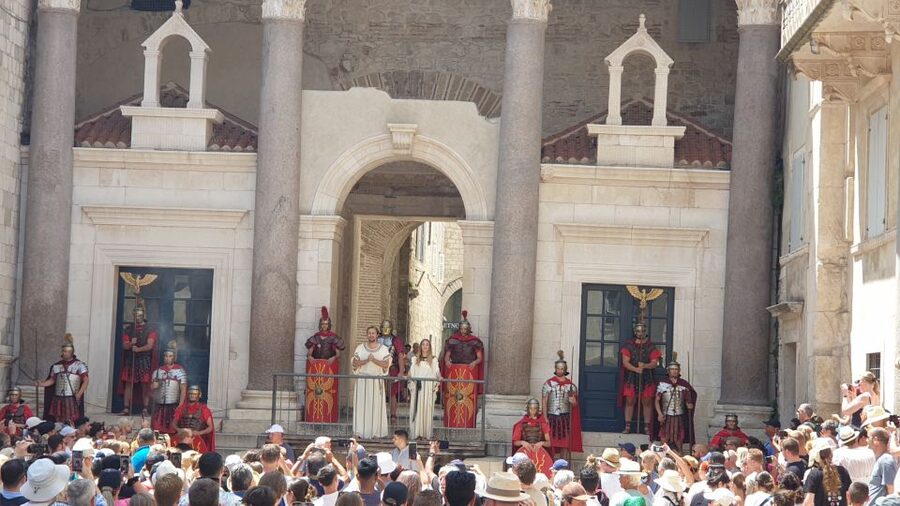
You will see why Split often feels unlike a conventional archaeological site. A Roman wall can form the side of a modern building. A narrow lane may follow an ancient route. A shop or café may occupy space that once served a very different purpose.
This is a good tour for people who enjoy seeing how old places are actually used. It is less about entering one grand interior and more about understanding the whole urban core.
The route includes the important highlights of Diocletian’s Palace and the city’s old center. Expect to learn about:
- Roman remains connected with Diocletian’s palace
- Romanesque churches
- Gothic palaces
- Medieval fortifications
- The changing role of the old city
- The influence of the Roman Empire, Croats, and Venetians
- Modern Split’s life inside the historic core
The supplied details do not promise entry into every paid site or interior. Admission tickets are not included, so you should treat this as a guided walk through the public historic center rather than a bundled museum visit.
That is not necessarily a weakness. At $18 per person, the tour stays affordable, and you can decide later which interiors deserve an extra visit. If you want a tour built around paid monuments, check the plan before booking.
Same streets, a different century:
- Walking Tour of Split with a ‘Magister’ of History
★ 5.0 · 1,122 reviews - Dubrovnik Combo: Old Town & Ancient City Walls
★ 5.0 · 1,019 reviews - Split Walking Tour with Professor of History
★ 5.0 · 926 reviews - Game of Thrones & History of Dubrovnik Tour
★ 5.0 · 628 reviews
Storytelling is the main attraction
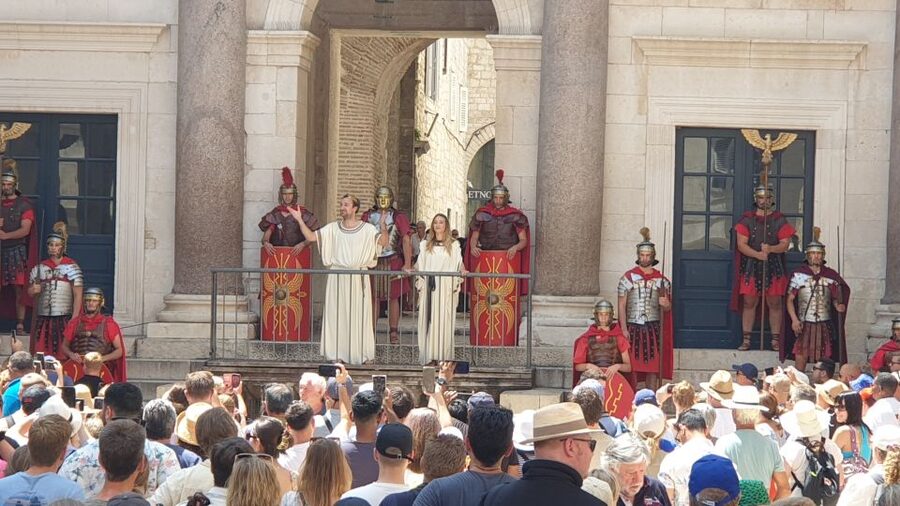
The strongest part of this experience is not a special ticket or a rare viewpoint. It is the guide’s ability to make the history stick.
Antonella and Antonela are praised repeatedly for enthusiasm, clear explanations, and an engaging style. Several comments describe them as especially good at keeping attention, including for people who do not usually choose history tours. Nikolas is noted for explaining the city’s Roman and Venetian influences and for adding a personal connection to Split.
That matters because the material could easily become a march through dates. Instead, the focus is on stories: Diocletian’s rise, the drama of imperial Rome, the arrival of the Croats, Venetian influence, and the way the palace changed over time.
You may also hear smaller cultural details along the way. One tour included traditional singing, and guides are described as sharing local facts that you might not notice while wandering alone.
The style is generally friendly and informal. Questions are welcomed, and the guides are described as willing to explain points in more detail. If you prefer a guide who talks constantly about architecture alone, this may feel more conversational and story-led than academic.
Game of Thrones details without losing the history
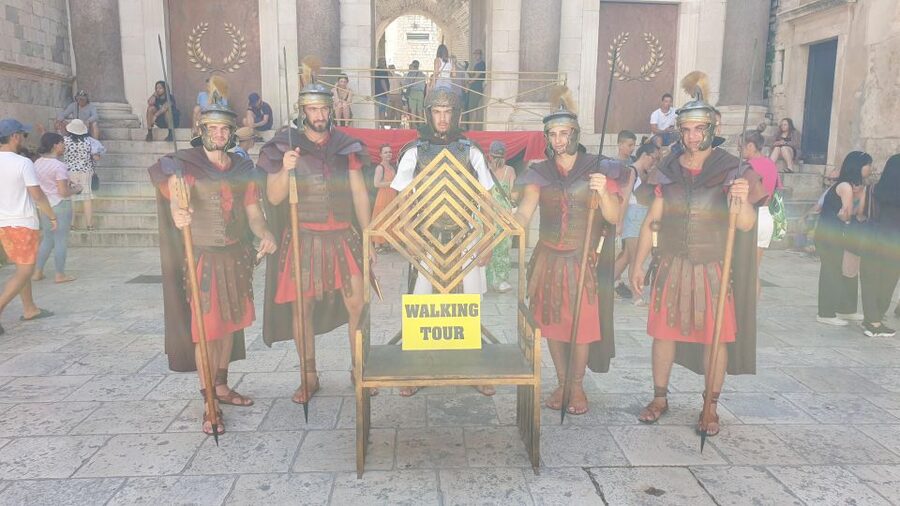
Game of Thrones locations are included as bonus information for fans. That is the right way to treat them here. The show connection adds a fun extra layer, but the tour is built around Split’s real Roman and medieval past.
If you know the series, you may enjoy recognizing places used for filming or hearing how parts of the old city appeared on screen. If you do not care about the show, you can simply regard this as a small extra rather than a reason to book.
The historical material remains the main event. That balance is useful for mixed groups, since one person can enjoy the Roman story while another keeps an eye out for screen locations.
What the $18 price really buys you
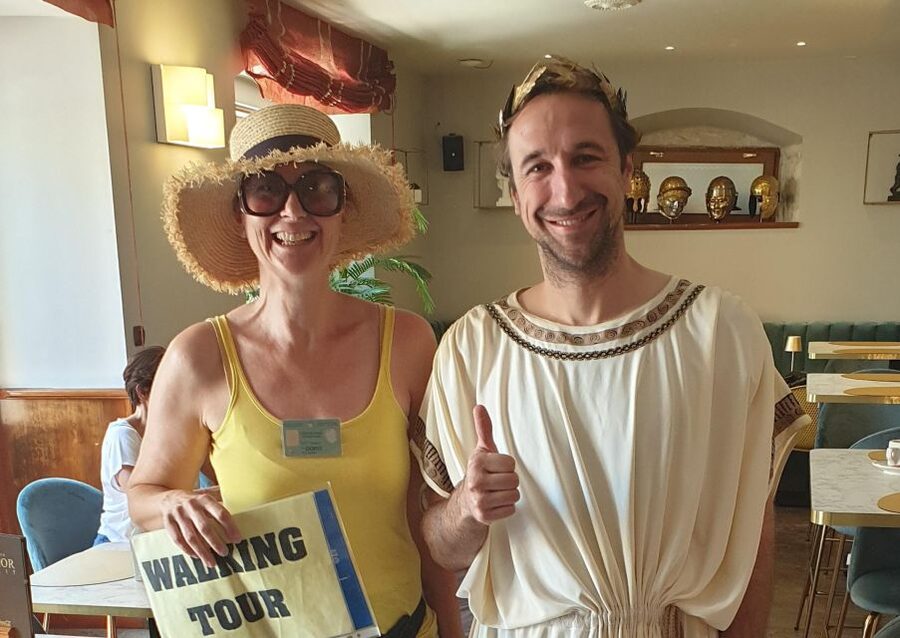
At $18, this is a low-cost way to get structure, local explanation, and a better sense of direction in Split. The value is strongest if this is your first time in the city or if you have only a short stay.
You are paying for the guide and the small-group walking format. Hotel pickup, food, drinks, and admission tickets are not included. Since the walk takes place in the old center, you do not need transport to reach the main sights once you arrive at Peristil Square.
The price also leaves room in your budget for an additional museum or historic interior later. That flexibility is useful because not every visitor wants the same level of archaeological detail.
The one value concern is the size of the group. A truly small group would allow more questions and less waiting. If attendance approaches 30 people, you may spend some time gathering everyone in crowded passages, and the guide’s explanations may be harder to hear from the back.
Bring your own patience, stay near the guide, and ask questions when the group stops. Those simple choices will help you get more from the experience.
Walking conditions, weather, and who should join
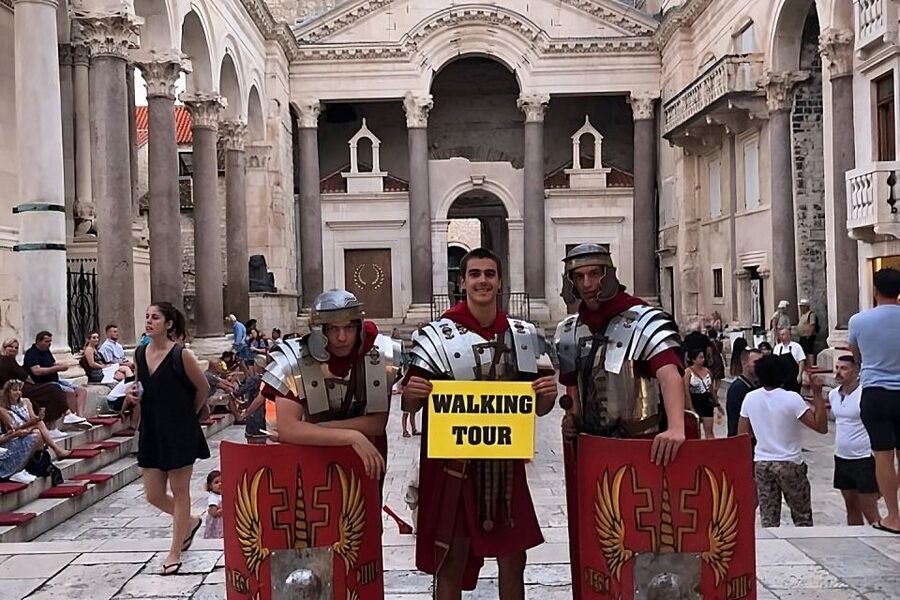
Wear comfortable shoes. The old center includes hard surfaces, narrow lanes, and frequent stops, so fashionable but uncomfortable footwear can quickly become a nuisance.
Bring a hat and wear comfortable clothes. The tour runs in sun or rain, so check the forecast and bring rain protection if needed. One guide provided an umbrella during rainy conditions, but you should not rely on that being available for everyone.
The tour is listed as suitable for all ages, but it is not recommended for people with high blood pressure or for people with hearing impairment. Since the group may move through busy areas, staying close to the guide is especially important if you need to hear every explanation.
This experience suits:
- First-time visitors who want orientation
- History fans interested in Roman and medieval Split
- Families looking for a guided activity suitable for different ages
- Visitors with only a short stay
- Game of Thrones fans who also want real local history
- People who prefer stories and context to wandering without a plan
It may suit you less if you dislike groups, need a private pace, or want extensive access to paid interiors.
Language choices and guide style

The tour is offered in English, German, French, and Russian. That gives you useful flexibility when planning a visit with a mixed-language group.
The guide’s delivery matters more than the language list alone. English-language comments repeatedly praise clear speech, enthusiasm, humor, and the ability to explain complex history simply. Antonella and Antonela are the names most often associated with that style, while Nikolas is also singled out for strong historical context.
The exact guide can vary by departure. You should book for the route and format rather than assume a particular person will lead your walk.
How to make the most of the walk
Start with an open schedule after the tour. Since the walk ends where it begins, you can use the guide’s explanations to choose what deserves a closer look.
I would keep these simple habits in mind:
- Arrive early at the Roman arch on Peristil Square.
- Stay near the guide if the group is large.
- Wear shoes that can handle hard walking surfaces.
- Ask about any Roman, medieval, or Venetian detail that catches your eye.
- Note the places you want to revisit after the group moves on.
- Treat the Game of Thrones material as an extra, not the main reason for the tour.
- Bring protection from both sun and rain.
The tour is also a good first activity because it helps you read the center afterward. Once you understand the palace’s basic structure and the city’s later changes, solo wandering becomes more rewarding.
Should you book Split: History and Heritage Walking Tour?
I would book this tour if you want a reasonably priced introduction to Split that explains what you are seeing rather than simply pointing it out. The combination of Roman remains, medieval architecture, Venetian influence, and modern city life gives you a useful foundation for the rest of your stay.
The strongest reason to choose it is the guide-led storytelling. Antonella and Antonela are especially praised for making history clear, lively, and easy to remember. The $18 price is fair for that context, particularly if you have only 48 hours in Split.
Go in knowing that the group may be larger than expected and that admission tickets are separate. If you need privacy, guaranteed quiet, or detailed access to interiors, seek a private or ticketed specialist tour instead. For most first-time visitors who want to understand the old city quickly, this is a sensible place to start.
FAQ
Where does the Split history walking tour begin?
It begins on Peristil Square under the old Roman arch on the north side of the square, next to the Tourist Information Office. Look for a yellow T-shirt or yellow umbrella.
Where does the tour finish?
The activity ends back at the meeting point on Peristil Square.
What does the tour focus on?
It focuses on Diocletian’s Palace, Roman architecture, Romanesque churches, medieval fortifications, Gothic palaces, and the wider history of Split from Roman times to the present.
Is Diocletian’s Palace included?
The tour explores the UNESCO-protected Roman palace and its public historic areas. Admission tickets to paid attractions are not included.
How much does the tour cost?
The listed price is $18 per person.
What is included in the price?
A small-group walking tour and a tour guide are included.
Are food and drinks included?
No. Food and drinks are not included.
Which languages are available?
The tour is offered in Russian, English, German, and French.
What should I bring?
Bring comfortable shoes, a hat, and comfortable clothing. The tour operates in rain or sun, so weather protection is also sensible.
Is the tour suitable for everyone?
It is listed as suitable for all ages, but it is not suitable for people with high blood pressure or hearing impairment.
Newest history tours we have reviewed in Croatia
- History Split Walking Tour in French -Small group★ 5.0 · 41 reviews
- Split History and Gastro Small-Group Tour with Food and Drinks★ 5.0 · 375 reviews
- Dubrovnik: Game of Thrones and History Small Group Tour★ 5.0 · 76 reviews
- Dubrovnik Old Town: Small-Group Walking Tour With A Local★ 5.0 · 123 reviews
- Private History Split Walking Tour in English★ 5.0 · 159 reviews
- Dubrovnik Jewish Heritage Private Walking Tour★ 5.0 · 121 reviews
- History & Cultural Walking Tour of Split and Diocletian’s Palace★ 5.0 · 104 reviews
- Jewish Heritage & Diocletian’s Palace Private Split Tour★ 5.0 · 80 reviews
History Walking Tours, compared.

History and Hauntings of Salem Guided Walking Tour
Read our review →

Freedom Trail History Small Group Walking Tour
Read our review →
Historic Charleston Guided Sightseeing Walking Tour
Read our review →
Tapas Walking Tour with Food, Wine, and History
Read our review →
Savannah History and Haunts Candlelit Ghost Walking Tour
Read our review →

A History of Terror – Belfast City Centre Walking Tour
Read our review →Browse the lists this tour appears in