
Review · SPLIT HISTORY TOURS
History & Cultural Walking Tour of Split and Diocletian’s Palace
Diocletian’s Palace is not a fenced-off ruin. It is the heart of Split, with homes, cafés, shops, streets, and church towers built into the old Roman complex. This tour helps you read that unusual city center, from the emperor’s ceremonial square to the working harbor and the medieval streets beyond.
I like the small maximum group of 15, which gives you a better chance to hear the guide and ask questions. I also like the route’s mix of Roman, Venetian, Croatian, and Jewish history. The main thing to consider is the pace: the tour lasts about 90 minutes, so some subjects receive a clear introduction rather than a long scholarly treatment. High steps can also be a problem if you have mobility concerns.
Key points to know before booking
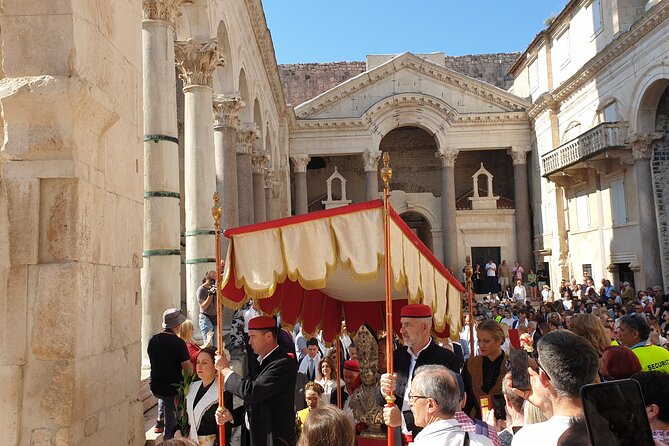
- You begin at the Peristyle, the central square and the best place to understand how Diocletian’s Palace was arranged.
- The route includes seven historic stops, from the palace substructures to Riva Harbor and Fruit’s Square.
- Traditional Dalmatian singing may be part of the visit at the Vestibule, adding a living local touch to the ancient setting.
- The tour is led in English and is designed for a maximum of 15 people.
- The $22.98 price is strong value if you want a useful introduction before exploring Split on your own.
- You end where you start, at Peristil Street, close to the core sights of the old city.
Why Diocletian’s Palace makes a good walking tour
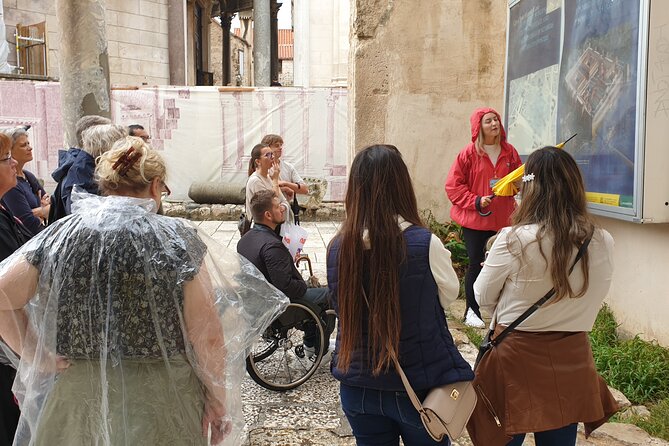
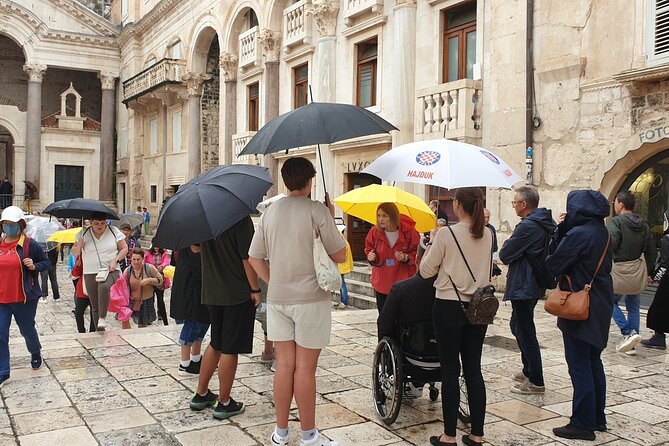
Split can be confusing at first. The palace does not look like one complete monument. Instead, its walls and rooms have been adapted over centuries, and ordinary city life continues inside them. A guide gives you the missing map.
The palace was built for Roman Emperor Diocletian, who retired to the area near his birthplace around the beginning of the fourth century. The key point is not simply that the structure is old. It was both a fortified residence and a ceremonial imperial complex, with grand entrances, private areas, underground service spaces, and a central square.
That design becomes easier to understand when you stand on the Peristyle. Without that context, you might see a handsome square surrounded by columns. With it, you can recognize the careful transition from public ceremony to imperial residence.
I would take this tour early in your stay, especially if Split is your first stop in Croatia. One morning tour began at 9 a.m., when the streets were quieter, and that timing can make the narrow old-city lanes easier to follow. It also leaves the rest of the day for museums, cafés, or a visit to sites the walk only introduces.
More Castle and Palace History Tours in Croatia
- SPLIT-PRIVATE Walking Tour of Diocletian’s Palace & Old Town
★ 5.0 · 467 reviews - Split: Historical Tour of Salona, Klis Fortress and Trogir
★ 4.1 · 108 reviews - Jewish Heritage & Diocletian’s Palace Private Split Tour
★ 5.0 · 80 reviews
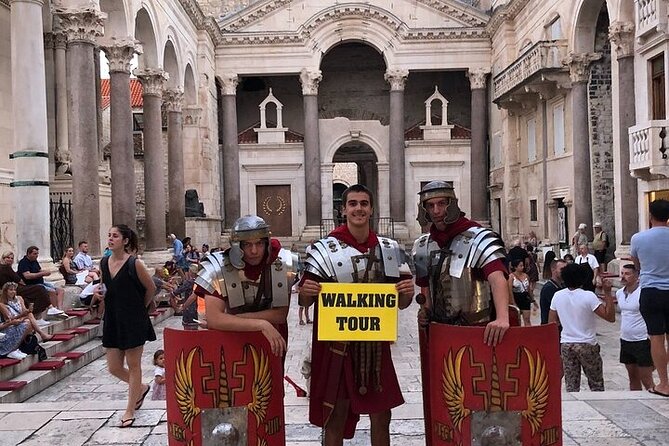
The Peristyle: Split’s Roman stage
The tour starts at the Peristyle, the main square of Diocletian’s Palace. This is the natural orientation point because nearly every part of the old palace can be reached from here.
The square was designed for imperial ceremony. Look around and notice how the columns, arches, and enclosing walls create a formal approach to the emperor’s former residence. The scale helps explain the power Roman rulers wanted to project.
Your guide spends about 15 minutes here, which is enough time to establish the palace plan and explain how the center connects to the rest of Split. This is one of the strongest parts of the walk because it gives you a useful framework for everything that follows.
The Peristyle can be an active public space, and the stone surface is uneven in places. Stay close enough to the guide to hear clearly, especially if the group reaches the square while other people are passing through.
The Vestibule and the sound of Dalmatia
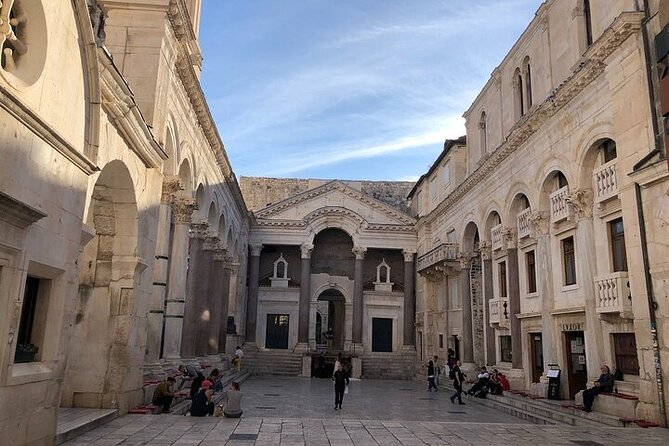
A short stop at the Vestibule follows. This circular entry space once formed part of the approach to Diocletian’s private quarters. Its shape and stone surfaces make it an appealing place to pause, but the guide’s explanation is what gives the room meaning.
You may also hear traditional Dalmatian singing here. The possibility of klapa singing is a welcome change from a tour that focuses only on dates and emperors. It connects the old architecture to a local musical tradition that still matters in Croatia.
The stop lasts about five minutes, so treat it as a brief atmospheric moment rather than a full performance. The singing is described as possible, not guaranteed, so you should not book the tour solely for that feature.
Palace substructures and the practical side of Roman design
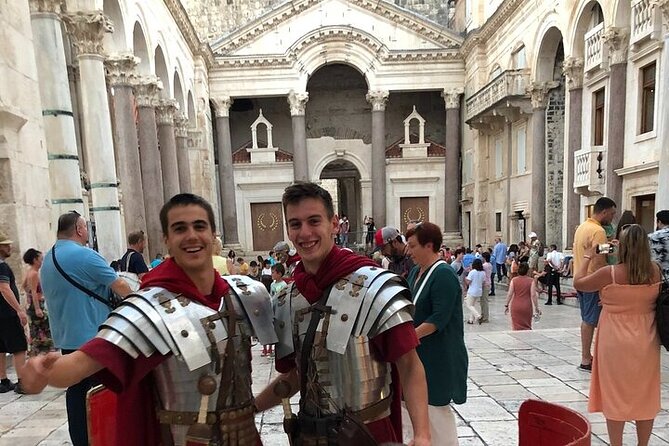
The palace substructures reveal how much engineering sits below the streets you see above. You walk through the underground areas and learn how they supported the palace and how their use changed over time.
This section is especially helpful for understanding the building’s original layout. The substructures mirror parts of the rooms above, allowing you to connect the underground plan with the emperor’s residence and ceremonial spaces.
The tour does not include the museum portion of the substructures. That is useful to know before you go. You receive an introduction to the underground spaces, then you can return later and visit the museum separately if you want a longer look.
I like this arrangement for a short orientation walk. You get the basic story without spending the whole tour underground. If ancient architecture is your main interest, plan extra time afterward for the museum area, since it is not part of the included visit.
More History Walking Tours in Croatia
- Dubrovnik Old Town History Walking Tour
★ 5.0 · 1,684 reviews - Dubrovnik: Ancient City Walls & Wars Walking Tour
★ 5.0 · 1,270 reviews - Zagreb: City & History Walking Tour & WW2 Tunnels
★ 4.9 · 1,202 reviews - Walking Tour of Split with a ‘Magister’ of History
★ 5.0 · 1,122 reviews
The Golden Gate and Gregory of Nin
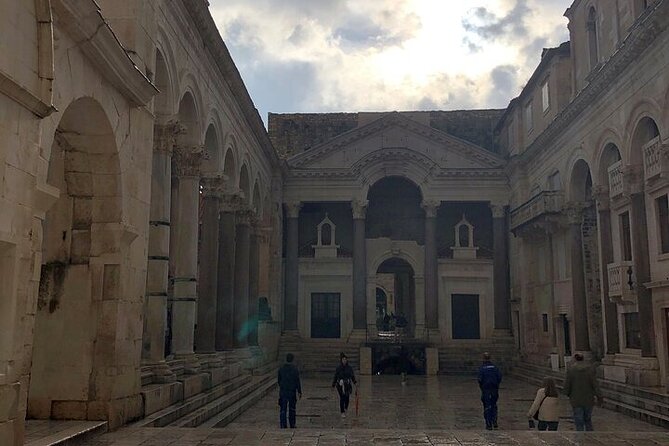
The Golden Gate was the main entrance to Diocletian’s Palace. It gives you a chance to think about how people entered the complex and how the palace functioned as a fortified imperial residence, not merely as a collection of grand rooms.
Here you also see the statue of Gregory of Nin. The guide explains his importance to Croatian history and language, giving the stop a national and cultural focus beyond Roman Split.
This is one of the places where a short explanation adds real value. A quick photograph of the gate or statue will not tell you why the figure matters. The guide connects the monument to Croatia’s past and to the development of the Croatian language.
The Golden Gate stop lasts around 10 minutes. It is also a practical point for orientation, since the gate helps you understand the relationship between the palace and the wider old city.
Riva Harbor: from imperial waterfront to city promenade
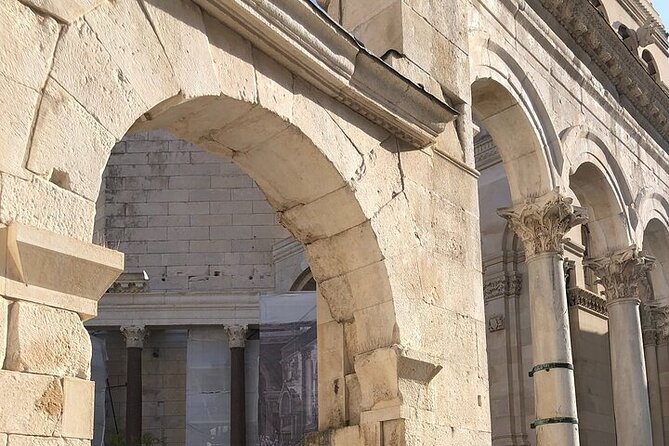
The walk continues to Riva Harbor, Split’s broad waterfront promenade. Here you see a bronze model of Diocletian’s Palace and learn how the Riva developed.
The model is useful because it gives you a compact view of the palace plan after you have seen several parts at ground level. I would take a moment to compare the model with the surrounding streets and waterfront. It can make the relationship between the old palace and modern Split much clearer.
The Riva also shows how the city’s identity reaches beyond ancient Roman walls. Split is not just an archaeological site. It is a living port city, and the promenade remains one of its main public spaces.
This stop takes about 15 minutes. It is a good place to pause, look outward, and reset after the tighter streets around the palace. The route involves regular walking, so comfortable shoes are sensible, particularly on old stone surfaces.
Fruit’s Square and the Venetian chapter
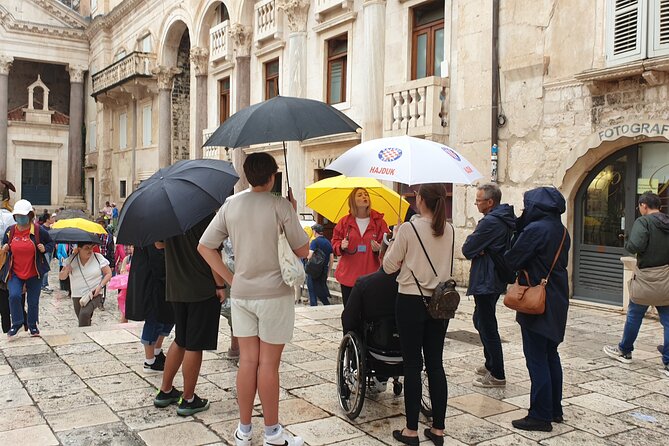
Fruit’s Square, officially Trg Braće Radić, introduces a later period of Split’s past. The square includes a 15th-century Venetian citadel, a reminder that the city’s story continued long after Diocletian.
The guide also explains the importance of Marko Marulić, often called the father of Croatian literature. This gives the walk another useful shift in focus. You move from Roman power to Venetian influence and then to Croatian cultural life.
I appreciate this wider scope. A tour limited to Diocletian can leave you thinking Split is mainly an ancient Roman site. Fruit’s Square helps correct that impression. The old center contains several historical layers, and this stop makes that clear in a compact way.
You spend about 10 minutes here. It is enough to understand the square’s role and identify details to revisit later on your own.
The old synagogue and Split’s Jewish history
The final listed stop is the 16th-century Split Synagogue. The tour passes by rather than taking you inside, and the admission is not included.
Even as a brief exterior stop, this is an important addition. It introduces the history of the Jewish community in Split, a subject that can be easy to miss when your attention is fixed on Roman monuments and Venetian buildings.
The stop lasts around 10 minutes. Ask questions if this part of the city’s past interests you, since the walk’s short format means the explanation cannot cover every detail.
Afterward, you return to the meeting point at Peristil. That makes the tour easy to fit into a day of sightseeing. You can continue exploring the palace, find lunch, or return to the substructures museum without having to arrange transport back across town.
The guides and the tone of the walk
The guide is the most important part of a history walk, and this experience is built around clear storytelling rather than a formal lecture. Guides named in the feedback include Darko, Ante, also called Anthony in American English, and Ivana.
Darko was described as eager to explain his city and particularly effective at combining architecture, culture, and history. One group also enjoyed a klapa performance and saw a Meštrović statue in a public park during its time with him. That extra detail suggests that the exact route or commentary can sometimes extend beyond the basic listed stops.
Ante was praised for making people feel welcome and for showing historical details beyond the obvious sights. Ivana used questions and answers to keep the group involved, then offered suggestions for places to explore afterward.
The tone appears friendly and engaging, with humor used to keep the material from becoming dry. That matters in Split, where a guide can easily overwhelm you with Roman dates, medieval changes, local figures, and architectural terms.
One important caution: the advertised duration is about 90 minutes, but one early-morning outing lasted nearly three hours because the guide spent extra time with a very small group. That may be a pleasant bonus if you have an open schedule. It could be inconvenient if you have a ferry, meal booking, or another timed activity.
What $22.98 buys you
At $22.98 per person, this is a reasonable price for a guided introduction to Split’s central sights. You are paying for an English-speaking guide, a planned route, historical explanation, and a group capped at 15 people. There are no separate admission fees for the listed stops, though the museum part of the substructures is not included.
The value is best if you want context. You can walk around the palace for free, but it is harder to understand why the Peristyle matters, how the underground spaces relate to the upper palace, or why Gregory of Nin is important without some explanation.
Group discounts are available, and the small-group limit is more useful than a vague promise of personal attention. A group of 15 is still large enough to feel social, but small enough for questions. Some departures may be much smaller, though you should not assume you will receive a private tour.
Gratuities are not included. If the guide gives you a strong orientation and useful local suggestions, plan to tip according to your own judgment.
Who should book this Split walking tour?
I would recommend it to first-time visitors who want a clear introduction before exploring alone. It suits people who enjoy history but do not want a four-hour academic lecture. Families and couples can also benefit from the short route and the mix of Roman monuments, local culture, and city life.
It is particularly useful if you have only a couple of days in Split. The tour gives you a basic mental map quickly, then leaves room for the Riva, palace museum, restaurants, and nearby sights.
You should think twice if you dislike walking on old stone streets or have trouble with high steps. The activity is suitable for most people, and service animals are allowed, but high steps are specifically noted as a concern. The tour is near public transportation, though it begins and ends in the old center.
The English option is clear from the tour details. If you need another language, this experience is not presented as a multilingual departure.
Should you book it?
Book this tour if you want to understand Split rather than simply photograph it. The strongest reasons are the central route, the small group limit, the mix of historical periods, and the chance to hear local singing at the Vestibule.
I would schedule it near the start of your stay, ideally with enough free time afterward. That way, an especially detailed guide can run longer than 90 minutes without causing trouble, and you can revisit the substructures museum or any square that caught your attention.
Skip it if you prefer to wander without commentary or already have a detailed plan for learning about Diocletian’s Palace. For most first-time visitors, though, $22.98 is a fair trade for a readable introduction to one of Europe’s most unusual old-city centers.
FAQ
How long does the tour last?
The advertised duration is approximately 1 hour and 30 minutes. A very small group may sometimes spend longer with the guide, so avoid scheduling another fixed activity immediately afterward.
Where does the tour begin?
The meeting point is on Peristil Street at the Peristyle of Diocletian’s Palace in Split.
Where does the tour end?
The tour ends back at the meeting point.
Is the tour offered in English?
Yes. The experience is offered in English.
How large is the group?
The tour has a maximum of 15 participants. Group discounts are available.
Are admission tickets included?
The listed stops have no admission charge for this tour. The museum portion of the palace substructures is not included, and the synagogue is viewed from outside.
Is the tour suitable for people with mobility concerns?
Most people can participate, but the experience is not recommended for people who have difficulty with high steps.
Can I cancel for a full refund?
Yes. You can cancel at least 24 hours before the local start time for a full refund. Cancellations or changes made less than 24 hours before the start time are not accepted for a refund.
More Local Culture and Traditions Tours in Croatia
- Amsterdam Food and Cultural Tour with Tastings
★ 5.0 · 4,315 reviews - Sevilla Food Tour: Tapas, Wine, History & Traditions
★ 5.0 · 3,468 reviews - Tromsø: Reindeer Camp and Sami Cultural Tour with Lunch
★ 4.7 · 3,326 reviews - Half Day Dominican Republic Cultural Tour : Small Group
★ 4.5 · 1,862 reviews
Newest history tours we have reviewed in Croatia
- History Split Walking Tour in French -Small group★ 5.0 · 41 reviews
- Split History and Gastro Small-Group Tour with Food and Drinks★ 5.0 · 375 reviews
- Dubrovnik: Game of Thrones and History Small Group Tour★ 5.0 · 76 reviews
- Dubrovnik Old Town: Small-Group Walking Tour With A Local★ 5.0 · 123 reviews
- Private History Split Walking Tour in English★ 5.0 · 159 reviews
- Dubrovnik Jewish Heritage Private Walking Tour★ 5.0 · 121 reviews
- Jewish Heritage & Diocletian’s Palace Private Split Tour★ 5.0 · 80 reviews
- Split: Historical Tour of Salona, Klis Fortress and Trogir★ 4.1 · 108 reviews
Castle & Palace History Tours, compared.
Edinburgh Castle Guided History Tour with Tickets
Read our review →
Madrid Essential: Historic Center, Plaza Mayor & Royal Palace
Read our review →
Venice’s Best: Basilica, Doge’s Palace, Gondola & History Gallery
Read our review →
Imperial Palace and Shogun Historical Walking Tour
Read our review →
Saadian Tombs & Bahia Palace, Medina Guided Tour
Read our review →
Charleston historical walking tour with a Professor of History at The Citadel
Read our review →
Abu Dhabi Grand Mosque, Palace, and Heritage Village
Read our review →
Buda Castle District Dark History, Legends and Vampire Night Tour
Read our review →Browse the lists this tour appears in