
Review · TOKYO HISTORY TOURS
Asakusa: A Big-picture History Walk to Know Japan
Japan’s past comes into focus on this compact Asakusa walk. Instead of treating Sensō-ji, Kaminarimon, and Nakamise as photo stops, the guide uses them to explain Japan’s isolation, religious customs, artistic influence, and reopening to the world.
I especially like the river opening, which ties Edo’s closed-door policy to Admiral Perry and modern Tokyo, and the clear Buddhism and Shinto comparison. The main drawback is that two hours can only sketch Japan’s story, and the moderate walking plus crowded temple approaches may not suit anyone with mobility problems.
Five things that make this Asakusa walk useful
- The Sumida River sets up Japan’s opening to the world, including the Dutch trade connection and Perry’s arrival.
- Buddhism and Shinto are explained at the start, so temple and shrine customs make more sense later.
- Ukiyo-e gets a global history lesson, including its effect on European Impressionist painters.
- The tour compares Japan and Europe 1,000 years ago, a thought-provoking angle rarely covered on a standard sightseeing walk.
- Temple and shrine coexistence becomes the finale, with Sensō-ji and Asakusa Shrine sharing one historic religious setting.
Why this short walk gives Asakusa a bigger meaning
Asakusa is easy to visit on your own. You can photograph Kaminarimon, walk Nakamise, toss a coin at Sensō-ji, and then leave with a pleasant collection of images.
This tour tries to give those images a framework. At each stop, the guide explains what you are looking at and why it matters. That makes the experience less about collecting landmarks and more about seeing how Japan developed through religion, trade, art, military rule, and contact with other countries.
The price is $58 per person for two hours. That is more than simply wandering through the district, but you are paying for a certified English-speaking guide, a planned historical thread, traditional snack tastings, and headsets for groups of three or more. If you want background and context, the cost is reasonable. If you prefer to explore quietly at your own pace, the same money may be better spent elsewhere.
The walk covers a small area, which is both its strength and its limit. You will not see all of Tokyo, and you will not receive a full course in Japanese history. You will get a clear introduction that helps the rest of your Japan trip make more sense.
More History Walking Tours in Japan
- Tokyo: Imperial Palace and Shogun Historical Walking Tour
★ 5.0 · 2,251 reviews - Tokyo Castle & Imperial PalaceーShogun Walking Tour
★ 4.7 · 1,068 reviews - Tokyo: Imperial Palace Japanese History Walking Tour
★ 4.9 · 987 reviews
Starting beside the Ginza Line
Meet in front of the Burger King beside Exit 4 of Asakusa subway station, station code G19, on the Ginza Line. Step outside the exit rather than waiting underground. This is a practical detail worth taking seriously, since Asakusa has several stations and exits spread across the district.
Wear comfortable shoes and bring water. The tour operates in rain, so weather-appropriate clothing matters. The route includes a moderate amount of walking, with time spent moving between landmarks and listening to explanations in open public spaces.
The guide may vary. Past tours have featured Choco, Sachi or Sachiko, Amy, Yasu, Yoko, and Kay. Names are useful to know when you meet your guide, but the important point is that the experience depends heavily on who leads it. The strongest guides on this walk are the ones who adjust their explanations, answer questions, and keep younger visitors involved.
Families can join, and children under six may participate without charge. The subject matter is historical, so adults and older children are likely to get the most from it. An eight-year-old enjoyed the temple fortune-telling activity on one tour, while a 13-year-old stayed engaged through the explanations. That suggests the walk can work for families when the guide keeps the storytelling active.
The Sumida River and Japan’s long period of isolation
The first major stop is Tokyo Cruise Asakusa Pier, where about 15 minutes are used to view the story of Japan from the Sumida River.
This is a smart place to begin. Rivers and harbors make Japan’s contact with the outside world easier to picture than a classroom explanation. Here, you learn why the Edo shogunate restricted foreign contact for more than 200 years, why the Netherlands was the one European trading partner allowed to continue business, and how Admiral Perry’s arrival forced Japan to reopen.
The guide also connects this older story to modern Tokyo. Odaiba’s former gun batteries show how the city once prepared to defend itself from ships. The Statue of Liberty replica facing the Pacific adds a slightly odd but memorable modern reference point. It is the kind of detail that helps you see Tokyo as a city shaped by both caution and outside influence.
You should expect a talk rather than a long riverside stroll. The pier is valuable because it gives the tour a broad starting point, but the view itself is not the main attraction. The historical explanation is.
At the Tourist Information Center, two religions become clear
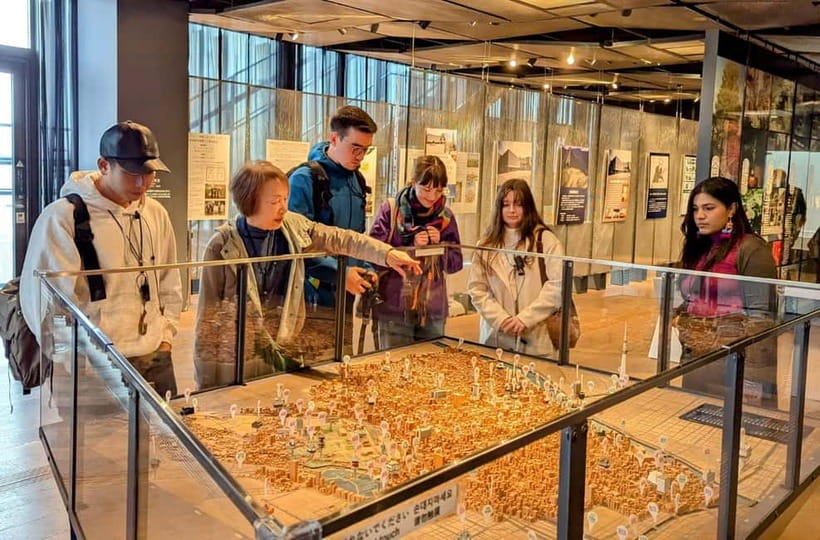
The Asakusa Culture Tourist Information Center receives another 15-minute explanation. This is where the guide introduces Buddhism and Shinto before you enter the gates and temple grounds.
That order helps. Many first-time visitors see incense, offering boxes, large gates, statues, and purification customs without knowing which tradition they belong to. Japan’s religious life does not fit neatly into the Western habit of choosing one faith and excluding another. A clear introduction here prepares you to notice the difference between a Buddhist temple and a Shinto shrine.
I like this stop because it deals with a common source of confusion without making the subject too academic. You learn enough to approach the next sites with respect, while still having room to ask questions.
The tour also explains how prayer differs in Buddhism and Shinto. That distinction becomes especially useful later, when the route ends at Asakusa Shrine beside Sensō-ji. You are not simply told that both places are religious. You begin to understand why their customs and identities are different, even though they share the same setting.
More History Walking Tours in Tokyo:
- Tokyo Castle & Imperial PalaceーShogun Walking Tour
★ 5.0 · 724 reviews - Tokyo: Shinjuku Historical Walking Tour & Secret Backstreets
★ 5.0 · 530 reviews - Imperial Palace East Garden and Edo Castle Walking Tour in Tokyo
★ 5.0 · 510 reviews - Asakusa: 3.5-hour Big-picture History Walk
★ 4.7 · 39 reviews
Kaminarimon and the Japanese dragon
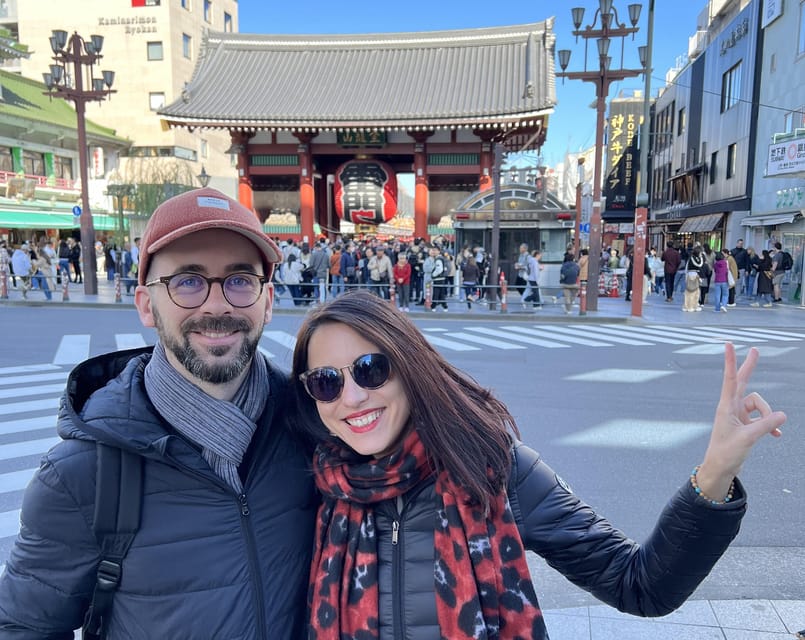
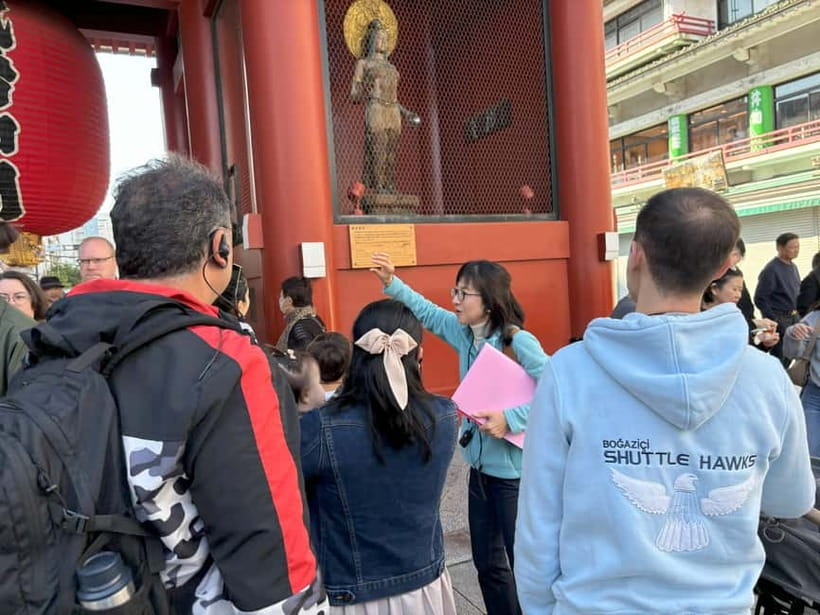
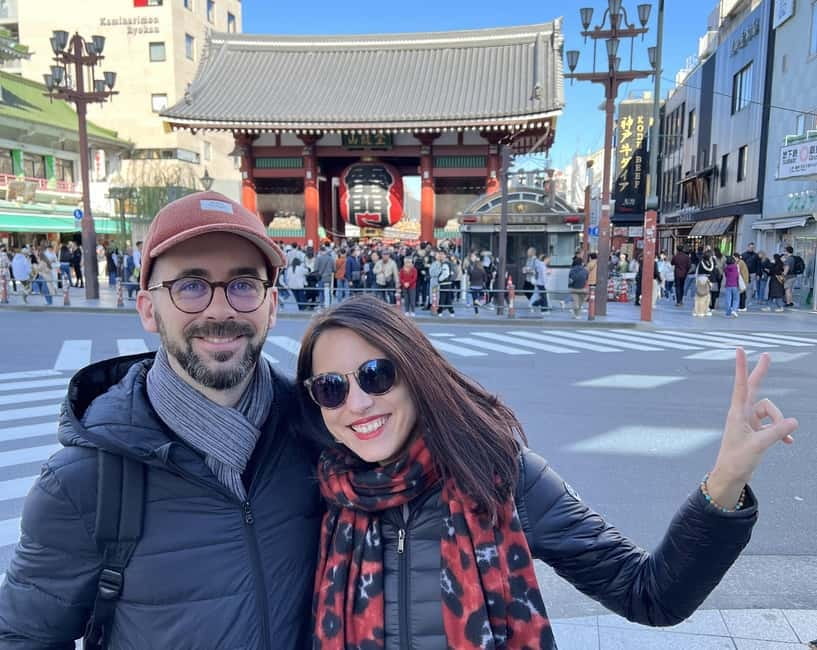
Kaminarimon, the Thunder Gate, is one of Asakusa’s most recognizable sights. The tour allows about 15 minutes here, with the guide using the gate to explain the difference between Japanese and Western dragons.
This is a good example of the tour’s method. A familiar object becomes a doorway into a larger idea. In much of Western tradition, dragons are dangerous creatures to defeat. The Japanese dragon has a different role, tied more closely to water, protection, and the natural world. The contrast gives you a quick way to understand that symbols do not carry the same meaning across cultures.
Kaminarimon is also a busy public place, so expect people taking photographs and moving through the gate. The guide’s headset helps groups of three or more hear the explanation, although one participant found the earpiece produced an echo at times. If you have trouble hearing, tell the guide quickly rather than trying to follow from a distance.
The gate itself is impressive, but the explanation is what turns a familiar photo into a cultural lesson.
Nakamise connects shopping, Buddhism, and European art
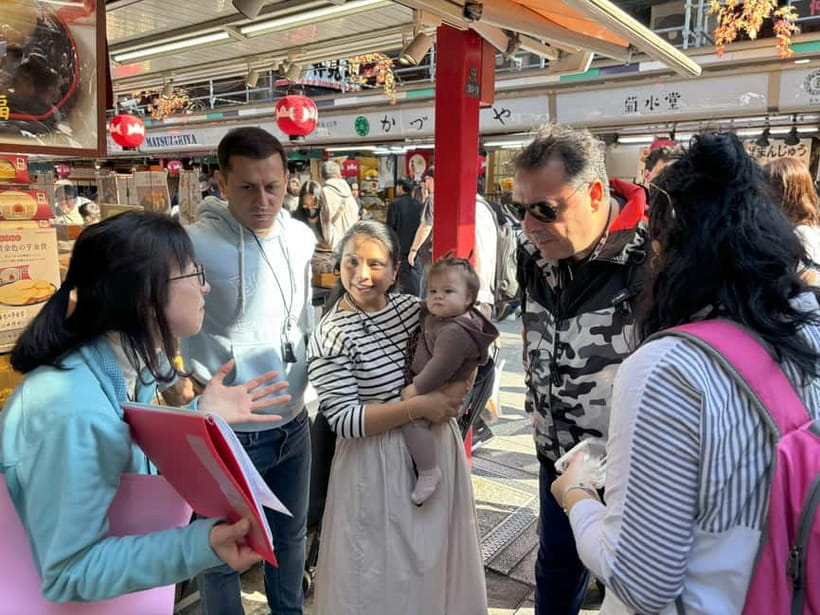
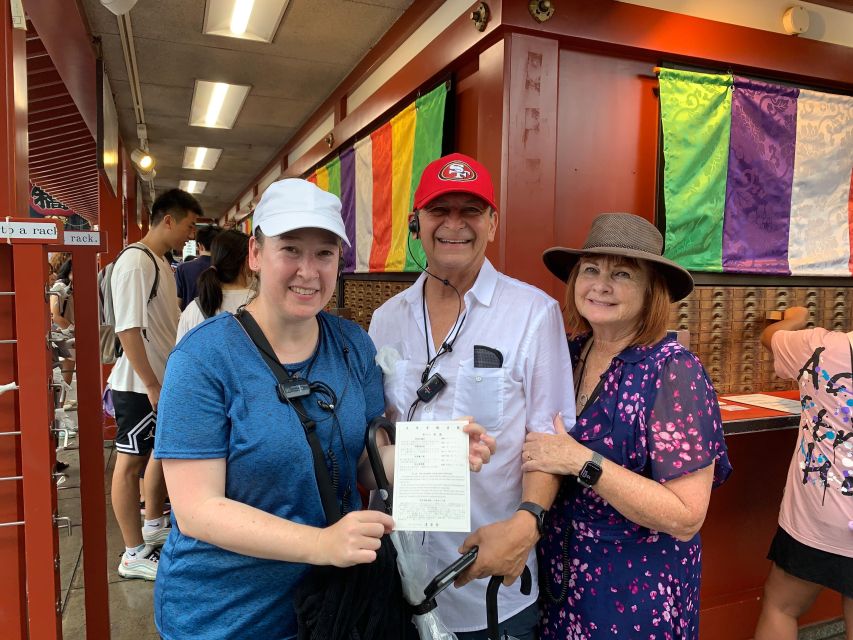
The walk along Nakamise Shopping Street lasts about 30 minutes, making it the longest part of the tour. This is where the experience feels most like a traditional Asakusa visit, with shops, souvenirs, food, and a steady flow of people heading toward Sensō-ji.
You learn about Buddhist objects and symbols, including the vajra, also called tokko. The guide then shifts from religious meaning to art history, explaining the rise of ukiyo-e woodblock prints and their surprising journey to Europe.
Ukiyo-e mattered far beyond Japan. These prints eventually influenced Western painters, including the Impressionists. Their unusual compositions, strong outlines, cropped views, and attention to ordinary life offered European artists a new way to look at pictures. As you walk through Nakamise, the point is not just that Japan exported objects. Japan also changed how artists elsewhere thought about framing and visual design.
This section gives the tour unusual range. A standard Asakusa walk may mention shops and snacks. This one links a shopping street to Buddhist symbols and then to a major shift in Western art.
Traditional snack tastings are included, though the supplied details do not specify which snacks or how many. Treat this as a small bonus rather than a food tour. Nakamise can be crowded, and the 30-minute schedule leaves limited time for browsing or shopping on your own.
Hōzōmon asks you to compare Japan and Europe
At Hōzōmon Gate, the guide spends about 15 minutes on a comparison that many people find unexpected: Japanese and European societies shared some similar ways of thinking 1,000 years ago.
This is not presented as a claim that the two cultures were identical. Instead, the point is to challenge the old habit of treating medieval Europe as the only place with complex political, religious, artistic, and social ideas. Japan had its own developed systems and concerns, and some patterns can look surprisingly familiar when placed side by side.
The stop works best if you enjoy connections rather than isolated facts. You are encouraged to consider Japan within world history, not as a country that developed in a vacuum. That broader view makes the later discussion of art and foreign contact more meaningful.
Hōzōmon is also a useful transition. You move from the commercial energy of Nakamise into the temple grounds, and the subject shifts from objects and images to institutions and beliefs.
Sensō-ji makes Buddhist practice easier to read
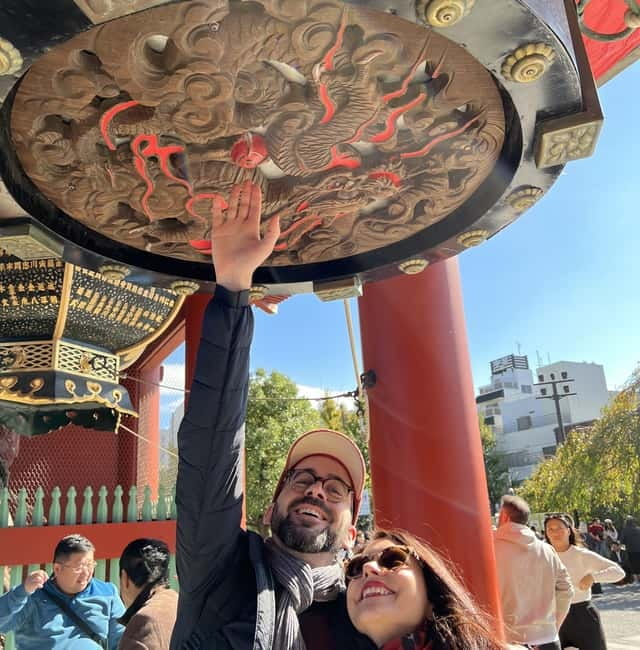
Sensō-ji, described as Japan’s oldest Buddhist temple, receives about 15 minutes. This is the tour’s central sight, and the historical explanation gives the temple more weight than a quick visit alone usually provides.
The guide compares medieval Japan with Europe again, helping you place Sensō-ji within a wider period of world history. You also receive a practical explanation of Buddhist prayer, which is useful when you are standing in front of the temple and watching people make offerings.
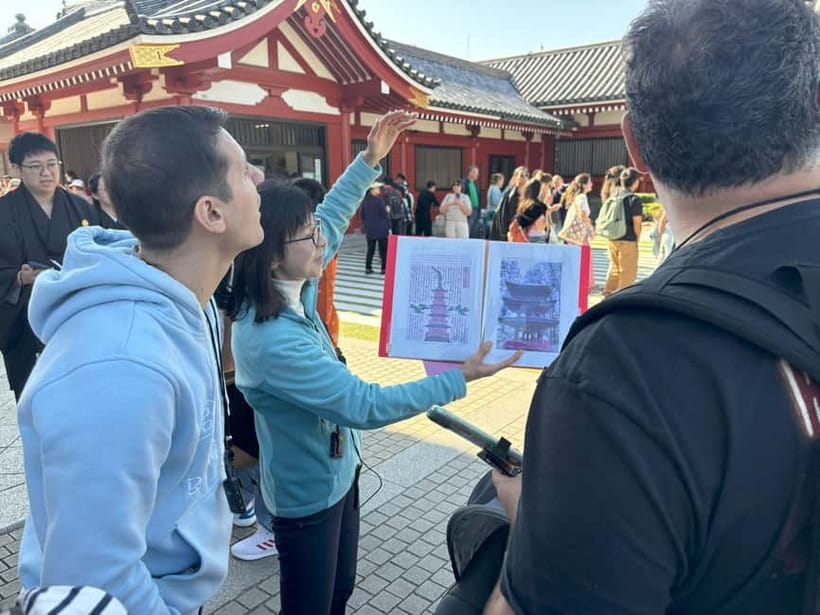
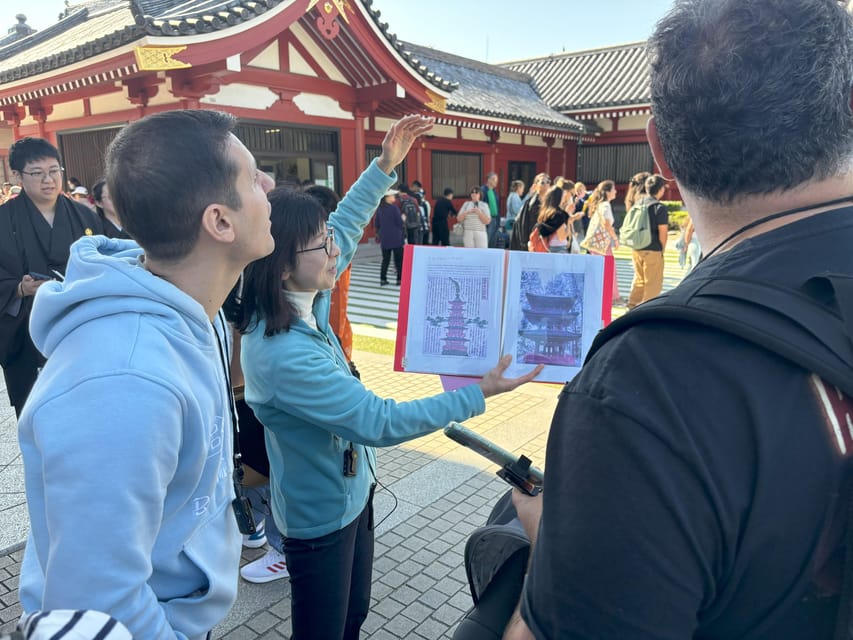
A good guide can make this stop feel approachable rather than solemn or confusing. Sachi, Choco, and the other named guides have been praised for keeping explanations friendly and clear, including when children are present. One guide used printed materials to make difficult ideas easier to follow. That kind of visual aid can be especially helpful when the group includes people with different levels of background knowledge.
You should allow yourself a few minutes after the official explanation to look around, but do not expect a long period of free time. The route has a schedule, and the temple grounds can be crowded. The purpose here is understanding, not an extended private meditation.
Asakusa Shrine shows a thousand years of coexistence
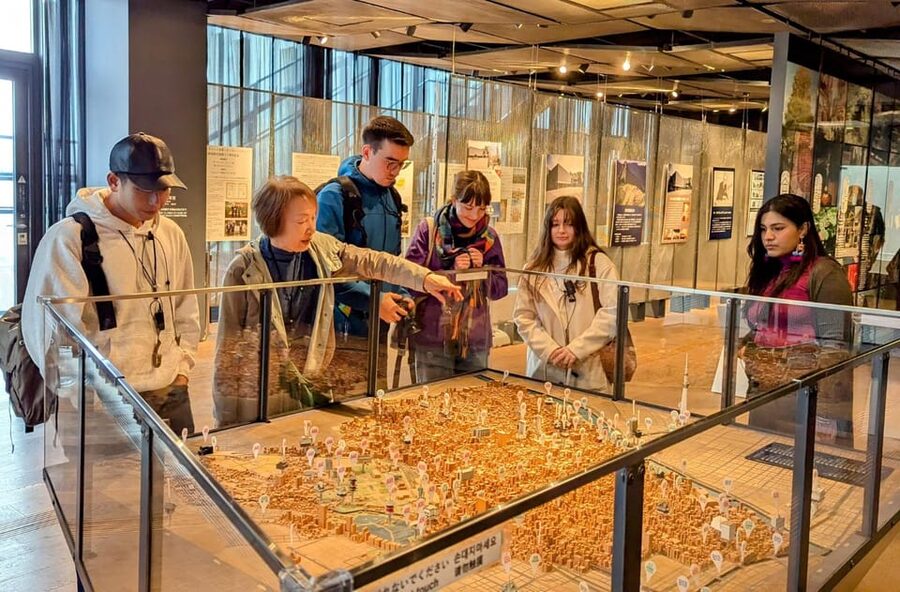
The final stop is Asakusa Shrine, with about 15 minutes devoted to its relationship with Sensō-ji.
This is the most distinctive lesson of the tour. A Shinto shrine and a Buddhist temple occupy the same grounds, with overlapping history and worshippers. For more than a thousand years, these traditions coexisted here. The arrangement may surprise visitors accustomed to seeing religious institutions as separate or competing.
The guide explains why this pairing exists and returns to the differences between Shinto and Buddhism. By this point, the earlier introduction at the Tourist Information Center should make the ending easier to understand. You see that Japanese religious life has often allowed traditions to share space and influence each other.
This ending also gives the walk a satisfying shape. You begin with Japan’s relationship to foreign powers and finish with the country’s internal religious relationships. Along the way, you move through art, commerce, politics, and everyday practice.
If a local festival happens during your visit, the setting can become even more compelling. During Sanja Matsuri, one group saw a mikoshi parade and received extra explanation from the guide. That is not a guaranteed part of the tour, but a flexible guide may help you understand special events taking place around the route.
How the guides shape the experience
The guide is the main reason to book this rather than follow a map. Names associated with the walk include Choco, Sachi, Sachiko, Amy, Yasu, Yoko, and Kay. The descriptions of these guides consistently emphasize warmth, clear explanations, local insight, and an ability to answer questions.
Kay, described as a Tokyo local, also explained how to approach shrines respectfully. Sachi was effective with both adults and children, while Amy brought printed material to support her explanations. Those details matter because the tour covers abstract subjects, including religious coexistence and the connection between Japanese art and European painting.
The guide may also make the walk feel more personal by explaining the neighborhood beyond the headline sights. At the same time, no guide can guarantee the exact same style or depth every day. If you have a specific interest, ask about it early so the guide can shape the discussion where possible.
English is the tour language. An audio guide is included, and headsets are provided for groups of three or more. The equipment should help in crowded areas, though an occasional echo has been reported. Sit or stand close enough to the guide to follow facial expressions and visual examples as well as sound.
Is $58 a fair price for two hours?
At $58, this is not the cheapest way to see Asakusa. You can walk the main route without paying an admission fee, and many of the sights are easy to find.
The value comes from the teaching. In two hours, you receive a connected explanation of Japan’s isolation, foreign trade, religious customs, medieval society, ukiyo-e, Western Impressionism, and temple and shrine coexistence. A private guide would cost more, while a self-guided visit would require research and planning.
The price makes the most sense at the beginning of your Japan trip. If you take the walk early, you can use the ideas later at other temples, shrines, museums, and historic districts. If you already know Japanese religious history and the Edo period well, the material may feel basic.
Free cancellation up to 24 hours before the start and reserve-now, pay-later booking add flexibility. The tour can be canceled if the minimum number of participants is not met, with notice sent at least 24 hours ahead and a full refund. It operates rain or shine, so plan your clothing accordingly.
Who should book this Asakusa walk?
I would choose this experience if you want a clear starting point for Japanese history rather than a long list of dates. It suits first-time visitors, families with older children, and anyone who wants temple etiquette explained without feeling foolish for asking.
It is also a good match if you like art history. The ukiyo-e section gives the walk an unusual angle, and the links to European Impressionism add value beyond the Asakusa district.
I would hesitate if you want lots of free time for shopping, a food-focused outing, or a slow photographic walk. The two-hour schedule keeps moving, and Nakamise is treated as a historical and cultural stop rather than a shopping session.
People with mobility impairments should contact the supplier before booking. The activity is described as unsuitable for people with mobility impairments, although the supplier will try to accommodate individual needs. The route is not a long-distance hike, but it includes moderate walking and public areas that may be crowded.
Should you book it?
Book this tour if you want Asakusa to explain Japan, not just display it. The best parts are the river lesson on isolation and reopening, the practical comparison of Buddhism and Shinto, and the final explanation of why a temple and shrine share one historic setting.
Skip it if you prefer independent wandering or already have a strong grasp of Japanese history and religion. For most first-time visitors, though, $58 buys useful context, a manageable two-hour route, and a better chance of recognizing what you are seeing after you leave Asakusa.
FAQ
Where does the Asakusa history walk meet?
Meet in front of the Burger King next to Exit 4 of Asakusa subway station, G19, on the Ginza Line. Step outside Exit 4 when you arrive.
How long does the tour last?
The walk lasts two hours and visits the Tokyo Cruise Asakusa Pier, Asakusa Culture Tourist Information Center, Kaminarimon, Nakamise Shopping Street, Hōzōmon Gate, Sensō-ji Temple, and Asakusa Shrine.
What language is the tour conducted in?
The live tour guide speaks English. An English audio guide is also included.
Are headsets provided?
Headsets are provided for groups of three or more so you can hear the guide more clearly. One participant found that the earpiece sometimes created an echo.
What is included in the price?
The price includes a certified guide, the walking tour, traditional snack tastings, and headsets for groups of three or more. Hotel pickup and drop-off are not included.
Can children join the tour?
Yes. Children younger than six may join free of charge. The tour is recommended mainly for adults because of its historical focus, but families are welcome. Comfortable shoes, water, and weather-appropriate clothing are recommended.
Newest history tours we have reviewed in Tokyo
- Asakusa: 3.5-hour Big-picture History Walk★ 4.7 · 39 reviews
- Tokyo: Nikko World Heritage Private Day Trip Hotel Pick-up★ 4.8 · 145 reviews
- From Tokyo: Nikko World Heritage Sight Full Day Private Tour★ 4.9 · 127 reviews
- From Tokyo: Nikko World Heritage Site Private Full-Day Trip★ 4.9 · 243 reviews
- Tokyo: The Best of Izakaya in Shinjuku Food & Cultural Tour★ 4.9 · 221 reviews
- Tokyo: 3-Hour Bike/E-Bike Tour of the City’s Hidden Gems★ 5.0 · 47 reviews
- Imperial Palace East Garden and Edo Castle Walking Tour in Tokyo★ 5.0 · 510 reviews
- Tokyo: Shinjuku Historical Walking Tour & Secret Backstreets★ 5.0 · 530 reviews
History Walking Tours, compared.
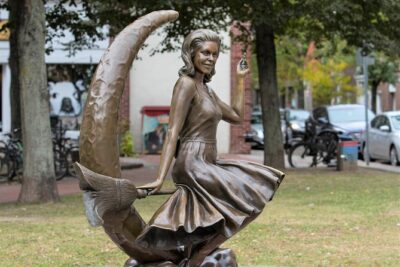
History and Hauntings of Salem Guided Walking Tour
Read our review →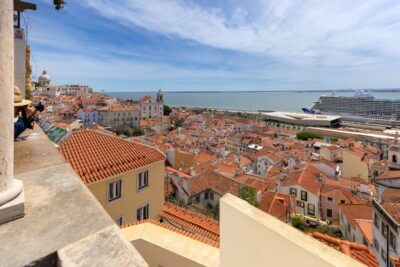
Freedom Trail History Small Group Walking Tour
Read our review →
Historic Charleston Guided Sightseeing Walking Tour
Read our review →
Tapas Walking Tour with Food, Wine, and History
Read our review →
Savannah History and Haunts Candlelit Ghost Walking Tour
Read our review →
A History of Terror – Belfast City Centre Walking Tour
Read our review →Browse the lists this tour appears in