Review · SPLIT HISTORY TOURS
SPLIT-PRIVATE Walking Tour of Diocletian’s Palace & Old Town
Diocletian’s Palace is not a lonely ruin behind a fence. It is the living center of Split, with cafés, shops, homes, churches, and narrow lanes built into the remains of a Roman emperor’s retirement palace. This private tour connects those pieces, from the AD 305 palace to medieval Old Town and the waterfront Riva.
I like two things right away. First, your group has a licensed local guide instead of a fixed script or a large crowd. Guides such as Joško are praised for making Roman history clear, funny, and easy to follow. Second, the route gives you useful bearings early in your stay, including the Peristyle, Golden Gate, markets, squares, cathedral, and palace cellars.
The main consideration is the price. At $240 per group, it is excellent value for a full group of 8 to 12, but expensive for one or two people. The two-hour format also means the tour gives you a strong introduction, not a slow inspection of every corner or a long visit inside each paid site.
Key points to know before booking
- A private group of up to 12: You pay one group price, so the cost per person drops sharply as your party grows.
- Joško is often the guide: His tours are praised for humor, strong storytelling, flexibility, and clear explanations of Split’s past.
- The palace is still part of city life: You walk through real streets and squares rather than an isolated archaeological park.
- The cellars cost extra: Admission to Diocletian’s Cellars is not included and costs €10 per person.
- Several optional interiors cost extra: Cathedral admission is €3.50 per person, while the Temple of Jupiter costs €1.50 per person.
- A good first activity in Split: The route helps you understand the Old Town before exploring it on your own.
Why Diocletian’s Palace feels different from a normal monument
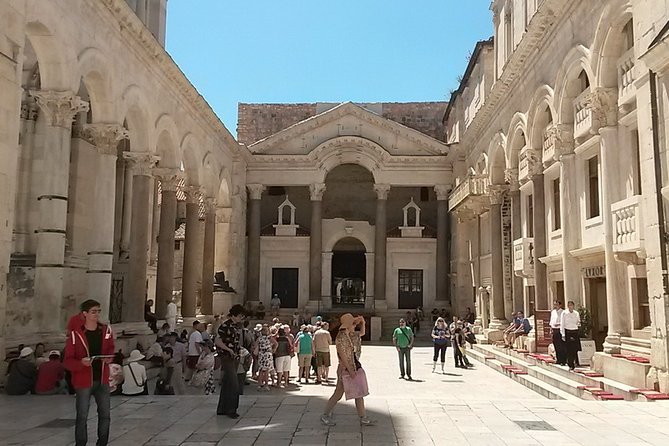
The palace began in AD 305 as the retirement residence of Emperor Diocletian. That date matters because Split is not simply showing you a Roman building. The city grew inside and around the palace for more than 1,700 years.
You will pass through spaces that once served an imperial household, then see how later residents altered them. Roman columns may sit beside medieval stonework. A grand ceremonial square leads into ordinary lanes. Ancient walls form the shell of modern buildings.
That mixture is the heart of the tour. You are not only looking at architecture. You are learning how one powerful residence became the core of a living city.
The guide’s job matters here. Without explanation, the Old Town can seem like a maze of attractive stone alleys. With a good guide, the maze starts to make sense. Joško is repeatedly praised for setting the historical scene, explaining Diocletian’s rule, and turning a long sequence of dates into stories you can remember.
The tone also suits people who do not normally choose heavy history tours. The experience is designed around conversation, questions, local details, and humor. Families have found that even teenagers stay involved, while history-minded visitors appreciate the architectural and political context.
More Castle and Palace History Tours in Croatia
- Split: Historical Tour of Salona, Klis Fortress and Trogir
★ 4.1 · 108 reviews - History & Cultural Walking Tour of Split and Diocletian’s Palace
★ 5.0 · 104 reviews - Jewish Heritage & Diocletian’s Palace Private Split Tour
★ 5.0 · 80 reviews
Starting on the Riva and entering the palace
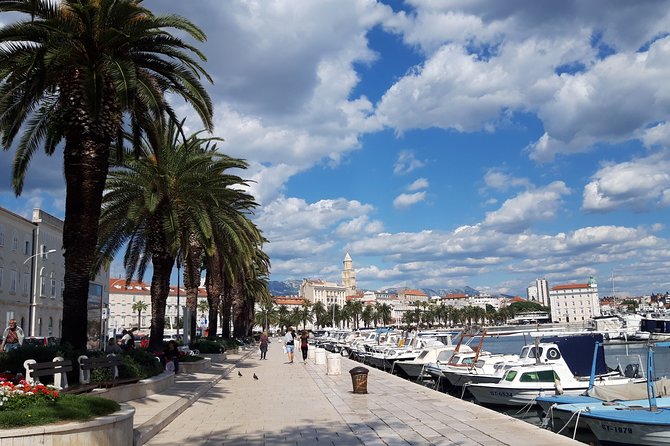
The meeting point is on Obala Hrvatskog narodnog preporoda 22, on Split’s main Riva promenade. The tour starts and ends there, which is handy if you arrive by the waterfront or want to continue with dinner, a drink, or a walk after the guide leaves.
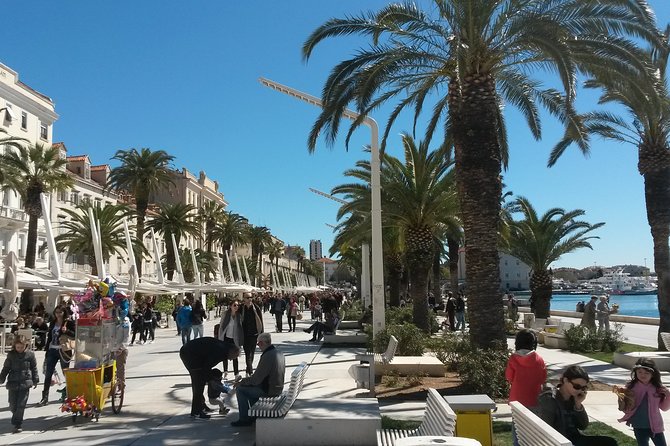
Beginning on the Riva gives you an immediate sense of Split’s setting. The harbor promenade is the modern front door to the Old Town, while the palace begins just inland. You do not need transport between sights. The route is a walking circuit through the center.
The first major stop is Diocletian’s Palace itself. Expect the guide to explain the original purpose of the complex, the emperor who built it, and the way its large plan worked. The listed guided visit lasts about 25 minutes, though the palace appears again throughout the rest of the walk.
You should not expect a silent museum atmosphere. Streets run through the site, and the palace is part of daily life. That is a benefit if you want to see Split as a functioning city. It can be a drawback if you are hoping for an empty archaeological setting or uninterrupted photographs.
The Peristyle, Vestibule, and the emperor’s private world
The Peristyle is the ceremonial heart of the palace. This was Diocletian’s imperial square, and it remains one of the key places where the scale and purpose of the complex become clear.
The guide uses the square to explain the emperor’s public image and the line between sacred, ceremonial, and private space. The Peristyle is also one of the easiest places to understand how Roman planning shaped the later city.
From there, the route includes the Vestibule, the main entrance to the emperor’s private residence. Its position helps you picture how the palace was divided. Public spaces and private quarters were not scattered at random. They were arranged to support the emperor’s authority and daily life.
The guide also covers the Golden Gate, the palace’s main and most impressive entrance. It is a useful place to think about movement through the complex: who entered, how the palace presented itself, and how its defenses and ceremonial design worked together.
These stops are short on the official schedule, usually around five minutes each. That does not mean they are unimportant. They work as focused explanations, with the longer palace and Old Town sections supplying the broader story.
The palace cellars are the tour’s most important paid stop
Diocletian’s Palace Substructures are described as the best-preserved part of the palace. This is the section that can change your understanding of the building above it.
The cellars preserve the shape of the original palace plan and help explain what happened on the upper level over time. The guide can use the lower rooms to show how the Roman structure was built and why the modern streets above follow such an old pattern.
Admission to the Diocletian’s Cellars Museum is not included. You should budget €10 per person if you want to enter. The supplied tour details also make clear that the experience is not a costumed theater show or staged performance. It is a spoken walking tour, built around the site and the guide’s interpretation.
This extra cost is worth considering when comparing the tour with cheaper walks. The cellar admission is separate from the $240 group price, and the visit may be especially important to you if the palace is your main reason for coming to Split.
Some descriptions of the experience emphasize that a large part of the visit takes place below the palace. Read that as a useful warning: this is an historical interpretation of the palace, not simply a surface-level stroll from photo stop to photo stop.
More History Walking Tours in Croatia
- Dubrovnik Old Town History Walking Tour
★ 5.0 · 1,684 reviews - Dubrovnik: Ancient City Walls & Wars Walking Tour
★ 5.0 · 1,270 reviews - Zagreb: City & History Walking Tour & WW2 Tunnels
★ 4.9 · 1,202 reviews - Walking Tour of Split with a ‘Magister’ of History
★ 5.0 · 1,122 reviews
Cathedral of Saint Domnius and the Temple of Jupiter
The tour sees the Cathedral of Saint Domnius from outside, with an optional interior visit. The additional admission is listed as €3.50 per person.
The cathedral is closely tied to the palace because its location and form reflect the layers of Split’s past. The guide can explain how a Roman imperial complex was adapted by later religious and civic life. The exterior stop is brief, about five minutes, so you should not book this walk expecting an extended cathedral visit.
The Temple of Jupiter is also viewed from outside, with optional entry for €1.50 per person. This small extra visit can appeal to anyone who wants to see another part of the Roman religious plan. If you choose every optional interior, the add-on costs begin to accumulate, especially for a family.
The route does not include all admission fees in its base price. In practical terms, you should allow for the cellar ticket and decide in advance whether the cathedral and temple interiors matter to you. If your priority is the guide’s explanation and the streets themselves, you can keep the extra cost down.
Medieval Split, Fruit’s Square, and People’s Square
The Old Split section shifts the focus from the emperor’s palace to the city that grew around it. The medieval town occupies and reshapes the Roman framework, giving you a chance to see how the same streets served different eras.
Fruit’s Square, officially Trg Brace Radic, was once the Green Market. It includes a statue of Marko Marulić, often called the father of Croatian literature. This is a useful stop because it connects the stonework of the Old Town with Croatian cultural life, rather than keeping the story trapped in Roman times.
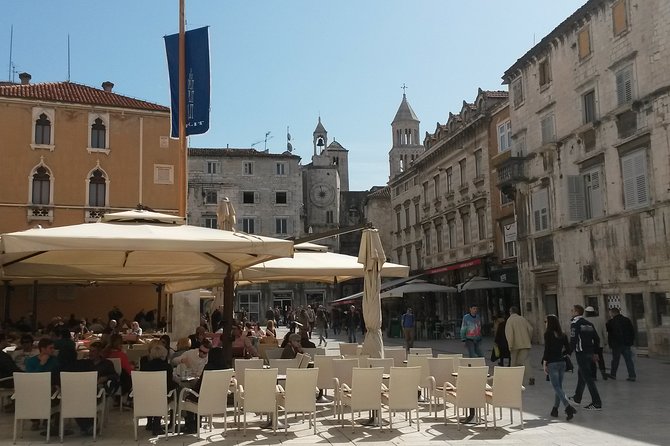
Narodni Trg, or People’s Square, is the largest and liveliest piazza in the Old Town. It gives the route a broader urban view. Here, you can see how Split functions as a social city, not just a historic site.
One useful feature of a private guide is the ability to ask for more attention in the Old Town if that is what interests you. The stated route gives about 25 minutes to the medieval section, and one past booking wished for more walking time in the Old Town on a pleasant day. That is a fair limitation to keep in mind. The tour covers a lot, so you may want to return later for a slower wander.
Grgur Ninski, the city clock, and small details
The statue of Grgur Ninski introduces one of Croatia’s important historical figures. The stop is short, but the guide uses it to broaden the story beyond emperors and Roman architecture.
You will also see Split’s 500-year-old 24-hour clock. Small details like this are part of what makes a guided walk useful. On your own, you might pass the clock without noticing its age or purpose. A local guide can point out details that turn a casual walk into a more informed one.
These stops do not require separate tickets. They also break up the longer historical story with recognizable landmarks, which helps families and first-time visitors keep their bearings.
The route ends back at the Riva meeting point after a final look at the palace and central Old Town. Since the tour finishes where it begins, you can easily use it as a morning orientation before lunch or as an early activity after arriving in Split.
What the $240 private price really buys you
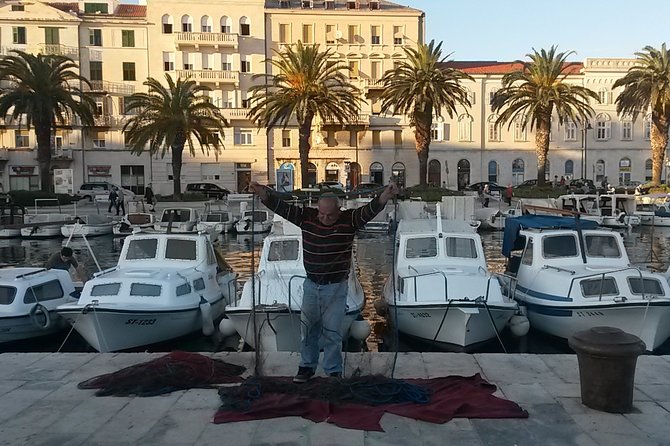
The listed price is $240 per group of up to 12 people. For a full group, that works out to $20 per person before optional admissions and gratuity. For six people, it is $40 each. For a couple, it becomes $120 per person, which is a much harder value to justify.
The price includes a private licensed resident guide and a custom-designed itinerary. That means you are paying for the guide’s time, not simply access to a standard route. You also avoid sharing the experience with strangers, which can make questions and pacing easier.
I think the value is strongest for families, friend groups, cruise groups, and small organizations that can divide the cost. It is also a practical choice if you want a guide who can adjust explanations to your interests. The private format gives you more room to ask about Roman history, Croatian culture, architecture, or local life.
You should also budget for gratuity because it is not included. The cost of optional entries is separate as well. The experience does not include a costumed show, so compare it with what you actually want. If you want storytelling, historical context, and a local perspective, the price can work well. If you mainly want a quick orientation and photographs, a private two-hour tour may feel costly.
Guide style and who will enjoy this most
Joško is the guide most often named in the supplied experiences, though his name also appears in forms such as Josko, Josic, and Joseph. The consistent picture is of a guide who mixes serious historical detail with jokes, personal warmth, and clear storytelling.
That style is useful in Split because the subject can become dense. Diocletian, Roman rule, medieval changes, religious buildings, Croatian figures, and modern city life all appear within a compact area. A guide who can reduce that information to memorable pieces makes the walk easier to follow.
The experience suits you best if:
- You are visiting Split for the first time.
- You want the palace explained instead of simply photographed.
- Your group includes children or teenagers who need an engaging guide.
- You prefer a private walk where you can ask questions.
- You are interested in how Roman and medieval Split overlap.
- You want practical orientation before exploring alone.
It may be less suitable if you want a long, relaxed stroll with plenty of free time at each stop. The schedule is busy, and several landmarks receive only a few minutes. It is also not the best fit if you want every interior included in one price.
Timing, weather, and practical planning
The tour lasts approximately two hours. The listed stop times add up to a compact route, so wear comfortable shoes and expect regular walking through historic streets and below-ground spaces.
The experience is offered in English. A mobile ticket is provided, and confirmation is received at booking. The meeting point is near public transportation, and the activity ends at the same Riva address.
Most people can participate, but the provider requires good weather. If poor weather cancels the tour, you are offered another date or a full refund. You can cancel for a full refund up to 24 hours before the start time. Changes or cancellations inside that 24-hour window are not accepted, except where the provider cancels under the stated conditions.
For the best use of the two hours, I would take this tour near the start of your stay. Keep a little time afterward for the places you want to revisit, especially the Old Town squares or the palace cellars. The guide’s local suggestions can also help you decide what deserves a second look.
Should you book the Split private walking tour?
I would book this tour if your group can share the $240 cost and you want Split’s history explained by a local guide rather than collected from plaques. The strongest parts are the private format, the palace cellars, the clear Roman and medieval timeline, and Joško’s lively delivery.
For two people, the cost is a serious consideration. You will get a focused introduction, but you may prefer a less expensive shared walk if you only need basic orientation. For a family or group of friends, the price becomes much more reasonable, especially if you value flexibility and questions.
Book it early if it fits your plans, since it is commonly reserved well ahead of the date. Choose it for context and storytelling, not a staged show or a slow museum visit. If you want to understand why Split feels like an ancient palace that grew into a modern city, this is a strong way to begin.
FAQ
How long does the private Split walking tour last?
The tour lasts approximately two hours and ends back at the Riva meeting point.
What is included in the tour price?
The price includes a private licensed resident guide, a custom-designed itinerary, and tour organization. Gratuities and certain admission fees are not included.
How much does the private tour cost?
The tour costs $240 per group, with up to 12 people participating.
Is entry to Diocletian’s Cellars included?
No. Admission to the Museum of Diocletian’s Cellars costs €10 per person and is paid separately.
Are the cathedral and Temple of Jupiter included?
The Cathedral of Saint Domnius and the Temple of Jupiter are viewed from outside. Optional interior admission costs €3.50 per person for the cathedral and €1.50 per person for the temple.
What happens if bad weather cancels the tour?
If poor weather causes cancellation, you are offered a different date or a full refund. You can also cancel up to 24 hours before the start time for a full refund.
More Private History Tours in Croatia
- Private History Split Walking Tour in English
★ 5.0 · 159 reviews - Dubrovnik Jewish Heritage Private Walking Tour
★ 5.0 · 121 reviews
More Old Town and Historic Centre Walks in Croatia
- Dubrovnik Combo: Old Town & Ancient City Walls
★ 5.0 · 1,019 reviews - Dubrovnik: Old Town History Walking Tour
★ 4.9 · 474 reviews - Dubrovnik Old Town: Small-Group Walking Tour With A Local
★ 5.0 · 123 reviews
Newest history tours we have reviewed in Croatia
- Dubrovnik Old Town: Small-Group Walking Tour With A Local★ 5.0 · 123 reviews
- History Split Walking Tour in French -Small group★ 5.0 · 41 reviews
- Split History and Gastro Small-Group Tour with Food and Drinks★ 5.0 · 375 reviews
- Dubrovnik: Game of Thrones and History Small Group Tour★ 5.0 · 76 reviews
- Dubrovnik Jewish Heritage Private Walking Tour★ 5.0 · 121 reviews
- Private History Split Walking Tour in English★ 5.0 · 159 reviews
- History & Cultural Walking Tour of Split and Diocletian’s Palace★ 5.0 · 104 reviews
- Jewish Heritage & Diocletian’s Palace Private Split Tour★ 5.0 · 80 reviews
Castle & Palace History Tours, compared.
Edinburgh Castle Guided History Tour with Tickets
Read our review →
Madrid Essential: Historic Center, Plaza Mayor & Royal Palace
Read our review →
Venice’s Best: Basilica, Doge’s Palace, Gondola & History Gallery
Read our review →
Imperial Palace and Shogun Historical Walking Tour
Read our review →
Saadian Tombs & Bahia Palace, Medina Guided Tour
Read our review →
Charleston historical walking tour with a Professor of History at The Citadel
Read our review →
Abu Dhabi Grand Mosque, Palace, and Heritage Village
Read our review →