
Review · SPLIT HISTORY TOURS
History Split Walking Tour in French -Small group
Split’s old town is not a museum behind ropes. It is a living city built into the bones of Diocletian’s Palace, where cafés, homes, shops, lanes, and ancient stone share the same small space. This French-language walk gives you the basic map and the big story, from Diocletian’s rise from an unknown soldier to Roman emperor to the later life of Split.
I like the route for two clear reasons: it covers the palace’s main landmarks without wasting time, and the guides add human details about Croatian language, Jewish life, Venetian rule, and local customs. I also like that the tour may stretch beyond its advertised 90 minutes when the guide has more to explain. The main consideration is group size. A maximum of 30 people is allowed, so small group should not be taken to mean a private or very intimate walk.
Key points to know before booking
- French is the focus: Guides such as Antonela and Irene have led tours in fluent French, making this a useful choice for French-speaking families and couples.
- The route covers seven central sights: You see the Peristyle, Vestibule, substructures, Golden Gate, Riva, Fruit’s Square, and the Split synagogue area.
- The palace cellars are included: You enter the substructures, but the museum section is not part of the walk.
- The history goes beyond Roman ruins: Expect stories about Gregory of Nin, Marko Marulić, Venetian defenses, Jewish life, and traditional Dalmatian singing.
- The tour is listed at $69.14 per person: The value depends on how much you want context and how much time you have for independent reading.
- Plan for uneven walking and high steps: Most people can take part, but the tour is not recommended if high steps are a serious problem.
Why Diocletian’s Palace makes a good French walking tour
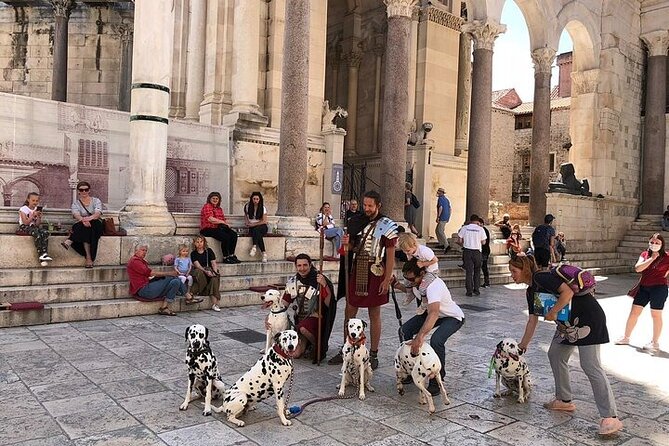
The best reason to take this tour early in your Split visit is orientation. The palace is compact, but its lanes can feel confusing at first. The Peristyle is the main anchor, and the route uses it to connect the Roman core with the harbor, western squares, and northern entrance.
The story is also larger than one emperor. Diocletian built a retirement palace near his birthplace, yet later generations reused it in ways he could never have planned. Roman walls became city walls. Palace rooms became homes and shops. The old center still functions as part of daily life.
A guide can make that change easier to understand than a quick walk with a map. You hear why the palace was built, how its sections worked, and how Split grew around it. The French language matters here. Historical names, dates, and political changes are easier to follow when the explanation feels natural to you.
The experience is advertised at about one hour and 30 minutes, though the walk may last more than two hours depending on the guide and questions. That flexibility is useful if you enjoy conversation, but it may matter if you have a ferry, museum reservation, or restaurant booking immediately afterward.
More History Walking Tours in Croatia
- Dubrovnik Old Town History Walking Tour
★ 5.0 · 1,684 reviews - Dubrovnik: Ancient City Walls & Wars Walking Tour
★ 5.0 · 1,270 reviews - Zagreb: City & History Walking Tour & WW2 Tunnels
★ 4.9 · 1,202 reviews
Peristyle: beginning at the palace’s ceremonial heart
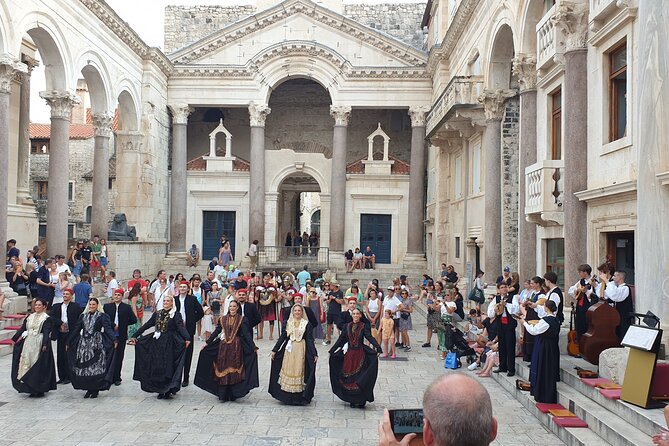
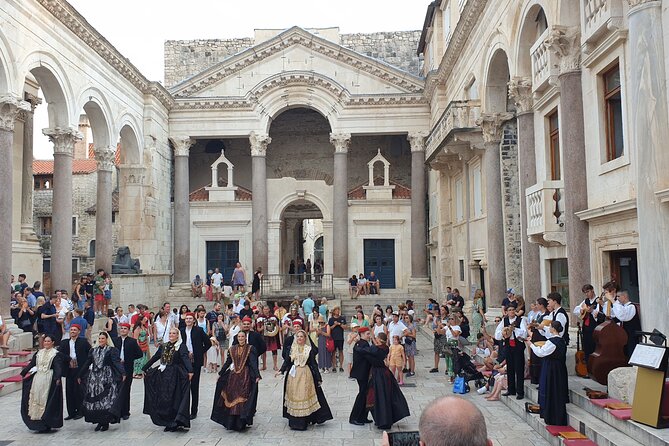
The tour starts on Peristil ulica, at the Peristyle, the grand central square of Diocletian’s Palace. This is the right opening point because several palace routes branch from here, and the square gives you a quick sense of the building’s original scale.
Allow about 15 minutes here. The guide explains the square’s purpose and its link to the emperor’s public image. This is where the story of Diocletian’s rise takes shape. He went from an obscure beginning to the most powerful man in the Roman world, then chose this coastal site for a palace connected to his retirement.
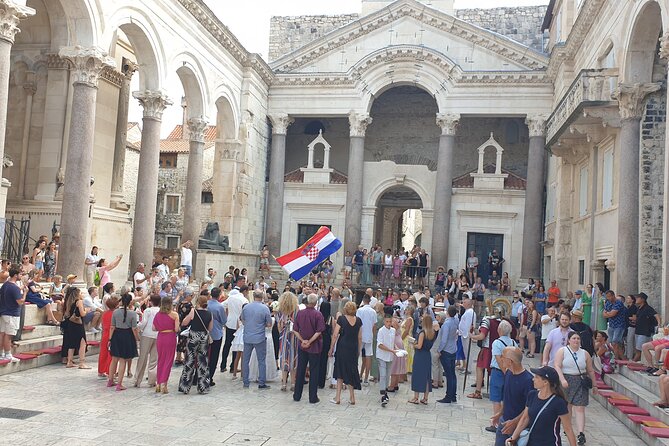
The Peristyle can be crowded and active, especially during the day. That is part of its appeal, since you see the space as part of modern Split rather than as an empty archaeological set. It can also make it harder to hear. Stay close to the guide and avoid drifting toward the edges while the explanation is under way.
The square is free to visit, and the tour does not require a separate admission ticket for this stop. Its real value is the explanation of what you are looking at.
The Vestibule and a chance to hear Dalmatian singing
A short walk brings you to the Vestibule, the entrance space associated with Diocletian. The stop lasts about five minutes, so it is brief, but it gives the route a strong architectural detail rather than just another view of old stone.
The Vestibule is also the place where you might hear traditional Dalmatian singing. The information provided for the tour says this may happen, so treat it as a possibility, not a scheduled performance. If the sound carries through the space during your visit, it adds a local touch that a standard monument tour could easily miss.
This stop is especially useful for understanding how the palace was designed as a controlled approach to the emperor. The guide can connect the room to the Peristyle and explain how visitors moved through the complex.
The palace substructures and what lies below the city
The palace substructures receive about 10 minutes. You go through the underground sections and learn how they were built and how their purpose changed over time.
This is one of the most useful parts of the walk because the lower rooms help explain the shape of the palace above. Their layout reflects the upper level, giving you a clearer picture of the original plan. The guide also discusses construction and later uses, so you are not simply walking through a dark passage without context.
There is an important limitation: the museum section of the substructures is not included. You can visit that area after the tour, but it is a separate addition to your day. If you want a longer archaeological visit, allow extra time and check the separate admission arrangements on site.
The underground route may include high steps, and the activity specifically warns people with problems handling high steps. Wear shoes that feel secure on uneven surfaces. This is a walking tour in an old stone complex, not a flat promenade.
More Small-Group History Tours in Croatia
- Split History and Gastro Small-Group Tour with Food and Drinks
★ 5.0 · 375 reviews - Dubrovnik Old Town: Small-Group Walking Tour With A Local
★ 5.0 · 123 reviews - Dubrovnik: Game of Thrones and History Small Group Tour
★ 5.0 · 76 reviews
The Golden Gate and Gregory of Nin
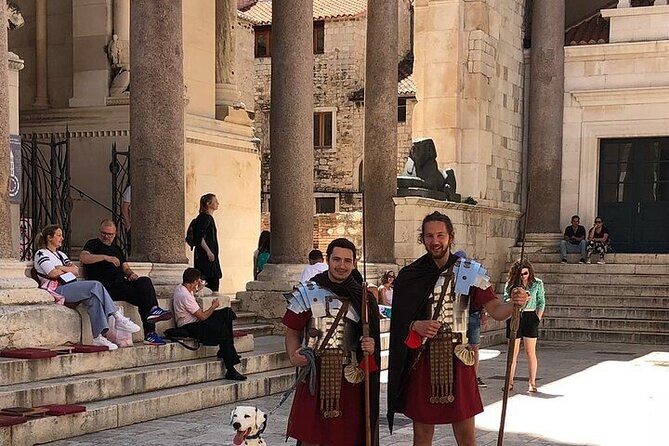
The Golden Gate is the palace’s main northern entrance, and the stop lasts about 10 minutes. It is a natural place to discuss how people entered the imperial complex and how the old defensive edge relates to Split’s later growth.
The large statue of Gregory of Nin adds a distinctly Croatian layer to the route. The guide explains why he matters to Croatian history and language. This is the kind of stop that makes the tour more than a Roman architecture lesson. You get a connection to national identity and the development of the local language.
The Golden Gate also helps you picture the palace as a working fortified residence rather than a collection of isolated monuments. Look at the transition between ancient masonry and the later city around it. The value is in seeing those layers together.
If you are taking photographs, this can be a busy passage. Keep listening for the explanation and save longer photo stops for after the group moves on.
Riva Harbor: the palace facing the sea
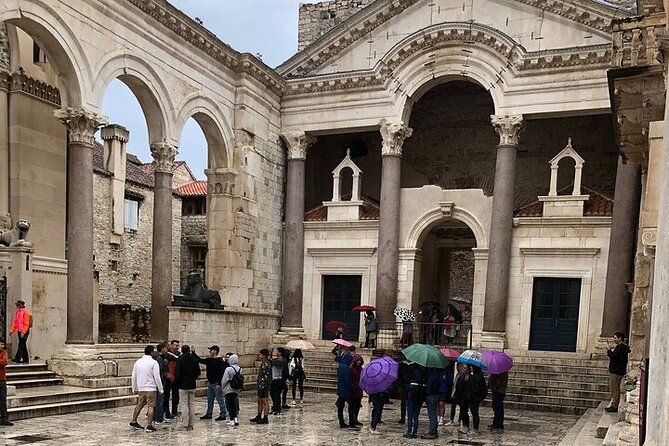
From the old center, the route reaches Riva Harbor for about 15 minutes. Riva is Split’s broad waterfront promenade, and the setting changes your view of the palace. Instead of looking inward at courtyards and lanes, you see how the city relates to the sea.
The tour includes a look at a bronze model of Diocletian’s Palace. This is particularly helpful if you have struggled to understand the palace’s full footprint. A model turns the maze into a plan, showing how the walls, entrances, and central spaces fit together.
The guide also explains the history of Riva itself. This gives you a useful contrast between imperial construction and the later public life of the harbor. After the tour, Riva is an easy place to revisit for a pause, a drink, or a slow walk by the water.
This stop is less demanding than the underground sections and offers a natural breather. If the tour runs beyond 90 minutes, the harbor is one place where you can listen while taking in the wider view.
Fruit’s Square and the Venetian chapter
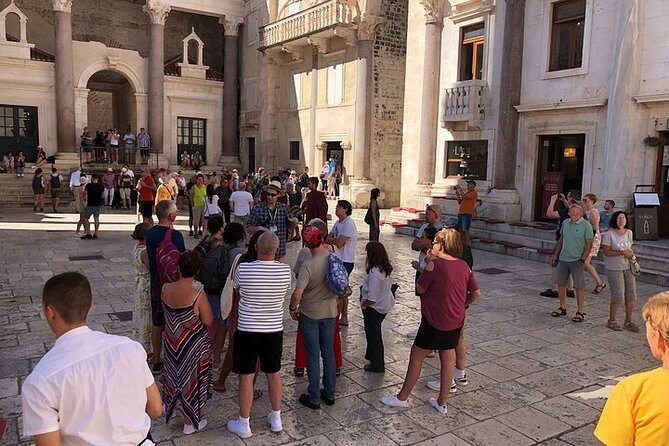
Fruit’s Square, officially Trg Braće Radić, receives about 10 minutes. The square brings the tour into a later period, with attention to a 15th-century Venetian citadel.
That shift is important. Split’s story did not end with the Roman emperor, and the Venetian fortification shows how later powers adapted the old city to new military needs. The setting also demonstrates how Split’s public squares developed outside the palace’s central ceremonial space.
The guide discusses Marko Marulić, often called the father of Croatian literature. His inclusion gives you another connection between place and language. After hearing about Gregory of Nin at the Golden Gate, you now get a literary figure tied to Croatian cultural identity.
Fruit’s Square is a good place to pause and notice how the old town feels in ordinary use. It is not only a route between monuments. It is a neighborhood square with layers of architecture around it.
The old synagogue and Split’s Jewish story
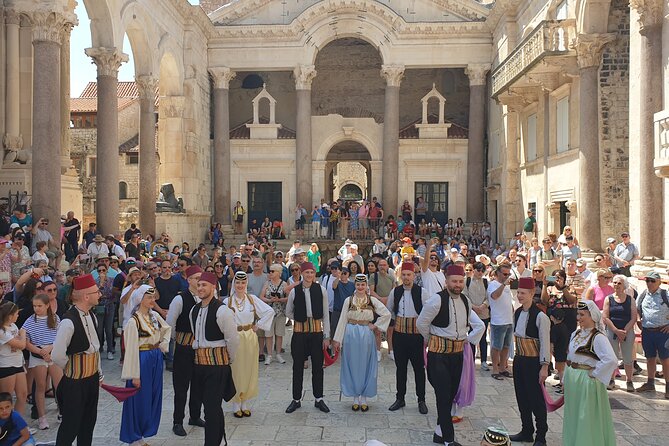
The final listed stop is the Split Synagogue area, where you pass a 16th-century synagogue and hear about the history of the Jewish people in Split. The stop takes about 10 minutes.
You should note the wording carefully: the tour passes by the synagogue rather than promising an interior visit. This is an outdoor history stop, focused on the community and its place in the city.
I value this addition because many short palace walks stay with emperors, walls, and churches. A discussion of Jewish life gives you a broader picture of the people who shaped Split across time. It also rounds out the tour’s range, which moves from Roman government to Croatian language, Venetian defense, and local religious history.
The route ends back at the meeting point. Since the walk begins and finishes in the palace area, you can continue exploring on foot afterward without needing transport back to a distant hotel or bus stop.
What the French-speaking guides add
The strongest feature of this experience is the guide. The available guide team is described as well educated and focused on the history of the palace and surrounding city. Specific guide names connected with past tours include Antonela and Irene.
Antonela is described as warm, engaging, and full of detail about the palace. Irene is described as an excellent guide who made the visit enjoyable for a family with children. Other French-speaking guides have been praised for answering unusual questions, explaining construction clearly, and speaking French with ease.
That matters because a site like Diocletian’s Palace can produce two very different visits. Without context, you may see impressive stone, columns, and narrow lanes. With a good guide, you understand why the palace was built, how it changed, and why Split still lives inside it.
The experience may suit families especially well. The route is short enough to be manageable, and the guides have been described as engaging with children. Still, the group can include up to 30 people, so do not expect every question to receive a long individual answer.
Is $69.14 a fair price?
At $69.14 per person, this is not the cheapest way to walk through Split. You can enter much of the old town on your own for free, and several of the listed stops do not require admission. The price pays mainly for the French-language explanation, the route planning, and the ability to connect scattered sights into one story.
I think the price makes more sense if you have limited time in Split, want French rather than English, or prefer a guide who can answer questions as you go. It is also useful on a first visit, before you return independently to the palace cellars, Riva, or the squares.
The value is weaker if you already know Roman and Croatian history, prefer to explore alone, or plan to spend several hours reading at your own pace. The tour does not include the museum section of the substructures, and gratuities are extra.
Group discounts are available, which may improve the cost for families or larger parties. The booking includes a mobile ticket, and the tour requires a minimum number of participants. If that minimum is not reached, you are offered another date or experience, or a full refund.
Who should take this tour?
I would choose this walk for a French-speaking visitor who wants a clear introduction to Split without committing to a half-day program. It is also a good fit for families who prefer stories and conversation to a silent audio guide.
You should book it if you want to understand the connection between the Roman palace and the modern city. You should also book it if the names Diocletian, Gregory of Nin, Marko Marulić, and Venetian Split mean little to you now but you want them placed in context.
I would hesitate if high steps are difficult for you, since the route includes underground sections and specifically warns about this issue. I would also hesitate if you need a guaranteed 90-minute finish. Past tours have run longer than planned, which is pleasant for an open afternoon but awkward before a fixed departure.
Bring a charged phone for the mobile ticket, wear practical shoes, and arrive ready to walk rather than simply stand at monuments. A small notebook can be useful if you want to remember names and dates, since the route covers several periods in a short time.
Should you book the French walking tour?
Book it if you want a guided introduction to Split in French, especially with a family or on your first day in town. The route covers the palace’s main points, adds the harbor and later city history, and gives you enough orientation to explore on your own afterward.
Skip it if you want a private guide, a guaranteed tiny group, or a full museum visit underground. At up to 30 participants, the group may feel larger than the title suggests, and the $69.14 price is aimed at people who place real value on fluent French narration and local historical context.
For the right visitor, this is a smart first look at Split: focused, walkable, and broad enough to show that Diocletian’s Palace is not just an ancient ruin. It is the framework of the city.
FAQ
Is the tour conducted in French?
Yes. The experience is a French-language walking tour, and the guides are expected to explain the palace and Split’s history in French.
How long does the tour last?
The stated duration is about one hour and 30 minutes. Some tours may last more than two hours, depending on the guide and the questions asked.
Where does the tour start and finish?
The meeting point is Peristil ulica, at the Peristyle in Split. The activity ends back at the meeting point.
Does the tour include the palace substructures?
Yes. You go through the substructures and learn about their construction and changing uses. The museum section of the substructures is not included.
Is the tour suitable for people with mobility concerns?
Most people can participate, but the experience is not recommended for people who have difficulty with high steps. Service animals are allowed, and the tour is near public transportation.
What happens if I need to cancel?
You can receive a full refund if you cancel at least 24 hours before the local start time. Cancellations or changes made less than 24 hours before the start are not refunded or accepted.
Newest history tours we have reviewed in Croatia
- Dubrovnik Old Town: Small-Group Walking Tour With A Local★ 5.0 · 123 reviews
- Split History and Gastro Small-Group Tour with Food and Drinks★ 5.0 · 375 reviews
- Dubrovnik: Game of Thrones and History Small Group Tour★ 5.0 · 76 reviews
- Dubrovnik Jewish Heritage Private Walking Tour★ 5.0 · 121 reviews
- Private History Split Walking Tour in English★ 5.0 · 159 reviews
- History & Cultural Walking Tour of Split and Diocletian’s Palace★ 5.0 · 104 reviews
- Jewish Heritage & Diocletian’s Palace Private Split Tour★ 5.0 · 80 reviews
- Split: Historical Tour of Salona, Klis Fortress and Trogir★ 4.1 · 108 reviews
Small-Group History Tours, compared.


Freedom Trail History Small Group Walking Tour
Read our review →
Madrid Tapas & Taverns Small Group Food & History Tour
Read our review →
Hidden Alleyways and Historic Sites Small-Group Walking Tour
Read our review →
New Orleans Small-Group Haunted History Carriage Tour
Read our review →
Half Day Dominican Republic Cultural Tour : Small Group
Read our review →
Ultimate Seville Tapas, Wine & History Small Group Tour
Read our review →
Vienna Historic Center Small Group Walking Tour
Read our review →Browse the lists this tour appears in