
Review · SPLIT HISTORY TOURS
Split: Private Walking Tour in the Historical Town Center
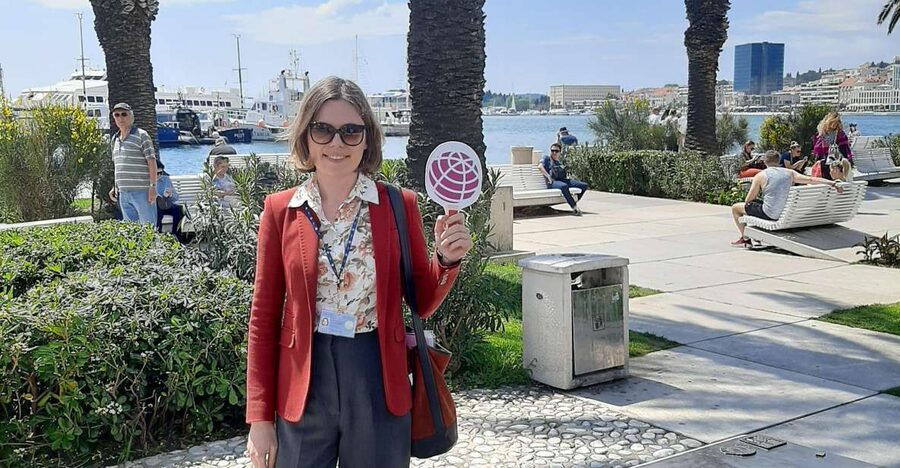
Split’s old town is not a museum behind velvet ropes. It is a living city built inside a 4th-century Roman palace, with laundry above ancient stone, cafés in former courtyards, and medieval homes fitted into imperial walls. This private walk with guide Sanja gives you a quick, clear way into that story.
I like the private format, especially for a group of up to 15 people, and I like the route’s mix of major sights and smaller corners, including the former Jewish quarter and its active synagogue. The main drawback is that 105 minutes goes quickly, and the Palace Substructures require an extra entrance fee.
Key points to know before you book
- Start with the Roman Palace: You enter Split’s oldest core and see how later homes and streets grew inside Diocletian’s imperial complex.
- Sanja guides in four languages: Tours are available in English, French, Italian, and Spanish.
- The private group matters: Your party can ask questions, hear the guide clearly, and shape the conversation more easily than on a large group tour.
- The Substructures cost extra: The basement level is included in the route, but admission is not part of the tour price.
- You cover more than Roman ruins: The walk also reaches Pjaca, Fruit Square, Prokurative, and the Riva, with context on Venetian, French, Austro-Hungarian, and Yugoslav rule.
- Plan for walking and steps: The experience is not suitable for wheelchair users.
Why a private walk makes sense in Split
Split can be confusing at first. The Palace is large, but its original Roman plan has been altered by centuries of building. An archway may lead into a narrow lane, a Roman column may sit beside a medieval house, and a busy square may occupy space once used for imperial ceremony.
A private guide helps you read those layers instead of simply passing them. Sanja has a master’s degree and works as a licensed local guide. Her explanations cover not just dates and rulers, but also how the city developed under different governments. That wider view is useful because Split’s character comes from many periods pressed into a small area.
The price is $153 per group, with up to 15 people included. For a large family or group of friends, that can be a fair deal. A party of two pays the same total price, so the value is less convincing for a couple than for a group. Still, the private setup gives you a quieter experience and a better chance to ask about places you want to revisit later.
I would schedule this early in your stay. One couple’s first full day with Sanja helped them understand the Palace and plan the rest of their time. That is the right use of a short orientation walk: learn the layout first, then return to the parts that deserve a slower look.
More History Walking Tours in Croatia
- Walking Tour of Split with a ‘Magister’ of History
★ 5.0 · 1,122 reviews - Split Walking Tour with Professor of History
★ 5.0 · 926 reviews - Split: History and Heritage Walking Tour
★ 4.9 · 650 reviews
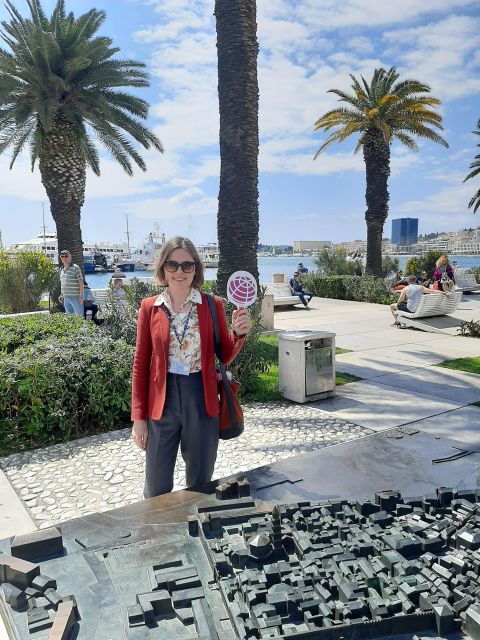
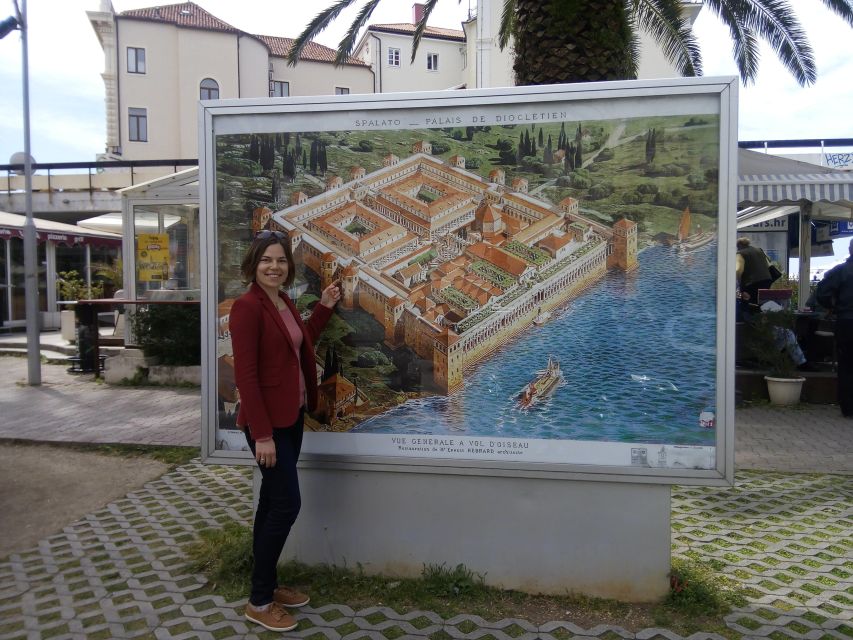
Meeting at the bronze model on the Riva
The tour begins beside the bronze model of Split’s historical core on the Riva promenade. The meeting point is by the sea, in front of the south entrance to Diocletian’s Palace.
That location is practical. The model gives you an immediate picture of the Palace, its walls, and the modern town surrounding it. It also puts you right beside the entrance used to begin the walk. Look for the bronze city model rather than simply waiting somewhere along the waterfront.
From here, you head into the Palace. The Riva itself is the modern edge of the old town, so the opening moments help you understand the relationship between the waterfront promenade and the Roman core behind it.
Entering Diocletian’s Palace after 1,700 years
The main focus is Diocletian’s Palace, built in the 4th century for the Roman emperor Diocletian. Calling it a palace can give the wrong impression. This is not just a single residence or an isolated archaeological site. It forms the oldest part of central Split and contains streets, homes, shops, religious buildings, and public spaces.
Sanja explains how a small medieval neighborhood developed inside the Roman structure. That is one of the most useful parts of the visit. You are not only looking at ancient stone; you are seeing how later residents adapted it for daily life.
The route takes about 30 minutes through the Palace itself. Expect a walking explanation rather than a long stop at one monument. The pace is designed to give you a strong first picture of the site, not every detail of every doorway.
Pay attention to the contrast in building styles. Roman walls and columns meet medieval houses and later façades. The odd-looking joins are not mistakes. They are the physical record of a city that kept using old structures instead of clearing them away.
The Substructures reveal the Palace plan
The Substructures, also called the Basements, occupy the lower level of the Palace. They require a separate entrance fee, so bring that extra cost into your planning.
This is one of the most worthwhile optional additions because the lower rooms help you understand the shape of the imperial complex above. As you walk through them, the plan of the Palace becomes easier to grasp. You can connect the underground spaces with the streets and squares on the upper level instead of treating them as unrelated ruins.
The Substructures also provide a change from the open streets. They are an enclosed historic space, so the visit feels different from walking through the active town. Since the total tour lasts only 105 minutes, Sanja cannot give every chamber a long stop. If the lower level interests you most, ask questions while you are there and consider returning on your own.
The entrance fee is not included in the $153 group price. The tour includes the guide and private service, but you pay separately for admission.
More Private History Tours in Croatia
- SPLIT-PRIVATE Walking Tour of Diocletian’s Palace & Old Town
★ 5.0 · 467 reviews - Private History Split Walking Tour in English
★ 5.0 · 159 reviews - Jewish Heritage & Diocletian’s Palace Private Split Tour
★ 5.0 · 80 reviews - Dubrovnik Jewish Heritage Private Walking Tour
★ 5.0 · 121 reviews
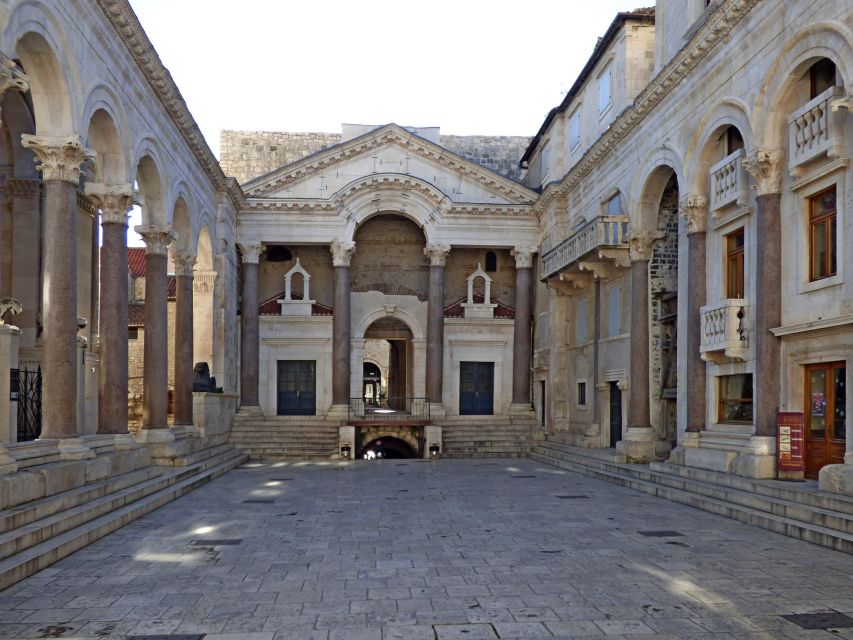
Peristil, the Palace’s grand central stage
Peristil is the Palace’s main square and one of the clearest places to see its imperial purpose. The guide spends about 10 minutes here, pointing out the space and explaining how it fits into the original complex.
This is a good place to stop and look up, not just ahead. The surrounding stone, columns, and buildings show how the square has continued to serve the city long after Roman rule ended. Later life grew around the old ceremonial center.
Because Peristil is a major stop, it can feel more open and public than the narrow lanes nearby. Sanja’s explanation gives the square a sense of order. Without that context, you may see an attractive stone courtyard; with it, you can better understand why this particular space mattered.
Cathedral and Jupiter’s Temple
The Cathedral of Saint Domnius occupies the former Mausoleum of Diocletian. The tour includes a guided look and a pass by, with about 10 minutes devoted to this area.
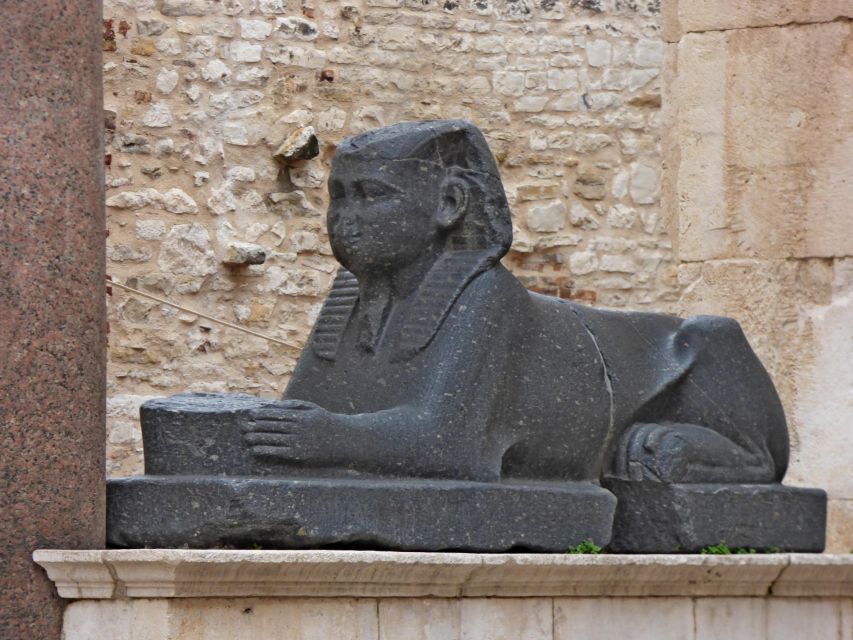
That pairing is especially striking. A Roman imperial tomb became a Christian cathedral, showing how the city reused and reinterpreted earlier buildings. Sanja connects the site to the changing religious and political life of Split rather than treating it as a single-period monument.
The nearby Temple of Jupiter is another short stop. It is viewed externally, with no entrance fee included or required for this part of the route. Today it is known as the Baptistery, another example of a Roman building taking on a Christian purpose.
These stops are brief. If you want interior time at the cathedral or a closer look at the Baptistery, ask Sanja what can be visited separately. The advertised walk focuses on orientation and explanation, not extended interior visits at every site.
Palace walls, gates, and the Golden Gate
The Palace walls and its four gates help you see how the Roman complex was organized and defended. The route includes the Golden Gate, with about 10 minutes for guided sightseeing and walking.
The gates are useful landmarks for the rest of your stay. Once you know them, you can use the Palace as a map rather than a maze. The south entrance near the Riva, the Golden Gate, and the other openings each connect the old core with a different part of modern Split.
The Golden Gate also shows the scale of the original Palace. It is not a tiny old quarter. Its walls once enclosed a major imperial residence and military complex, and the modern town has grown around that footprint.
Sanja also points out medieval noble houses and other buildings fitted into the older structure. These details prevent the tour from becoming a parade of famous names. You see how people lived with the Roman past, not simply how archaeologists label it.
The former Jewish quarter and everyday Split
One of the more unusual parts of the route is the small former Jewish ghetto, including a synagogue that is still active. It is easy to miss this corner if you follow only the biggest monuments.
This stop adds a human scale to the tour. The Palace was not only home to emperors, priests, and civic officials. It also became a neighborhood shaped by different communities, trades, and religious traditions.
The active synagogue is a reminder that Split’s old town is still a lived-in place. Be respectful around the building and remember that this is part of a functioning community, not just a historic backdrop.
Beyond the Palace: Pjaca and Fruit Square
The second half moves into the medieval neighborhood outside the Roman Palace. This shift matters. You leave the imperial plan and enter the later town, where public life developed around newer squares and streets.
Pjaca, also called People’s Square, receives about 15 minutes. It is a natural place to discuss civic life and the changes that came with later rule. Sanja covers the city under Venetian, French, Austro-Hungarian, and Yugoslav governments, helping you connect architecture with political change.
Fruit Square is a shorter stop of about 10 minutes. Its name and setting give you another view of everyday urban life outside the Palace walls. As you move between these squares, look for the different proportions and façades. The city’s layers are easier to spot after you have seen the Roman core.
This part of the walk is valuable for anyone who wants more than ancient history. Split’s modern identity was shaped by centuries of rule and change, and the square-by-square route makes that story easier to follow.
Prokurative and the return to the sea
The route continues to Prokurative before returning to the Riva. The square reflects a later period of Split’s development and helps round out the architectural story beyond Roman and medieval buildings.
The final 10 minutes take you back to the waterfront. Ending on the Riva is convenient because you are close to cafés, the sea, and the central old town. It also gives you a clear place to continue your day.
Use the last few minutes to ask for practical suggestions about what to see next. The tour is designed to give you ideas for your own exploration, and the private format makes this advice more personal than a standard speech delivered to a large crowd.
Timing, pace, and physical demands
The total duration is 105 minutes, or about 1 hour and 45 minutes. That is long enough to cover the main framework of Split’s historic center without taking up half your day.
You will walk through streets, squares, gates, and historic interiors. The tour is not suitable for wheelchair users, and the uneven historic setting may be tiring for anyone who has trouble walking. Wear comfortable shoes and avoid treating this as a seated sightseeing activity.
The itinerary includes many stops, so the pace is purposeful. You get roughly 30 minutes in the Palace, then shorter explanations at the main monuments and squares. If you prefer slow photography, long café breaks, or extended museum visits, this tour may feel brisk.
The private group is a real advantage here. In a party of four, for example, everyone can hear the guide easily and ask questions without holding up a large crowd. A group of 15 can still benefit from the private setup, but keep close together in narrow lanes.
Language choices and guide style
Sanja leads in English, French, Italian, or Spanish. Her French has been praised as clear and natural, and she has been described as especially good at connecting Split’s history with French culture. Her English is also reported as excellent, with clear explanations and an easy style.
That matters on a history tour. Split’s story includes Roman, medieval, Venetian, French, Austro-Hungarian, and Yugoslav periods. If the language is not comfortable, the rapid changes can blur together. Choose the language in which you can ask detailed questions.
Her approach suits people who want context without a lecture that stays trapped in dates. The strongest focus is on how the town developed, how architecture changed, and how different rulers shaped civic life.
Is $153 good value?
The answer depends on your group size. For 10 to 15 people, $153 works out to a modest amount per person for a private local guide. For two people, it is a much higher per-person cost, but you are paying for privacy, flexibility, and direct access to the guide.
The Substructures entrance fee is extra, so include that when comparing the total cost with other walks. The tour does include a professional licensed guide, private service, and the guide’s commission and tax.
I see the best value for families, friend groups, and cruise or short-stay visitors who want a fast orientation. If you have several days in Split and enjoy reading signs and exploring independently, you may prefer to save the money and wander slowly. If you want the city to make sense right away, the private format earns its keep.
Who should book this walk?
Book it if you want to understand Split before exploring alone, especially on your first full day. It suits history-minded visitors, first-time guests, small groups, and anyone who wants to ask questions about the city’s Roman and later periods.
It is also a good fit if you prefer a guide who can speak French, Italian, Spanish, or English. The route covers major sights but also includes less obvious places, such as the former Jewish quarter and the active synagogue.
Think twice if you need wheelchair access, dislike walking on old streets, or want long interior visits at the cathedral and Substructures. The tour gives you a broad, useful framework, but it is not a substitute for a full archaeological visit.
Final call: book early in your Split stay
I would book this private walk near the beginning of a Split visit. Sanja’s route gives you the key map: the Roman Palace, its gates and central square, the cathedral and Baptistery, medieval neighborhoods, later public squares, and the Riva.
The strongest reasons to book are clear historical connections, a private group, and a route that reaches beyond the usual Roman highlights. The main cautions are the extra Substructures fee, the brisk 105-minute pace, and the lack of wheelchair suitability.
For a group of friends or family members, the $153 price is easier to justify. For a couple on a tight budget, compare it with a shared tour or self-guided visit. If you choose this experience, use it as your introduction, then return to the Palace and its squares with your own slower plan.
FAQ
Where does the tour begin?
It begins beside the bronze model of Split’s historical core on the Riva promenade by the sea, in front of the south entrance to Diocletian’s Palace.
How long does the walking tour last?
The tour lasts 105 minutes, or about 1 hour and 45 minutes.
What languages are available?
The live guide can lead the tour in English, Italian, French, or Spanish.
Is the tour private?
Yes. It is a private group experience for up to 15 people.
Is entry to the Palace Substructures included?
No. The Substructures, also called the Basements, require a separate entrance fee.
Is the tour suitable for wheelchair users?
No. The experience is listed as unsuitable for wheelchair users.
More Private History Tours in Split
- Private Historical Walking Tour of York
★ 5.0 · 1,324 reviews - Private Guided Historic Electric Cart Tour of St. Augustine
★ 5.0 · 1,194 reviews - Istanbul: Acemoglu Historical Turkish Bath w/Private Options
★ 4.6 · 1,190 reviews - From Cairo: Private Full-Day Tour of Historical Alexandria
★ 4.1 · 1,155 reviews
More History Walking Tours in Split
- Split: Local History and Culture 90-Minute Walking Tour
★ 5.0 · 194 reviews - Split: Walking tour of Split with a ‘Magister’ of History
★ 5.0 · 110 reviews - History & Cultural Walking Tour of Split and Diocletian’s Palace
★ 5.0 · 104 reviews - History Split Walking Tour in French -Small group
★ 5.0 · 41 reviews
Newest history tours we have reviewed in Split
- Split: Historical & Gastro Treasures Tour with Green Market★ 4.9 · 144 reviews
- Split Walking Tour with History Professor★ 5.0 · 23 reviews
- Split: Walking tour of Split with a ‘Magister’ of History★ 5.0 · 110 reviews
- Split: Local History and Culture 90-Minute Walking Tour★ 5.0 · 194 reviews
- Experience Split History Walking Tour With Local Historian★ 5.0 · 28 reviews
- Split History and Gastro Small-Group Tour with Food and Drinks★ 5.0 · 375 reviews
- History Split Walking Tour in French -Small group★ 5.0 · 41 reviews
- Private History Split Walking Tour in English★ 5.0 · 159 reviews
Private History Tours, compared.
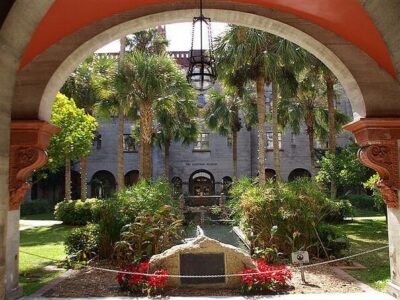
Private Guided Historic Electric Cart Tour of St. Augustine
Read our review →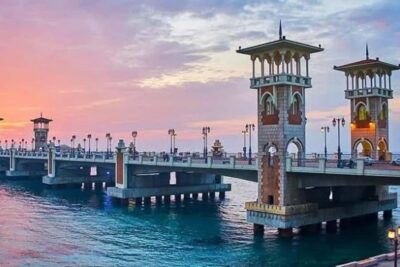
Private Full-Day Tour of Historical Alexandria
Read our review →
Private Tour of the Historic City in a Ford T Car
Read our review →
Madrid Historical Tour with Local Guide in Eco Tuk Tuk Private
Read our review →
Private Biblical Tour Ancient Corinth & Isthmus Canal from Athens
Read our review →
Private Kathmandu Sightseeing Tour | UNESCO World Heritage sites
Read our review →
Historic Porto by Private Electric Tuk Tuk to Top Landmarks
Read our review →Browse the lists this tour appears in