
Review · CROATIA HISTORY TOURS
Pula: Historic Walking Tour with Local Guide & City Views
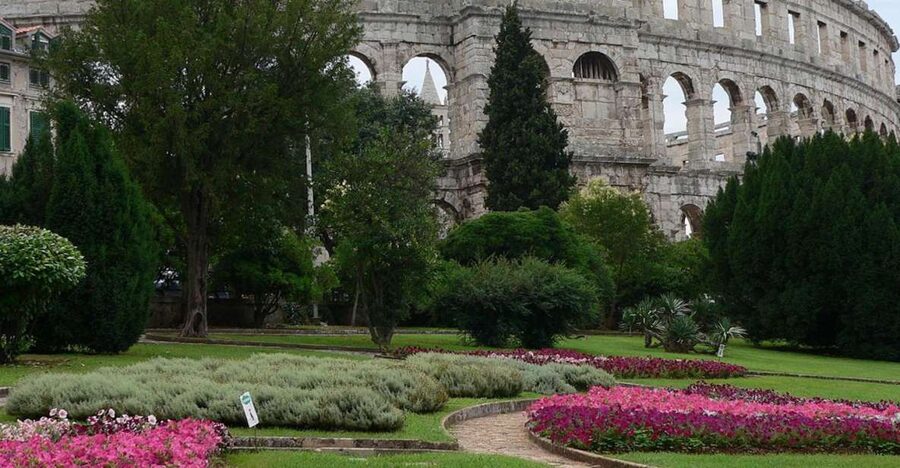
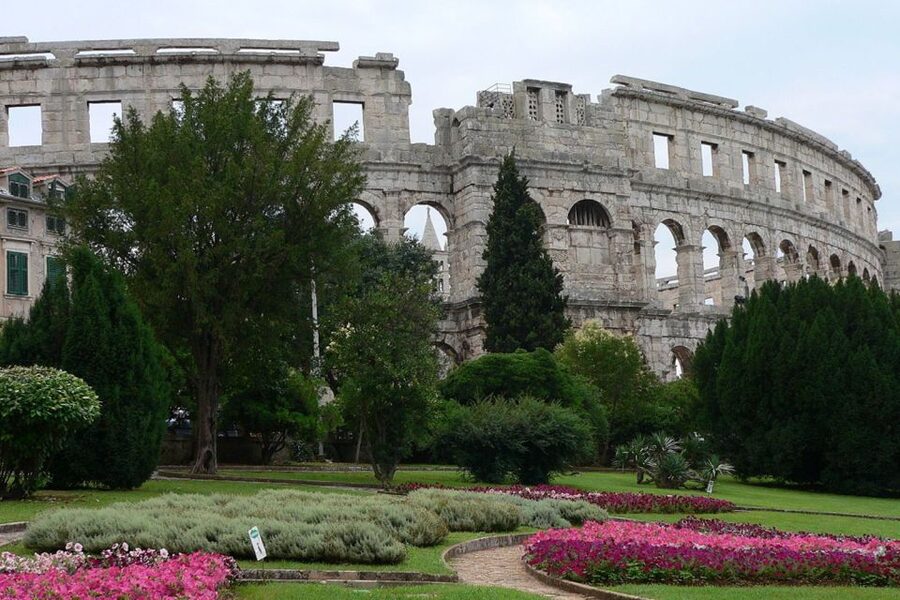
Pula’s Roman Amphitheatre is more than a quick photo stop on this walking tour. Your German-speaking guide, Marina, begins beneath the wooden roof at the Arena entrance, then links the famous monument to the city gates, market and Forum. You get the bigger story of Pula, not just its most famous building.
I like the personal approach. You can steer the conversation toward local food, daily life, culture or nature, and Marina has more than 18 years of guiding experience in Istria. I also like the market visit, where ancient Roman trade connects with the place locals still use to buy Istrian produce. The main consideration is language: this experience is offered in German, so it is best suited to German-speaking visitors.
Key points at a glance
- The Arena is the starting point: Learn why Pula’s Roman Amphitheatre was built and used for more than gladiator contests.
- Three Roman gates remain: See the Twin, Hercules and Sergii gates, with preserved details that help explain Pula’s ancient city plan.
- The market adds local flavor: Connect Roman commerce with the farmers market and Istrian food traditions.
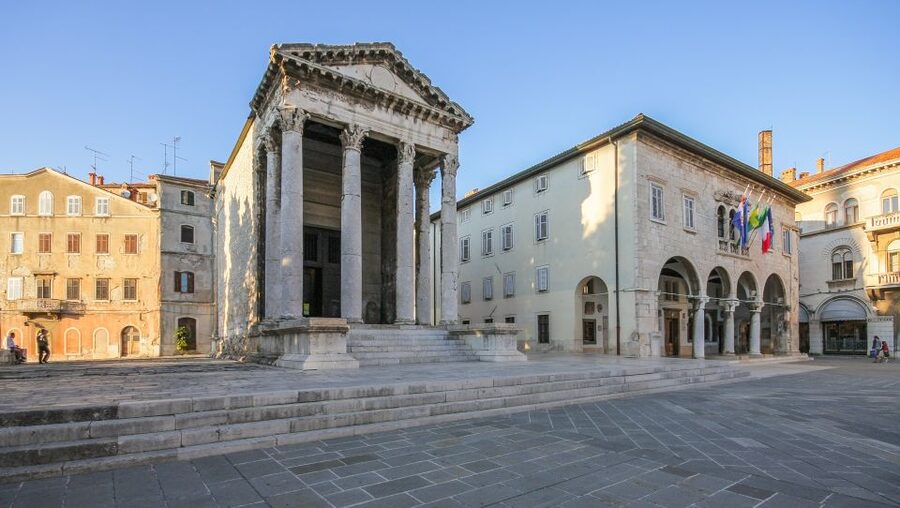
- Forum square brings the eras together: See the August temple and Venetian city hall in one of Pula’s most important public spaces.
- You can shape the conversation: Ask about food, culture, nature or local life during this personalized walk.
- The format is flexible: Plan on 90 minutes to 2 hours, with private groups available and wheelchair access listed.
Why this Pula walk is more than an Arena visit
Pula can be easy to misread. At first glance, it seems like a Roman monument with a town attached. In fact, the city’s streets carry Roman, Venetian and later local layers, and this tour is designed to connect them in a manageable walk.
You begin at the Arena, Pula’s Roman Amphitheatre and the city’s main attraction. That is a smart meeting point. You do not have to hunt for a small office or find an obscure street corner. Look for the entrance beneath the wooden roof, where the guide meets the group.
The tour lasts about 90 minutes, though the stated duration can extend to two hours. That extra time matters because this is not presented as a rushed checklist. Marina can pause for questions and adjust the conversation around your interests. If your group wants more attention on local cooking, for example, the market becomes especially useful. If you prefer history, the Roman and Venetian remains give you plenty to ask about.
The tour is in German. This is not a minor detail. The appeal depends on explanation, questions and local stories, so you will get the most from it if you are comfortable following a German-speaking guide.
More History Walking Tours in Croatia
- Dubrovnik Old Town History Walking Tour
★ 5.0 · 1,684 reviews - Dubrovnik: Ancient City Walls & Wars Walking Tour
★ 5.0 · 1,270 reviews - Zagreb: City & History Walking Tour & WW2 Tunnels
★ 4.9 · 1,202 reviews
The Arena: Pula’s Roman starting point
The Amphitheatre is the obvious star, but the useful part of the visit is the explanation of its purpose. You will hear what the building was made for and how its use went beyond the familiar image of gladiatorial contests.
That wider context helps. Roman amphitheatres were places for public events, and the building’s scale tells you something about the importance of Pula in the ancient world. Rather than treating the Arena as a detached ruin, the guide places it at the center of the city’s Roman identity.
You should clarify at the start if you want to enter the Arena. One booking chose to include a visit inside, while the tour information notes that entrance fees are not included. That means your $29 price covers the walking guide, not paid admission to monuments. Ask about this before setting off so you know exactly what the route will include.
If you only want the exterior and the surrounding streets, the walk still works well. If entering the Amphitheatre matters to you, budget separately for the ticket and confirm the arrangement with the guide.
The meeting point is practical, but the area can be busy around Pula’s most famous sight. Arrive with enough time to identify the entrance beneath the wooden roof. You do not need transport between stops, since the experience is a city walk.
Roman gates and the shape of old Pula
After the Arena, the route leads into older parts of the city. Pula still has three Roman gates: the Twin Gate, Hercules Gate and Sergii Gate. Seeing them together gives you a better sense of how Roman Pula was organized.
The names are easy to forget, but the details are not. Look closely at the surviving stonework and decorative elements. These features give the guide a way to explain the gates, their place in the city and the people connected with them.
This is where a local guide can add value over a quick self-guided circuit. A sign may tell you a gate’s name and approximate age. A guide can connect it to the streets you are walking through and explain why the preserved details matter.
The route through older Pula also helps you notice the city’s mixed identity. Roman remains are not kept in a sealed archaeological park. They are part of an inhabited town, alongside later buildings and everyday streets. That combination is one of the strongest reasons to take the walk instead of seeing only the Arena.
The tradeoff is that historic streets are not the same as a purpose-built museum route. You will be walking through the city rather than moving from one controlled exhibit to another. Wear comfortable shoes and expect the tour to be an outdoor experience, even though the details come from many centuries.
The farmers market and the taste of Istria
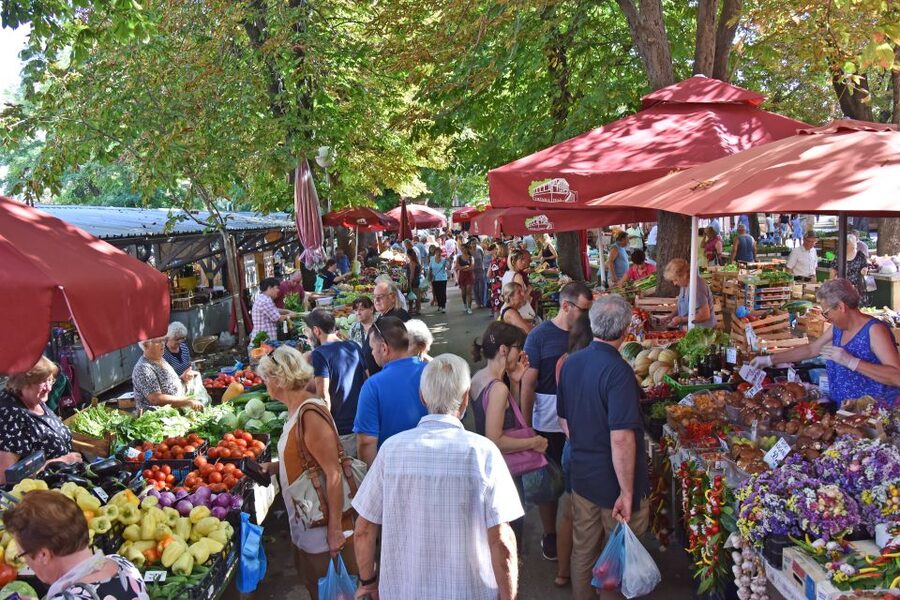
The farmers market is a particularly good stop for anyone who cares about food. Marina describes herself as a passionate cook, and the route uses the market to talk about products native to Istrian soil.
You can expect this part of the walk to feel different from the Roman monuments. The Arena and city gates tell you about stone, power and public life. The market shows you how local identity is expressed through food and trade.
This stop also makes the ancient story easier to picture. The Forum was the Roman version of a market and public center, while Pula’s modern farmers market remains a place where people buy and sell local products. The connection is not that the two places are identical. It is that buying, selling and gathering have remained important parts of city life across very different periods.
If you are interested in Istrian cuisine, use this section to ask questions. The tour can focus on local food, and the guide’s cooking interest makes that a natural subject. The information provided does not promise tastings or food samples, so think of the market as a place for explanation and observation rather than a guaranteed tasting session.
Market activity can also vary by day and time. No specific opening schedule is supplied for this tour, so check the availability and timing when you book if the market is a major reason for choosing the experience.
Same streets, a different century:
- Walking Tour of Split with a ‘Magister’ of History
★ 5.0 · 1,122 reviews - Dubrovnik Combo: Old Town & Ancient City Walls
★ 5.0 · 1,019 reviews - Split Walking Tour with Professor of History
★ 5.0 · 926 reviews - Split: History and Heritage Walking Tour
★ 4.9 · 650 reviews
Forum square and the goat on the flag
The route continues to Forum square, one of the best places to see Pula’s different eras sharing the same space. In Roman times, the Forum was a central public area. Today, the square helps you read the city’s past through the remains of the August temple and the Venetian city hall.
The August temple is the Roman anchor here. Its survival gives you a clear point of contact with the ancient city, even as later architecture surrounds it. The Venetian city hall adds another layer and keeps the story from stopping with Rome.
This is also where you can learn why a goat appears on the regional flag. It is a small detail, but it is exactly the sort of question that can make a city feel less like a collection of monuments and more like a place with its own symbols and stories.
I appreciate that the tour includes this kind of local fact. The goat is not the reason to visit Pula, but it gives the walk personality. It is also a useful reminder that the guide is not simply reciting dates. You can ask about the regional identity behind the buildings.
Forum square is a good final area for questions because several themes meet there: Roman public life, Venetian rule, local symbols and present-day city life. If you have spent the walk asking about food or culture, this is a natural place to connect those subjects with Pula’s past.
Marina’s personalized guiding style
The activity is led by Marina, a licensed guide who has worked in Istria for more than 18 years and specializes in German-speaking visitors. That experience is relevant because the walk depends on explanation rather than spectacle. You are not simply following a route to photograph monuments.
The tour is described as personalized. You can ask to focus on local lifestyle, culture, nature or food. This makes the experience a better fit for a couple, family or small group with a clear interest than for someone who wants a fixed script and no questions.
One point needs clarification at booking. The supplied information names Marina, while one written account refers to Veronika as the guide. The safest approach is to confirm who will lead your departure if having a particular guide matters to you. The central facts remain clear: the experience is conducted in German, and a local licensed guide leads the walk.
The tone also appears suited to families and small groups. A group of seven, including a friendly young child, found the walk enjoyable, and another booking praised the guide for taking time with explanations. That does not make the tour a dedicated children’s program, but it suggests that a small family group can take part comfortably.
What the $29 price delivers
At $29 per person, the tour is priced as a guided orientation to Pula rather than an all-inclusive attraction pass. The value comes from the route, the local guide and the ability to ask questions across several periods of the city’s past.
You visit the Arena, Roman gates, farmers market and Forum area in one compact experience. If you tried to research each stop alone, you could certainly walk the same streets, but you would lose the links between the monuments. The guide is most useful when explaining why a Roman gate, a market and a Venetian city hall belong in the same story.
Entrance fees are not included. This is the key cost issue. If you choose to enter the Amphitheatre, expect to pay admission separately. The tour can still be worthwhile without entering, but anyone focused on the Arena interior should include that extra charge in the budget.
The duration also helps the value calculation. Ninety minutes is long enough to get your bearings and see major sights without using half a day. The possibility of running closer to two hours gives the guide room to answer questions, though the exact length may depend on the route and group.
A private group is available. For families, friends or a small German-speaking party, private guiding may justify a higher total cost because you can shape the conversation more directly. If you are traveling alone or as a couple, the $29 individual price offers a lower-cost way to get a local introduction.
Practical details before you book
The meeting point is at the entrance to the Arena, under the wooden roof. The wording is supplied in German, so identify the Arena entrance rather than waiting at a generic point somewhere in the old city.
The experience is wheelchair accessible, which is important for anyone planning a historic-center walk. Still, the description does not provide a detailed surface report for every street or specify the exact route used by wheelchair participants. If you need precise information about paving, slopes or access to the Arena interior, ask before booking.
Free cancellation is available up to 24 hours before the activity for a full refund. You can also reserve now and pay later, which helps if your Istrian schedule is still changing.
Starting times vary, so check availability for your date. The tour is listed at 90 minutes to 2 hours, and entrance fees are separate. Those are the practical points most likely to affect your plans.
The activity provider is Acta Est Fabula. German is the listed tour language, and private groups are available.
Who will get the most from this walk?
I would choose this tour if you want a clear first look at Pula and prefer explanations in German. It suits people who want Roman remains, later architecture, food culture and local stories in one route.
It is also a good match for visitors who dislike rigid sightseeing. You can guide the conversation toward food, nature, culture or everyday life. That flexibility makes the experience more useful for repeat visitors who have already seen the main monuments and want a local angle.
Families and small groups should consider it, especially if they want to keep the pace conversational. The format is not presented as a children’s tour, but the walk has enough variety to hold attention better than a long lecture at one archaeological site.
I would be more cautious if you need a tour in English or another language. German is the stated language, and the value drops sharply if you cannot follow the explanations. I would also think twice if you want a paid, inside-only Arena visit, since this experience is primarily a broader walking tour and admission is not included.
Should you book the Pula Historic Walking Tour?
Book it if you want to understand how Pula’s Roman, Venetian and modern local life fit together. The best parts are the links between the Arena and the city gates, the farmers market’s connection to trade and food, and the Forum square’s mix of the August temple and Venetian city hall.
At $29, it is a sensible introduction to the city, provided you remember that entrance fees are extra. Choose it especially if you speak German, value a guide who will answer questions, and want the freedom to talk about Istrian cooking, culture or daily life rather than follow a fixed monument script.
FAQ
Where does the tour meet?
The meeting point is at the entrance to Pula’s Arena, under the wooden roof.
How long does the walking tour last?
The stated duration is 90 minutes to 2 hours. The included guided walk is described as 1.5 hours long.
What language is the tour conducted in?
The listed tour language is German.
Is the tour wheelchair accessible?
Yes, the activity is listed as wheelchair accessible.
Is the Pula Amphitheatre entrance fee included?
No. Entrance fees are not included in the tour price.
Can I visit inside the Arena during the tour?
The tour information allows for the possibility of visiting the Arena, but admission is separate. Confirm the arrangement with the guide before the walk.
Is a private group available?
Yes, a private group option is available.
What subjects can I discuss with the guide?
You can focus the conversation on local lifestyle, culture, nature or food.
Can I cancel for a full refund?
Yes. You can cancel up to 24 hours in advance for a full refund.
Newest history tours we have reviewed in Croatia
- Enjoy Ancient Mostar★ 4.0 · 45 reviews
- Dubrovnik by Night, History, Wine & Bites★ 5.0 · 41 reviews
- Ancient Old City– Finest tour of Dubrovnik★ 5.0 · 64 reviews
- Split: Historical & Gastro Treasures Tour with Green Market★ 4.9 · 144 reviews
- Split: Private Walking Tour in the Historical Town Center★ 5.0 · 25 reviews
- Split Walking Tour with History Professor★ 5.0 · 23 reviews
- Split: Walking tour of Split with a ‘Magister’ of History★ 5.0 · 110 reviews
- Split: Local History and Culture 90-Minute Walking Tour★ 5.0 · 194 reviews
History Walking Tours, compared.
History and Hauntings of Salem Guided Walking Tour
Read our review →
Freedom Trail History Small Group Walking Tour
Read our review →
Historic Charleston Guided Sightseeing Walking Tour
Read our review →
Tapas Walking Tour with Food, Wine, and History
Read our review →
Savannah History and Haunts Candlelit Ghost Walking Tour
Read our review →
A History of Terror – Belfast City Centre Walking Tour
Read our review →Browse the lists this tour appears in