
Review · GERMANY HISTORY TOURS
Historical Walking Tour of Augsburg / Historische Führung
Augsburg’s story comes into focus on foot, from the gold-filled Rathaus to the canals, merchant houses, writers, musicians, and cathedral that shaped the city. I like the way this tour links famous names, especially the Fuggers, Bertolt Brecht, and the Mozart family, instead of treating each sight as a separate photo stop. I also like that the walk includes Augsburg Cathedral, including its old stained glass and bronze door.
The main consideration is language. This is a German-language tour, and one review noted that the guide was sometimes difficult to hear. It also covers roughly 5 kilometers, with a moderate amount of walking, so good shoes and reasonable mobility matter.
Key details that shape the experience
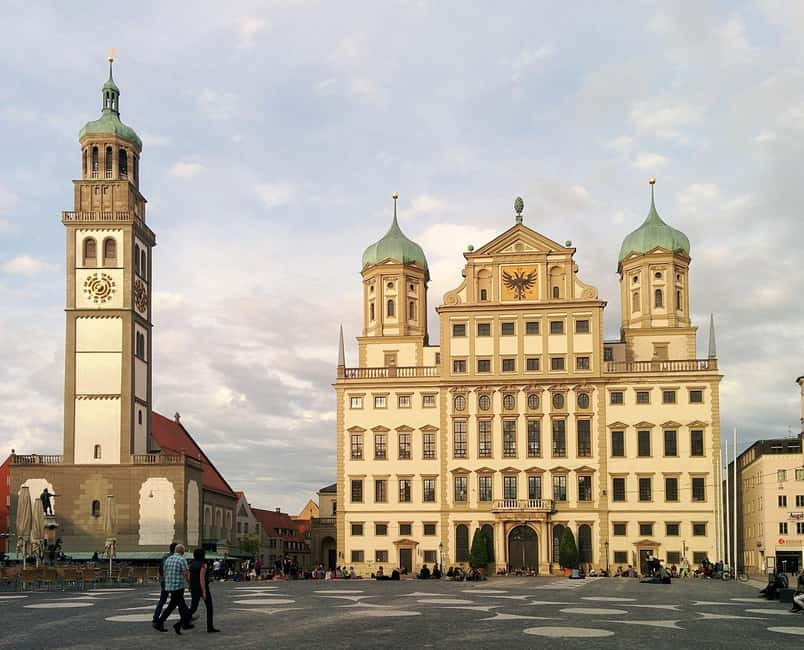
- Augsburg’s Rathausplatz begins the story: The tour starts at the city’s main square, beside Elias Holl’s grand Renaissance town hall.
- The Fugger family gets proper attention: Fugger Square provides the setting for understanding one of Europe’s most powerful merchant dynasties.
- Brecht and Mozart add a personal side: You visit the birthplace of playwright Bertolt Brecht and Leopold Mozart, Wolfgang Amadeus Mozart’s father.
- Little Venice changes the mood: Canals and old-town scenery offer a quieter, more picturesque stretch between the major monuments.
- The cathedral visit is included: Romanesque and Gothic details, 12th-century stained glass, and a detailed bronze door round out the walk.
- The tour costs $22: For 150 minutes with a live German-speaking guide and cathedral access, that is a reasonable introduction to central Augsburg.
Starting at Rathausplatz under the yellow umbrella

You meet at 10:30 a.m. in Rathausplatz, the natural starting point for Augsburg’s old town. Look for the yellow umbrella. This is useful in a broad square, especially if several groups are gathering around the town hall.
The square gives you an immediate sense of Augsburg’s scale and ambition. The Rathaus is the first major sight, and it is not a modest town hall tucked into a side street. Designed by Elias Holl, it is a major Renaissance building with the famous Goldener Saal, or Golden Hall, inside.
The tour uses this spot to introduce Augsburg’s civic story. That matters because the city’s wealth was not only private. It also shaped public buildings, urban planning, and the formal face Augsburg presented to visitors and residents.
The nearby Perlach Tower adds another strong visual marker. It began as a watchtower and now offers views across the city. The tour itinerary identifies the tower as a sightseeing stop, but it does not promise an ascent, so you should not book this walk specifically for tower access. Even from street level, it helps you understand how the old center is organized around Rathausplatz.
I like beginning here because the square gives you context before the walking starts in earnest. You are not thrown straight into a list of dates. You first see the buildings that made Augsburg’s public center important.
More History Walking Tours in Germany
- Leipzig: 1.5-Hour Historical Walking Tour in German
★ 4.7 · 2,217 reviews - Berlin: History of the Third Reich Guided Walking Tour
★ 4.7 · 791 reviews - Trier: Guided Old Town Highlights and History Walking Tour
★ 4.7 · 687 reviews
Rathaus and the Goldener Saal
The Augsburg Town Hall is one of the tour’s strongest stops. Its Renaissance design makes a clear impression from outside, but the interior Goldener Saal is the detail that gives the building its real drama.
The room is known for its ornate golden decoration, and the tour points you toward the building’s artistic and civic importance. Access to the Goldener Saal is not specifically listed as included, so treat the town hall as an exterior highlight unless your guide confirms interior entry on the day.
That distinction is worth noting. The tour includes access to Augsburg Cathedral, but it does not say that admission to every other museum or monument is part of the $22 price. If you want to spend time inside the Rathaus, ask about entry and any extra cost before the walk begins.
The town hall also provides a good reminder that Augsburg is not simply a medieval old town. Its architectural story moves through medieval, Renaissance, Romanesque, and Gothic periods. A short guided explanation helps you read those changes instead of seeing one old building after another.
Following the Fugger story to Fugger Square
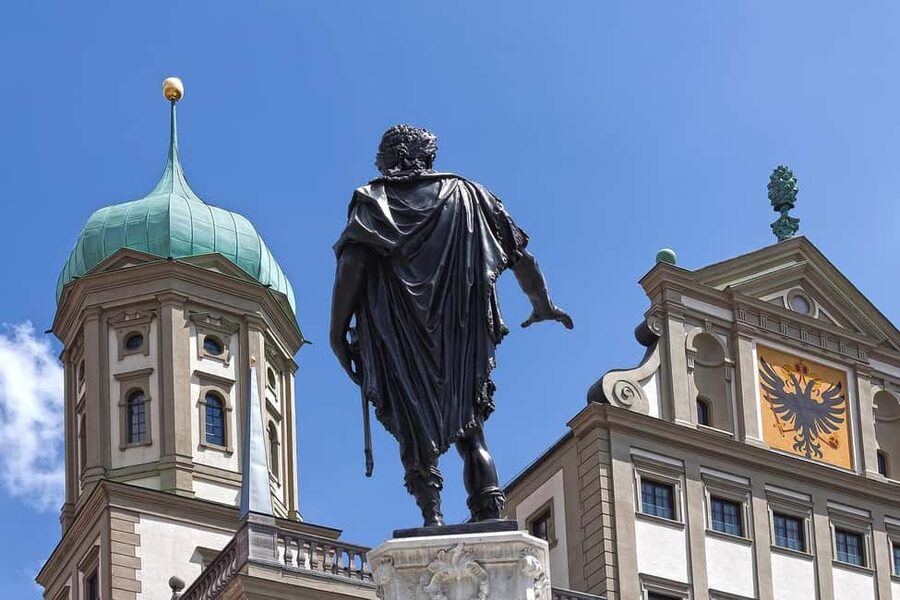
From the civic center, the walk turns toward Fugger Square and the story of the Fugger family. This is one of the most valuable parts of the route because the Fuggers give Augsburg a direct connection to European trade, finance, and power.
The family became one of Europe’s most powerful merchant dynasties. That description can sound abstract in a guidebook, but the square makes the subject more concrete. You are learning how private wealth shaped the city and how one family left its mark on Augsburg’s buildings and public life.
The tour appears to keep its historical explanations light rather than loading you down with dates. That approach suits a city walk. A review praised the guide’s relaxed presentation and the way the information was not overloaded with numbers. Another specifically appreciated the attention given to the Fuggers.
Guide Michael has been singled out by name in the feedback, with praise for his warm, authentic manner and personal connection to Augsburg. You should not assume every departure will be led by Michael, but his name is useful to know if he is listed for your date.
Fugger Square is also a good place to pause and connect the grand architecture with the people who paid for it. I prefer that kind of explanation to a quick statement that a family was wealthy. The important question is what that wealth changed, and this stop begins to answer it.
Little Venice and the quieter side of old Augsburg
The route next reaches Little Venice, a picturesque district with canals. This part of the walk changes the pace. After the formal square, tower, and merchant story, you get a more relaxed look at Augsburg’s waterways and older residential character.
The name points to the canals and the visual comparison with Venice, but you should keep your expectations sensible. This is a small Augsburg district, not a full-scale Italian cityscape. Its value is the contrast it provides and the chance to see how water fits into the city’s old layout.
This stop may also be one of the better places for photographs. Photography is allowed throughout the tour, and the canals offer a different backdrop from the heavy stone and formal facades around Rathausplatz.
Little Venice is especially helpful if your time in Augsburg is short. It shows you that the city is not only about celebrated interiors and famous families. It also has small-scale streets and waterside views that reward a slower walk.
Because the tour covers several parts of the center in 150 minutes, you should expect short explanations and movement rather than long periods at every stop. That is a fair trade for seeing a wide range of Augsburg landmarks in one morning.
Same streets, a different century:
- Leipzig: City History Canal Sightseeing Tour on a Motorboat
★ 4.7 · 7,671 reviews - Berlin: 3-Hour World Heritage Cruise to Potsdam
★ 4.5 · 1,569 reviews - Heidelberg: Night Watchman Historic Adventure Tour
★ 4.7 · 1,186 reviews - The Local Tour of Hamburg Historic Centre
★ 5.0 · 1,058 reviews
Brecht House and Augsburg’s literary connection
The walk continues to the Brecht House, the birthplace of playwright Bertolt Brecht. The house now serves as a museum devoted to his life and work.
You should see this stop as a link between the city’s older mercantile identity and its more modern cultural life. Brecht is one of Augsburg’s best-known literary figures, and visiting his birthplace gives the city a personal connection to a major German playwright.
The itinerary identifies the house as a stop, but it does not state that museum admission is included. The included admission specifically covers Augsburg Cathedral. If you want to enter the Brecht House, ask your guide about opening hours and ticket arrangements rather than assuming it forms part of the guided walk.
Even without a museum visit, the exterior and the explanation give you a useful new angle on Augsburg. I like tours that make room for artists as well as rulers and wealthy families. Brecht helps you see the city as a place of ideas, not only a collection of grand old buildings.
Leopold Mozart House and the family behind the music
The next major personal connection is the Leopold Mozart House. Leopold Mozart, father of Wolfgang Amadeus Mozart, was born in Augsburg, and the building is now a museum focused on the musical history of the Mozart family.
This is another stop where the personal detail improves the sightseeing. Instead of simply hearing Augsburg connected to Mozart, you get a specific place associated with his father and the family’s early story.
The museum offers a chance to explore that musical background in more detail, though museum admission is not listed among the inclusions. The tour’s value here is the introduction. If this subject catches your interest, you can return later for a longer visit, subject to opening hours.
The sequence from Brecht House to Leopold Mozart House works well. One stop brings in theatre and political writing, while the other brings in music and family history. Together they broaden your picture of Augsburg beyond architecture.
A review praised the tour for covering famous figures including the Fuggers, Mozart, Holbein, and Brecht. Holbein is not listed as a formal stop in the supplied route, so you should not expect a dedicated museum visit, but the broader cultural references appear to be part of the guide’s storytelling.
Augsburg Cathedral and the final architectural payoff
The final major stop is Augsburg Cathedral, or Dom. This is where the tour’s included entry matters. Unlike the optional-sounding museum visits, access to the cathedral is part of the experience.
The cathedral combines Romanesque and Gothic elements, giving you a chance to see how the building changed over time. The two details you should make a point of seeing are the 12th-century stained-glass windows and the detailed bronze door.
The stained glass is particularly important because it brings very old art into direct view. You do not need to be a specialist to appreciate the age and craftsmanship. Your guide can help explain what you are looking at, while the building itself provides a quiet change from the outdoor route.
The bronze door is another good detail to seek out rather than simply walking through. On a guided tour, small features like this are less likely to be missed.
The cathedral also gives the route a strong ending. You begin with civic power at the Rathaus, move through commercial power with the Fuggers, encounter artists and musicians, and finish in one of Augsburg’s major religious buildings.
The walk ends at Hofgarten. The finish is not back at Rathausplatz, so plan your next move from Hofgarten rather than assuming you will return to the meeting point. The supplied information does not specify onward transport or the exact final route, but Hofgarten is the stated endpoint.
What the $22 price really gets you
At $22 per person, this tour offers a solid introduction to central Augsburg. You get 150 minutes with a live guide, a route through several important districts, and admission to Augsburg Cathedral.
The value is strongest if you are new to Augsburg and want a clear first look at the city. A self-guided walk can show you the same streets, but it may not explain why the Fuggers matter, how the Mozart family connects to Augsburg, or why the town hall and cathedral belong in the same story.
The price is less compelling if you want long interior visits at multiple museums. The route identifies Brecht House and Leopold Mozart House, but only cathedral access is included. You may need separate tickets if you decide to go inside those museums.
The tour is also a good fit for visitors who prefer a broad overview to a narrow specialist subject. It covers civic architecture, trade, canals, literature, music, and religion in one walk. The tradeoff is that no single topic receives hours of attention.
The overall rating is 4.7 from 41 reviews, and the strongest praise focuses on the guide’s friendly manner, the relaxed storytelling, the interesting stops, and the useful introduction to Augsburg. One review specifically called the route about 5 kilometers, not too long or tiring. That gives you a practical sense of the pace, though the moderate walking requirement remains important.
Language, pace, and practical preparation
The tour is conducted in German. You should book it only if you can follow spoken German comfortably, or if someone in your group can translate as needed.
One piece of feedback points out that the guide was sometimes too quiet to hear everything. That is worth taking seriously. Arrive ready to stand near the guide, and ask politely if you miss a point. On a walking tour, street noise and the distance between the guide and the group can affect how much you catch.
Wear comfortable shoes. The route involves a moderate amount of walking and may cover roughly 5 kilometers. Bring water, a camera, and clothing suited to the weather.
The tour runs in weather other than rain or snow. It is not designed for wheelchair users or people with mobility impairments. Uneven streets, standing time, and the total walking distance make this a poor match if you need an accessible route.
Photography is allowed. Since the walk includes canals, major public buildings, and cathedral details, a camera is useful, but keep your attention on the guide as well. The best value comes from understanding what you are seeing, not only collecting pictures.
You can cancel up to 24 hours before the start for a full refund, and the reserve-now, pay-later option keeps your plans flexible. Those terms are helpful if your Augsburg visit depends on changing train or weather plans.
Who should book this Augsburg walk?
I would choose this tour if you have a half day in Augsburg and want the city explained in a sensible order. It suits first-time visitors, history fans who enjoy connections between people and places, and anyone who prefers walking to a bus-based sightseeing circuit.
It is particularly good for you if the Fuggers, the Mozart family, or Brecht interest you. The tour gives each of them a place in Augsburg’s story without turning the morning into a specialist lecture.
You should look elsewhere if you want an English-language guide, extensive museum time, or a fully accessible route. You may also prefer an independent walk if you want to set your own pace and spend an hour inside each museum.
For most visitors who can follow German and walk comfortably, $22 is a fair price for a 150-minute orientation. Book it early in your stay if possible. The landmarks and explanations can help you decide which museums or interiors deserve a second visit.
Should you book it?
Book this tour if you want Augsburg’s main sights tied together by people, money, art, and faith rather than presented as isolated monuments. The Rathaus and cathedral provide the big architecture, while the Fuggers, Brecht, and Leopold Mozart add the human stories that make the city easier to remember.
Skip it if German is a serious barrier, if rain or snow is expected, or if the 5-kilometer walk would be uncomfortable. For everyone else, this is a well-priced way to get your bearings, hear local stories, and leave Augsburg with a clear sense of why its old center matters.
FAQ
Where does the Augsburg walking tour begin?
The tour begins at 10:30 a.m. at Rathausplatz in Augsburg. Look for the yellow umbrella.
Where does the tour finish?
The walk finishes at Hofgarten.
How long does the tour last?
The tour lasts 150 minutes, or 2.5 hours.
What language is the tour conducted in?
The live tour guide conducts the experience in German.
Is Augsburg Cathedral admission included?
Yes. Access to Augsburg Cathedral is included, including the chance to see its Romanesque and Gothic features, 12th-century stained-glass windows, and detailed bronze door.
Is the tour suitable for wheelchair users?
No. The experience is not suitable for wheelchair users or people with mobility impairments. It involves a moderate amount of walking, so comfortable shoes are recommended.
Newest history tours we have reviewed in Germany
- Historic Dresden Private Walking Tour★ 5.0 · 32 reviews
- Walking Through Dresden’s Past with Dr. Fraser Macdonald★ 5.0 · 72 reviews
- Berlin Food & Cultural Tour: Must-Try German & Berliner Classics★ 5.0 · 51 reviews
- Small-Group Historical Bike Tour in Berlin★ 4.5 · 103 reviews
- Historic center of Berlin – Tour in Italian★ 5.0 · 143 reviews
- Private Tour: Jewish Heritage Walking Tour of Berlin★ 5.0 · 29 reviews
- East Berlin Food & History Tour with Eating Europe★ 5.0 · 204 reviews
- Private Berlin WWII and Cold War History Tour with Local Expert Guide★ 5.0 · 28 reviews
History Walking Tours, compared.

History and Hauntings of Salem Guided Walking Tour
Read our review →

Freedom Trail History Small Group Walking Tour
Read our review →
Historic Charleston Guided Sightseeing Walking Tour
Read our review →
Tapas Walking Tour with Food, Wine, and History
Read our review →
Savannah History and Haunts Candlelit Ghost Walking Tour
Read our review →
A History of Terror – Belfast City Centre Walking Tour
Read our review →Browse the lists this tour appears in