
Review · GERMANY HISTORY TOURS
Walking Through Dresden’s Past with Dr. Fraser Macdonald
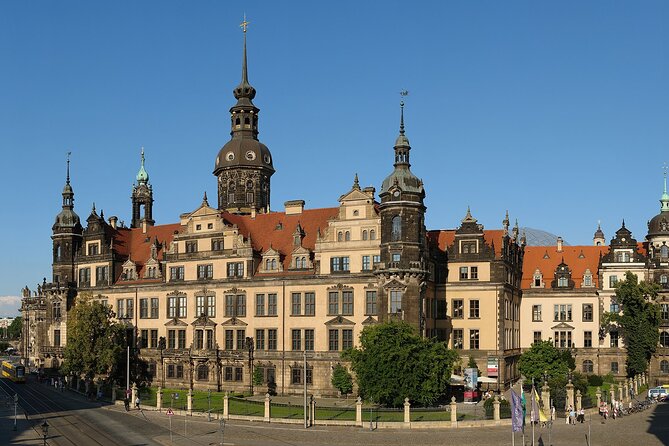
Dresden’s story is written in its streets, churches, ruins, rebuilt facades, and sudden changes in architectural style. Dr. Fraser Macdonald’s walk connects those pieces, beginning beside the Elbe and ending at Theaterplatz after crossing Augustus Bridge. It is a useful first look at a city that can otherwise feel like a set of beautiful but disconnected monuments.
I like the human scale of the route, which moves between famous sights and less obvious corners of Neustadt. I also like Fraser’s anthropological angle. He links buildings to the people, beliefs, political shifts, and cultural changes behind them. The main limitation is clear: this is an outdoor overview, not a museum tour, and the roughly two-hour schedule leaves only brief stops at each place.
Key points to know before you book
- A two-hour route across both sides of the Elbe: Start in Neustadt and finish in the Altstadt, covering about a mile at a manageable pace.
- Fraser Macdonald leads in English: His background in anthropology shapes the tour’s focus on people, culture, language, religion, and politics.
- The walk links major sights with lesser-known places: You see the Golden Rider area, Augustus Bridge, Frauenkirche, Holy Cross Church, Sophienkirche memorial space, and Dresden Castle.
- It is best taken early in your stay: The route helps you understand Dresden’s layout and gives you ideas for museums and sites to visit afterward.
- Indoor admissions are not included: Tower access at Dreikönigskirche, the Royal Palace, and the Museum of Saxon Folk Art cost extra.
- The group may reach 30 people: That is a useful detail to consider if you prefer a very small, highly personal walk.
Why this walk helps you understand Dresden
Dresden is easy to admire and surprisingly hard to read. The rebuilt Baroque center looks polished, yet the city also carries medieval foundations, Reformation-era upheaval, the marks of the Second World War, socialist rebuilding, and post-reunification restoration.
This tour gives you a timeline as you walk. Instead of seeing the Frauenkirche, Dresden Castle, and the churches as separate photo stops, you learn how they fit into the city’s rise from a small settlement to the seat of Saxon electors and kings.
Fraser’s approach also reaches beyond dates and royal names. The tour considers the people who first lived along the Elbe, the religious forces that changed Dresden, and the different political systems that left their mark on its buildings. That wider view is especially helpful if you want more than a list of construction dates.
The walk is offered in English, and the pace is designed for sightseeing rather than exercise. You cover a fair amount of ground, but the route is only about a mile according to the tour information, with time to stop, listen, look around, and ask questions.
More History Walking Tours in Germany
- Leipzig: 1.5-Hour Historical Walking Tour in German
★ 4.7 · 2,217 reviews - Berlin: History of the Third Reich Guided Walking Tour
★ 4.7 · 791 reviews - Trier: Guided Old Town Highlights and History Walking Tour
★ 4.7 · 687 reviews
Starting beside the Elbe at Köpckestraße
The meeting point is at the Golden Rider on Neustädter Markt, near Köpckestraße. This is a convenient place to begin because you are close to the river, public transport, and one of Dresden’s best-known monuments.
The opening stop looks at the first permanent settlement along the Elbe. Fraser uses the riverbank to discuss the people who lived here before Dresden became a royal and cultural center. You also consider their culture, language, and eventual displacement.
That opening gives the walk a useful moral and human frame. Dresden did not begin with palaces and grand churches. It began with communities and a place shaped by the river. The stop lasts about 15 minutes and costs nothing to enter because it takes place outdoors.
You should arrive ready for a standing discussion. There is no indoor shelter built into the stop, so good weather matters. The tour requires suitable weather and may be moved or canceled if conditions are poor.
A former monastery and royal hunting lodge
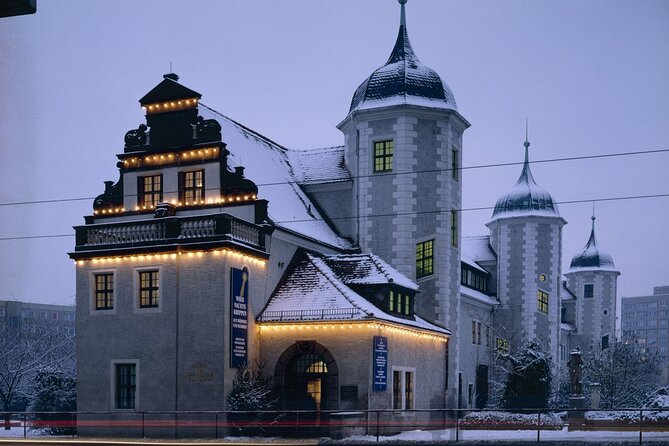
The next stop is the Museum für Sächsische Volkskunst mit Puppentheatersammlung. You do not enter the museum as part of the guided walk, but the site itself carries a remarkable sequence of changes.
It began in the 15th century as a wealthy Augustinian monastery. After Luther’s Reformation, the monastery was demolished and converted into a royal hunting lodge in the 16th century. That shift captures a major change in Dresden’s religious and political life: a religious foundation gave way to a space tied to court power and royal leisure.
This is the kind of stop that benefits from explanation. On your own, you might see a building or museum sign and move on. With Fraser, you get the earlier layers of the site before deciding if you want to return inside.
Museum admission is not included and is listed at €5. If you have a strong interest in folk art or puppet theater, you can plan a separate visit after the walk. The tour gives you the context, but not the museum’s full collection.
Dreikönigskirche and the story of Altendresden
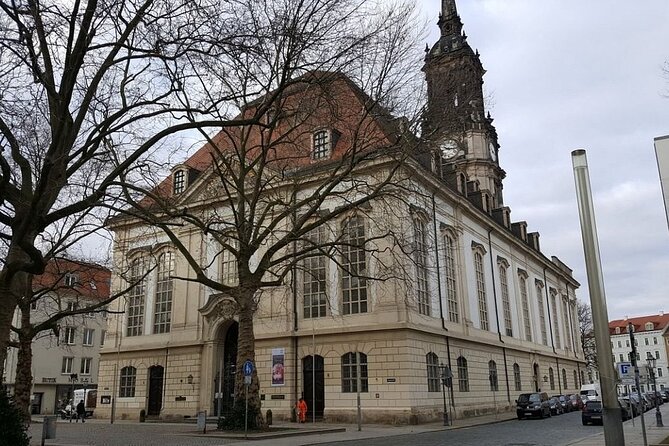
At Haus der Kirche, or Dreikönigskirche, the focus shifts to the former Altendresden. The church is now a striking Baroque building, but Fraser explains the longer story of this important site, beginning in the early 15th century.
This stop is useful because it shows how Dresden’s two historic sides developed. You begin in the Neustadt, then later cross Augustus Bridge into the Altstadt. The route is not simply a walk from one attraction to another. It shows how the city’s separate areas relate to one another.
The church interior and tower are not part of the guided visit. You can return independently, and tower access costs €5. If you want a broad city view, check the tower opening details before you go and allow extra time after the tour.
I would treat this as one of the tour’s practical strengths. Fraser provides enough background for you to decide which sites deserve a longer visit. You do not spend the whole morning inside one church when your main goal is to understand Dresden as a city.
Same streets, a different century:
- Leipzig: City History Canal Sightseeing Tour on a Motorboat
★ 4.7 · 7,671 reviews - Berlin: 3-Hour World Heritage Cruise to Potsdam
★ 4.5 · 1,569 reviews - Heidelberg: Night Watchman Historic Adventure Tour
★ 4.7 · 1,186 reviews - The Local Tour of Hamburg Historic Centre
★ 5.0 · 1,058 reviews
Crossing Augustus Bridge into the Altstadt
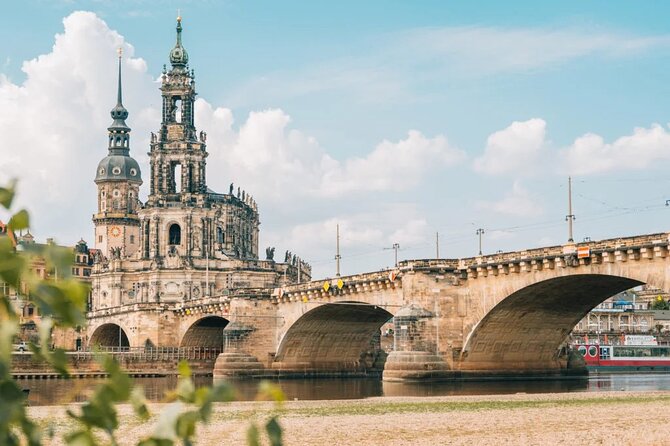
The walk then crosses Augustus Bridge, one of Dresden’s best-known connections between Neustadt and the historic center. The bridge gives you a natural pause between the two halves of the route and opens views toward the river and the city skyline.
This is also where the tour’s layout becomes especially clear. You have started with early settlement and the north-bank story. Now you enter the Altstadt, where the royal court, major churches, and central monuments tell a different part of Dresden’s past.
The bridge crossing is not a separate admission stop, but it adds real value to the route. You are not being driven between sights. You feel the city’s geography and see how the river shapes Dresden’s identity.
Frauenkirche, a 700-year story beneath the Baroque facade
The Frauenkirche is the most famous stop on the walk, but Fraser does not limit the discussion to its familiar dome and restored stonework. He covers roughly 700 years of history connected with the church and the changes it witnessed before the Baroque building took its final form.
The stop considers structural and religious changes over time. That matters because the Frauenkirche is often reduced to a symbol of wartime destruction and rebuilding. Its story began centuries earlier and reflects Dresden’s shifting place in religious and political life.
The guided portion takes about 20 minutes. Entry to the church and its museums is not included, although the main outdoor stop is free. If you want to go inside, plan that as a separate activity.
The timing here is sensible for a city introduction. You get enough background to understand the building, but the tour does not use up your entire visit at one landmark. You can return later when you have more time to look at the interior without holding up the group.
Holy Cross Church and Reformation-era Dresden
Holy Cross Church adds another religious layer to the walk. Its origins reach back to the 13th century, and its history includes repeated destruction and rebuilding. The church also witnessed important moments during the Reformation.
That repeated rebuilding is central to understanding Dresden. Churches here are not static monuments. Fire, war, religious change, and political shifts altered their form and use. Fraser uses the church to explain those changes rather than treating the facade as the whole story.
The stop lasts about 15 minutes and is free. It is a concise visit, so you should not expect a full architectural study or extended time inside. Instead, you get a clear explanation of why the church matters and how it fits into the larger story.
Denkraum Sophienkirche and a lost Dresden church
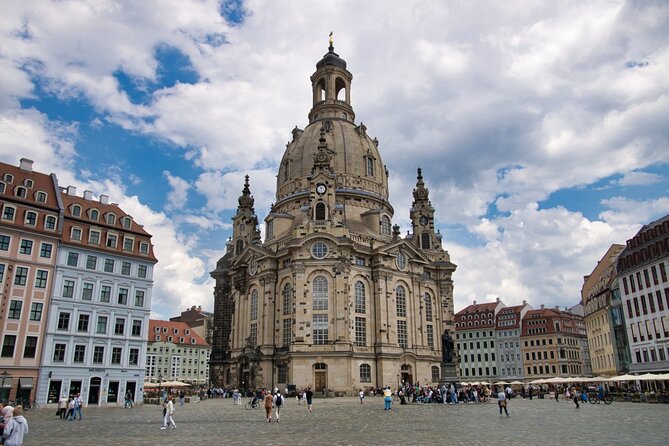
The Denkraum Sophienkirche offers one of the route’s most unusual stops. Fraser explains the first Franciscan monastery in Dresden, founded in the 13th century, and follows its later transformation into the Sophienkirche.
The church was eventually lost, but the site remains a powerful way to consider Dresden’s changing religious and political currents. Its story includes destruction, survival in altered form, and the memory of a building that no longer defines the city skyline.
This stop may appeal most to people who like places with visible absence. Famous landmarks are easy to find. A lost church asks you to picture what used to be there and think about the decisions that shaped what remains.
The stop lasts about 20 minutes and is free. It also helps balance the route. You see the grand, rebuilt center, but you also spend time with a site that points to what Dresden has lost.
Dresden Castle and the rise of Saxon power
The final guided stop is Dresden Castle, or Residenzschloss, near Theaterplatz. Here the story expands from individual churches to the city’s political rise.
Dresden began as a relatively small and less important city. The castle marks its transformation into a major center of the Holy Roman Empire and the residence of Saxony’s electors and kings. Fraser explains how the palace changed as the city and its rulers gained power.
The castle is also a useful final stop because it gathers several themes from the walk: court ambition, religious change, architectural rebuilding, and the political importance of Saxony. You finish with a clearer idea of why so many grand buildings were concentrated in Dresden.
The guided visit does not include entry to the palace or its museums. Admission is listed at €14, so add that cost if you want to continue indoors. The tour ends at Theaterplatz, leaving you close to the Zwinger, Semperoper, and the rest of the Altstadt.
What the guide adds to the walk
Fraser Macdonald’s strongest contribution is the way he ties architecture to human events. He explains Dresden’s older history, but he also addresses the Second World War bombing, the years under GDR rule, and the visible differences between prewar, postwar, socialist, and reunified construction.
That modern context is important. Dresden can look like a restored Baroque city, yet the urban fabric includes several very different periods. Fraser helps you notice those changes rather than seeing every building as part of one uniform old town.
His anthropology background also suits the subject. The emphasis is not only on rulers and architects. You hear about culture, language, religion, displacement, and the way modern Dresden differs from other parts of Germany.
The tour’s personal tone is another plus. The route is structured, but there is room for questions and conversation. The guide has also been praised for a friendly manner, clear communication, humor, and a willingness to suggest museums and other places to visit. That can be valuable if Dresden is one stop in a longer Germany trip.
Price, group size, and what you get
The tour costs $60.34 per person for about two hours. That is not the cheapest way to walk through Dresden, since the main sights can be seen from public streets without a ticket.
The value comes from the explanation and route design. You are paying for a guide who links the city’s medieval beginnings, religious changes, royal growth, war damage, GDR period, and rebuilding in one coherent walk. If you are visiting for only a short time, that structure can save you from wandering between disconnected landmarks.
The group can include up to 30 people, so do not book expecting a private walk. Some departures may feel quite personal, but the maximum is large enough that hearing every comment clearly could depend on where you stand.
Extra costs are modest but worth noting. The Museum für Sächsische Volkskunst is listed at €5, the Dreikönigskirche tower at €5, and Dresden Castle at €14. None is required for the walking tour, and you can choose only the sites that fit your interests and schedule.
Confirmation arrives when you book, service animals are allowed, and most people can take part. The tour is near public transportation. You can cancel for a full refund up to 24 hours before the start time. If bad weather or too few bookings causes cancellation, you are offered another date or a refund.
Who should book it
I would choose this walk at the start of a Dresden visit. It gives you a physical map of the city and helps you decide how to spend the rest of your day. It is especially well suited to first-time visitors, history fans, architecture students, and anyone curious about the difference between old, rebuilt, socialist, and modern Dresden.
It also works well if you have only a short stay. The route covers major sights without demanding a full day, and it ends in a part of town where you can continue on your own.
You may want something else if your main goal is extended interior time. You do not tour the museums, climb the church tower, or enter the castle as part of the guided experience. You should also consider the weather and the possible 30-person group size.
Should you book Walking Through Dresden’s Past?
Book it if you want Dresden explained as a living city rather than a collection of famous facades. Fraser’s route is short, focused, and unusually attentive to religion, displacement, political change, and the city’s less visible past.
Skip it if you already know Dresden well or want a private tour with long indoor visits. For most first-time visitors, though, the walk offers a useful foundation, a sensible route, and enough free time afterward to explore the Zwinger, Semperoper, castle, museums, or churches that catch your interest.
FAQ
Where does the Dresden walking tour begin?
The tour begins at the Golden Rider, Neustädter Markt 14, 01097 Dresden, Germany.
Where does the tour end?
It ends at Theaterplatz in the Altstadt, near the Zwinger, Semperoper, and other central sights.
How long does the tour last?
The tour lasts approximately two hours.
What language is the tour offered in?
The tour is offered in English.
Is admission to the museums and churches included?
No. The guided experience does not include entry to Dreikönigskirche, the Museum für Sächsische Volkskunst, or Dresden Castle. You may visit them independently.
How much do the optional admissions cost?
The Dreikönigskirche tower costs €5, the Museum für Sächsische Volkskunst costs €5, and Dresden Castle admission costs €14.
Does the tour enter the Frauenkirche?
The tour stops at the Frauenkirche, but entry to the building and its museums is not part of the guided experience.
How many people can join the tour?
The maximum group size is 30 people.
Can I cancel for a refund?
You can cancel at least 24 hours before the start time for a full refund. Changes or cancellations made less than 24 hours before the start time are not accepted for a refund.
Newest history tours we have reviewed in Germany
- Historic Dresden Private Walking Tour★ 5.0 · 32 reviews
- Berlin Food & Cultural Tour: Must-Try German & Berliner Classics★ 5.0 · 51 reviews
- Historic center of Berlin – Tour in Italian★ 5.0 · 143 reviews
- Private Tour: Jewish Heritage Walking Tour of Berlin★ 5.0 · 29 reviews
- Small-Group Historical Bike Tour in Berlin★ 4.5 · 103 reviews
- East Berlin Food & History Tour with Eating Europe★ 5.0 · 204 reviews
- Private Berlin WWII and Cold War History Tour with Local Expert Guide★ 5.0 · 28 reviews
- Berlin: Private Bike Tour of the Berlin Wall and Third Reich★ 5.0 · 23 reviews
History Walking Tours, compared.
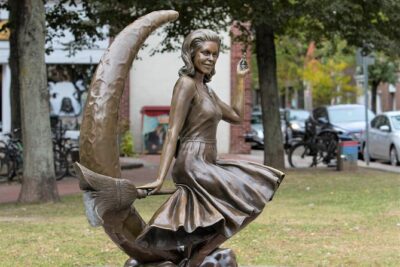
History and Hauntings of Salem Guided Walking Tour
Read our review →
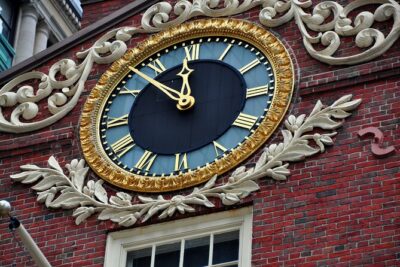
Freedom Trail History Small Group Walking Tour
Read our review →
Historic Charleston Guided Sightseeing Walking Tour
Read our review →
Tapas Walking Tour with Food, Wine, and History
Read our review →
Savannah History and Haunts Candlelit Ghost Walking Tour
Read our review →
A History of Terror – Belfast City Centre Walking Tour
Read our review →Browse the lists this tour appears in