

Review · BERLIN HISTORY TOURS
Explore Berlin History and Highlights Sightseeing Walking Tour
Berlin’s past is written into its streets, and this tour reads those pages in order. In three and a half hours, you move from Prussian power at Brandenburg Gate to the Nazi era, the Berlin Wall years, and the reunified city around Museum Island. The route is packed, but it gives you a useful first map of central Berlin.
I like the small group limit of 15, which leaves room for questions and makes it easier to hear the guide. I also like the range: you see famous places such as the Reichstag and Checkpoint Charlie, but you also stop at the former Luftwaffe headquarters, the site of the Führerbunker, and the memorial beneath Bebelplatz. The main drawback is simple: this is a serious 3.5-hour walk, not a quick photo outing. Anyone with limited walking ability should think carefully before booking.
Key points to know before you book
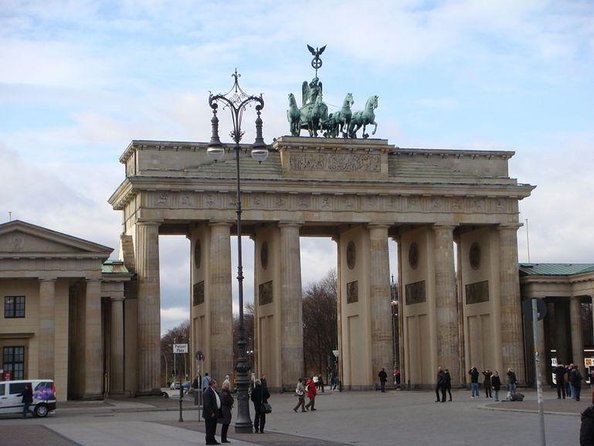
- A full central Berlin route: The tour connects 11 major sites, ending on Museum Island after covering Prussian, Nazi, Cold War, and modern history.
- Small groups matter: A maximum of 15 people allows a more personal pace and time for questions.
- Strong guide-led storytelling: Guides such as Aurel, Cairan, Eugen, Rhys, Steve, Paul, and Aaron are praised for clear explanations, humor, and personal connection.
- No admission tickets are needed: Every stop is visited from public areas, with the guide providing the context on site.
- A genuine walking tour: The start is at Wurst 🙂 am Brandenburger Tor at 10:00 a.m., and the finish is on Museum Island.
- Good value at $32.58: For a long guided introduction to Berlin’s central sights, the price is reasonable, especially if this is your first visit.
Why this route works for a first look at Berlin
Berlin can feel confusing at first. Its landmarks are spread across a large central area, and the city’s story does not fit neatly into one museum. A Prussian square may sit a few minutes from a Nazi-era site, while a Cold War checkpoint appears beside modern shops and traffic.
This walk helps you connect those pieces. You are not simply collecting photos of famous buildings. You are moving through the city in a rough historical sequence, with the guide explaining how Berlin changed from royal capital to imperial center, Nazi headquarters, divided Cold War city, and reunited German capital.
That order is one of the tour’s best features. Steve, for example, is praised for explaining Prussia and Berlin in chronological order. Aurel is noted for linking architecture with the reasons buildings were built, damaged, and rebuilt. Those details help you see why Berlin often feels like several cities placed on top of one another.
The route also gives you a useful orientation for later exploring. One guide reportedly offered advice about using public transport after the tour, while another used photographs on an iPad to clarify places that have changed. That kind of practical context can save you time during the rest of your stay.
More History Walking Tours in Berlin
- Berlin: History of the Third Reich Guided Walking Tour
★ 4.7 · 791 reviews - Berlin Historical Highlights Walking Tour
★ 4.9 · 657 reviews - Berlin Private Complete History All Day Walking Tour
★ 5.0 · 474 reviews
Brandenburg Gate and the Reichstag: Berlin’s political front door
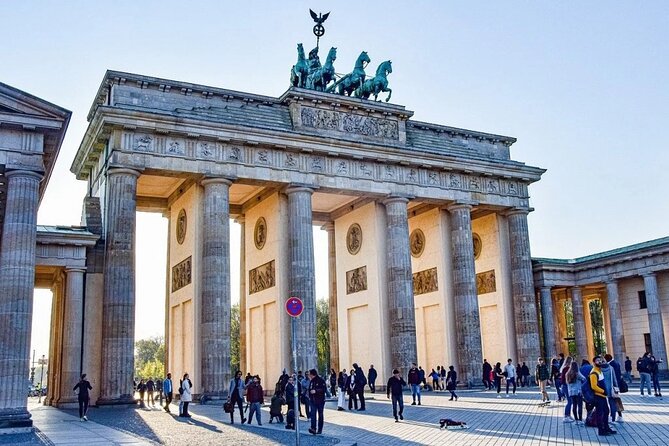
The meeting point is beside Brandenburg Gate, at Wurst 🙂 am Brandenburger Tor, where the tour begins at 10:00 a.m. Allow a little time to find the exact corner of Ebertstraße and Scheidemannstraße, especially if you are relying on a phone map.
The gate is a natural starting point because it has witnessed many of Berlin’s defining moments. Your guide explains its place in the city’s political story and why it became one of Germany’s most recognizable symbols. You have about 20 minutes here, enough for an explanation and photographs without turning the stop into a long architectural lecture.
For the clearest photos, arriving before 10:00 a.m. or later in the day can help avoid the heaviest crowds around the gate. The tour itself begins at the busiest part of the morning, so the setting may not be quiet.
Next comes the Reichstag Building, another 20-minute stop. The guide covers its role as the parliament of imperial Germany, the fire shortly after Hitler became chancellor, and the building’s importance during the Soviet capture of Berlin at the end of the Second World War.
This is an exterior history stop rather than a listed interior visit. The tour gives you the building’s political context, but you should not book it expecting a dome visit or a guided trip inside the parliament.
Holocaust Memorial and the Führerbunker site
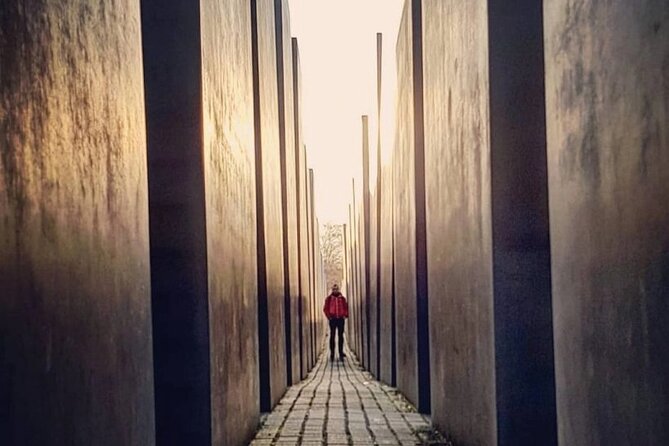
The Memorial to the Murdered Jews of Europe is one of the most affecting stops on the route. You have about 15 minutes to consider the field of concrete blocks and hear how the memorial came to be built in central Berlin.
The guide also explains the crimes the memorial addresses. That context matters, since the site can otherwise seem abstract or difficult to interpret. The stop is brief, so it cannot replace a museum visit, but it gives you a respectful starting point for understanding the memorial and the Nazi persecution it represents.
A short walk brings you to the site of the Führerbunker, now beneath an unremarkable car park. The contrast is striking. One of the most notorious locations in twentieth-century history is marked not by a grand monument, but by an ordinary modern setting.
You spend about 15 minutes here learning about the bunker’s location within the former gardens of the New Reich Chancellery and the final days of Hitler’s rule. The guide’s role is especially useful because little visible remains. Without explanation, you could easily pass by without realizing what was beneath the ground.
This part of the tour is not light sightseeing. The subject matter includes dictatorship, mass murder, and war. The guides are praised for adding humor at suitable moments, but this section calls for a serious tone, and the route generally treats it that way.
Former Nazi headquarters and the Topography of Terror
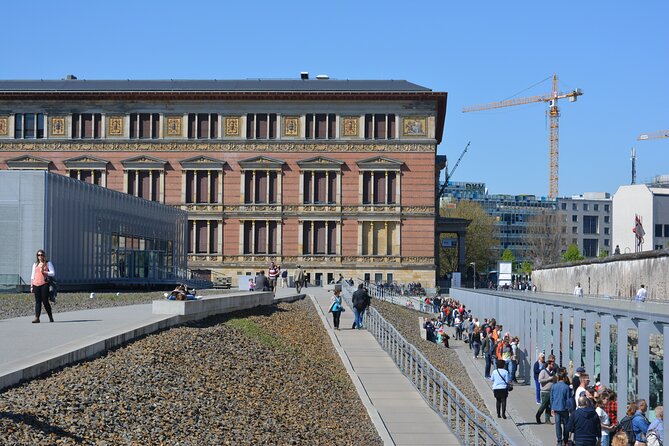
The next stop is the building now used by Germany’s Finance Ministry. Its earlier role was as the headquarters of the Luftwaffe, and the guide discusses both its construction and its later Cold War importance.
This is a good example of what the tour does best. The building is not always at the top of a first-time visitor’s list, yet its history helps explain how government power operated across different periods. You see how one structure can pass through imperial, Nazi, postwar, and modern uses.
At the Topography of Terror, you spend around 20 minutes at the former headquarters of the SS, Gestapo, and SD. The guide explains the Nazi institutions connected with the site and the later effort to create a memorial and documentation center there.
The stop adds depth to the earlier memorial and bunker visits. Instead of focusing only on famous leaders and major buildings, it points you toward the machinery of persecution. It also introduces the question of how postwar Berlin chose to mark places tied to Nazi crimes.
If you want a longer visit to the Topography of Terror exhibition, plan to return independently. The walking tour gives you an introduction from outside and around the site, not an extended museum session.
More History Walking Tours in Germany
- Berlin: Charité Hospital Walking Tour of Medical History
★ 4.9 · 276 reviews - Berlin Private Half-Day Walking Tour: Discover the German Capital’s History
★ 5.0 · 244 reviews - Berlin History Walking Tour with a French-Speaking Guide
★ 5.0 · 240 reviews - The History of Berlin: WWII PRIVATE Walking Tour With Locals
★ 5.0 · 209 reviews
Checkpoint Charlie and the complicated Cold War story
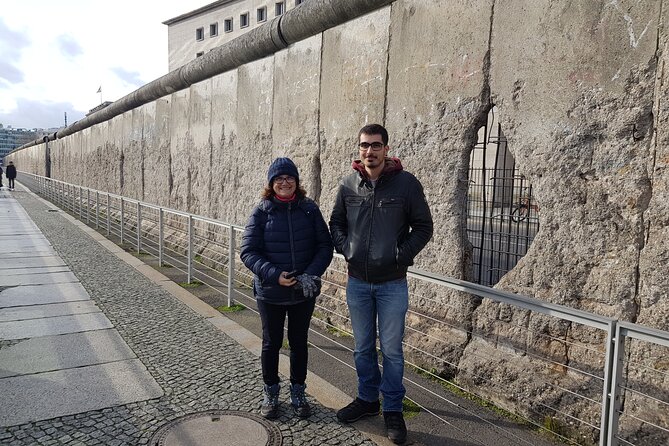
Checkpoint Charlie is one of Berlin’s best-known Cold War locations, and the tour spends about 20 minutes here. The guide places the checkpoint within the larger story of divided Berlin and the border between East and West.
The site today is busy with visitors, traffic, and commercial activity. That can make it feel more like a photo stop than a preserved historical scene. A guide helps correct that impression by explaining what the checkpoint represented and how Berlin’s division shaped everyday life.
This is also a useful point to ask questions. Several guides are praised for being patient and willing to explain topics in detail. Cairan, in particular, is described as encouraging questions and connecting the site to wider German and world history.
The Cold War section is one reason this tour works well for people who know the Nazi period but are less familiar with what happened after 1945. The route does not treat reunification as an isolated happy ending. It connects the division of Berlin to the city you see now.
Gendarmenmarkt and Bebelplatz: Berlin’s Prussian face
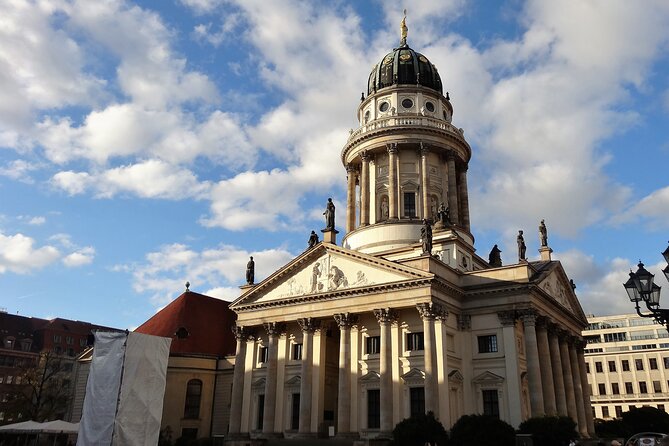
Gendarmenmarkt changes the mood. After the difficult subjects of the twentieth century, you reach one of central Berlin’s grandest architectural squares. The tour spends about 15 minutes explaining how the square developed and how its eighteenth and nineteenth-century buildings fit into the growth of Prussian Berlin.
This is a useful reminder that Berlin was a royal and imperial capital long before it became a symbol of dictatorship and division. The architecture gives you a clearer sense of the city’s earlier ambitions.
Bebelplatz offers another strong contrast. The square is surrounded by impressive buildings from the era of Frederick the Great, and the guide explains why those institutions were built. You also see the memorial connected with the Nazi book burning of 1933.
The memorial is easy to miss if you are not looking for it. Its quiet design works differently from a large monument, and the guide’s explanation gives the small feature its full meaning. You learn not only what happened, but why this square became associated with an attack on books, ideas, and public life.
The 15-minute stop is enough for the main story, though readers with a special interest in Prussian architecture or Nazi cultural policy may want to return later.
Unter den Linden and the route toward Museum Island
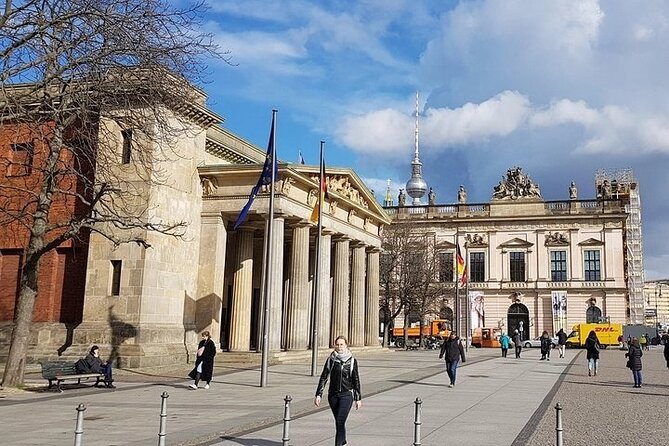
The walk continues along the eastern end of Unter den Linden, Berlin’s famous boulevard. You visit or discuss Humboldt University, the Memorial to the Victims of War and Tyranny, and the German History Museum.
This section helps tie together the city’s intellectual, military, and political identities. Humboldt University points to Berlin’s role as a center of learning. The memorial raises questions about how Germany remembers war and suffering. The German History Museum provides a link to the wider national story.
You spend about 20 minutes along this stretch, so expect a moving outdoor explanation rather than entry into each institution. That is important when planning your day. The tour gives you a map and a reason to visit, but it does not replace time inside Berlin’s museums.
The boulevard is also one of the easier places to understand Berlin’s scale. You are no longer seeing isolated monuments. You are walking through a broad urban axis that connects royal Berlin, the former East German center, and Museum Island.
Museum Island and the view toward Alexanderplatz
The final stop is Museum Island, reached after crossing into what was medieval Berlin. The guide discusses the former city palace, Berlin Cathedral, and the group of five major museums on the island.
You finish on the eastern side of Museum Island, looking toward Alexanderplatz and the center of postwar East Berlin. That ending is well chosen. It brings the story forward from medieval origins and royal power to the socialist city built after the war.
You have about 20 minutes here, enough to identify the main buildings and understand how the island fits into Berlin’s development. If you plan to visit one of the museums, this is a handy place to continue your day. The tour itself does not include museum admission.
The endpoint also works well for onward sightseeing, though no specific transport service is included. You can use the finish to plan a museum visit, explore the cathedral area, or continue toward Alexanderplatz.
What the $32.58 price gets you
At $32.58 per person, the tour offers solid value if you want a guided introduction rather than a series of unconnected photo stops. The price covers an expert guide and a route lasting about three and a half hours. You do not pay separate admission fees for the listed stops.
That value comes from interpretation, not access to interiors. If you mainly want to enter the Reichstag dome, museums, or other buildings, this is not the right product by itself. If you want someone to explain what you are seeing while you walk between the major sites, the cost is modest.
The maximum group size of 15 is another important part of the value. Some groups have been much smaller, including one reported private-feeling outing with only three people and another where the guide was able to tailor the pace. A small group does not guarantee a private tour, but it gives you a better chance to hear clearly and ask questions.
Guides named in the feedback include Aurel, Cairan, Eugen, Rhys, Steve, Paul, Aaron, and Kieran. The strongest praise centers on clear historical explanation, enthusiasm, patience, humor, and the ability to connect personal stories with major events. Kieran, for example, used family photographs related to East Berlin to make the divided city feel more personal.
Who should book, and who should choose another format
I would recommend this walk to a first-time Berlin visitor who wants the main central sights explained in one morning. It suits history-minded adults, families with older children, and anyone who prefers a human guide over an audio app.
It is also useful for English speakers who want a clear introduction to German history. Several guides are described as easy to understand, and one review specifically notes that the tour worked well for a family member with only basic English.
You should think twice if walking for three and a half hours is difficult. One person missed the tour after realizing too late that it was entirely on foot. The description is clear that this is a walking tour, and most participants can take part, but that does not make the route easy for everyone.
The subject matter may also feel heavy. The tour covers Nazi crimes, the Holocaust, war, dictatorship, and the Berlin division. You get architecture and beautiful squares too, but this is not a light sightseeing loop.
Booking is flexible up to 24 hours before the start time for a full refund. Changes or cancellations inside that 24-hour window are not accepted, based on local time. Service animals are allowed, and the meeting point is near public transportation.
Final call: a strong Berlin orientation with one clear warning
Book this tour if you want Berlin’s major landmarks placed into a single understandable story. The combination of Brandenburg Gate, the Reichstag, the Holocaust Memorial, the Führerbunker site, Checkpoint Charlie, Gendarmenmarkt, and Museum Island gives you a useful first framework for the city.
I especially like the small-group format and the range of guide styles. Aurel, Cairan, Eugen, Rhys, Steve, Paul, Aaron, and Kieran are repeatedly praised for making difficult subjects clear and personal. Just bring comfortable shoes, allow the full three and a half hours, and remember that you are booking a serious walking history lesson, not an interior tour of Berlin’s museums and government buildings.
FAQ
How long does the Berlin history walking tour last?
The tour lasts approximately 3 hours and 30 minutes.
What time does the tour begin?
The tour starts at 10:00 a.m.
Where does the tour meet?
The meeting point is Wurst 🙂 am Brandenburger Tor, at Ebertstraße and Scheidemannstraße, 10117 Berlin, Germany.
Where does the tour finish?
The tour ends on Museum Island in Berlin.
How many people can join the tour?
The group has a maximum of 15 participants.
Is this an English-language tour?
Yes. The tour is offered in English.
Are admission tickets included?
The listed stops have no admission charge as part of the walking route. The tour includes an expert guide, but it does not include entry to museums or interior visits that are not listed.
Can I cancel for a full refund?
Yes. You can cancel at least 24 hours before the start time for a full refund. Cancellations or changes made less than 24 hours before the start time are not accepted for a refund.
Newest history tours we have reviewed in Berlin
- Berlin Food & Cultural Tour: Must-Try German & Berliner Classics★ 5.0 · 51 reviews
- Private Tour: Jewish Heritage Walking Tour of Berlin★ 5.0 · 29 reviews
- Small-Group Historical Bike Tour in Berlin★ 4.5 · 103 reviews
- Historic center of Berlin – Tour in Italian★ 5.0 · 143 reviews
- East Berlin Food & History Tour with Eating Europe★ 5.0 · 204 reviews
- Private Berlin WWII and Cold War History Tour with Local Expert Guide★ 5.0 · 28 reviews
- Berlin: Private Bike Tour of the Berlin Wall and Third Reich★ 5.0 · 23 reviews
- Where It All Began: Berlin’s Queer & Trans History Tour★ 5.0 · 27 reviews
History Walking Tours, compared.
History and Hauntings of Salem Guided Walking Tour
Read our review →

Freedom Trail History Small Group Walking Tour
Read our review →
Historic Charleston Guided Sightseeing Walking Tour
Read our review →
Tapas Walking Tour with Food, Wine, and History
Read our review →
Savannah History and Haunts Candlelit Ghost Walking Tour
Read our review →
A History of Terror – Belfast City Centre Walking Tour
Read our review →Browse the lists this tour appears in