
Review · BERLIN HISTORY TOURS
Where It All Began: Berlin’s Queer & Trans History Tour
Berlin’s queer past is not tucked away in one museum. It is written into street names, former bars, club doors, memorials, and ordinary corners of Schöneberg. This walking tour connects those places, from Karl Heinrich Ulrichs and Magnus Hirschfeld to Cabaret, trans nightlife, AIDS activism, and today’s fight to protect queer spaces.
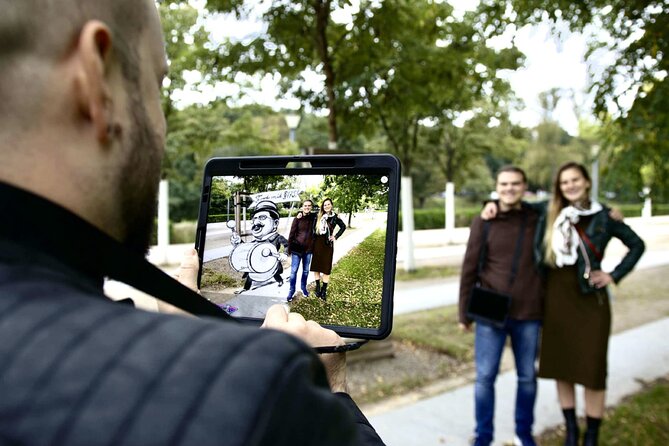
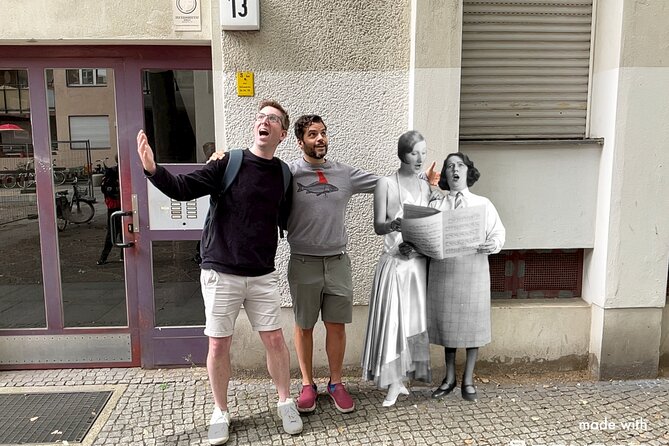
I like the small group of no more than 10 and the supplied iPad, which brings old photographs and videos into the streets where the events took place. I also like the way the tour covers lesbian, gay, bisexual, and trans lives rather than treating Berlin’s past as only a story of gay men. The main consideration is the price, $83.13 per person, and the serious subject matter, which may feel demanding during a 3.5-hour walk.
Key points to know before you book
- The tour moves through real queer landmarks: You visit sites linked to Magnus Hirschfeld, Christopher Isherwood, Eldorado, SchwuZ, Chez Romy Haag, and Berlin’s modern club scene.
- AR adds a useful visual layer: The iPad can show archival photographs and videos over the present-day streets, along with personalized group images called Mixies.
- The history is broad: Topics include lesbian cabaret, Nazi persecution, trans life in East and West Berlin, the AIDS crisis, Pride, fetish culture, and gentrification.
- The group stays intimate: A maximum of 10 people makes it easier to see the screen and ask questions.
- The guide matters: The tour is led by a queer activist and gender scholar. Jeff, named in the tour information, uses photos, videos, and an engaging presentation style.
- Plan for a walking afternoon: It starts at 2 p.m. near Alnatura Super Natur Markt and ends at Metropol on Nollendorfplatz.
Berlin’s queer story begins on an ordinary street
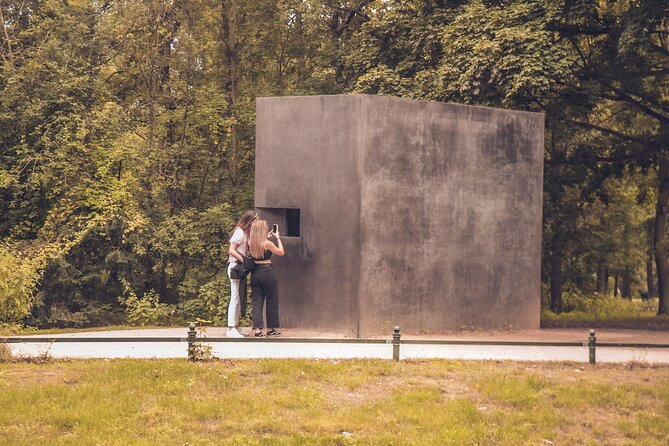
The meeting point is at Alnatura Super Natur Markt, Else-Lasker-Schüler-Straße 18, in the Schöneberg area. The first stop is only a short introduction at Karl-Heinrich-Ulrichs-Straße 1, but it gives the rest of the afternoon a clear starting point.
Karl Heinrich Ulrichs was one of the first people to publicly argue that same-sex relationships should not be criminalized. He developed language for queer identities before the modern word homosexual was in common use. Seeing his name on a Berlin street makes the history feel less abstract. You are not beginning with a distant date in a textbook, but with a person whose ideas helped shape later LGBTQIA+ rights movements.
That opening also sets the tone. This is not simply a tour of famous bars. It asks how queer people named themselves, found one another, created meeting places, and resisted laws that treated their lives as crimes.
More History Tours in Berlin:
- Berlin: 3-Hour World Heritage Cruise to Potsdam
★ 4.5 · 1,569 reviews - Berlin: History of the Third Reich Guided Walking Tour
★ 4.7 · 791 reviews - Berlin: Berlin Charité Guided History Tour
★ 4.4 · 660 reviews
Nollendorfplatz and the danger of the Nazi period
Nollendorfplatz is one of the central places in Berlin’s queer story. Here, the tour turns from early activism to the conflict and contradictions of the Nazi era.
You hear about Adolf Brand, right-wing gay activists, and Ernst Röhm, an openly gay Nazi leader. Röhm’s story is especially difficult because it shows that sexual identity did not automatically produce political solidarity. He and other queer people within the Nazi party were killed during the Night of the Long Knives, even as the regime went on to persecute LGBTQIA+ people more broadly.
The discussion then moves to the pink triangle used to identify gay men in concentration camps and to the people who resisted persecution. This is a serious section, and the guide’s job is important. The material needs care, context, and room for questions, rather than quick shocking facts.
For me, this is one of the tour’s most valuable stops because it avoids a simple story of progress. Berlin could offer unusual freedom in one period and terrible repression in another. The same city held queer clubs, police files, political activism, and state violence.
Lesbian bars, cabaret, and the sound of 1920s Berlin
At Schwerinstraße 13, the focus shifts to lesbian life. The site was once associated with Toppkeller, a lesbian bar that offered queer women a place to meet and form community.
The tour also brings in Claire Waldoff, a lesbian cabaret singer whose songs became linked with defiance. This matters because queer history is not only made through court cases and political organizations. It also lives in music, performance, humor, and the ability to take up public space.
Josephine Baker adds another layer. The tour discusses her as a bisexual performer and sex symbol for people of different genders. Her presence helps widen the story beyond a narrow Berlin-only account, while still showing how the city’s entertainment scene gave queer audiences and performers room to test social rules.
This stop should appeal to you if you enjoy cultural history. It shows what daily life could look like when clubs and cabarets offered more freedom than respectable public life. The limitation is that you are visiting former sites, not entering a preserved lesbian bar. The iPad’s old images are therefore important, since the physical setting alone may not reveal what stood there.
Isherwood, Cabaret, and queer life under surveillance
At Nollendorfstraße 17, the tour explores a striking contradiction: Berlin had a homosexual department within its police force. That detail opens a discussion about how the state watched queer people even while queer nightlife and social life flourished.
You also hear about gay male life in the 1920s and Christopher Isherwood’s time in Berlin. His writing helped inspire Cabaret, but the tour places his work in a more personal setting by discussing his relationship with Heinz Neddermeyer and their escape from Nazi Germany as queer refugees.
This makes the stop more useful than a simple film connection. You are not just standing where a musical was inspired. You are looking at how literature, memory, and real danger became mixed together. The familiar Cabaret image of Weimar Berlin can seem glamorous from a distance, but this tour points out the police files, political threats, and fragile nature of that freedom.
The AR material should be especially helpful here. A historical photograph shown beside the present-day street can make the gap between the old neighborhood and the modern city easier to understand.
Same streets, a different century:
- Berlin Historical Highlights Walking Tour
★ 4.9 · 657 reviews - Berlin Private Complete History All Day Walking Tour
★ 5.0 · 474 reviews - Berlin: Cold War & Berlin Wall History Guided Bike Tour
★ 4.8 · 422 reviews - Berlin: Historic Boat Sightseeing City Center Tour
★ 4.5 · 415 reviews
Magnus Hirschfeld’s lost Institute for Sexual Science
The stop near Magnus-Apotheke is the intellectual center of the tour. Magnus Hirschfeld helped create the Scientific-Humanitarian Committee, described here as the first organization devoted to queer rights and gender studies.
His Institute for Sexual Science examined sexuality and gender at a time when many doctors and politicians treated queer people as problems to be corrected. The tour explains his ideas about sexual intermediaries and Berlin’s so-called third gender, along with the institute’s work against Paragraph 175, the law that criminalized sex between men.
You also learn about early gender-affirming surgeries connected with Dora Richter, Lili Elbe, and Karl M. Baer. These stories need careful explanation, since medical language and ideas have changed over time. The value of this stop is that it presents trans history as part of Berlin’s early LGBTQIA+ rights movement, not as a recent addition.
The Nazi destruction of the institute was a major loss of records, research, and personal material. That loss explains why the archival images on the iPad are more than a fun extra. They help rebuild a record that was deliberately attacked.
Eldorado and the contradictions of queer nightlife
Today, Denns BioMarkt occupies the former site of Eldorado, one of Berlin’s best-known drag bars of the 1920s. Eldorado attracted drag performers, gender-nonconforming people, and queer nightlife crowds.
The site also carries one of the tour’s strangest contradictions. Ernst Röhm, later associated with Nazi persecution, was among the high-profile figures who visited the club. His presence shows that people could participate in queer nightlife while supporting politics that endangered other queer people.
This is a good place to consider what a bar can and cannot do. Eldorado offered visibility and social connection, but it did not erase class, political, or personal differences. A club can be liberating for one person and unsafe for another, depending on the wider political climate.
The present-day supermarket makes the old club easy to miss. That is precisely why the guide’s archival material helps. The iPad can place a historical image over the current address and let you see the former building as part of the modern street.
Post-war activism and Charlotte von Mahlsdorf
At Prinz Eisenherz, the story moves into the years after World War II. The tour covers Homosexuelle Aktion West-Berlin, an early post-war queer rights organization, and SchwuZ, one of Berlin’s major queer clubs.
This section shows that liberation did not arrive simply because the Nazi regime ended. Queer people still had to organize, build meeting spaces, and fight laws and social attitudes that remained in place.
Charlotte von Mahlsdorf gives the stop a strong personal focus. A trans woman in East Berlin, she preserved queer history and created safe spaces for the community. Her story is especially useful because it complicates the usual division between West Berlin as free and East Berlin as repressive. Life on both sides of the city had limits, opportunities, and people who worked to make room for others.
Chez Romy Haag and the trans club revolution
At Connection, the tour looks at the trans community in West Berlin during the 1970s and 1980s. The main story is Chez Romy Haag, a trans-led nightclub that changed the city’s nightlife.
A club like this was not only an entertainment venue. It gave gender-diverse people a place to appear in public on their own terms. The tour links that earlier club culture with Berlin’s present reputation for queer nightlife.
This is one of the stops where the guide’s personal and academic background can add real value. A queer activist and gender scholar can explain why a trans-led venue mattered beyond its celebrity appeal or nightlife reputation.
The location itself may not look like a historic attraction, so set your expectations accordingly. You are learning through the story, the images, and the guide’s explanation rather than visiting a preserved interior.
AIDS, divided Berlin, and political action
At the Internationale Stele GEGEN DAS VERGESSEN, the tour addresses the AIDS crisis and the different conditions in East and West Berlin. The focus is not only on loss, but also on the community’s organizing and practical fight for survival.
Rita Süssmuth is discussed as one of the politicians who supported AIDS awareness. The tour also explains the darkly ironic phrase that described the Berlin Wall as the condom of the GDR, pointing to differences in how East and West Berlin handled the crisis.
This section gives the tour a needed political edge. Public health policy, sexual education, stigma, and access to information all shaped queer lives. You may find this part emotionally heavy, but it connects earlier struggles with questions that still matter.
Metropol, club culture, and Berlin’s present-day fight
The final stop is Metropol at Nollendorfplatz 5. It connects the club’s earlier role in gay life and techno culture with Berlin institutions such as Berghain and Lab.Oratory.
The tour also covers SO36’s queer nights, Folsom Europe, Kreuzberg Pride, the Dyke March, and the radical Tuntenhaus squat. These examples show that modern queer culture is not one single scene. It includes dance clubs, marches, fetish festivals, community housing, and campaigns against rising rents.
This ending is useful because it avoids treating history as finished. Berlin’s queer spaces can be celebrated and still be under pressure from gentrification and the high cost of living. The city’s reputation draws people from around the world, but that attention can also make it harder for the communities that built the culture to remain.
You finish at a place with a direct connection to nightlife, rather than at a formal museum. That feels right for a tour that treats clubs, streets, and community spaces as historical evidence.
What the AR material adds to the walk
The supplied iPad is one of the clearest reasons to choose this tour instead of exploring the same neighborhoods alone. It provides access to more than 200 historical photographs, videos, and archival items.
The most useful feature is the ability to show a past image at the location where it was taken. This helps when a bar, institute, or club has disappeared and the current building gives little clue about its earlier role.
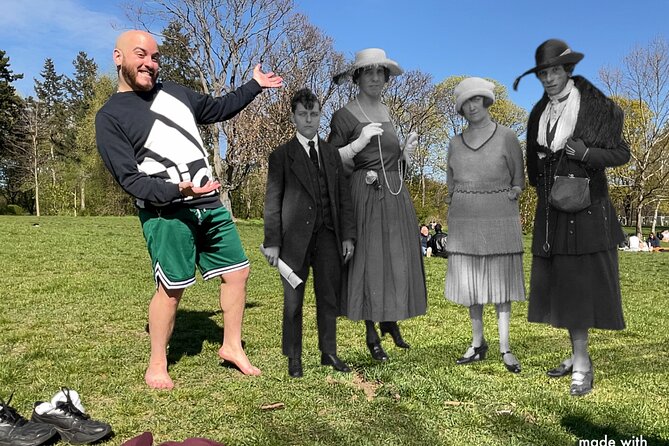
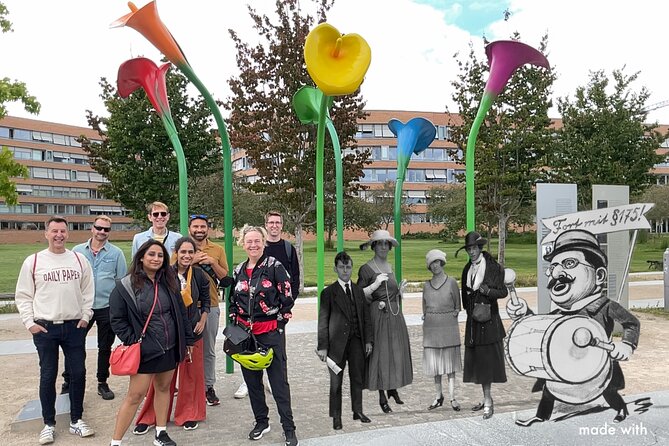
The tour also includes Mixies, personalized photos that combine your group with AR elements. That is a lighter feature than the historical material, but it can give you a memorable record of the afternoon.
The technology is not a substitute for a strong guide. It works best when the image supports a clear story instead of becoming a distraction. The feedback connected with Jeff specifically praised the way photographs, videos, and AR were used to bring the past into the present.
Price, pace, and practical details
At $83.13 per person, this costs more than a standard large-group city walk. You are paying for a specialized subject, a small group, a guide with queer activism and gender studies experience, and access to visual material that would be difficult to gather on your own.
The group limit of 10 is a real advantage. You should be able to see the iPad, hear the guide, and ask questions without fighting through a crowd. The tour lasts about 3 hours and 30 minutes, so it is a substantial afternoon rather than a quick orientation.
It begins at 2 p.m. near public transportation and ends at Metropol. A café break may be included, but coffee or tea is not included in the price. Wear shoes suited to walking and allow enough time for the full route.
The tour is offered in English. Service animals are allowed, and most people can participate, though the supplied information does not provide detailed accessibility specifications. Ask the operator if you need exact information about walking distances or surfaces.
You can cancel for a full refund up to 24 hours before the start time. Poor weather or too few bookings can lead to cancellation, with a different date or a full refund offered.
Who should book this Berlin tour?
I would book it if you want Berlin’s LGBTQIA+ history treated as a central part of the city, not as a quick mention between general sightseeing stops. It is particularly suited to people interested in social history, gender studies, nightlife, activism, or the real stories behind Cabaret and Berlin’s club culture.
The tour also works well if you prefer a focused experience with a small group and visual aids. The high praise for the guide’s presentation, along with the use of old photographs and videos, suggests that the storytelling is a major part of the value.
I would think twice if you want a relaxed sightseeing walk with little difficult material, or if $83.13 feels high for a walking tour. The afternoon covers persecution, the AIDS crisis, and the loss of queer institutions, so it is not light entertainment from start to finish.
For the right reader, this is a strong way to see Berlin. You leave with street addresses, names, political context, and a better sense of how queer people made room for themselves across a divided and changing city.
FAQ
Where does the tour start?
It starts at Alnatura Super Natur Markt, Else-Lasker-Schüler-Straße 18, 10783 Berlin, Germany.
Where does the tour end?
The tour ends at Metropol, Nollendorfpl. 5, 10777 Berlin, Germany.
What time does the tour begin?
The stated start time is 2 p.m.
How large is the group?
The experience has a maximum of 10 people.
Is the tour offered in English?
Yes. The tour is offered in English.
What happens if I need to cancel?
You can receive a full refund if you cancel at least 24 hours before the start time. Cancellations or changes made less than 24 hours in advance are not refunded or accepted.
Newest history tours we have reviewed in Berlin
- Berlin Food & Cultural Tour: Must-Try German & Berliner Classics★ 5.0 · 51 reviews
- Private Tour: Jewish Heritage Walking Tour of Berlin★ 5.0 · 29 reviews
- Small-Group Historical Bike Tour in Berlin★ 4.5 · 103 reviews
- Historic center of Berlin – Tour in Italian★ 5.0 · 143 reviews
- East Berlin Food & History Tour with Eating Europe★ 5.0 · 204 reviews
- Private Berlin WWII and Cold War History Tour with Local Expert Guide★ 5.0 · 28 reviews
- Berlin: Private Bike Tour of the Berlin Wall and Third Reich★ 5.0 · 23 reviews
- Explore Berlin History and Highlights Sightseeing Walking Tour★ 5.0 · 81 reviews
Berlin History Tours, compared.

Berlin Private Complete History All Day Walking Tour
Read our review →
Cold War & Berlin Wall History Guided Bike Tour
Read our review →
Browse the lists this tour appears in