
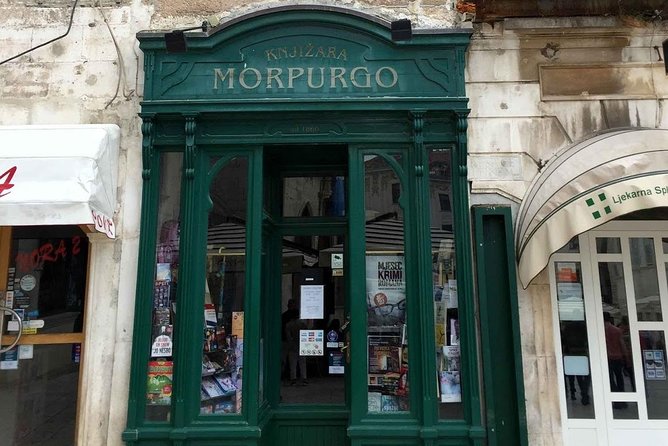
Review · SPLIT HISTORY TOURS
Jewish Heritage & Diocletian’s Palace Private Split Tour
Split’s Jewish story begins beneath the Roman palace. In the substructures of Diocletian’s Palace, menorah carvings point to Jewish life in the city centuries ago, linking today’s Split with the Roman settlement of Salona and the people who fled into the palace when Salona came under attack.
I like two things right away: the private format lets your guide adjust the pace, and the synagogue visit brings a living voice to a subject that can otherwise feel like a list of dates. Guides such as Jelena, Emil, Vinka, and Pero are praised for clear storytelling, humor, and the ability to adapt the walk to a family’s interests or mobility needs.
The main consideration is time. Two and a half hours gives you a good introduction, but the itinerary packs in Roman ruins, Jewish history, Venetian squares, Croatian culture, and modern Split. You will get a strong overview, not a slow study of every monument.
Key points to know before booking
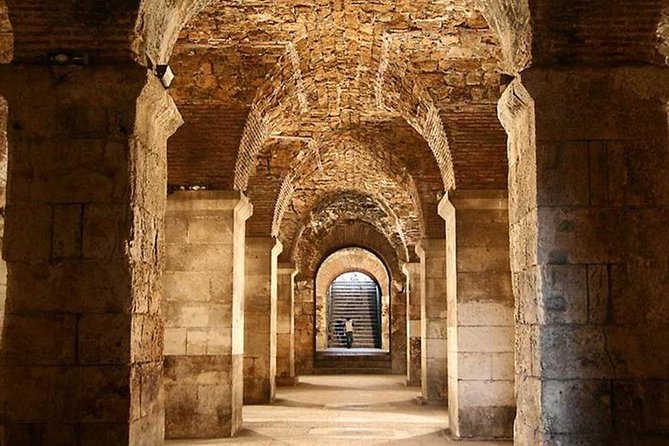
- Menorah carvings in the palace substructures connect Split’s Roman foundations with its Jewish past.
- A private guide keeps the tour flexible, with the pace adjusted for questions, age, weather, or mobility.
- The synagogue visit is the emotional center, with a member of the local Jewish community sharing personal and historical context.
- The route covers both major sights and everyday Split, from the Peristyle and Vestibule to the fish market and Riva.
- Cruise-ship pickup is available at the port, while Old Town accommodations can arrange a nearby meeting point.
- The $187.05 price is per person, so the value improves when several people share the private experience and want a focused Jewish heritage tour.
Why the palace substructures are the right place to begin
Diocletian’s Palace is not simply a freestanding monument. It is the core of modern Split, with homes, cafés, shops, lanes, and public squares built into and around the ancient complex. Starting below street level helps you understand that unusual arrangement.
The substructures are the only paid admission included in the tour. For about 45 minutes, you explore the lower rooms and hear how the palace functioned when Emperor Diocletian built it in 305 AD. The underground spaces mirror the layout of the rooms above, giving your guide a useful way to explain the emperor’s residence and the people who worked there.
This is also where the Jewish focus first comes into view. Menorah carvings in the basement are small details, but they carry unusual weight. They help place Jewish life in Split within the wider story of Salona, the nearby Roman city where Jews lived alongside Romans as early as the second or third century AD.
When Salona faced attacks from barbarian groups, its residents moved into the fortified palace. The Jewish population shared that fate and began a new chapter in Split. You are not just looking at ancient stone here. You are seeing how one community’s story continued as the city itself changed.
The substructures can be uneven and enclosed, so wear sensible shoes. If you have mobility concerns, mention them when arranging the private tour. One guide adjusted the route and timing for a group with walking difficulties, which is a useful advantage of booking privately.
More Castle and Palace History Tours in Croatia
- SPLIT-PRIVATE Walking Tour of Diocletian’s Palace & Old Town
★ 5.0 · 467 reviews - Split: Historical Tour of Salona, Klis Fortress and Trogir
★ 4.1 · 108 reviews - History & Cultural Walking Tour of Split and Diocletian’s Palace
★ 5.0 · 104 reviews
The Vestibule and Peristyle explain Roman Split
From the substructures, the tour moves through the Vestibule, the former foyer of the palace. It is a brief stop, listed at around 10 minutes, but it helps you picture the transition from the outside world into the emperor’s private domain.
Next comes the Peristyle, the main Roman square. Here, your guide explains both its original role and its present use. Columns brought from different parts of the Roman Empire frame the space, reminding you that Diocletian’s palace was built with materials and influence gathered from far beyond Dalmatia.
This is one of the places where a guide earns the fee. On your own, you can admire the columns and take photographs. With a good explanation, you can also see how the square worked as a ceremonial center and how later generations gave the Roman setting new meaning.
The stop is short, so expect an introduction rather than an extended archaeological lecture. That suits the overall design of the tour, which keeps moving and adds several layers of Split’s past.
Grgur Ninski adds a Croatian chapter
The large statue of Grgur Ninski, made by Croatian sculptor Ivan Meštrović, shifts the subject from Roman power to Croatian religious and cultural identity. Your guide explains the bishop and the place he holds in Croatia’s story.
This stop also breaks up the ancient material. The tour is not limited to emperors and ruins. It shows how Split’s identity was shaped by Roman rule, medieval religious life, Venetian influence, Jewish residents, Croatian writers, and modern local habits.
The statue is a quick stop, around 10 minutes. You will have time to hear the basic story and admire the sculpture, but not to study Meštrović’s work in detail.
Walking through Split’s Jewish quarter
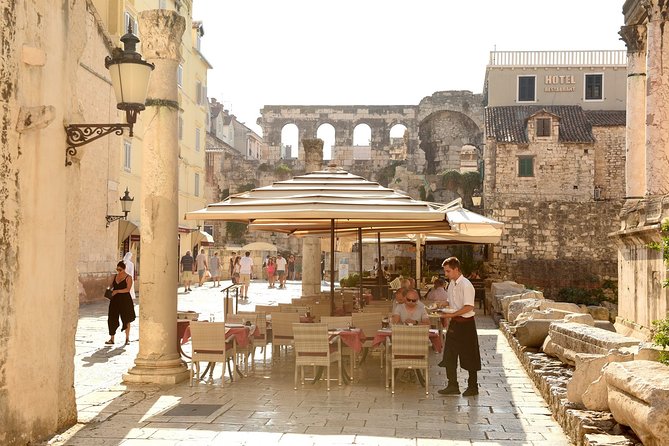
The route then turns toward the old Jewish quarter and Split Synagogue. This is the part of the walk that gives the theme its human scale.
The Jewish community of Split is among Europe’s oldest. Its story reaches back to the Roman period, then continues through the community’s life inside the palace and the later development of the city. The guide explains where Jewish residents lived, worked, and contributed to Split’s economic and civic life.
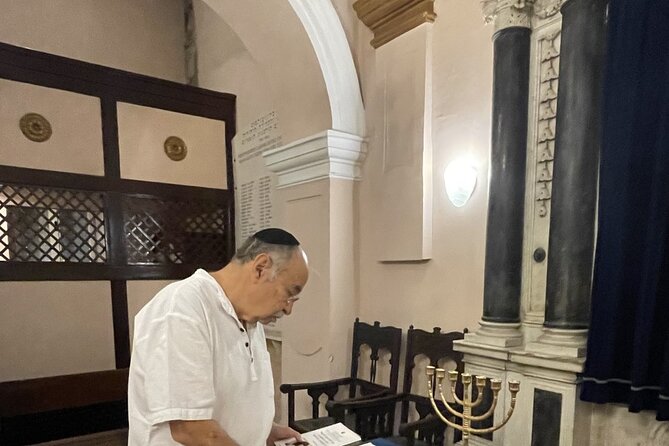
At the synagogue, you meet a member of the local Jewish community. Albert is specifically associated with these visits, and other guides may arrange the meeting with the synagogue caretaker or another community representative. That conversation matters because it moves the subject beyond distant history. You hear about the community as something connected to Split today, even though it is small.
The synagogue is not presented as a grand museum. Its value is its continued use and its connection to the people who have cared for it. If you have a special interest in Jewish history, this is the reason to choose this tour instead of a standard palace walk.
The visit should be treated with respect. It is an active religious place, not just another sightseeing stop. The private setting makes it easier to ask thoughtful questions without holding up a large group.
More Private History Tours in Croatia
- Private History Split Walking Tour in English
★ 5.0 · 159 reviews - Dubrovnik Jewish Heritage Private Walking Tour
★ 5.0 · 121 reviews
Narodni Trg recalls a painful wartime loss
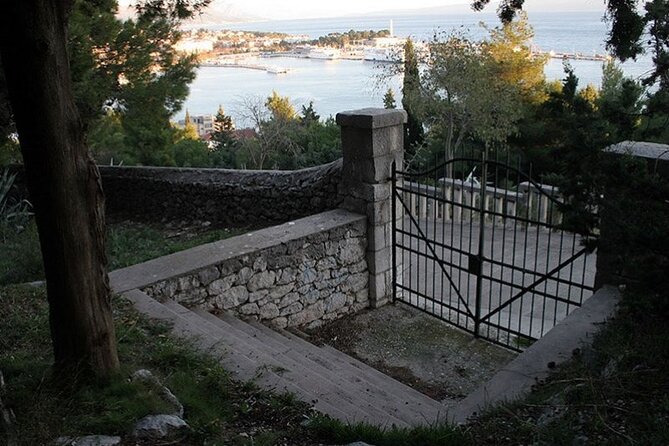
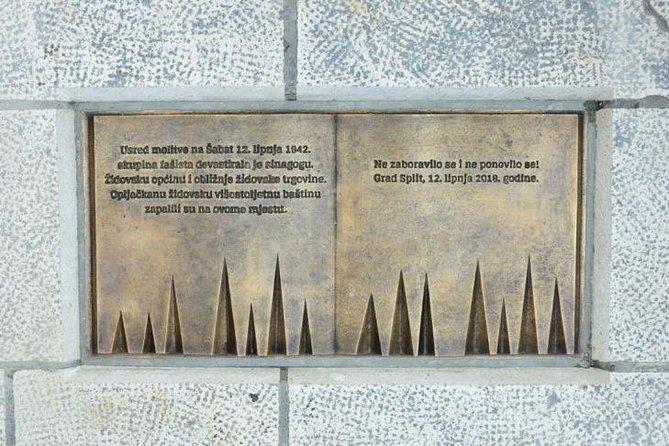
At Narodni Trg, Split’s main piazza, your guide points out a bronze plaque marking the destruction of synagogue objects and archives on June 12, 1942. This is a sober moment in the tour.
The square itself has handsome Venetian architecture, but the plaque changes how you read the setting. The city’s public spaces carry both beauty and memory. A well-paced explanation helps you understand that Jewish heritage is not only about early settlement or architecture. It also includes loss, interrupted records, and the effort to preserve what remains.
The stop lasts about 10 minutes. It is brief, but the subject deserves your attention. If you prefer tours that avoid difficult history, this section may feel heavy. That is also why it gives the Jewish theme more substance than a quick mention of a former neighborhood.
Fruit’s Square brings in Croatian literary life
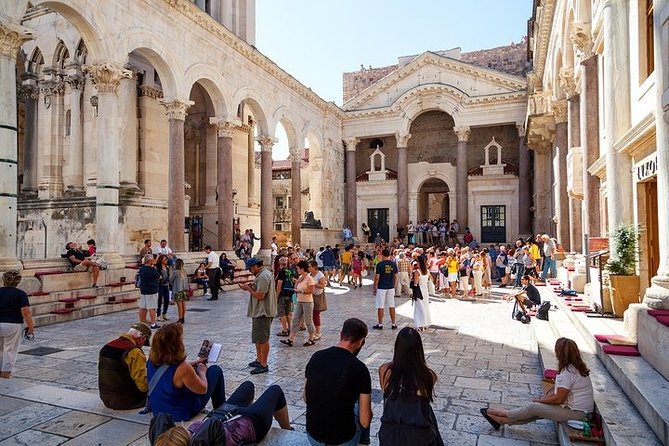
Fruit’s Square, officially Trg Braće Radić, sits just outside the palace. It is one of Split’s most attractive small squares, with the statue of Marko Marulić at its center.
Marulić is known as the father of Croatian literature. His presence gives the tour another useful turn. Split is not only a Roman site or a port with Venetian façades. It is also a Croatian cultural center shaped by writers, artists, clergy, merchants, and ordinary residents.
This is a five-minute stop, so you mainly get the story and a chance to look around. You might want to return later for photographs or a quiet pause, especially because the tour moves at a steady pace.
Riva shows how Split lives today
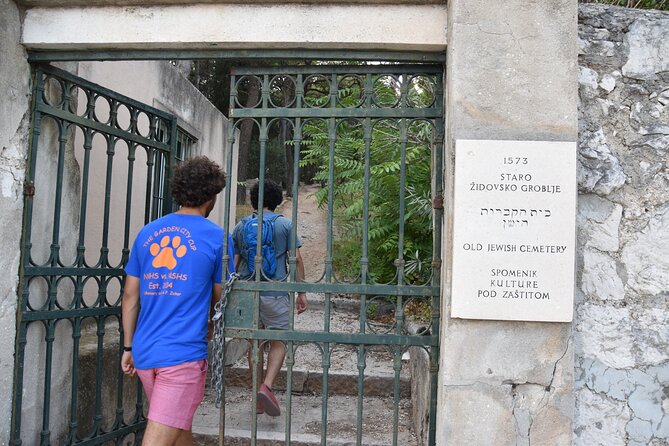
The walk continues to the Riva, the waterfront promenade locals call their living room. This is where the tour leaves behind most of the formal monuments and explains contemporary Split.
Cafés and restaurants line the pedestrian waterfront, and the Riva is used for morning coffee, afternoon breaks, and evening drinks. Your guide explains what makes the city tick today, giving you practical context for the rest of your stay.
I like this part because it prevents the tour from becoming a museum lesson. You see where residents gather, not only where emperors once lived. It also gives you a useful orientation point for later meals, walks, and independent exploring.
The Riva is an easy place to find, which helps with meeting arrangements. The standard meeting point is near the bronze city map at 23 Obala Hrvatskog narodnog preporoda. Cruise-ship passengers are met at the port near the customs gate, with the guide holding a sign bearing your name.
Prokurative and Marmontova finish the city story
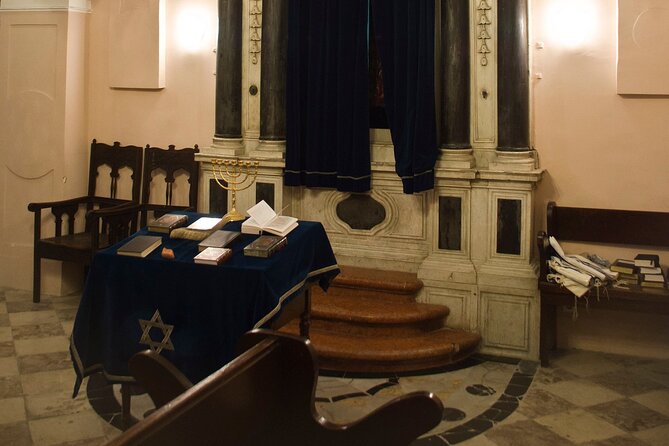
Prokurative, officially Republic Square, sits west of the Riva. Its neo-Renaissance buildings and arches recall Venice’s St. Mark’s Square, while the open southern side faces the harbor and waterfront.
Your guide uses the square to explain Split’s later architectural influences. It is a good contrast with the Roman palace and the narrower medieval lanes. The stop lasts about 10 minutes, enough to understand the layout and admire the view toward the harbor.
The final listed stop is Marmontova Ulica, a popular pedestrian promenade. Nearby, the fish market offers a quick look at where locals buy fresh Adriatic fish. You can ask to stop and see it, but the tour description makes clear that this is optional rather than a formal market visit.
This last section is useful because it returns you to ordinary city life. After Roman emperors, Jewish archives, Venetian façades, and Croatian literature, you finish with streets people use every day.
What the private format adds
This is a private activity, so only your own group takes part. That makes a real difference on a route with several subjects and a synagogue visit.
You can ask more questions than you could in a large group. A family can slow down for children. A group in its seventies can keep a steady pace. A person with a strong interest in Jewish history can spend more time on the synagogue and wartime story rather than rushing through them.
The guides are repeatedly praised for a relaxed manner, clear English, humor, and the ability to answer questions. Jelena is especially associated with adjusting the schedule during heavy rain, using indoor time first and moving outside when conditions improved. She also helped one group find a restaurant afterward.
Guides named in the tour’s feedback include Jelena, Emil, Vinka, and Pero. Your booking may be assigned to one of them or another guide from the same provider, so do not assume a particular person unless the provider confirms it.
Is $187.05 per person a fair price?
At $187.05 per person, this is not a cheap walking tour. The price makes the most sense for a couple, family, or small group that specifically wants private guiding and Jewish heritage rather than a general introduction to Split.
The fee includes a licensed private guide, the synagogue and Jewish quarter visit, and admission to the palace substructures. Meals, drinks, and taxis are extra. Since the tour is private, the cost can feel more reasonable when shared by several people, especially if you value a flexible pace and direct conversation.
A standard palace tour would likely cost less, but it would not necessarily include the synagogue, the local Jewish community connection, or the focused explanation of the 1942 destruction. If those details are central to your visit, the added cost has a clear purpose.
The tour lasts about two and a half hours. That is long enough to cover the palace, Jewish quarter, waterfront, and main squares without taking up an entire day. It is also short enough to fit a cruise stop, provided your ship schedule is supplied in advance.
Practical details that matter
The start time is arranged on request because this is a private tour. Give the provider your ship name, docking time, disembarkation time, and departure time if you are arriving by cruise ship.
Pickup is available at the port. You walk toward the customs gate after leaving the ship, where the guide waits with your name printed on a sign. Old Town apartment pickup is also available. If you stay outside the Old Town, the usual meeting point is the Riva.
The tour is offered in English. Children must be accompanied by an adult, and service animals are allowed. Public transportation is nearby, but taxis are not included.
Free cancellation is available up to 24 hours before the start time. Changes or cancellations made later are not refunded, so keep your port schedule and meeting time in mind.
Who should book this Split tour?
I would choose this experience if you want the palace explained through human stories rather than only architecture. It suits families, history-focused couples, cruise passengers, and anyone with a personal or academic interest in Jewish life in Croatia.
It is also a good choice for a group with mixed interests. The route includes Roman ruins, Croatian art and literature, Venetian buildings, modern café life, and the fish market. Someone who is less focused on Jewish history still gets a solid introduction to Split.
You may prefer another tour if you want a long archaeological visit, a food-focused walk, or a full-day excursion beyond the Old Town. The itinerary moves briskly, and several stops are short. The synagogue is the main reason to book this particular route.
Final call: a focused way to understand Split
Book it if you want Diocletian’s Palace connected to the people who lived around it, not treated as an isolated monument. The menorah carvings, the synagogue meeting, the plaque at Narodni Trg, and the walk through the Jewish quarter give the city a human story that a standard palace tour can miss.
The strongest part is the combination of private pacing and local explanation. Ask for the synagogue visit to be confirmed when you book, share your mobility needs or ship schedule early, and allow the guide to adjust the route. At $187.05 per person, it is best viewed as a specialized private experience, not a budget city walk.
FAQ
How long does the Jewish Heritage and Diocletian’s Palace tour last?
The tour lasts approximately 2 hours and 30 minutes.
Is this a private tour?
Yes. Only your own group participates in the activity.
Is the synagogue visit included?
The tour includes a visit to Split Synagogue and the Jewish quarter. A member of the local Jewish community shares stories during the synagogue visit.
Where does the tour begin?
The usual meeting point is near the bronze city map at 23 Obala Hrvatskog narodnog preporoda on the Riva waterfront in Split.
Can cruise-ship passengers be picked up?
Yes. Cruise passengers are met at the port near the customs gate. You must provide the ship name, docking time, disembarkation time, and departure time so the meeting can be arranged.
What is included in the price?
The price includes a private licensed guide, the synagogue and Jewish quarter visit, and admission to the substructures of Diocletian’s Palace. Meals, beverages, and taxis are not included.
More Jewish Heritage Tours in Croatia
- Budapest Jewish Heritage Memorial Walking Tour & Synagogue Entry
★ 5.0 · 568 reviews - Budapest: Jewish Heritage Guided Tour with Synagogue Ticket
★ 4.8 · 533 reviews - 3-Hour Porto Jewish Heritage Walking Tour with Local Guide
★ 4.5 · 396 reviews - Warsaw: Jewish History Guided Walking Tour in English
★ 4.7 · 324 reviews
Newest history tours we have reviewed in Croatia
- History Split Walking Tour in French -Small group★ 5.0 · 41 reviews
- Split History and Gastro Small-Group Tour with Food and Drinks★ 5.0 · 375 reviews
- Dubrovnik: Game of Thrones and History Small Group Tour★ 5.0 · 76 reviews
- Dubrovnik Old Town: Small-Group Walking Tour With A Local★ 5.0 · 123 reviews
- Dubrovnik Jewish Heritage Private Walking Tour★ 5.0 · 121 reviews
- Private History Split Walking Tour in English★ 5.0 · 159 reviews
- History & Cultural Walking Tour of Split and Diocletian’s Palace★ 5.0 · 104 reviews
- Split: Historical Tour of Salona, Klis Fortress and Trogir★ 4.1 · 108 reviews
Jewish Heritage Tours, compared.
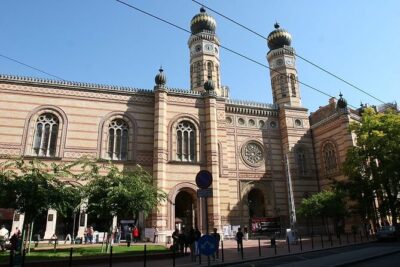
Budapest Jewish Heritage Memorial Walking Tour & Synagogue Entry
Read our review →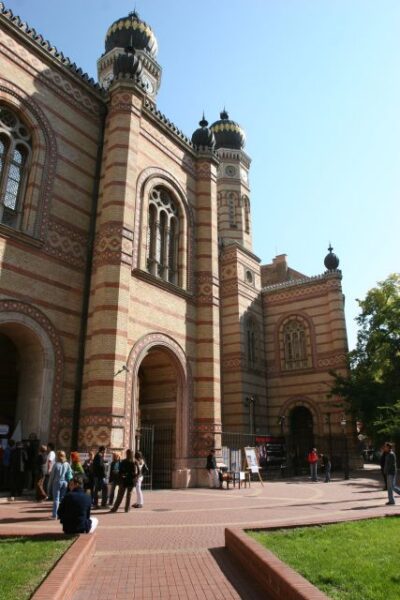
Jewish Heritage Guided Tour with Synagogue Ticket
Read our review →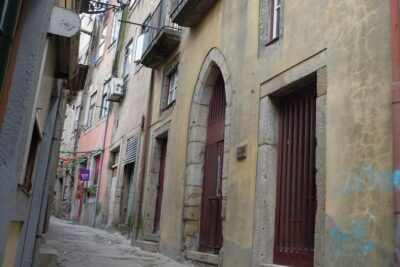
3-Hour Porto Jewish Heritage Walking Tour with Local Guide
Read our review →

Anne Frank and the Jewish History of Amsterdam Private Tour
Read our review →
Lisbon Jewish Heritage and History – Private Tour Van
Read our review →
Anne Frank and Amsterdam Jewish History Walking Tour
Read our review →Browse the lists this tour appears in