
Review · GERMANY HISTORY TOURS
Historic Dresden Small-Group Walking Tour in English
Dresden’s story is written in stone, tile, and carefully rebuilt façades. On this two-hour walk, you move from the grand royal stage of Theaterplatz to the quiet courtyard of Stallhof, then finish with the powerful story of the Frauenkirche rising from wartime ruins. The route covers the city’s essential historic sights without sending you inside every museum.
I like the small maximum of 15 people, which gives you a fair chance to ask questions. I also like the guides’ focus on stories rather than dates alone. Guides including Laura, Leo, Christina, Doris, Karen, and Helga have been praised for clear English, good pacing, and personal insight into Dresden before and after reunification. The main drawback is sound: without headsets, a full group can make it hard to hear, especially in busy squares or if the group grows beyond the stated limit.
Key points to know before you book
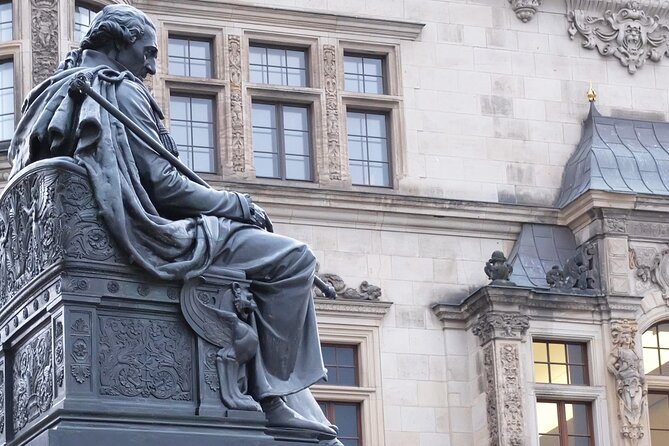
- Augustus the Strong shapes the tour: His ambition and love of spectacle explain much of the Zwinger and Dresden’s grand royal center.
- The route packs in major sights: You see Theaterplatz, the Zwinger, Residenzschloss, Stallhof, the Fürstenzug mural, the cathedral, Brühl’s Terrace, Neumarkt, and Frauenkirche.
- It is history told outdoors: Museum admission is not included, but your guide can help you choose which collections are worth visiting afterward.
- The Frauenkirche gives the walk its emotional finish: Its destruction and reconstruction tell Dresden’s modern story better than any simple date list.
- The pace suits many visitors: The walk is not described as demanding, though there are stairs, and comfortable shoes remain a good idea.
Dresden’s grand story begins at Theaterplatz
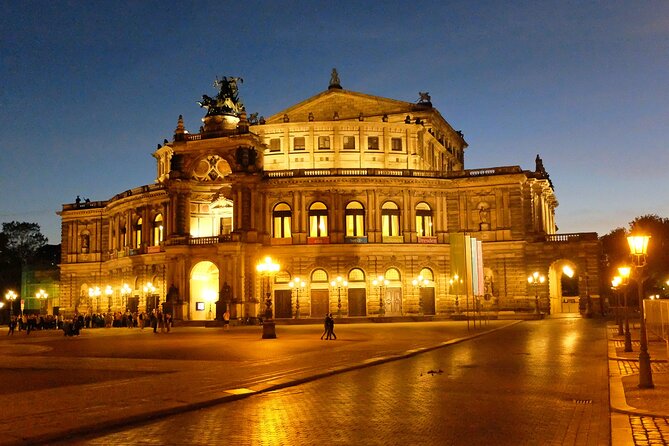
Meet at Schlossplatz in Dresden’s Old Town, close to the royal complex. From there, the walk reaches Theaterplatz, a square that gathers Dresden’s cultural power into one view.
The Semper Opera House faces the plaza with its graceful 19th-century design. Nearby are the Zwinger, the former royal palace, and the Dresden Cathedral. Your guide can also point out the Old Masters Gallery, helping you connect the buildings around you before you start exploring them one by one.
This is a strong opening because Dresden can feel like a collection of impressive buildings without a clear thread. Here, your guide provides that thread: royal ambition, music, art, Catholic and Protestant tension, war, and reconstruction.
I especially like this first stop for orientation. You are not simply told that each building is important. You learn how the buildings relate to one another and why this small part of Dresden became the center of Saxon power.
The stop lasts about 15 minutes and costs nothing beyond the tour. You remain outside, so anyone hoping to enter the opera house, cathedral, or gallery will need extra time later.
More History Walking Tours in Germany
- Leipzig: 1.5-Hour Historical Walking Tour in German
★ 4.7 · 2,217 reviews - Berlin: History of the Third Reich Guided Walking Tour
★ 4.7 · 791 reviews - Trier: Guided Old Town Highlights and History Walking Tour
★ 4.7 · 687 reviews
The Zwinger turns royal excess into architecture
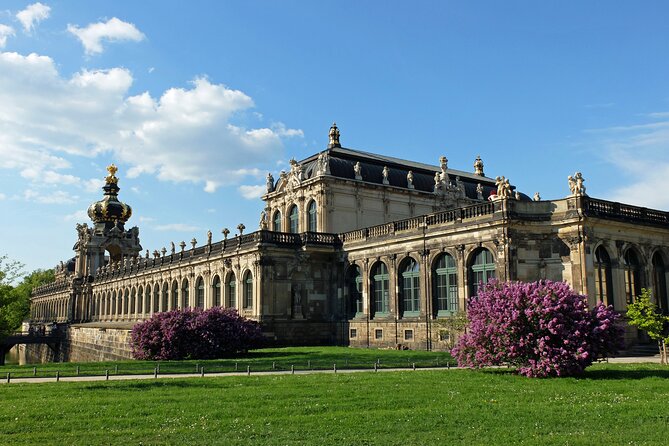
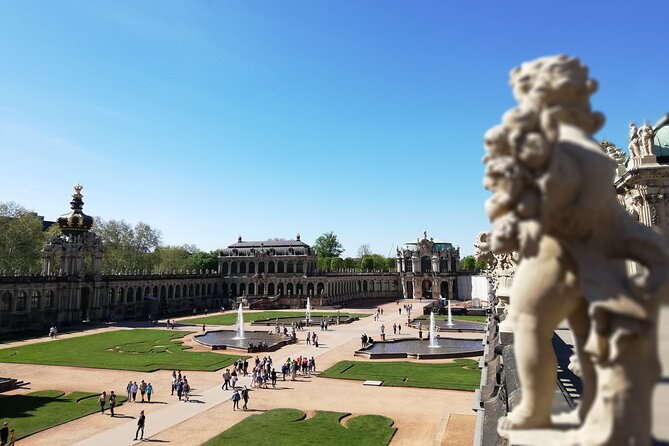
The Dresden Zwinger is one of the walk’s best stops. It was planned as the grand entrance to a new royal palace that was never built. That unfinished purpose helps explain the building’s unusual character. The Zwinger feels like a complete world of courtyards, sculpture, ornament, and open sky, even though it was meant to lead somewhere else.
Your guide introduces the ruler who commissioned it, Augustus the Strong. His taste for ceremony, beauty, and elaborate festivities appears in the building’s details. You get more from the Zwinger when you understand that it was not merely a palace garden or decorative enclosure. It was a stage for court life.
If the area is open and time allows, the guide may show you an outdoor grotto that is easy to miss. That possibility adds a welcome sense of discovery, though it is not guaranteed. If you want a detailed look at the Zwinger’s museums and galleries, plan a separate visit.
The official stop is about 15 minutes. That is enough for a lively explanation and a first look, but not enough for every courtyard, sculpture, or museum room. I would treat this part as a preview that helps you decide how much more time to spend here.
Residenzschloss reveals Saxony’s royal past
The former Residenzschloss, or Royal Palace, carries a more complicated story. It was built, burned, rebuilt, repaired, extended, and burned again. Today, its mixture of old forms and later work reflects the long history of the Saxon ruling family.
The walk takes you through one of the palace courtyards, where Renaissance sgraffito decorates the walls. Sgraffito is made by scratching through layers of plaster to reveal contrasting surfaces below. It is a small technical detail, but it rewards close attention. Ask your guide to point out how much work went into the courtyard’s decoration.
You do not enter the palace museums during this tour. That is both a limit and a practical advantage. The palace holds major treasure collections, and a guide can explain the choices available before you spend money on a museum ticket. If you already know you want to see the collections, reserve additional time after the walk.
This is also where the tour’s value becomes clear. A quick look at a palace courtyard costs nothing, but the historical explanation helps you understand why Dresden’s royal collections matter and how the buildings changed over time.
Stallhof offers a quieter royal corner
Behind the palace, Stallhof feels more intimate than Theaterplatz or the Zwinger. This Renaissance courtyard was used for jousting tournaments and royal celebrations. Its arcaded galleries and sandstone columns preserve the sense of a court built for ceremony and display.
The stop lasts about five minutes, so expect a concise explanation rather than a long visit. That short pause works well in the rhythm of the walk. After the large royal spaces, Stallhof gives you a quieter place to picture Dresden’s courtly life.
The courtyard is also useful for understanding scale. Dresden’s center was not made only for enormous ceremonies. It included smaller enclosed spaces where royal traditions played out close to the palace itself.
More Small-Group History Tours in Germany
- Small group Potsdam: A Journey Through History and Palaces
★ 4.7 · 317 reviews - Berlin Wall History Small Group Cycling Tour
★ 4.9 · 152 reviews - Small group Potsdam: A Journey Through History and Palaces
★ 4.5 · 151 reviews
The Fürstenzug mural rewards a close look
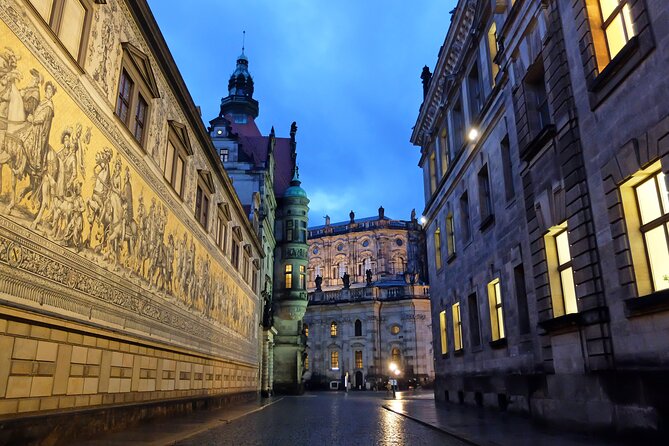
The walk then brings you to the Fürstenzug, the Procession of Princes. This outdoor artwork stretches roughly 100 meters and contains about 24,000 porcelain tiles, making it one of Dresden’s most memorable public works.
Do not rush past it. Your guide can point out figures, symbols, and small details hidden within the long procession. The mural presents Saxon rulers across time, but its real appeal is visual. It is easy to grasp at a glance and surprisingly difficult to take in fully.
This is one of the tour’s most useful moments for a first visit because you get context and a viewing strategy. Afterward, you can return on your own and spend more time examining the tiles. The mural is outdoors, so it fits naturally into the walking route without adding an admission fee.
Dresden Cathedral carries a religious paradox

The Dresden Cathedral, also known as the former court church, has an unusual place in the city’s story. It was built secretly by a Catholic ruler in Protestant Saxony. That fact alone gives the building a political edge, and your guide explains how the church served the royal court.
You see the cathedral from outside rather than going in. The guide also discusses its connection to the Saxon royal family and its use as a burial site. This is a compact stop, but it adds an important layer to the tour. Dresden’s royal story was not only about art and military power. Religion shaped how the court presented itself and how it operated.
If you want to see the interior, plan to return independently. The walking tour gives you the background, not a full church visit.
Brühl’s Terrace opens the view toward the Elbe

From the historic center, the walk reaches Brühl’s Terrace, often called the Balcony of Europe. This elevated promenade gives you a broad view toward the Elbe River and beyond the compact Old Town.
Most guides take the group up the stairs and point out the river, Dresden’s White Fleet of historic steam boats, riverside buildings, church steeples, and distant wine slopes. This is a welcome change from close views of façades and courtyards. You get a sense of the city’s setting and a few ideas for later exploring.
The stop lasts about 10 minutes. That is enough to orient yourself, but not enough to linger by the river or take a boat. If the view catches your interest, note the White Fleet and the riverfront as possible additions to your own Dresden plans.
The stairs deserve a practical mention. The walk is generally manageable, and one older visitor specifically found the pace comfortable, but there are steps. Anyone who walks slowly should tell the guide early so the group can keep a sensible pace.
Neumarkt and Frauenkirche tell Dresden’s modern story
The tour usually moves toward Neumarkt, the square anchored by the Frauenkirche. Neumarkt was reduced to rubble and later rebuilt with an appearance inspired by its 18th-century form. The colorful façades can look old at first glance, but the square also tells a modern story about memory, reconstruction, and how a city chooses to present its past.
This is a good place to pause after the walk. You can find German, Saxon, and international food nearby, and the square gives you a central base for further exploring.
The Frauenkirche is the emotional center of the route. Its dome was rebuilt from the ruins left after World War II, and the church has become a symbol of Dresden’s return from destruction and its message of reconciliation.
Your guide explains the church’s destruction, the long rebuilding process, and the international effort that helped bring it back. The lesson works because you have already seen Dresden’s royal buildings and restored streets. By this point, reconstruction is not an abstract theme. You have watched it unfold across the whole Old Town.
I recommend returning inside on your own if the church is open. Sit quietly in the pastel interior, then visit the crypt, where a small exhibition explains the rebuilding. The walking tour does not include admission or a full interior visit, so leave room in your day if you want that experience.
How the two-hour format works for you
The route covers a lot in about two hours, but it is not designed for long stops inside buildings. You spend most of your time outdoors, listening, looking, and moving between landmarks.
That format suits me for a first morning or afternoon in Dresden. It gives you a clear map of the Old Town and helps you decide where to return. It also prevents a common problem on short city visits: spending too long in one grand building and missing the connections between the rest.
The pace has been praised as comfortable, including for older people, and guides such as Leo, Laura, Christina, Doris, Karen, Helga, Marion, and Robert have been described as engaging and clear in English. Their styles differ. Some use personal stories and humor, while one assessment found a guide slightly too familiar and chatty. That is a minor but real reminder that the guide shapes the experience.
The group limit is 15 people. Smaller groups can feel almost like a private walk, with more room for questions. The tradeoff is that the provider does not normally supply headsets. In a group of 15, or in a noisy square, stand close to the guide and speak up if you miss something.
Price, practical details, and who gets the most value
At $30.25 per person, this is a modest fee for a licensed, English-speaking guide and two hours of concentrated orientation. It is more than a free walk, but the point is not simply to be led from one building to another. The value comes from the explanation, the chance to ask questions, and the guide’s ability to connect Dresden’s royal past with its wartime destruction and modern rebuilding.
The tour is booked, on average, about 21 days ahead, so early planning makes sense if your Dresden dates are fixed. Confirmation is provided at booking, the activity is near public transportation, and service animals are allowed. Most people can take part, though you should expect normal city walking and some stairs.
The published meeting point is Schlossplatz in Dresden’s Old Town. The information also says the activity ends back at the meeting point, while the route description says it usually finishes at Neumarkt by the Frauenkirche. Since those details do not perfectly match, confirm the exact finish point when you book or meet the guide.
Free cancellation is available up to 24 hours before the start time. A minimum number of participants is required, and if that minimum is not met, you are offered another date or experience, or a full refund.
Should you book this Dresden walking tour?
I would book it if Dresden is new to you and you want the main historic center explained in clear English before choosing your museums. The route gives you the city’s essential first chapter: Augustus the Strong, royal architecture, religious politics, wartime destruction, and the Frauenkirche’s reconstruction.
It is especially suited to people who value stories and questions over a checklist of interiors. You should also book if you want a calm introduction before exploring the Zwinger, Residenzschloss collections, or Frauenkirche by yourself.
I would hesitate only if you need guaranteed museum entry, a very quiet audio setup, or a fully private pace. For everyone else, $30.25 is a fair price for a well-paced orientation, provided you stay close enough to hear the guide.
FAQ
How long is the Historic Dresden Small-Group Walking Tour?
The tour lasts approximately two hours.
What language is the tour offered in?
The tour is offered in English.
How much does the tour cost?
The listed price is $30.25 per person.
What sights are included on the walking route?
The route includes Theaterplatz, the Dresden Zwinger, a courtyard of the Residenzschloss, Stallhof, the Fürstenzug mural, Dresden Cathedral from the outside, Brühl’s Terrace, Neumarkt, and the Frauenkirche.
Are museum admissions included?
No. The tour stays outside the museums. Your guide can provide information to help you decide what to visit and which ticket to buy later.
Does the tour enter the Frauenkirche?
The walking tour explains the church from the outside. You can visit the interior and crypt independently afterward.
Where does the tour begin?
The meeting point is Schlossplatz, Schlossplatz, 01067 Dresden-Altstadt, Germany.
Where does the tour end?
The booking information says the activity ends back at the meeting point, while the route description says it usually ends at Neumarkt by the Frauenkirche. Confirm the exact finish point with the guide.
How large is the group?
The tour has a maximum of 15 travelers.
Can I cancel for a full refund?
Yes, you can cancel up to 24 hours before the experience start time for a full refund. Changes or cancellations made less than 24 hours before the start time are not accepted for a refund.
Newest history tours we have reviewed in Germany
- Berlin: Nazi History Walking Tour★ 4.8 · 33 reviews
- Berlin: History and Sightseeing with Kids (Free for Kids)★ 4.9 · 19 reviews
- Berlin: Historical Sights & Berlin Wall Tour with a Berliner★ 5.0 · 62 reviews
- Berlin: Urbex Abandoned Places & History Tour★ 4.8 · 18 reviews
- Berlin (E)Bike Tour Historical Highlights in Small groups★ 4.5 · 24 reviews
- East Berlin Food & History Tour with Eating Europe★ 4.8 · 20 reviews
- Berlin: Historic Center Walking Tour with a Real Berliner★ 5.0 · 134 reviews
- Berlin: Guided Craft Beer & Cultural Tour With Snacks★ 5.0 · 68 reviews
Small-Group History Tours, compared.


Freedom Trail History Small Group Walking Tour
Read our review →
Madrid Tapas & Taverns Small Group Food & History Tour
Read our review →
Hidden Alleyways and Historic Sites Small-Group Walking Tour
Read our review →
New Orleans Small-Group Haunted History Carriage Tour
Read our review →
Half Day Dominican Republic Cultural Tour : Small Group
Read our review →
Ultimate Seville Tapas, Wine & History Small Group Tour
Read our review →
Vienna Historic Center Small Group Walking Tour
Read our review →Browse the lists this tour appears in