
Review · BERLIN HISTORY TOURS
Charité Hospital Walking Tour: Exploring Berlin’s Medical History
Berlin’s Charité hospital is more than a medical center. It is a record of scientific breakthroughs, political pressure, and human courage, all packed into a walk of about two hours. You’ll hear how doctors fought disease, how medicine was abused under the Third Reich, and how people later tried to escape East Berlin by swimming past the hospital.
I like the small maximum group of 15, which should make it easier to hear the guide and ask questions. I also like the tight route: six stops, free outdoor admission, and an end point only about 10 minutes from Berlin Central Station. The main drawback is that you will not enter buildings where clinical or university work is taking place.
Key points before you book
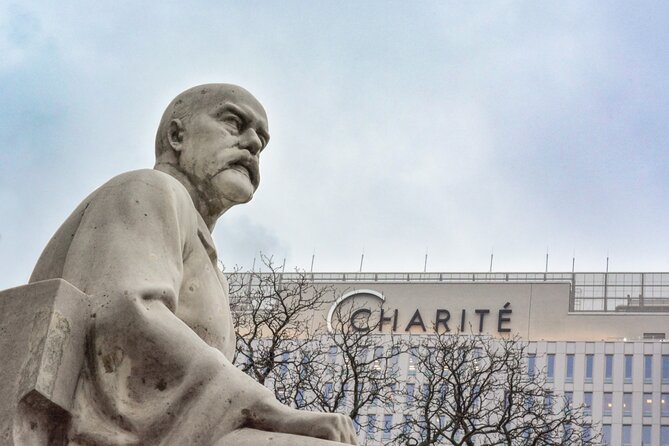
- Robert Koch’s monument opens the story: Learn how the Charité began in the 18th century and how Koch helped identify the causes of tuberculosis, anthrax, and cholera.
- The route covers more than medicine: Stories reach into Nazi Germany, socialist East Berlin, and escape attempts near the Berlin Wall.
- The Tieranatomisches Theater is a rare sight: This neoclassical building is Berlin’s oldest surviving academic building.
- The tour stays compact: Six stops are planned at about 20 minutes each, making this a good choice for a short schedule.
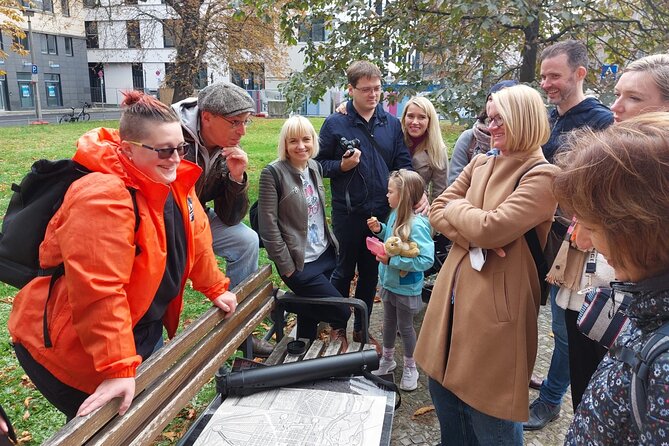
- The group is limited to 15 people: That gives the guide room to tell stories rather than simply point at buildings.
- The price is reasonable for guided context: At $30.12, you are paying mainly for interpretation, since the stops themselves have no admission charge.
Why Charité makes such a strong walking-tour subject
Many medical institutions are difficult to visit as tourists. They are working hospitals, not museums, and much of what happens inside is private. Charité solves that problem in another way: its monuments, courtyards, streets, and surrounding buildings let you trace Berlin’s medical story from the outside.
I like this format because the guide supplies the missing links. A statue of a scientist can feel like a quick photo stop on its own. Here, each monument points to a larger question: How did doctors identify disease? How were patients treated before modern science? What happens when medicine is placed under a dictatorship?
The route also avoids reducing Charité to a list of famous names. Robert Koch represents laboratory science. Rudolf Virchow connects pathology to social conditions. Albrecht von Graefe shows how a single medical specialty could change. The hospital campus then brings you into the moral problems of the 20th century.
The tour is offered in English and lasts about two hours. That makes it easy to fit between other central Berlin plans. You should expect a steady outdoor walk, with each of the six stops taking roughly 20 minutes.
More History Walking Tours in Berlin
- Berlin: History of the Third Reich Guided Walking Tour
★ 4.7 · 791 reviews - Berlin Historical Highlights Walking Tour
★ 4.9 · 657 reviews - Berlin Private Complete History All Day Walking Tour
★ 5.0 · 474 reviews
Robert-Koch-Platz and the origins of Charité
The walk begins at Robert-Koch-Platz, where the monument to Robert Koch sets the tone. You learn why Charité was established in the 18th century and how Berlin’s oldest hospital developed into a major center of medicine.
Koch’s work gives the opening stop real weight. He discovered the causes of tuberculosis, anthrax, and cholera, diseases that once caused widespread fear and death. The guide also explains Koch’s role in what is described as the first pharmaceutical scandal in medical history, a useful reminder that scientific fame does not make every decision correct.
I appreciate that the opening is not simply a celebration of one famous doctor. It gives you both achievement and controversy. That balance matters in a tour about medicine, since progress often arrives with mistakes, pressure, and competing claims.
You will spend about 20 minutes here, and there is no admission charge. The starting point is easy to locate at Robert-Koch-Platz, 10115 Berlin, with public transportation nearby.
The Tieranatomisches Theater and medicine before modern science
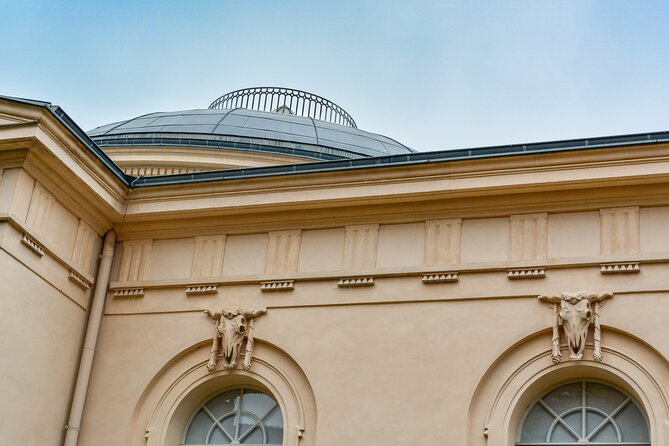
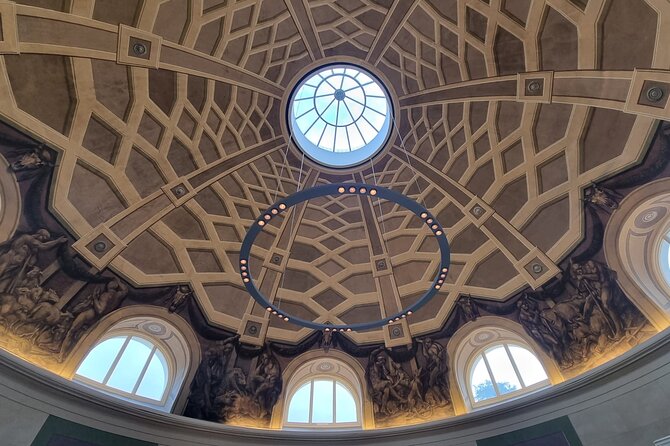
Next comes the Tieranatomisches Theater, an 18th-century neoclassical building and the oldest surviving academic building in Berlin. Its original purpose was the study of animal diseases, giving the tour a useful shift from human hospital care to veterinary science.
The building itself is one of the route’s most distinctive sights. Its formal design contrasts with the practical, sometimes grim medical stories connected to it. You hear how disease was treated before science had the tools and methods that doctors rely on today.
This stop helps you understand how uncertain medical treatment could be. Before modern research, physicians often worked with limited evidence. The guide’s job here is especially important because the building cannot tell that story by itself.
The weakness is also clear: the walk does not include entry into working clinical or university buildings. You should treat the theater as an exterior stop unless the tour provider gives you different information at booking. Still, 20 minutes is enough to examine the building and get the historical context without turning the tour into a full museum visit.
Rudolf Virchow and the social side of medicine
At the monument to Rudolf Virchow, the focus shifts from individual disease to the wider conditions that shape public health. Virchow is presented as the father of modern pathology and the founder of social medicine.
That combination makes this one of the most important stops for anyone interested in how medicine affects ordinary life. Pathology looks closely at disease in the body. Social medicine asks how housing, poverty, working conditions, and public policy can affect health. The two ideas belong together, and Virchow’s story gives the guide a chance to make that connection.
I like this section because it keeps the tour from becoming a parade of scientific heroes. Medical history is not only about laboratories and new treatments. It is also about who gets care, what causes illness in the first place, and how a city responds.
The monument receives about 20 minutes of attention. You will not need a separate ticket, and the guide provides the value here by explaining why Virchow still matters rather than simply identifying the statue.
More History Walking Tours in Germany
- Berlin: Charité Hospital Walking Tour of Medical History
★ 4.9 · 276 reviews - Berlin Private Half-Day Walking Tour: Discover the German Capital’s History
★ 5.0 · 244 reviews - Berlin History Walking Tour with a French-Speaking Guide
★ 5.0 · 240 reviews - The History of Berlin: WWII PRIVATE Walking Tour With Locals
★ 5.0 · 209 reviews
Albrecht von Graefe and the rise of specialist medicine
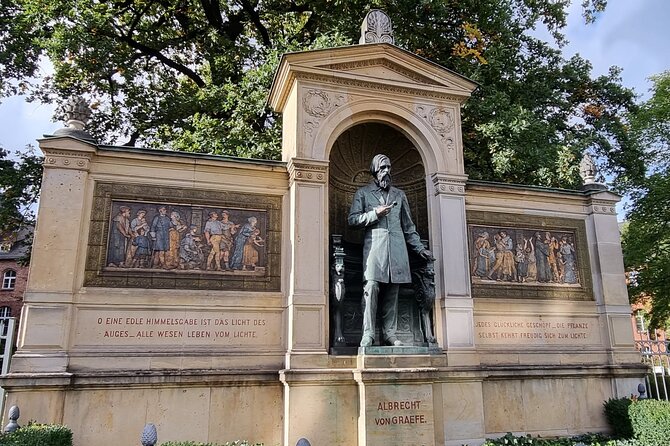
The monument to Albrecht von Graefe introduces another side of Charité’s story. Von Graefe was a groundbreaking ophthalmologist, and his monument was the first in Berlin dedicated to a scientist.
That detail gives the stop a civic meaning as well as a medical one. Berlin was making a public statement that scientific work deserved honor in the same way political and military figures had long received it.
For you, this is a good example of how the tour builds its subject through people and places. The monument is not just a marker for an ophthalmologist. It shows how medicine gained status in public life and how specialist care became an important part of modern practice.
The stop takes about 20 minutes. If you have little interest in eye medicine, the wider story about public recognition may be the part that holds your attention. The guide’s storytelling makes a difference here, and the tour has earned a full 5 rating from 26 published ratings, with 100 percent recommending it. One particularly positive comment praised the leader’s storytelling and the way the tour connected medical history with current issues.
Charité Campus Mitte and medicine under dictatorship
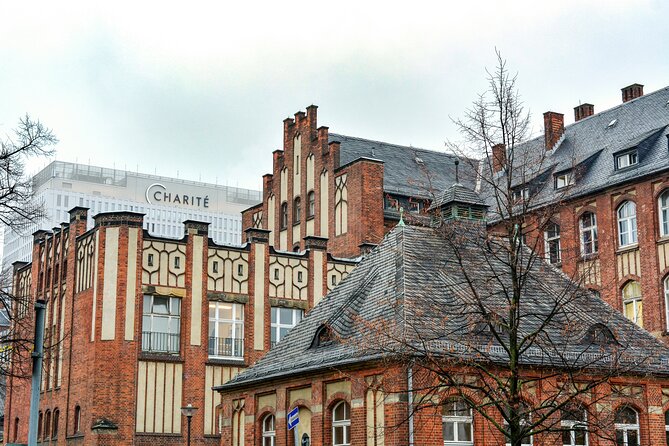
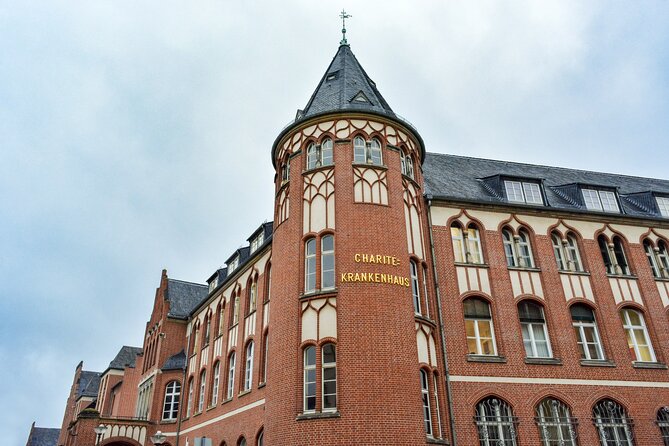
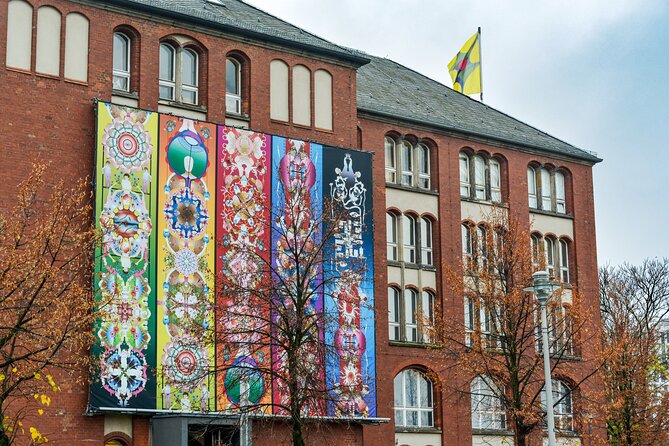
The Charité Campus Mitte is the visual heart of the walk. You see the hospital’s red-brick, neo-Gothic architecture and learn about the doctors who worked there during the Third Reich.
This is the point where the tour becomes morally difficult, in a useful way. Some doctors abused medicine under the Nazi regime. Others continued to help people without discrimination until the final days of World War II. The contrast gives you a clearer picture of how institutions and individuals respond under political pressure.
I value this stop because it avoids a polished version of hospital history. A beautiful campus can hide painful decisions, and the guide brings those decisions into view. You are not simply looking at old brickwork. You are considering how professional duty can survive, or fail, when the state demands obedience.
The material may be heavier than the earlier stops, so you should allow yourself time to listen rather than rush for photographs. The tour does not enter areas used for clinical or university operations, but the exterior setting still carries much of the story.
Humboldthafen and the Cold War escape stories
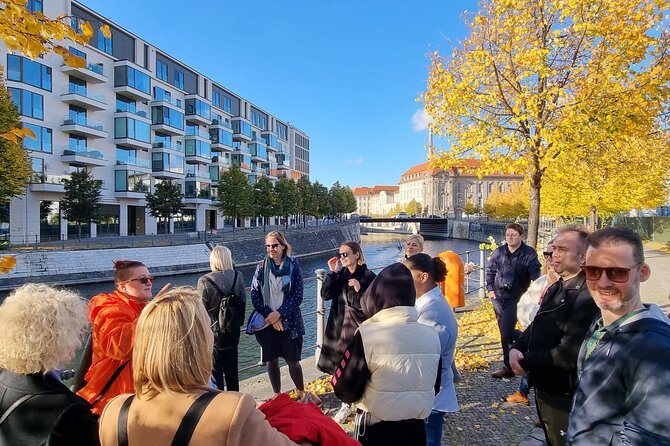
The walk ends near Humboldthafen, close to Design Offices Berlin Humboldthafen. Here, the focus moves to East Berlin and the period after World War II.
Just outside the Charité campus, several East Berliners attempted to reach the West by swimming across the city canal. The location gives you a physical connection to the risks of the divided city. A canal beside a hospital may look ordinary, but the stories attached to it show how sharply daily life was controlled during the socialist era.
You also hear about life inside the hospital during East Germany’s socialist period and after the Berlin Wall fell. That makes the ending broader than a Cold War anecdote. It brings the institution into recent memory and shows how Charité continued to change as Berlin changed around it.
The route finishes at Alexanderufer, 10117 Berlin, by the Humboldthafen canal. Berlin Central Station is about a 10-minute walk away, which is handy if you are continuing to another part of the city. The ending is less ceremonial than a return to the starting point, but it is practical and gives you a simple onward connection.
What the $30.12 price covers
At $30.12 per person, this is a mid-priced short walking tour. The fee includes the guide, all taxes, and the tour’s planned stops. You do not pay separate admission charges at any of the six locations.
The value depends on what you want from Berlin. If you only want to see the buildings, you can walk around the Charité area yourself. If you want the links between Koch, Virchow, von Graefe, Nazi medicine, East Berlin, and the hospital’s founding, the guide is the reason to pay.
A two-hour duration also keeps the cost in proportion. You are not committing half a day or losing an afternoon to a specialist museum. For someone curious about science, ethics, and Berlin’s political past, the price is fair because the tour turns scattered sights into one clear story.
The tour is often booked about 19 days ahead, so I would not leave it until the last minute if your dates are fixed. Confirmation arrives when you book, and the mobile ticket makes the practical side simple.
Who will get the most from this walk
I would recommend this tour to you if you enjoy Berlin’s history but want something beyond the usual wall, palace, and war sites. It suits people interested in medicine, public health, science, architecture, and the moral choices made by institutions.
It also works well if you have only a short window in the city. The six-stop plan is focused, and the end near Central Station makes it easy to fit into a day of sightseeing.
The subject may be less suitable if you want to go inside hospital buildings or spend a long time with exhibits. This is an outdoor walking tour, not a hospital museum visit. You should also be comfortable with serious material concerning medical abuse and wartime conduct.
Most people can participate, and service animals are allowed. The tour requires good weather, so poor conditions can lead to a different date or a full refund.
Practical details that affect your day
Wear shoes suited to a two-hour city walk. The information provided does not specify the exact walking distance, but you will move between six locations, so plan for regular walking rather than standing in one place.
The small-group limit is 15 people. That is large enough to have some energy but small enough for the guide to address questions without losing the group. Since one of the strongest points in the available feedback is the leader’s storytelling, staying close enough to hear clearly will matter.
The start is at Robert-Koch-Platz. The finish is at Alexanderufer beside Humboldthafen, about 10 minutes on foot from Berlin Central Station. The tour is in English and uses a mobile ticket.
Free cancellation is available up to 24 hours before the start time for a full refund. Changes or cancellations inside that 24-hour window are not accepted for a refund. Cutoff times use local Berlin time.
Should you book the Charité walking tour?
Book it if you want a compact, thoughtful look at Berlin through medicine. The best parts are the range of subjects, the strong individual stories, the small group, and the final connection between Charité and the city’s divided past.
Skip it if your priority is entering hospital buildings or seeing medical collections indoors. At $30.12, the tour earns its price through the guide’s explanations, not through included exhibits.
For a short English-language walk with a clear route and unusually broad subject matter, I would put this high on the list for curious visitors who have already seen Berlin’s standard sights or want a different way to understand the city.
FAQ
How long does the Charité Hospital Walking Tour last?
The tour lasts approximately two hours. Each of the six planned stops is scheduled for about 20 minutes.
What language is the tour offered in?
The tour is offered in English.
Where does the tour start?
It starts at Robert-Koch-Platz, 10115 Berlin, Germany.
Where does the tour finish?
It finishes at Alexanderufer, 10117 Berlin, by the Humboldthafen canal. Berlin Central Station is about a 10-minute walk away.
Are admission tickets included?
All fees and taxes, along with the guide, are included. The listed stops have no admission charge. The tour does not include visits inside buildings used for clinical or university operations.
How large is the tour group?
The tour has a maximum of 15 participants.
What happens if the weather is poor?
The experience requires good weather. If it is canceled because of poor weather, you will be offered another date or a full refund.
Newest history tours we have reviewed in Berlin
- Berlin Food & Cultural Tour: Must-Try German & Berliner Classics★ 5.0 · 51 reviews
- Small-Group Historical Bike Tour in Berlin★ 4.5 · 103 reviews
- Historic center of Berlin – Tour in Italian★ 5.0 · 143 reviews
- Private Tour: Jewish Heritage Walking Tour of Berlin★ 5.0 · 29 reviews
- East Berlin Food & History Tour with Eating Europe★ 5.0 · 204 reviews
- Private Berlin WWII and Cold War History Tour with Local Expert Guide★ 5.0 · 28 reviews
- Berlin: Private Bike Tour of the Berlin Wall and Third Reich★ 5.0 · 23 reviews
- Where It All Began: Berlin’s Queer & Trans History Tour★ 5.0 · 27 reviews
History Walking Tours, compared.

History and Hauntings of Salem Guided Walking Tour
Read our review →

Freedom Trail History Small Group Walking Tour
Read our review →
Historic Charleston Guided Sightseeing Walking Tour
Read our review →
Tapas Walking Tour with Food, Wine, and History
Read our review →
Savannah History and Haunts Candlelit Ghost Walking Tour
Read our review →
A History of Terror – Belfast City Centre Walking Tour
Read our review →Browse the lists this tour appears in