
Review · NORWAY HISTORY TOURS
Bergen in Your Pocket: Landmarks and Lore Audio Tour
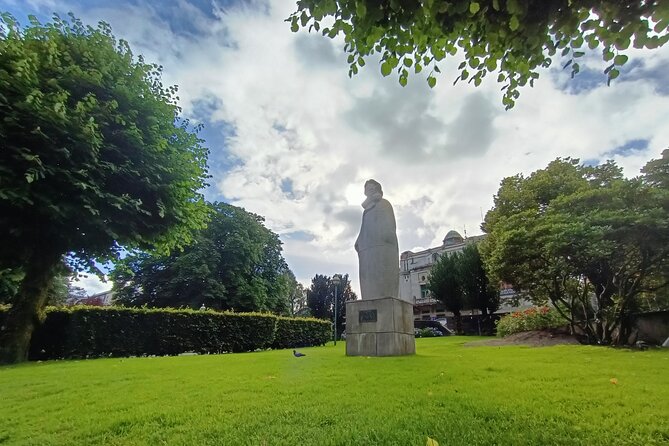
Bergen’s story is written across its squares, statues, cathedral walls, and harbor streets. This self-guided walk links those pieces in about 45 minutes to 1 hour 15 minutes, beginning with King Olav Kyrre and ending at writer Ludvig Holberg.
I like the offline maps and audio, which let you keep moving without worrying about a signal. I also like the mix of famous names, from Edvard Grieg to Henrik Ibsen, with less cheerful history at the Gestapomuseet and the cannonball still set in the cathedral façade. The tradeoff is simple: you guide yourself, and the tour does not take you inside any museums or attractions.
Key points at a glance
- A compact central route: Walk from the King Olav Kyrre sculpture to the Ludvig Holberg statue through Bergen’s main squares and streets.
- A good history mix: Hear about medieval power, maritime trade, famous artists, and the Nazi occupation.
- Offline access included: Download the VoiceMap app, audio, map, and geodata before you set out.
- Flexible timing: The route takes roughly 45 minutes to 1 hour 15 minutes, depending on your pace and stops.
- Several notable statues: See Christian Michelsen, Edvard Grieg, Ole Bull, Henrik Ibsen, and the Sailor’s Monument.
- A low-cost introduction: At $8.99 per person, it costs less than many guided walks, but you do not get a live guide or attraction admission.
Starting with King Olav Kyrre in central Bergen
The route begins in front of the steel sculpture of King Olav Kyrre at Strømgaten 6. This is more than a convenient meeting point. The opening section uses the king and the city’s origins to explain how Bergen began and how it expanded over time.
That start gives you a useful frame for the rest of the walk. Bergen was once the medieval capital of Norway and later became Scandinavia’s main commercial centre until the 1600s. Its position on the coast helped shape its fortunes, and the city’s long connection with sea trade still appears in its monuments and public spaces.
I like this opening because it gives the walk a clear historical direction. You are not simply ticking off statues. You are following the growth of a small coastal city that became a seat of royal power and an important trading town.
The route is private in the sense that only your group uses your booking, but it is not a private live tour with a guide beside you. You listen through the VoiceMap app on your own phone, using headphones if you prefer. That distinction matters if you are expecting conversation, questions, or personal recommendations along the way.
More Self-Guided History Audio Tours in the world:
- Taormina: Ancient Theater Skip-the-Line Ticket & Audio Guide
★ 4.5 · 2,412 reviews - Athens: Ancient Agora E-Ticket and Audio Tour
★ 3.9 · 413 reviews - Katakolo Port: Transfer to Ancient Olympia and VR Audio Tour
★ 4.1 · 403 reviews
Festplassen and Bergen’s public squares
From the starting point, the walk moves through Festplassen Plaza. This broad public square gives you a chance to settle into the route before the stops become more concentrated in the city centre.
The appeal of a self-guided walk here is its pace. You can pause to look around, take photographs, or replay a section if you missed a detail. The route is planned for a leisurely walk, not a race between landmarks.
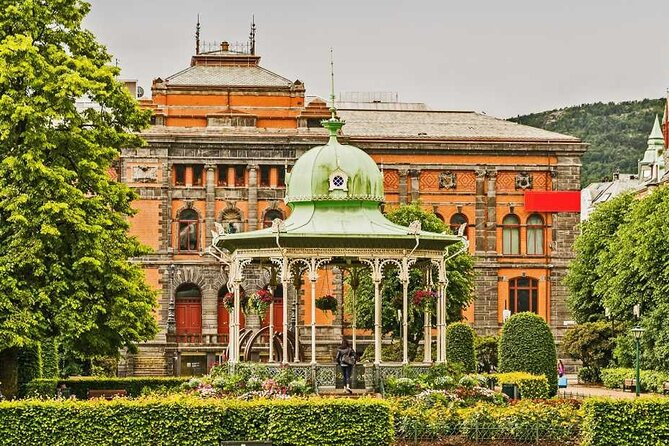
You then pass through city parks and squares, including the area around the Musikkpaviljongen, or Music Pavilion. These spaces help you see how Bergen works as a living city, not just as a collection of old buildings. The route uses public places to connect the city’s cultural life with its political and commercial past.
This part may feel less dramatic than Bergen’s famous harbor district, but it helps break up the history with open space. If you are arriving by cruise ship or have only a short time in town, the central location also makes the walk fairly easy to fit around other plans.
Meeting Bergen’s artists and political figures
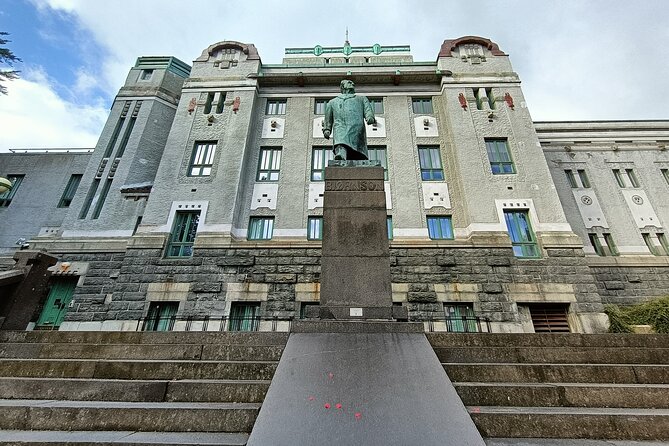
A strong feature of this tour is its attention to statues. You will see the statue of Christian Michelsen, a Norwegian politician and national hero. His presence gives the audio guide a chance to discuss national identity and the people Bergen has chosen to honor in its public spaces.
The walk then brings you to Edvard Grieg’s statue. Grieg is one of Norway’s best-known composers, and the stop adds a musical note to the city’s story. You do not need to enter a concert hall or museum to get something from this section. The statue and the surrounding streets become a simple outdoor introduction to his place in Norwegian culture.
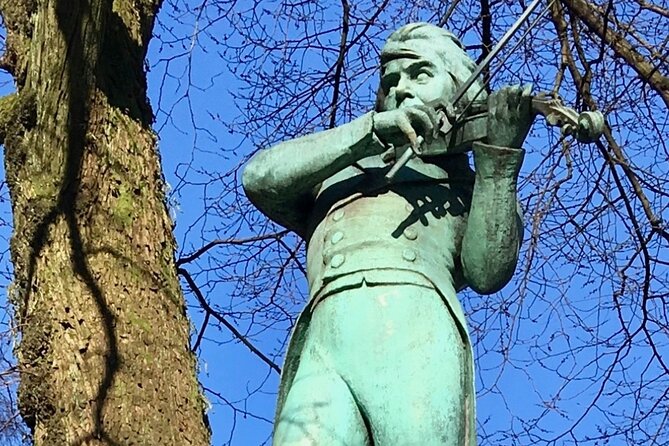
Next comes Ole Bull, the celebrated violinist whose statue sits on top of a fountain. This is one of the more distinctive monuments on the route. It is also a good example of how Bergen’s memorials are not all formal figures on pedestals. Some are built into the city’s everyday spaces.
Henrik Ibsen appears next in granite form. The playwright is one of Norway’s major literary figures, and his statue adds another layer to the route’s portrait of Bergen’s cultural life.
I like this sequence because it gives you four different ways to think about the city: politics through Michelsen, music through Grieg and Bull, and theatre through Ibsen. The walk does not treat Bergen only as a gateway to the fjords. It shows a city with its own artistic and intellectual life.
The National Theatre and Bergen Cathedral
The central section takes you past important buildings, including the National Theatre and Bergen Cathedral. These are exterior stops, so you should plan to visit inside on your own if you want a closer look.
The National Theatre fits naturally into the earlier stops for Ibsen and the city’s creative figures. Bergen Cathedral shifts the mood toward the city’s religious and architectural past. Together, these buildings show how much of Bergen’s story can be read within a short walk through the centre.
One small detail makes the cathedral especially appealing: a 17th-century cannonball is embedded in its façade. It is the sort of thing you could easily miss if you walked past without context. The audio stop gives you a reason to look closely at the stone instead of simply photographing the building from a distance.
That is where this tour works best. It points out details that are easy to overlook and explains why they matter. You still need to look for the cannonball yourself, but the app helps direct your attention.
More History Tours in the world:
- New York City: American Museum of Natural History Ticket
★ 4.5 · 15,447 reviews - History and Hauntings of Salem Guided Walking Tour
★ 5.0 · 14,564 reviews - Colosseum: Underground and Ancient Rome Tour
★ 4.7 · 12,691 reviews - Lisbon: History, Stories and Lifestyle Walking Tour
★ 4.8 · 10,902 reviews
Bergen’s darker story at the Gestapomuseet
The stop near the Gestapomuseet introduces the Nazi occupation and Bergen’s wartime past. This section changes the tone of the walk. The route moves away from statues and public culture to the city’s experience under occupation.
The audio also tells you about the only way prisoners could escape from the torture rooms. That detail gives the stop a stark, human focus. It is not presented as a general wartime lecture. Instead, the route ties the history to a particular place in the city.
I value this inclusion because a city tour should not smooth away the difficult parts of local history. Bergen’s famous buildings and scenic setting are only part of its story. The occupation period adds weight and reminds you that these streets have seen far more than commerce and tourism.
You should keep your expectations clear, though. The tour does not guide you through the Gestapomuseet. If you want to visit a museum or attraction mentioned along the way, admission is separate and you will need to make that visit on your own.
Torgallmenningen and the Sailor’s Monument
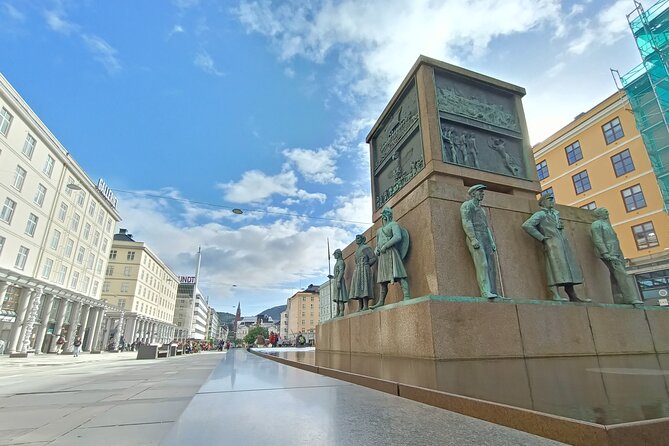
The route continues down Torgallmenningen toward the Sailor’s Monument. This is one of the city’s major public spaces and a useful place to see Bergen’s connection with the sea.
The Sailor’s Monument honors Norwegian sailors, their work, and their adventures at sea. It is an important stop because maritime life is central to Bergen’s identity. The city’s commercial power did not develop in isolation. Ships, sailors, trade, and coastal connections made that growth possible.
The monument also gives the tour a physical link between Bergen’s earlier commercial role and its modern public memory. You are not only hearing that Bergen was a trading centre. You are seeing how the city commemorates the people who carried goods, news, and risk across the water.
For me, this is one of the route’s most useful transitions. The earlier statues focus on individual artists and politicians. Here, the subject expands to a whole group of people whose work shaped Norway.
Skotstredet and the final statue
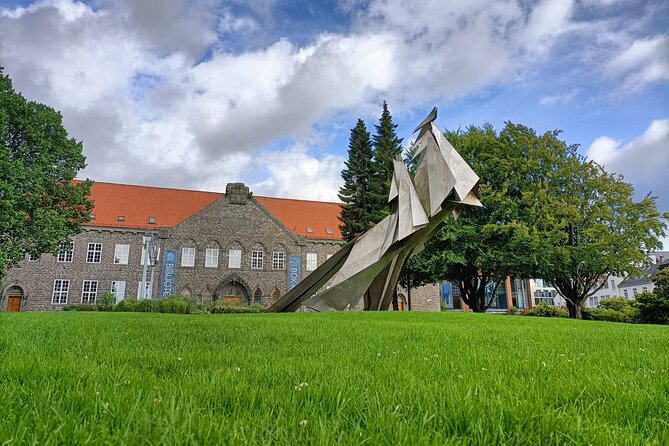
Near the end, the walk leads you into Skotstredet, described as one of Bergen’s trendiest areas. This gives the route a more current feel after its long look at kings, composers, playwrights, sailors, and wartime history.
Skotstredet helps show that Bergen is not frozen in its past. The route moves from medieval origins and historic monuments into a part of the city associated with present-day energy. You may find this section especially useful if you want to pair the audio walk with your own choice of cafés, shops, or additional exploring, though food and drinks are not part of the tour.
The audio ends in Vågsallmenningen square, in front of the statue of Ludvig Holberg. Holberg was a writer and poet, and his statue provides a fitting final stop after a route that has given so much attention to Norwegian culture.
Ending here also makes the walk feel complete. You begin with a king connected to Bergen’s early growth and finish with a literary figure linked to the city’s later cultural life. The route covers a lot without requiring a long trek across the city.
What the VoiceMap format means for you
This is an audio tour, not a walking tour with a person leading your group. You receive lifetime access in English through the VoiceMap app for Android and iOS. Offline access includes the audio, maps, and geodata, which is valuable if you download everything before setting out.
The app is designed to make the route easy to follow. You can use the map to locate each stop and walk at your own speed. The tour has been described as easy to understand and user-friendly, which is important because a self-guided route is only useful if the directions do not distract you from the city.
You will need to supply your own smartphone and headphones. There is no transportation, food, or drink included. Most people can take part, but you should be comfortable walking through city streets while managing your phone and audio.
The flexibility is the main benefit. You can pause when a square catches your eye, stop for a photograph, or take a break without holding up a group. The weakness is the lack of a live person who can answer a question or adjust the route for your interests.
Is $8.99 a fair price?
At $8.99 per person, this is a modest way to get an introduction to central Bergen. The value is strongest if you want history and orientation without committing to a scheduled group tour.
You are paying for a prepared route, spoken commentary, maps, and lifetime access in English. If you use the tour once, the cost is still reasonable for a walk of up to 75 minutes. If you return to Bergen or want to repeat sections at a slower pace, lifetime access gives the purchase a little more weight.
The comparison is not with a free stroll. It is with the cost of a live guided walk, where you would normally pay more for a person’s time and gain the ability to ask questions. This audio tour gives you privacy and control instead.
The published score is 4.6 out of 5 from 22 ratings, with 95 percent recommending it. One practical issue has been noted: a statue may be difficult to find if it is being renovated. That is a fair warning for any statue-based route. Public monuments can be moved, covered, or temporarily blocked, and the audio cannot fix that.
Who should choose this Bergen walk?
I would choose this tour if you want a compact first look at Bergen’s centre and prefer to set your own pace. It suits independent visitors, couples, families with older children, and anyone who wants context before exploring the city on foot.
It is especially useful for:
- A first orientation to Bergen’s central streets
- A short stop between other plans
- Visitors interested in statues, music, literature, and politics
- People who prefer audio commentary to a scheduled group
- Anyone who wants offline navigation and lifetime access
- Visitors who do not need museum admission included
I would look elsewhere if you want a local guide, a long visit inside historic buildings, or a route focused mainly on food and the harbor. The tour passes important attractions, but it does not include entry or guided time inside them.
You should also allow extra time if you want to pause often or enter places along the way. The stated duration is about 45 minutes to 1 hour 15 minutes, but your own visits are separate from that timing.
Should you book Bergen in Your Pocket?
Book it if you want a low-cost, self-paced introduction to Bergen’s history and public monuments. The best parts are the clear route through central squares, the range of figures from Grieg to Ibsen, the cannonball detail at the cathedral, and the honest look at the occupation period.
Skip it if the idea of following an app feels like work or if you expect a guide to walk beside you. For everyone else, $8.99 buys a useful hour of background and orientation, with enough flexibility to make the city your own afterward.
FAQ
How long does the Bergen audio tour take?
The walk takes approximately 45 minutes to 1 hour 15 minutes. Your total time may be longer if you stop to take photographs or visit attractions independently.
What language is the audio tour offered in?
The tour is offered in English.
Where does the tour begin?
It begins in front of the steel sculpture of King Olav Kyrre at Strømgaten 6, 5015 Bergen, Norway.
Where does the tour end?
It ends in Vågsallmenningen square, in front of the Ludvig Holberg Statue at Vågsallmenningen 4, 5014 Bergen, Norway.
Are museum visits included?
No. The tour does not guide you through museums or other attractions mentioned along the route. Any admission fees are paid separately.
Do I need an internet connection during the walk?
The tour includes offline access to the audio, maps, and geodata through the VoiceMap app. You need your own smartphone and headphones.
Newest history tours we have reviewed in the world
- Enjoy Ancient Mostar★ 4.0 · 45 reviews
- Private Dublin Historical and Heritage Tour by Bike★ 5.0 · 30 reviews
- Dubrovnik by Night, History, Wine & Bites★ 5.0 · 41 reviews
- Historical Walking Tour of Dublin★ 5.0 · 50 reviews
- DayTripper Dublin: A Guided City Walking Tour★ 5.0 · 90 reviews
- Ancient Old City– Finest tour of Dubrovnik★ 5.0 · 64 reviews
- Dublin LGBTQ Pride Historical and Cultural Walking Tour★ 5.0 · 91 reviews
- Interactive Living History in Dalkey Castle near Dublin City★ 5.0 · 133 reviews
Self-Guided History Audio Tours, compared.

Taormina: Ancient Theater Skip-the-Line Ticket & Audio Guide
Read our review →
Katakolo Port: Transfer to Ancient Olympia and VR Audio Tour
Read our review →
Matera: Sassi di Matera Historical Self-Guided Audio Tour
Read our review →
Self-Guided Ngilgi Cave Ancient Lands Experience
Read our review →
Hagia Sophia History Museum Entry with Audio Guide
Read our review →

Browse the lists this tour appears in