
Review · ITALY HISTORY TOURS
Matera: Sassi di Matera Historical Self-Guided Audio Tour
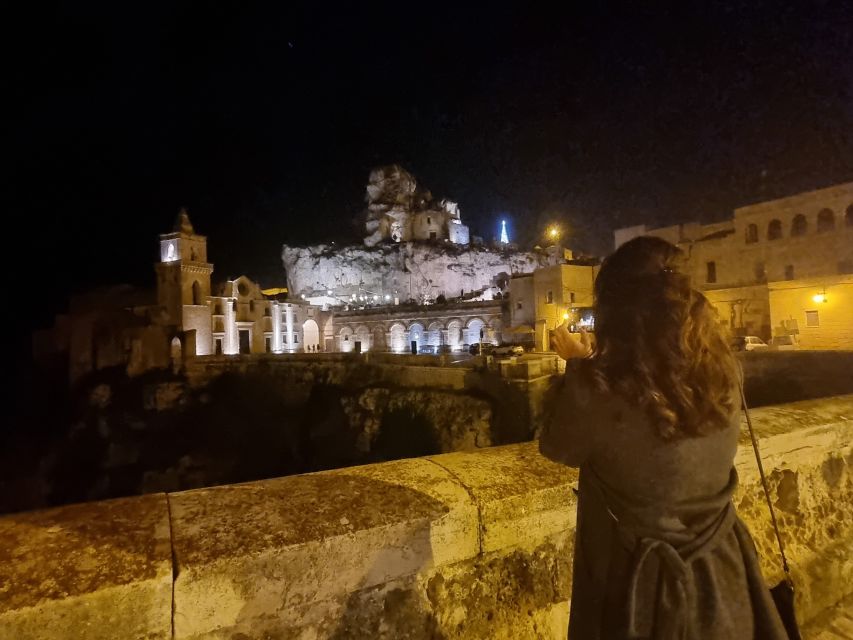
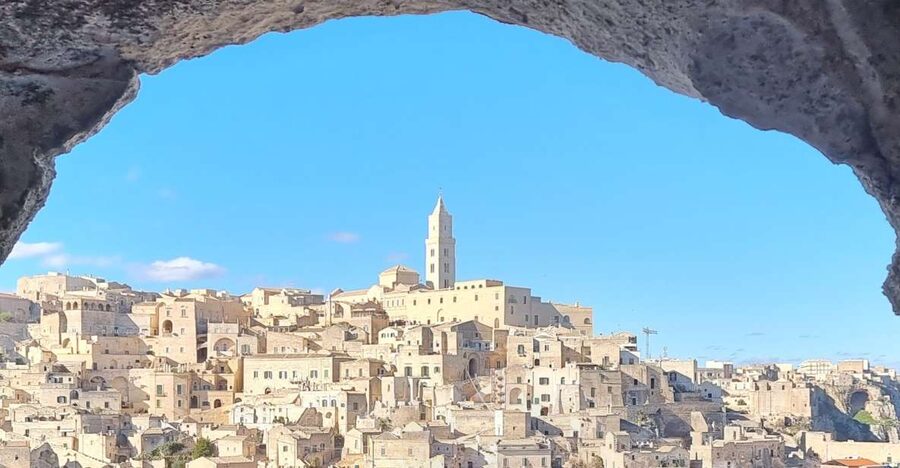
The most striking thing about Matera is that the city seems to grow out of the rock. The Sassi, or Stones, fill two valleys with caves, stairways, churches, cisterns, and homes cut into soft limestone. This self-guided tour lets you explore that world without a group, timetable, or meeting point.
I like the freedom to stop for a photo, linger at a viewpoint, or pause the commentary when the streets get confusing. I also like the price, about $4.70 per person, and the 365-day validity, which makes this a low-risk way to add context to a visit. The main drawback is that the commentary appears strongest at individual sights, with less broad explanation of where Matera fits in the wider story of southern Italy.
Key points to know before you go
- More than 30 geolocated stops: The app guides you to outdoor points around the Sassi and plays the related audio when you reach them.
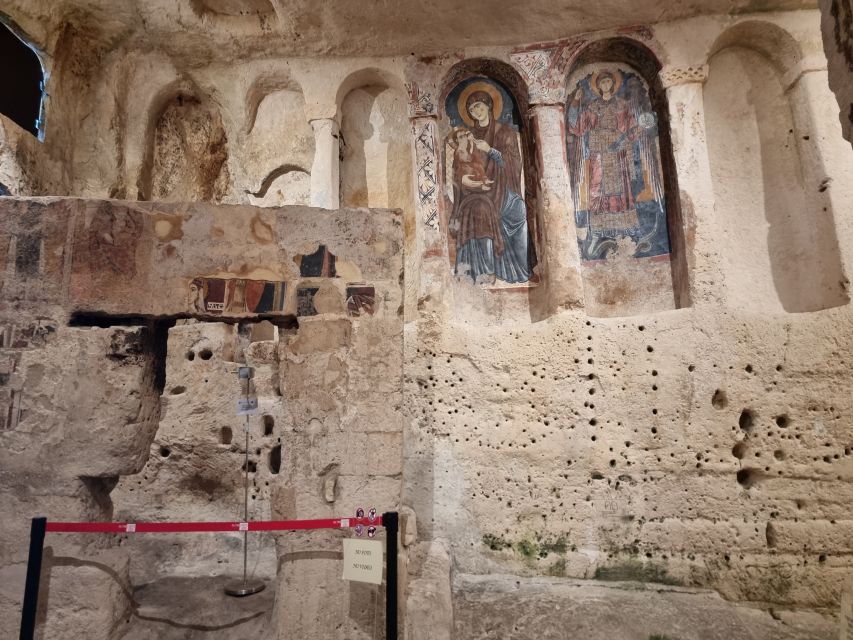
- Caves and rock churches: Expect information about natural caves, underground spaces, cisterns, and churches decorated with Byzantine frescoes.
- Four language choices: Audio is available in English, French, German, and Italian.
- Bring your own phone: You need an Android or Apple smartphone, and earphones are useful but not required.
- No entrance tickets included: The audio covers the visit, but paid interiors or museums require separate tickets.
- Flexible for independent sightseeing: There is no meeting point, fixed group, or set departure time.
Why Matera works so well with an audio guide
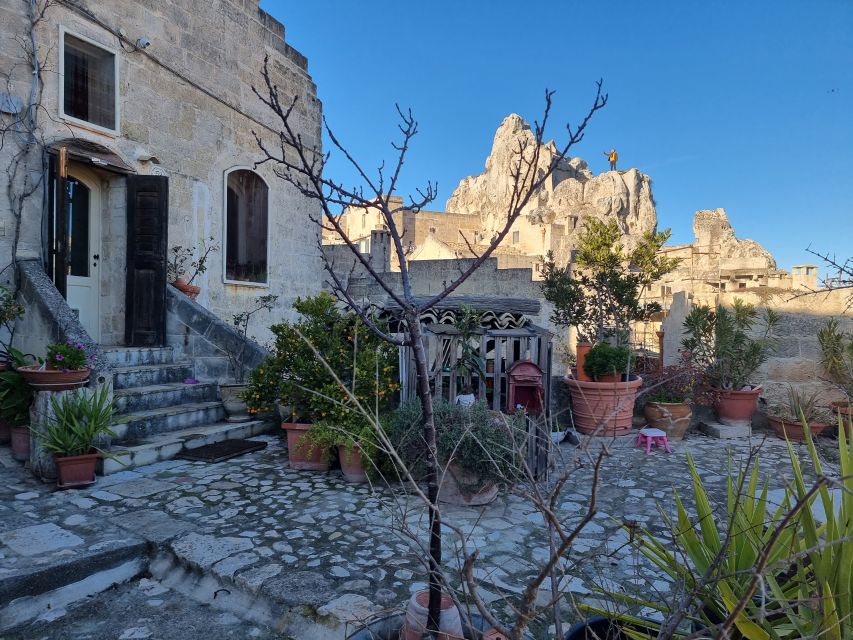
Matera is not a city you understand from one postcard view. The Sassi are a network of ravines, cave dwellings, lanes, terraces, and churches. You can admire the stone from outside and still miss how people lived inside it, how water was collected, or why so many small churches were carved into the rock.
That is where an audio guide earns its small fee. You can look at a cave entrance and immediately hear how caves served as dwellings, shelters, places of worship, and storage spaces. The setting remains in front of you while the explanation fills in the missing pieces.
I find this format especially useful in Matera because the streets do not behave like a tidy museum route. You may walk uphill, turn down a lane, cross a stone terrace, and suddenly find yourself beside a church or a view across the ravine. A phone-based guide lets you set your own rhythm instead of trying to keep up with a group.
The ITGUIDES app uses geolocation for outdoor attractions. That means the audio is tied to places on the ground, not just a general recording about Matera. You still need to pay attention to your phone and surroundings, but the location-based format can help you connect the sound to the building or feature you are looking at.
More Self-Guided History Audio Tours in Italy:
- Taormina: Ancient Theater Skip-the-Line Ticket & Audio Guide
★ 4.5 · 2,412 reviews - Rome: Ancient Baths of Caracalla Ticket & Audio Guide
★ 4.2 · 99 reviews - Pisa: Historic Center Tour by Bike Self-Guided
★ 4.4 · 68 reviews
The Sassi’s caves and ancient urban fabric
The tour’s central subject is the Sassi themselves. The name means Stones, and it describes the area’s appearance as much as its geology. Natural caves were gradually enlarged and adapted by people over many centuries.
Human use here reaches back to the Neolithic period. Caves served as homes, shelters, natural refuges, and religious spaces. That long continuity is what gives Matera its unusual character. You are not simply seeing a medieval quarter preserved in stone. You are looking at a place shaped by repeated use from prehistoric times through the Middle Ages and into modern life.
The audio stops can help you read features that otherwise look like ordinary rock. A wall may hide a cistern. A dark opening may once have been a room. A stepped passage may link spaces that were built at different times. The guide’s value is strongest when it turns these rough surfaces into evidence of daily life.
The route covers more than 30 points of interest, though the supplied details do not name every stop. That gives you broad coverage of the area, but you should not expect a detailed architectural lecture at every corner. The commentary is described as essential at some monuments, with exterior information and interior information at selected sites.
That distinction matters. If you want a full scholarly study of every church, room, and fresco, this is probably too light. If you want useful explanations as you walk, without paying for a private guide, the format makes good sense.
Rock churches and Byzantine frescoes
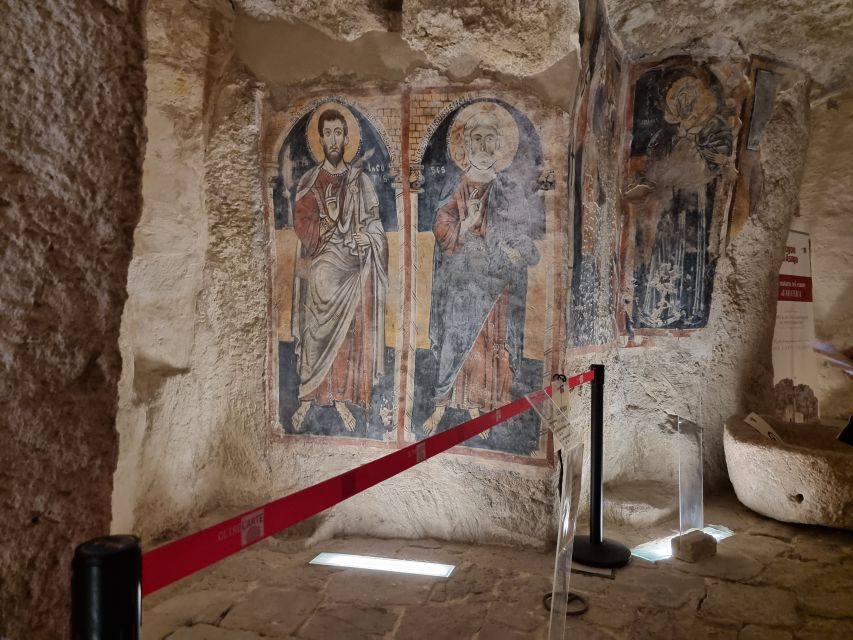
Matera’s churches carved into rock are among the most memorable parts of the visit. The area contains 155 rock churches, and the tradition reached a high point here. Many were decorated with Byzantine-style frescoes, reflecting the influence of communities from Armenia, Syria, Cappadocia, and Asia Minor.
During the Middle Ages, lay people and monks who had been persecuted in their home regions sought refuge in the caves. They brought religious practices and artistic influences with them. The result was a local style shaped by eastern Christian traditions and the materials available in the rock.
The audio guide can give you the basic setting for these churches before you look inside. That is useful because a small carved chapel may appear plain at first glance. With some context, you can pay attention to the wall paintings, the shape of the chamber, and the way worship took place in a space that was never designed like a large cathedral.
Keep your expectations realistic about interiors. Entrance tickets are not part of the audio tour, so you may need to pay separately for sites that charge admission. Also, not every audio point should be assumed to include an open interior. The information specifically covers outdoor attractions through geolocation and describes interiors at some locations.
For the best experience, download everything before setting out, then use the guide as a companion to the places that are open. It is frustrating to reach a church and discover that the commentary is unavailable because the file was not saved or the phone signal is weak.
Cisterns, ravines, and the practical side of life
Matera’s beauty can make it easy to forget that the Sassi were working neighborhoods. Water collection was a basic concern, and underground cisterns formed part of the settlement’s infrastructure. Caves and ravines were not just scenic features. They were practical spaces that supported homes and communities.
A self-guided audio tour is well suited to this subject because you can stop beside a cistern or underground feature and hear how it fit into the settlement. The experience becomes less about looking at old stone and more about understanding how people managed water, shelter, worship, and movement.
You should allow time to look around between audio points. The guide is not a substitute for noticing the city yourself. Pause the recording when you want to study a doorway, inspect a carved wall, or take in the view across the ravine.
The Sassi can also be physically demanding. The supplied information describes the activity as wheelchair accessible, but the area includes caves, ravines, stairs, and uneven historic streets. Accessibility can vary from one point or interior to another, so anyone with specific mobility needs should confirm which locations can be reached and entered before relying on the full route.
More Guided Tours in Italy:
- Rome: Colosseum with Arena, Roman Forum and Palatine Guided Tour
★ 4.0 · 5,598 reviews - Venice: St. Mark’s Basilica Guided Tour & VR History Intro
★ 3.9 · 4,880 reviews - Colosseum with Arena, Roman Forum and Palatine Hill Guided Tour
★ 4.5 · 3,526 reviews - Colosseum Underground & Ancient Rome Guided Tour
★ 4.5 · 2,590 reviews
Matera’s difficult modern chapter
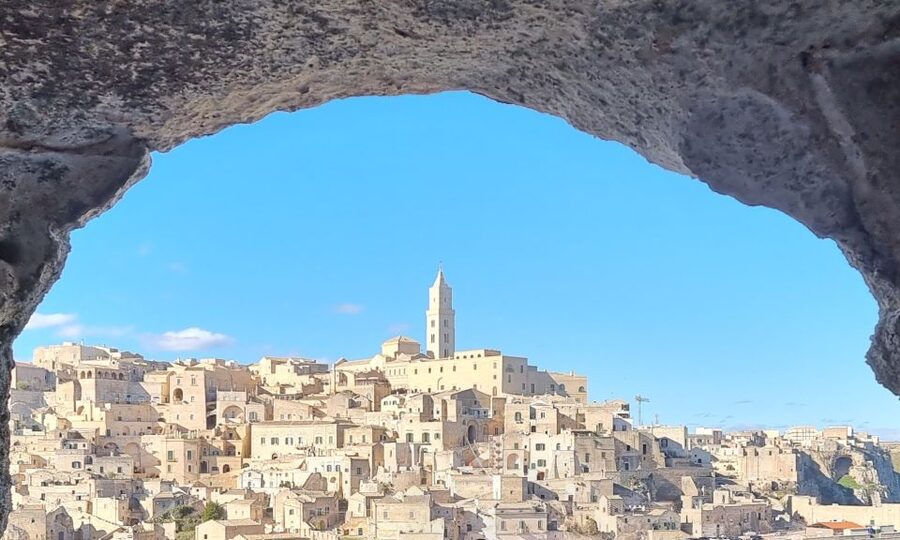
The audio content is not limited to ancient and medieval stories. One of the most important parts of Matera’s past comes after the Second World War, when almost 20,000 people still lived in the Sassi.
Living conditions were difficult, and the Italian government passed the Sassi Law in 1952, setting aside funds for a major restoration and relocation effort. Moving families out of caves they had occupied for generations was not a simple act of urban planning. It meant breaking long-standing ties to homes, neighborhoods, and ways of life.
This chapter helps prevent a common misunderstanding. Matera is not an untouched old town that simply survived into the present. It was once treated as a serious social and public health problem, then gradually became a place of restoration and cultural interest.
The supplied comments suggest that the tour gives useful information about individual monuments but may offer less general historical framing. I would keep that in mind as you listen. The app can explain what you are standing beside, but you may want to supplement it with your own reading if the postwar story is a major reason for your visit.
How the ITGUIDES app shapes the visit
Before you begin, download the free ITGUIDES app and try the demo. You will receive instructions with your voucher explaining how to download and redeem the guide. The practical rule is simple: use a strong Wi-Fi or cellular connection to save all the content before entering the Sassi.
The guide is available in English, French, German, and Italian. Select the language that lets you listen comfortably, since the value of an audio tour depends on how easily you can follow the details while walking.
Earphones are recommended but not required. I would bring them, especially if you are visiting with someone else or want to hear the commentary clearly in busy public spaces. If your phone battery is weak, charge it before starting. The tour depends on your own device, so there is no guide carrying equipment or handing you a receiver.
There is no meeting point. You start independently, and the activity has no fixed group departure. The stated duration is 365 days, which refers to the validity period rather than the number of hours needed to walk the route. You can use the guide during that period, subject to availability and the booking details.
The geolocation feature is useful, but do not treat it as a perfect replacement for a map. Buildings can be close together, phone signals can vary, and historic lanes can be hard to read at a glance. Keep your bearings, listen for the relevant point, and do not rush simply because the next stop appears nearby.
What the $4.70 price really gives you
At about $4.70, this is one of the less expensive ways to add organized commentary to a Matera visit. The price is appealing because you are paying for access to a phone guide covering more than 30 points, not for a fixed time slot that ends after a short walk.
The 365-day validity adds unusual flexibility. You can book well ahead, change your plans, or use the guide on a later visit without the pressure of a same-day reservation. Free cancellation up to 24 hours before the activity and reserve-now, pay-later booking also reduce the risk of committing too early.
Still, the low price comes with clear limits. There is no live guide to answer questions, adjust the route, or explain a point in a different way. Entrance fees are separate, and you provide the smartphone and earphones.
I see this as a good-value basic guide, not a full replacement for a private historian. The price works best if you want independent structure and a little context. It works less well if you expect long explanations, personal storytelling, or detailed discussion of every monument.
Who will appreciate this tour most
This experience suits independent visitors who dislike fixed schedules. You can stop for lunch, return to a point, or take a break without holding up a group. It also works well for couples or families who want to explore together while keeping the day relaxed.
It is a sensible choice if you already know that you prefer listening to short explanations rather than reading long panels. The clear route and self-paced format make it easy to adjust the visit to your interest level.
It may also suit a repeat visitor. The app’s long validity means you could use it on a first walk through the Sassi, then return to selected points later. You do not need to hear every recording in one session.
I would look elsewhere if you want a guide to lead you through the most important interiors or provide a detailed overview of Matera’s place in Italian history. The supplied rating of 3.6 from 183 bookings suggests a mixed experience overall, so it is wise to see this as a modest, practical product rather than a polished substitute for a specialist tour.
My practical plan for using the guide
Download the app and all audio files before leaving your hotel or another place with dependable Wi-Fi. Test the demo, check your chosen language, and make sure your phone has enough storage and battery.
Start with the points that interest you most, then let the geolocation guide you through the rest. Since the tour includes more than 30 locations, listening to every recording back to back may feel tiring. Use the pause button freely.
Give yourself time for the rock churches, cave spaces, and cistern-related points. These are the places where the audio can add the most meaning to what you see. For paid interiors, check the entrance requirement before you assume the audio includes admission.
Finally, keep the bigger story in mind. Matera is not only a collection of attractive stone buildings. Its significance comes from the long use of the caves, the eastern Christian influence, the difficult living conditions of the twentieth century, and the slow work of restoration.
Should you book it?
Book this audio tour if you want an inexpensive, flexible introduction to the Sassi and are comfortable exploring with your own phone. The strongest reasons are the low price, four language options, more than 30 geolocated points, and the freedom to walk at your own speed.
Skip it if you want a live guide, detailed historical debate, or guaranteed access to every church interior. For most independent visitors, though, it is a useful layer of explanation for a remarkable place, provided you download the material first and keep your expectations in line with the price.
FAQ
Where does the tour meet?
There is no meeting point. This is a self-guided audio tour that you access independently through the ITGUIDES app.
How long is the tour valid?
The audio guide is valid for 365 days. This refers to the period in which you can use the product, not a required 365-day visit.
How much does the tour cost?
The listed price is $4.70 per person.
Which languages are available?
You can use the audio guide in English, French, German, or Italian.
How many points of interest are included?
The guide includes more than 30 geolocated points of interest.
Do I need a smartphone?
Yes. You need an Android or Apple smartphone to download and use the ITGUIDES app.
Do I need earphones?
Earphones are recommended but not mandatory.
Are entrance tickets included?
No. Entrance tickets are not included in the activity price.
Should I download the audio before visiting?
Yes. Download all content using a strong cellular connection or Wi-Fi before you start the visit.
Can I cancel the booking?
You can cancel up to 24 hours in advance for a full refund. The activity also offers reserve-now, pay-later booking.
Newest history tours we have reviewed in Italy
- Guided Cultural Tour of the Godfather Film in Messina★ 5.0 · 31 reviews
- SU NURAXI BARUMINI Unesco World Heritage Site★ 5.0 · 129 reviews
- Picnic aperitif in the vineyard of an ancient trullo in Martina Franca★ 5.0 · 21 reviews
- Brescia the Unexpected: History, Local Stories & a drink★ 5.0 · 31 reviews
- Bologna historical art walking tour with hidden gems and tastings★ 5.0 · 108 reviews
- Bolognese Cooking Class with Margherita in the Historic Center★ 5.0 · 26 reviews
- Best of Bologna in one day : Food, architecture, art and history★ 5.0 · 27 reviews
- Private or semi-private tour of the historic center of Bologna★ 5.0 · 34 reviews
Self-Guided History Audio Tours, compared.
Taormina: Ancient Theater Skip-the-Line Ticket & Audio Guide
Read our review →
Katakolo Port: Transfer to Ancient Olympia and VR Audio Tour
Read our review →
Self-Guided Ngilgi Cave Ancient Lands Experience
Read our review →
Hagia Sophia History Museum Entry with Audio Guide
Read our review →
Ancient Agora Self-Guided Tour with 3D & Audio (No Ticket)
Read our review →Browse the lists this tour appears in