

Review · NEW YORK CITY HISTORY TOURS
Hamilton and Washington Revolutionary Walking Tour
Lower Manhattan is where the story of the early United States feels most physical. On this three-hour walk, you move from Bowling Green to Trinity Church, tracing the lives of Alexander Hamilton and George Washington through streets, churches, taverns, banks, and government buildings tied to the nation’s first years.
I like the small maximum of 16 people and the guide’s long experience as a licensed New York City historian. I also like the way the tour connects familiar Hamilton musical locations with the less polished, more complicated history behind them. The main drawback is simple: you will spend much of the tour outdoors, walking and standing, and some key buildings may be closed or require separate admission.
Key points to know before booking

- Hamilton’s story is tied to real places: See the Custom House, Wall Street, Federal Hall, and Trinity Church, all linked to his work and legacy.
- Washington’s farewell happened at Fraunces Tavern: The tour explains his departure from his officers and why it mattered.
- The group is capped at 16: That makes questions and conversation easier than on a large coach-style tour.
- The walk stays in a compact part of Lower Manhattan: You cover a lot of history without crossing a huge stretch of the city.
- Guide quality is central: Bruce is the main name associated with the experience, and George has also led the tour.
- Plan for weather and standing: The tour operates in rain, snow, and sunshine, with no short-notice weather changes accepted within 24 hours.
Why this small Lower Manhattan walk works
The best thing about this tour is its sense of place. You are not simply hearing a classroom lecture about the Revolution. You are standing near the locations where New York’s political, military, and financial future took shape.
That matters because Lower Manhattan can feel like a wall of modern office towers. Without a guide, it is easy to walk past Federal Hall or Trinity Church and miss the fact that these places connect directly to the founding of the United States. A good narrator gives the streets a second layer.
The tour also avoids treating Hamilton as a figure who exists only through the musical. You will hear about his financial plans, his work as the first Secretary of the Treasury, his relationship with Washington, and his rivalry with Aaron Burr. The musical gives you a useful doorway into the story, but the tour goes beyond the songs and stage characters.
The experience costs $52.95 per person, which is not the cheapest way to spend three hours in New York. Still, the value rests in the guide. You are paying for a licensed historian who can connect scattered buildings and events into one clear story. If you already know the basic history and prefer to explore at your own pace, the price may feel high. If you want context, questions answered, and a human voice to make sense of the streets, it is a fair price for a small-group walk.
Bruce is repeatedly identified as the guide who brings the strongest personality to the experience. He has been described as funny, organized, warm, and able to adjust his delivery for children, adults, and mixed-age groups. George has also led the walk and received praise for working well with a multigenerational group. Guide assignments can vary, so you should not assume a particular person will lead your departure, but the format depends heavily on this kind of engaged storytelling.
More History Walking Tours in New York City
- #1 Rated NYC Chinatown Food and History Walking Tour with FNYT
★ 5.0 · 171 reviews - Tribeca Architecture And History Walking Tour
★ 5.0 · 141 reviews - Lower Manhattan Secrets And History Walking Tour
★ 5.0 · 96 reviews
Starting at the Alexander Hamilton U.S. Custom House
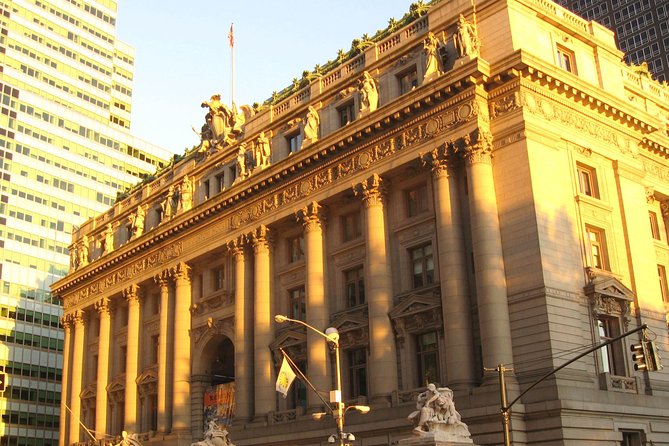
The meeting point is 1 Bowling Green, beside the Alexander Hamilton U.S. Custom House. This is a fitting place to begin because the building gives the tour its first direct connection to Hamilton’s government career.
The focus here is Hamilton’s role as the first Secretary of the Treasury. You will learn why customs duties and federal revenue mattered so much to the young nation, and how Hamilton’s financial ideas helped shape the new government.
The building itself is worth looking at even before the explanation begins. The tour does not treat it as a random grand structure. It uses the site to show how Hamilton’s work continued to influence the financial machinery of the United States.
The stop is scheduled for about 20 minutes. Admission is not included, so the experience is primarily about the exterior and the guide’s interpretation rather than a guaranteed interior visit. Arrive ready to listen outdoors, especially in winter, when the southern end of Manhattan can feel cold and exposed.
Bowling Green and the fall of King George III
The next stop is Bowling Green, where the walk turns to the rising anger that led to the Revolutionary War. This small park is one of the most useful places on the route because it connects political ideas with public action.
Here you hear about the destruction of the 4,000-pound lead statue of King George III. That episode gives a vivid sense of how quickly loyalty to the British Crown could turn into open rejection. It also helps explain why public symbols mattered so much in the years before and during the Revolution.
The stop is free and lasts about 20 minutes. Since the tour begins here, you should not confuse the meeting point with a later stop. The group starts at 1 Bowling Green and then uses the park as the first major history lesson.
This is also a good point to judge the pace. Much of the walk takes place in a small area, but the experience includes plenty of standing while the guide speaks. One visitor specifically described the tour as involving a lot of walking and standing, while another found that there was not much walking because so much history is packed into a compact area. Both observations can be true. The route is geographically short, but the stops are story-heavy.
Peter Minuit Plaza and Hamilton’s beginnings
At Peter Minuit Plaza, the focus shifts toward New York at the beginning of the Revolutionary War and Hamilton’s origins. This stop helps place the young Hamilton in the broader setting of a city shaped by trade, immigration, conflict, and political change.
The value here is context. Hamilton did not appear fully formed as the polished statesman seen in later portraits. His early life, ambition, and rise are part of the reason his New York story is so striking. The guide uses this location to connect his personal background with the city and the upheaval around him.
The stop lasts about 20 minutes and is free. It is one of the places where a strong guide matters most because the physical setting alone does not tell the whole story. Much of what you gain comes through the explanation, questions, and links between events.
More History Walking Tours in the USA
- History and Hauntings of Salem Guided Walking Tour
★ 5.0 · 14,564 reviews - Boston: Freedom Trail History Small Group Walking Tour
★ 5.0 · 6,450 reviews - Historic Charleston Guided Sightseeing Walking Tour
★ 5.0 · 6,216 reviews - Savannah History and Haunts Candlelit Ghost Walking Tour
★ 5.0 · 3,235 reviews
Fraunces Tavern and Washington’s farewell
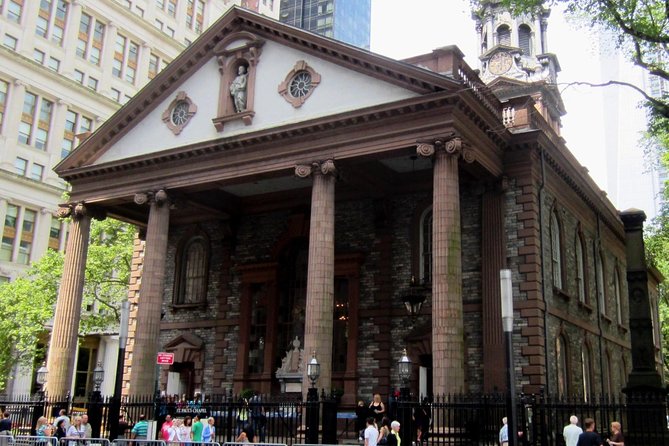
Fraunces Tavern is one of the most memorable stops because it is tied to George Washington’s farewell to his officers. This was not a routine military dinner. Washington’s departure from his troops carried unusual weight, and the guide explains why his decision mattered in the fragile early republic.
You also hear other stories connected with the tavern and the city’s Revolutionary period. The stop gives Washington a more personal setting than the formal government sites later in the walk. Instead of seeing him only as a general or president, you encounter the emotional and political pressures surrounding his departure from military leadership.
The planned visit lasts about 15 minutes. Admission is not included, so you should not expect the tour price to cover entry into the museum. The exact access can depend on opening conditions, but the location remains an important part of the walking route.
For me, this is the sort of stop that makes a history walk worthwhile. A date in a textbook can feel remote. A farewell in a tavern, tied to the people who were actually present, is easier to picture and remember.
The New York Stock Exchange and Hamilton’s financial plan
The route then reaches the New York Stock Exchange, where the guide discusses Hamilton’s financial plan and his connection to the institution. This is one of the tour’s more useful corrections to the idea that Revolutionary history is only about battles and speeches.
Hamilton’s work involved debt, credit, taxation, and the practical problem of making a new federal government function. The stop shows how financial decisions became part of the nation-building project.
Admission is not included, and the visit is scheduled for about 15 minutes. The focus is the surrounding location and the guide’s talk rather than a promise of a full interior tour.
If financial history usually makes your eyes glaze over, this is where the guide’s skill matters. The tour uses the site to connect money with power and politics, rather than presenting a list of dry policy details.
Wall Street, Hamilton’s bank, and Aaron Burr
At Wall Street, the guide brings Hamilton’s Bank of New York and Aaron Burr into the same part of the story. This is where personal ambition and public finance begin to overlap.
You learn about Hamilton’s connection to the bank and hear about Burr’s political aspirations. The rivalry between Hamilton and Burr is often simplified into a dramatic personal feud, but the route gives you a chance to understand the political setting around it.
This 20-minute stop is free and remains outdoors. It is also a good place to ask questions because the story covers several connected subjects: Hamilton’s economic ideas, Burr’s ambitions, and the political tensions of the young republic.
If you know the musical, you may recognize the broad outline of the rivalry. The useful part is seeing that conflict attached to actual streets and institutions rather than leaving it as a stage plot.
Federal Hall and Washington’s inauguration
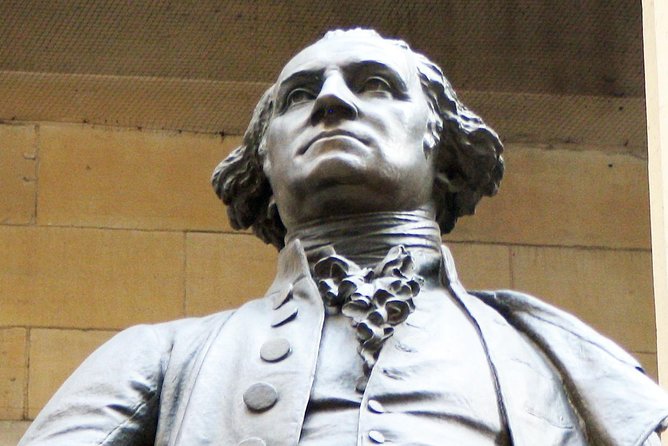
Federal Hall is one of the essential stops. This site served as the first Capitol of the United States under the Constitution, hosted the first meeting of Congress, and witnessed Washington’s inauguration.
That is a remarkable concentration of national milestones in one location. The stop helps explain why New York was so important during the earliest phase of the federal government, before the capital moved elsewhere.
The scheduled time is about 20 minutes. Admission is not included, and the building is closed on weekends. That detail matters. If seeing the interior is important to you, choose a weekday departure and check the operating schedule before you book. Even when the building is closed, the guide can still explain the site and its role, but the visit will be more exterior-focused.
Federal Hall also provides a useful counterpoint to the more personal stories at Fraunces Tavern. Here, the emphasis is formal government: Congress, the Constitution, and the new presidency.
Trinity Church and the Hamilton family graves
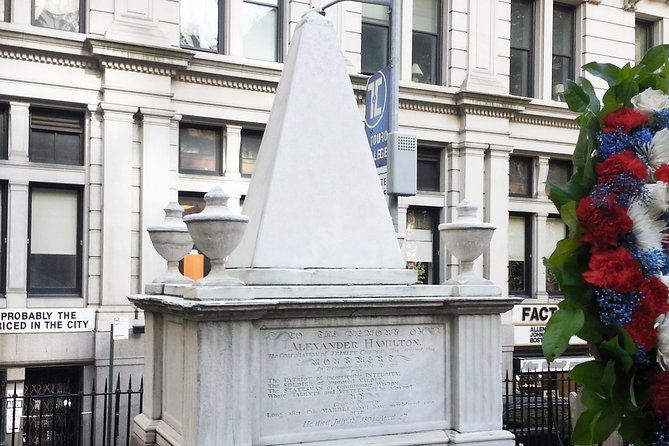
The walk ends at Trinity Church, 89 Broadway, where Alexander and Eliza Hamilton are buried. The churchyard also includes other notable Revolutionary War figures, including Hercules Mulligan.
This is the quietest and most reflective part of the route. After hearing about Hamilton’s ambitions, financial plans, political battles, and eventual death, standing at his grave gives the story a clear ending. Eliza’s presence is equally important, since her life and work are often reduced when the focus stays only on Hamilton.
The tour plans about 20 minutes here and enters the churchyard only when it is open. That means access depends on the day and time of your booking. The stop is free, but opening conditions can affect what you see.
Ending here is practical as well as symbolic. You finish in the same general area where the walk began, near public transportation and several other Lower Manhattan sights. You can continue exploring on your own, though the tour itself ends at Trinity Church.
What the three-hour format feels like
The listed stops add up to about two and a half hours of scheduled time, with the full experience lasting approximately three hours. That gives the guide room for transitions, questions, and the natural pauses that happen in a city walk.
You should expect a steady sequence of short talks rather than one long lecture. The route remains concentrated in Lower Manhattan, but the amount of information is substantial. Some stops last 15 minutes, while others take 20.
The group limit of 16 is a real advantage. A smaller group is easier to hear, easier to gather around a guide, and less awkward when crossing between sites. It also gives you a better chance to ask about a detail that catches your attention.
This is not a tour for someone who wants to sit down often. Reviews of the experience repeatedly praise the guide’s energy and clarity, but one useful warning comes through clearly: you will be on your feet. Wear comfortable shoes and plan for outdoor conditions.
The tour is offered in English and includes a mobile ticket. Children must be accompanied by an adult, and service animals are allowed. Most people can participate, and the route is near public transportation.
Weather, timing, and the practical details that matter
The operator says tours go out in rain, snow, and sunshine, so dress for the forecast rather than hoping for perfect weather. The cancellation terms also state that poor weather may lead to a different date or a full refund, while no rain or snow cancellation or rescheduling is accepted within 24 hours of the start. In practical terms, make your weather decision early.
Winter deserves special attention. The southern tip of Manhattan can feel especially cold, and the tour includes outdoor pauses. Bring a warm layer, even if the city feels mild elsewhere.
The experience is often booked well ahead, with an average booking time of 27 days in advance. That suggests you should reserve early if your New York schedule is fixed, especially if you want a particular date.
Free cancellation is available up to 24 hours before the start time for a full refund. Changes inside that window are not accepted. The tour also requires a minimum number of participants, so a cancellation by the operator can result in another date, another experience, or a full refund.
Gratuity is not included. If the guide gives you the engaging, clear presentation this tour is built around, plan to tip separately.
Who should book this Hamilton and Washington walk
I would choose this experience if you want American history tied to real city streets. It suits Hamilton fans, but you do not need to know the musical to enjoy it. The tour also works well for families, solo visitors, couples, and groups with different ages because the guide can adjust the discussion and welcome questions.
It is especially useful early in a New York visit. The walk gives you a framework for Lower Manhattan, so later visits to the Financial District, Trinity Church, or Federal Hall have more meaning.
I would be more cautious if you dislike standing, need frequent indoor breaks, or want extensive interior access. Several admissions are not included, Federal Hall is closed on weekends, and Trinity Church is entered only when open. The tour is about guided interpretation of the places, not a package of museum visits.
Should you book it?
Book this tour if you want a compact, story-led introduction to the Revolution and the early republic, with Hamilton and Washington as your guides through the subject. The strongest reasons are the small group, the licensed historian, and the clear connection between famous names and actual Lower Manhattan locations.
Skip it if you prefer a self-guided walk, already know the subject in detail, or want a mostly indoor activity. For everyone else, $52.95 is a reasonable price for three hours of focused history, provided you arrive ready for outdoor walking, standing, and changing weather.
FAQ
How long is the Hamilton and Washington Revolutionary Walking Tour?
The tour lasts approximately three hours. Individual stops generally last 15 or 20 minutes, with additional time for walking between locations and questions.
Where does the tour start and end?
It starts at 1 Bowling Green in Lower Manhattan and ends at Trinity Church, 89 Broadway, New York, NY 10006.
How large is the tour group?
The experience has a maximum of 16 participants, creating a smaller group setting.
Is admission to the buildings included?
No. Admission is not included at the Alexander Hamilton U.S. Custom House, Fraunces Tavern Museum, the New York Stock Exchange, or Federal Hall. Trinity Church is entered only when it is open, and Bowling Green, Peter Minuit Plaza, Wall Street, and the Trinity Church graveyard are listed as free stops.
Is Federal Hall open during the tour?
Federal Hall is closed on weekends. If interior access matters to you, select a weekday date and check the schedule before booking.
What is the cancellation policy?
You can cancel up to 24 hours before the start time for a full refund. Changes or cancellations made less than 24 hours before the start are not accepted for a refund. If the tour is canceled because of poor weather or because the minimum number of participants is not met, you will be offered another date or experience, or a full refund.
Newest history tours we have reviewed in the USA
- Nashville: Belle Meade Historic Mansion Tour★ 4.8 · 63 reviews
- Beaufort: Local History and Film Sites Tour by golf cart★ 4.9 · 102 reviews
- Boston: Guided Seafood Tasting and History Tour★ 4.9 · 90 reviews
- Beaufort: Gullah Heritage Tour★ 4.8 · 26 reviews
- Beaufort: Historic City Tour by Bus★ 4.9 · 228 reviews
- Austin: Downtown Austin Haunted History Tour★ 4.4 · 31 reviews
- Austin: Morning History Walking Tour of Downtown Austin★ 4.9 · 71 reviews
- Atlanta: Beltline Food, Street Art, and History Walking Tour★ 5.0 · 47 reviews
History Walking Tours, compared.

History and Hauntings of Salem Guided Walking Tour
Read our review →

Freedom Trail History Small Group Walking Tour
Read our review →
Historic Charleston Guided Sightseeing Walking Tour
Read our review →
Tapas Walking Tour with Food, Wine, and History
Read our review →
Savannah History and Haunts Candlelit Ghost Walking Tour
Read our review →
A History of Terror – Belfast City Centre Walking Tour
Read our review →Browse the lists this tour appears in