
Review · BUDAPEST HISTORY TOURS
Budapest Historical Sightseeing – Free Walking Tour
Budapest’s past is never far from its present, and this walk puts that contrast right in front of you. You move from grand palaces and Parliament to communist monuments, wartime memory, student districts, and nightlife streets, all on the Pest side of the Danube. It is a useful first look at a city that can otherwise feel scattered.
I like the low upfront price and the way the tour mixes famous sights with less obvious stops such as Unger’s House and the Ronald Reagan statue. I also like the practical local advice. Guides such as Victoria, Peter, George, and Sabi have helped visitors with food, transport, customs, and plans for the rest of a Budapest stay.
The main consideration is the walking. You cover roughly 3 miles over two and a half hours, often on cobblestones, and the group can reach 50 people. The tour is also tip-supported, so the $3.63 booking price is not the full cost of the experience.
Key points to know before you book
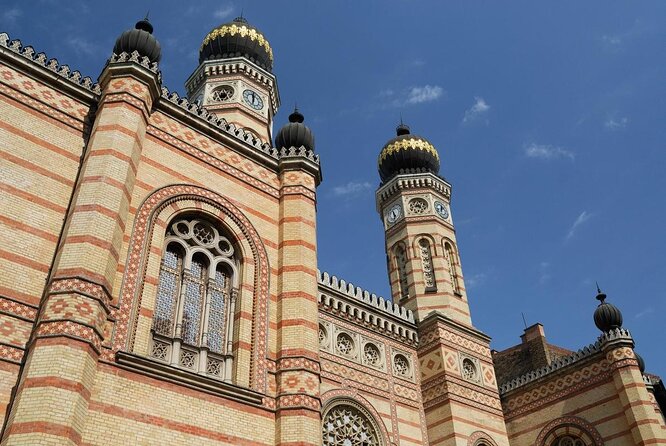
- Pest-side route: See the National Museum, Jewish Quarter, St. Stephen’s Basilica, Parliament, the Danube memorial, and the Chain Bridge.
- A history-first walk: The guide covers Hungary’s communist era, wartime Jewish history, royal and national symbols, and present-day Budapest.
- Tip-based pricing: The small booking fee keeps the tour accessible, but you should budget a tip for the guide.
- Strong first-day choice: The route gives you a useful map of central Pest and ideas for what to do next.
- Long outdoor experience: Bring water, sunscreen, an umbrella, or warm clothing according to the forecast.
- English only: The tour is offered in English, with an in-person guide and a mobile ticket.
Why this walk works best early in your Budapest stay
I would schedule this tour near the beginning of a Budapest visit. It links many central sights, so you quickly learn how Kálvin tér, the Jewish Quarter, Deák tér, Liberty Square, Parliament, and the river fit together.
That orientation has real value. After the walk, you can decide which places deserve a longer visit, which neighborhoods suit an evening stroll, and how to plan your time between Pest and Buda. Several guides also offer practical advice about eating, drinking, public transport, local customs, and reasonable places to visit.
This is not a tour of the interiors. You mainly see buildings and monuments from outside, and Buda’s castle district is viewed across the river rather than visited. If you want entry to Parliament, the basilica, or the museums, plan separate visits.
More History Walking Tours in the world:
- History and Hauntings of Salem Guided Walking Tour
★ 5.0 · 14,564 reviews - Lisbon: History, Stories and Lifestyle Walking Tour
★ 4.8 · 10,902 reviews - Boston: Freedom Trail History Small Group Walking Tour
★ 5.0 · 6,450 reviews
Meeting the yellow-shirted guide at Kálvin tér
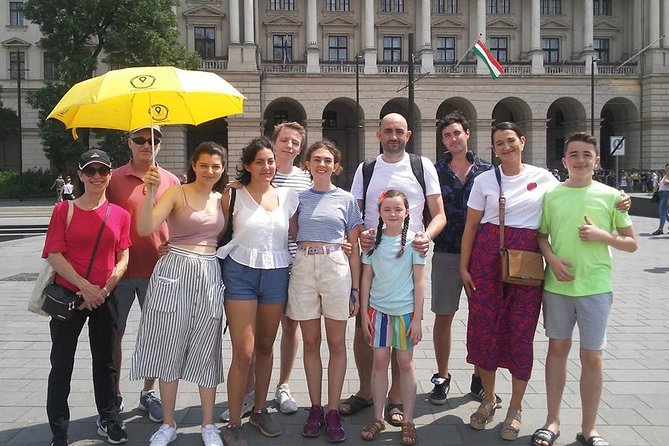
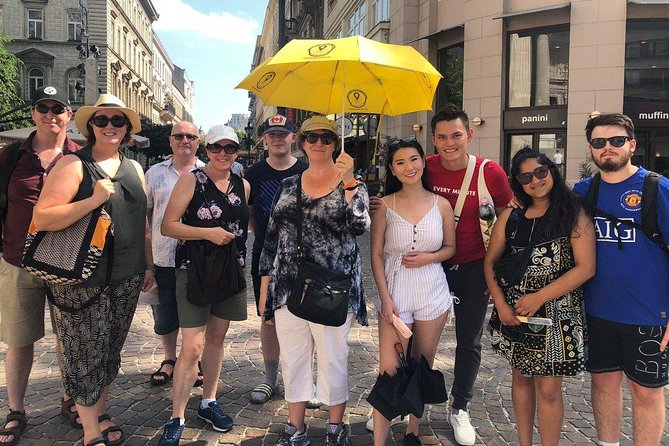
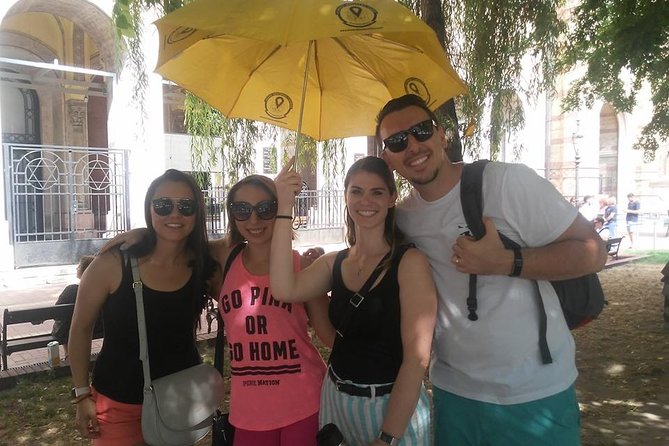
The official meeting point is OTP Bank at Kálvin tér 12-13. Look for the guides in yellow. The square has places to sit and some shelter, which helps if you arrive early or the weather turns unpleasant.
Kálvin Square is named for John Calvin, the French Protestant reformer. It is also a practical starting point, close to public transport and near the Hungarian National Museum. Make sure you arrive with water and use the toilet before setting off. The tour includes only a short five-minute pause, and drinks or food are not provided.
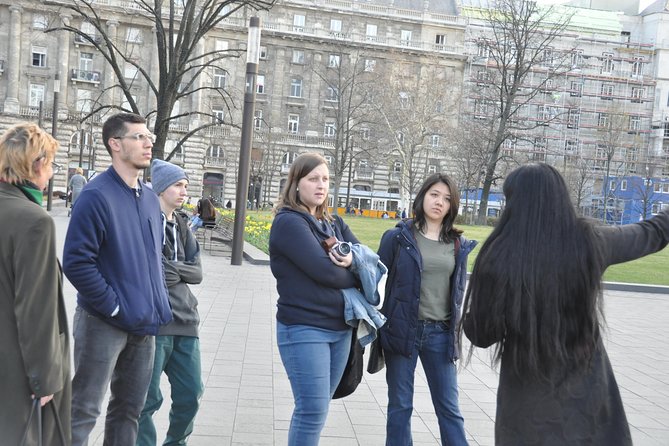
The group limit is listed as 50 people. That is reasonable for a low-cost city walk, but sound can become a problem in busy streets. One useful tip is to stay near the guide and speak up immediately if you cannot hear. Smaller groups have been reported, but the size can vary.
Hungarian National Museum and the old VIII District
The first major stop is the garden of the Hungarian National Museum. Here you see the mythical turul bird, a powerful symbol in Hungarian tradition, and hear about the museum, its collections, and its founder.
The guide also explains the 1848 uprising, an important moment in Hungary’s long struggle for self-rule. That early stop gives the rest of the walk a clear frame: Budapest’s grand buildings are not just decoration. They reflect repeated fights over identity, power, and independence.
You also get an introduction to the VIII District, once associated with grand palaces and now known for a more mixed character. This is one of the more useful parts of the route because it moves beyond postcard Budapest and points out how districts change over time.
The stop lasts about ten minutes and does not require an admission ticket. You will not tour the museum itself, so reserve another time if its national collections interest you.
Unger’s House and Budapest’s changing architecture

At Unger’s House, you pause in the courtyard of a building linked to architect Miklós Ybl. Its design brings together Byzantine, Gothic, Moorish, Renaissance, and Romantic details.
That mixture says a lot about Budapest. The city often feels like several periods placed side by side, and this courtyard gives the guide a chance to explain that visually rather than through a long lecture. The building is described as fading, which is part of its appeal. You are seeing an older architectural creation that has not been polished into a perfect tourist display.
The stop is brief, about five minutes. That is enough to understand why the building matters, but not enough for a detailed architectural study. Keep your expectations realistic: this is a quick outdoor look, not a specialist architecture tour.
More History Tours in the world:
- New York City: American Museum of Natural History Ticket
★ 4.5 · 15,447 reviews - Colosseum: Underground and Ancient Rome Tour
★ 4.7 · 12,691 reviews - London Small Group Tour of Historical Pubs
★ 5.0 · 10,422 reviews - Prague: Oldtown, Medieval Underground & Dungeon History Tour
★ 4.3 · 10,277 reviews
Elizabeth Square, Astoria, and the Jewish Quarter
Elizabeth Square brings the tour into modern Budapest. You see the Budapest Eye, hear about the square’s past, and learn why the area is associated with bars and nightlife. It is a useful change of pace after the museum and historic buildings.
The walk then passes the Danubius Hotel Astoria, a grand French Empire-style building. The guide points out its elegant design and its connection with international stars and film productions, including the Josephine Baker Story directed by Brian Gibson.
From there, the route enters the Jewish Quarter. This is one of the most important sections of the tour. You hear how the district was once home to a major Jewish community, became a ghetto during the Second World War, and later developed into an area associated with artists, students, independent shops, designers, and bars.
The subject matter is serious, and the route does not treat the quarter as only a nightlife zone. That balance matters. You see how a neighborhood can carry painful memories while also becoming one of the city’s most active areas today.
The route description does not give a precise stop time for the Jewish Quarter, so expect the guide to explain parts of it while walking. If you want to visit synagogues or museums, you will need separate admission and extra time.
St. Stephen’s Basilica and the meaning of its name
Outside St. Stephen’s Basilica, the guide explains why the church is named after Hungary’s first king. The building is one of Pest’s major landmarks, and its scale gives you a strong sense of the city’s religious and national traditions.
The tour does not include entry. You see the exterior and hear the background, then continue. That suits a first orientation, but you should check the basilica’s own visiting arrangements if you want to go inside.
The stop lasts about ten minutes. It is also a good point to pay attention to the guide’s presentation style. The most praised guides, including Victoria and Peter, are described as clear, engaging, and easy to follow. Victoria in particular is noted for combining serious subjects with humor, while Peter is often praised for explaining historical material in a direct way.
Liberty Square and Hungary’s communist past
At Szabadság tér, or Liberty Square, the tour turns directly toward Hungary’s communist past. You see the communist memorial and hear about the political pressures that shaped the country.
This is where the tour’s historical approach becomes most useful. Budapest is not presented as only a pretty city of thermal baths and grand avenues. You are given a sense of the conflicts, occupations, political changes, and national frustrations behind the public spaces.
The stop lasts around fifteen minutes, longer than many of the earlier pauses. That allows room for questions, though a large group can make discussion harder. The guide’s tone may be direct and sometimes dark. The history itself is painful, and the tour does not avoid that.
If you prefer a light sightseeing loop with little political discussion, this may feel heavier than expected. If you want help understanding modern Hungary, it is one of the tour’s strongest sections.
Stock Exchange Palace and two unusual statues
The Stock Exchange Palace is another quick architectural stop. The building covers about 50,000 square meters and is described as the largest privately owned historic landmark in Budapest.
You then see the Ronald Reagan statue. The guide explains why Reagan appears to be walking away from Parliament and why George H. W. Bush is positioned nearby, apparently waiting for him. These statues add a little humor and modern political context to a route otherwise filled with older history.
Both stops are brief. The Stock Exchange Palace is viewed from outside, and no admission is included. These moments work best as part of the wider story rather than as reasons to book the tour on their own.
Parliament Square and views across the Danube
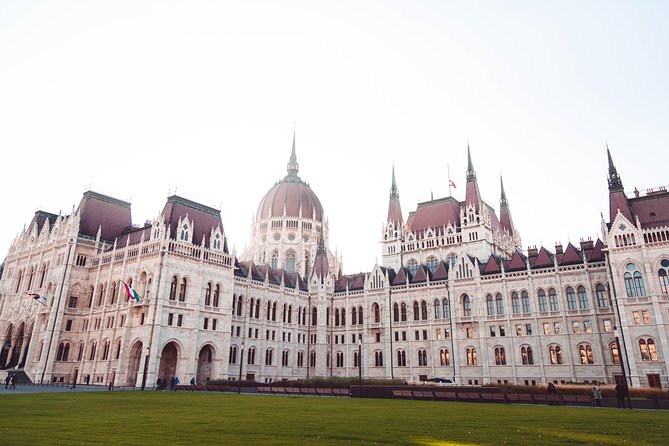
At the Hungarian Parliament Building, you stop outside one of Budapest’s most striking buildings. The guide discusses its electric or neo-Gothic exterior and the view toward the Danube.
You also hear about other important buildings around the square, including the former Ministry of Justice, the agricultural museum, and the chocolate museum. The route does not take you inside Parliament, and no entry is included. That is worth noting because Parliament tickets and interior visits require separate planning.
This is one of the most rewarding photo stops. The building is close enough to appreciate its details, while the river gives the scene space. The guide also helps you read the square instead of simply taking a picture and moving on.
Fisherman’s Bastion, Buda Castle, and the view from Pest
The tour remains on the Pest side but looks across the river toward Buda. From here you can see Fisherman’s Bastion, Matthias Church with its colored tiled roof, and the former Royal Palace area.
You also look toward Margaret Island and Gellért Hill. The guide explains the history of these places from across the Danube, giving you a useful preview of the Buda side without adding a long climb or separate crossing to the itinerary.
This is both a strength and a limitation. You get a broad view of Budapest’s geography, but you do not explore Fisherman’s Bastion, Matthias Church, or the castle district on foot. Plan another half-day if those sights are high on your list.
Chain Bridge and the Shoes on the Danube
The walk ends at Széchenyi Chain Bridge, often simply called the Chain Bridge. You hear about its construction, history, and reconstruction. The bridge provides a natural close because it connects the Pest route with Buda and gives you an easy way to continue exploring.
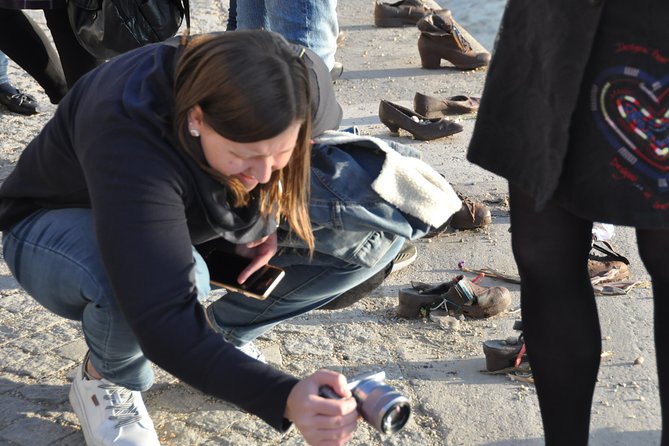
The final stop is the Shoes on the Danube Bank memorial. The simple arrangement of 60 pairs of shoes honors Jewish people who were lined up and shot at the river during the Holocaust. It is a quiet, haunting place, and the guide’s explanation gives the memorial necessary context.
The official end point is near Id. Antall József rkp. 1. From the Chain Bridge, you can walk back toward the starting area or continue into central Budapest. The route therefore ends in a useful location rather than leaving you in an outlying district.
What the $3.63 price really means
At $3.63 per person, the booking price is remarkably low for two and a half hours with an in-person guide. It makes sense for budget visitors, solo travelers, and anyone who wants a basic orientation without committing to an expensive private tour.
The important catch is the tip-based model. Tips are not included, and the guide’s income depends on them. Treat the booking price as a small reservation fee, not as the complete cost. Bring cash if possible, since one visitor was unable to tip by machine.
The tour does not include drinks, food, toilet costs, museum admission, basilica admission, Parliament admission, or luggage carrying. Public toilets may cost between 100 and 500 HUF. These are small expenses, but knowing them in advance makes the walk easier.
Weather, footwear, and group comfort
Wear comfortable shoes. You will walk for around three miles, and Budapest’s cobblestones can be tiring. The tour is not recommended for anyone unable to manage that distance.
Weather matters because the entire experience is outdoors. Bring water and sunscreen in warm weather. An umbrella or warm jacket may be needed in rain or cold. The walk can continue in very cold conditions, so winter visitors should dress seriously rather than relying on a short city stroll.
The tour suits adults and children over 12 best, though younger children are welcome. Service animals are allowed, but ordinary dogs are not. The provider does not offer a hearing induction loop.
Who should book this Budapest walk?
You should book it if you want a strong first look at Pest, enjoy history mixed with local advice, and are comfortable walking outdoors for two and a half hours. It is especially useful for a first day, when you still need to understand the city’s layout.
It also suits budget visitors who accept the tip system and want more than a list of monuments. The strongest guides make the route feel personal, with family stories, humor, photographs, and advice about what to do next. Victoria, Peter, George, and Sabi are among the guides praised for clear explanations and helpful local suggestions.
You may prefer another option if you need a small group, want interior visits, have mobility limitations, or prefer a gentle sightseeing ride. A group of up to 50 can be hard to hear in busy areas, and the tour does not visit Buda Castle or enter the major buildings.
Should you book it?
For most first-time visitors, yes. The route gives you history, geography, architecture, modern culture, and practical advice at a very small starting price. Book it early in your stay, wear good shoes, check the forecast, and bring money for a tip.
Just understand the format. This is a brisk outdoor orientation, not a private tour and not an interior museum experience. If you want a thoughtful introduction to Budapest’s difficult past and central Pest sights, it is a very good value.
FAQ
How long does the Budapest Historical Sightseeing Free Walking Tour last?
The tour lasts approximately two hours and 30 minutes.
What language is the tour offered in?
The tour is offered in English.
Where does the tour start?
It starts at OTP Bank, Budapest, Kálvin tér 12-13, 1085 Hungary. Look for guides dressed in yellow.
Where does the tour finish?
It finishes near Id. Antall József rkp. 1, close to the Chain Bridge. From there, you can walk back toward the starting point or continue into central Budapest.
Is the tour really free?
The booking price is listed as $3.63 per person, and the tour operates with a minimal fee plus tips. Tips for the guide are not included.
Does the tour enter Parliament or St. Stephen’s Basilica?
No. The tour visits these buildings from outside. Admission is not included, so arrange separate entry if you want to go inside.
Does the tour visit Buda Castle and Fisherman’s Bastion?
No. You view Fisherman’s Bastion, Matthias Church, the palace area, Margaret Island, and Gellért Hill from the Pest side of the Danube.
How much walking is involved?
You should expect roughly 3 miles of walking over the course of the tour. Comfortable shoes are essential, and the experience is not recommended if you are unable to walk that distance.
Can I cancel the booking?
You can cancel for a full refund up to 24 hours before the experience starts. Changes or cancellations made less than 24 hours in advance are not accepted for a refund. If poor weather or an insufficient number of bookings cancels the tour, you will be offered another date or a full refund.
Newest history tours we have reviewed in the world
- Bilbao Historical Tour in small group★ 4.7 · 52 reviews
- Bologna: Street Food Tour in the Historic Center★ 4.8 · 125 reviews
- Bishkek : City Tour (History, Architects, Statues & Culture)★ 4.9 · 54 reviews
- Blenheim: Omaka Aviation Heritage Centre Admission Ticket★ 4.9 · 31 reviews
- CEBU: Cebu City Heritage and Uphill Guided Tour★ 4.2 · 31 reviews
- Berlin: Nazi History Walking Tour★ 4.8 · 33 reviews
- Best of Baku: 4-Hour City Tour Historic and Modern Landmarks★ 4.7 · 63 reviews
- Belfast: Best of Belfast History, Culture & Art Walking Tour★ 4.9 · 158 reviews
History Walking Tours, compared.

History and Hauntings of Salem Guided Walking Tour
Read our review →
Freedom Trail History Small Group Walking Tour
Read our review →
Historic Charleston Guided Sightseeing Walking Tour
Read our review →
Tapas Walking Tour with Food, Wine, and History
Read our review →
Savannah History and Haunts Candlelit Ghost Walking Tour
Read our review →
A History of Terror – Belfast City Centre Walking Tour
Read our review →Browse the lists this tour appears in