
Review · UK HISTORY TOURS
Walking Bogside History Tour in Guildhall
The most powerful part of this Derry walking tour is its personal account of the Troubles. The route moves from Guildhall into the Bogside, past the Museum of Free Derry, murals, Free Derry Corner, and the Bloody Sunday memorial. Guides such as Jimmy Toye, John, Paul, Neil, and McCrea have brought local memories and, in some cases, firsthand experience to the story.
I like two things especially: the tour connects major events to the actual streets where people marched, were wounded, and died, and the small group size, capped at 20, leaves room for questions. The main consideration is that the guide can shape the experience greatly. Most accounts describe a warm, funny, moving guide, but one person found the presentation cold, while another could not hear the guide well.
Key points about the Bogside walk
- Personal stories from Derry guides: Jimmy Toye and other guides have shared direct memories of growing up in the Bogside and living through the Troubles.
- A route through key sites: You walk from Guildhall toward the Bogside, pass the Museum of Free Derry, and finish near Free Derry Corner and the Bloody Sunday monument.
- A serious but human tone: The subject is painful, but guides often use gentle humor to make a difficult hour and a half easier to absorb.
- Good value at $27.73: You get a focused walking tour of Derry’s modern political history without paying for a long museum visit or a larger sightseeing circuit.
- Small group limit: A maximum of 20 people is more manageable than a large city tour, though hearing the guide can still depend on where you walk.
- Plan for some flexibility: The stated duration is about 90 minutes, but some tours have lasted closer to two hours.
Why the Bogside matters to your visit
Derry’s Bogside sits outside the city walls and has been at the center of some of the city’s most painful modern events. This is not a tour about old stonework alone. It deals with the Battle of the Bogside in 1969, the march associated with Bloody Sunday, and the political and social effects that followed.
I find this setting valuable because the story is tied to ordinary streets and visible landmarks. You are not simply hearing a timeline in a lecture room. You are walking through the area where those events unfolded, seeing the walls and memorials that continue to shape how Derry remembers them.
The tour also gives you a way to approach the subject with care. The Bogside is a living neighborhood, not a museum display. A good guide helps you understand both the public events and the effect on families and local life. Jimmy Toye, in particular, is described as having grown up in the Bogside and experienced the events as a young person. John and other guides have also shared personal memories, anecdotes, and local connections.
That personal angle is the reason this tour can feel much more affecting than a standard city walk. It also means the presentation may not be completely detached. One particularly useful assessment described the guide as authentic and passionate, but not impartial. That is worth knowing before you book. You are signing up for a local perspective, not a neutral university seminar.
More History Walking Tours in the UK
- A History of Terror – Belfast City Centre Walking Tour
★ 5.0 · 2,883 reviews - Edinburgh: Old Town History and Tales Walking Tour
★ 4.8 · 2,361 reviews - Old Town Walking Tour History and Tales in Edinburgh
★ 5.0 · 2,168 reviews
Starting at Guildhall and crossing into the story
The meeting point is Derry Guildhall, in the city center. From there, the walk heads toward the Bogside. The start gives you a clear contrast between the formal civic center and the neighborhood outside the walls where much of the tour’s story took place.
The route is advertised as about one hour for the main Bogside section, followed by around 30 minutes near Free Derry Corner. In practice, allow more time than the headline 90 minutes if your guide pauses for questions or tells longer personal stories. One account placed the walk closer to two hours, so I would not schedule a tight departure immediately afterward.
You should arrive ready to listen rather than race from one stop to the next. This is a short route in physical terms, but the subject requires pauses. The best parts are often the moments when the guide explains why a particular place mattered, rather than simply pointing out another mural or monument.
The maximum group size is 20. That is a reasonable limit for a street walk and should make it easier to stay close to the guide. Still, one person found that the guide spoke too softly to hear clearly. If you are hard of hearing, stay near the front and ask the guide to speak up at the start. There is no stated microphone system.
The Battle of the Bogside and the streets of 1969
A central part of the walk is the Battle of the Bogside, a fierce three-day confrontation in 1969 that became a starting point of the Troubles. The guide places this event within the neighborhood itself, helping you see how the Bogside became a focus of political tension and social unrest.
This section works best when you let the guide explain the human scale of the event. The strongest accounts describe stories of people who were teenagers at the time, rather than only dates and political labels. Jimmy Toye’s personal memories have been especially valued because they connect the public record with what it felt like to grow up in the area during those years.
You may hear humor alongside grief. That can seem surprising, but it is one of the tour’s most effective traits when handled well. Guides such as Jimmy, John, McCrea, and Paul have been praised for using light humor without losing sight of the suffering. It gives you a sense of the people who lived through the period, rather than reducing them to victims in a history lesson.
The balance is not guaranteed every time. One person found the guide too matter of fact and rushed, with little opportunity for questions. If discussion matters to you, ask early and politely. The quality of the tour depends heavily on whether your guide treats the walk as a conversation or a speech.
The murals and the Museum of Free Derry
The Bogside is known for its large gable-wall murals, created by the Bogside Artists. These murals are among the area’s most recognizable sights, and they give the walk a strong visual element.
The murals are not presented as isolated works of public art. They form part of the story of the neighborhood and its memory of the Troubles. As you walk, the guide can connect what you see on the walls with the events being discussed. That makes the art easier to understand than it would be if you simply arrived, took photographs, and moved on.
The route passes the Museum of Free Derry. The tour does not appear to include a separate museum visit, so you should not expect an indoor exhibition as part of the 90-minute walk. Instead, the guide uses the museum as one of the key places along the route.
That distinction matters. If you want displays, documents, and more time with the historical record, you may wish to visit the museum separately. If you have only a day in Derry, the walking tour gives you useful context before or instead of a longer museum stop.
Same streets, a different century:
- London Small Group Tour of Historical Pubs
★ 5.0 · 10,422 reviews - Edinburgh: Edinburgh Castle Guided History Tour with Tickets
★ 4.8 · 9,933 reviews - Edinburgh: Whisky Tasting with History and Storytelling
★ 4.9 · 2,451 reviews - Soho Music & Historic Pubs Tour
★ 5.0 · 1,993 reviews
Bloody Sunday, the march, and the memorial
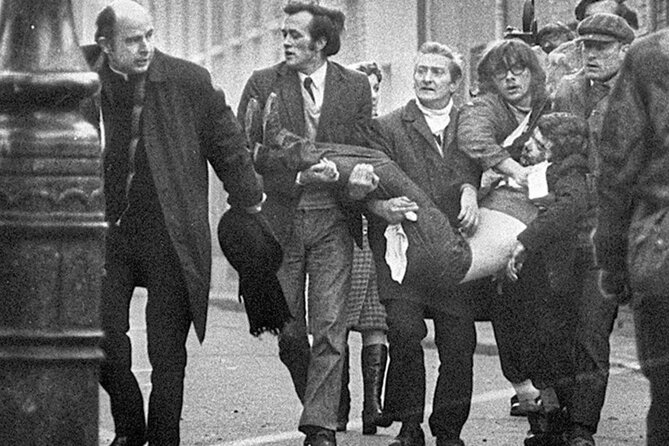
The most solemn section retraces parts of the original march linked to Bloody Sunday and visits places where people were killed or wounded. The guide explains the event and its political and social repercussions, bringing the story to the point where memory, grief, and public history meet.
The tour concludes at the Bloody Sunday monument, within sight of Free Derry Corner and beneath the city walls. This is a strong ending because several important symbols come together in one place. You have the memorial itself, the famous corner, the Bogside murals nearby, and the old walls above.
The emotional effect varies from guide to guide, but the strongest tours use personal memories to make the subject understandable without turning it into spectacle. Jimmy Toye has been praised for describing the events with both sorrow and humor, including the loss of his own father. John has also been described as sharing detailed personal experiences in a warm and thoughtful way.
I would give yourself a quiet moment at the end. This is not a photo stop to rush through. You may want to ask a final question, look back toward the route, or simply take in the setting before continuing around Derry.
The activity information says the tour ends back at the meeting point, while the route description says it concludes near the Bloody Sunday monument. Treat the finish as something to confirm with your guide on the day. Either way, you will be in the central Derry area rather than far from town.
What the guides add to the experience
Guide names can vary, so you cannot safely book on the assumption that one particular person will lead your walk. Still, several names recur in the strongest accounts:
- Jimmy Toye is praised for firsthand memories, warmth, humor, and a powerful account of Bloody Sunday and the Battle of the Bogside.
- John is described as personable, detailed, and generous with local stories. His community connections can make the walk feel informal and personal.
- Paul has been praised for humor, historical explanation, and a family connection to the subject.
- McCrea or McCrae is described as informed, friendly, and willing to answer questions from a small group.
- Neil has been praised for speaking from the heart and making an effort to accommodate a person using a wheelchair.
- Peter has been described as sharing both the history of the Troubles and his own story.
The spelling of some names varies in the supplied material, so do not assume that every guide is the same person. The practical point is simple: expect a local guide with a personal perspective, but understand that the tone, volume, and amount of discussion may change from one departure to another.
Price, timing, and practical value
At $27.73 per person, this is a good-value way to understand Derry’s modern history. You get a focused walk through the Bogside, a local guide, and access to stories tied to the places you see. Since the major outdoor sites are free to view, much of what you are paying for is interpretation and personal context.
That is important here. Free Derry Corner and the murals can be visited independently, but you would not automatically know how the sites connect to the Battle of the Bogside, Bloody Sunday, or the wider history of the area. The tour helps you make sense of what you are seeing.
The listed duration is approximately one hour and 30 minutes. Several accounts suggest allowing closer to two hours, especially if the guide encourages questions. The tour is offered in English and uses a mobile ticket.
It is generally suitable for most people, and service animals are allowed. The activity is near public transportation. The official information does not promise full wheelchair access, although Neil was praised for making efforts to accommodate a wheelchair user. If mobility is a concern, contact the provider before booking and ask about the exact route and street conditions.
You can cancel for a full refund up to 24 hours before the start time. Changes or cancellations made less than 24 hours ahead are not accepted for a refund.
Who will get the most from this tour
I would choose this tour if you want to understand Derry through the people who lived through its most difficult period. It suits anyone interested in the Troubles, modern Irish and British history, political memory, murals, or the way a community tells its own story.
It is also a strong choice if you have only one day in Derry. The walk gives you an informed route through the Bogside without taking up an entire afternoon. One account described the tour as the part of a short stay that made the city worthwhile, which makes sense if you want context quickly.
I would be more cautious if you need a polished, strictly neutral presentation. The tour’s strength is its local voice, and that can also be its limitation. It may reflect the guide’s own experience and viewpoint. That is not a flaw, but you should listen with an open mind and recognize the difference between lived memory and a complete academic account.
Families can participate, but the subject includes death, injury, political violence, and grief. Parents should decide if the material suits younger children. The walk may also be less satisfying if you are looking mainly for old architecture, shopping, or light sightseeing.
Should you book the Bogside History Tour?
Book it if you want an honest, place-based introduction to Derry’s Troubles and value a guide who can explain events through personal memory. At $27.73, it offers strong value, especially for a first visit or a short stay.
Go with realistic expectations. The guide may be Jimmy Toye, John, Paul, McCrea, Neil, Peter, or someone else from the company. The experience can be moving, funny, detailed, and deeply personal, but the delivery may vary. Stay close so you can hear, allow up to two hours, and leave room for questions.
For many people, this will be the most meaningful way to see the Bogside. It does not replace the Museum of Free Derry or your own reading, but it gives the streets a human voice.
FAQ
Where does the Walking Bogside History Tour start?
The tour starts at Derry Guildhall, Londonderry BT48 7BB, UK.
Where does the tour end?
The activity information says it ends back at the meeting point. The route description says it concludes near the Bloody Sunday monument, within sight of Free Derry Corner and beneath Derry’s city walls. Confirm the exact finish with your guide on the day.
How long does the tour last?
The stated duration is about one hour and 30 minutes. Some accounts describe tours lasting closer to two hours, so allow extra time.
What language is the tour offered in?
The tour is offered in English.
How much does the tour cost?
The listed price is $27.73 per person.
What places does the tour visit?
The walk starts at Guildhall and goes into the Bogside. It passes the Museum of Free Derry, Free Derry Corner, the Bogside murals, and the Bloody Sunday monument.
Is the tour suitable for most people?
The activity information says most people can participate. It is near public transportation, and service animals are allowed.
How many people can join the tour?
The group size is limited to a maximum of 20 people.
Can I cancel for a refund?
Yes. You can cancel at least 24 hours before the start time for a full refund. Cancellations or changes made less than 24 hours before the experience are not refunded.
Newest history tours we have reviewed in the UK
- Ilfracombe Seafront History Walking Guided Tour★ 5.0 · 18 reviews
- Private tour of the stunning Cotswolds with an expert local guide★ 5.0 · 45 reviews
- Curious Cambridge – The History Tour that’s FUN!!!★ 5.0 · 80 reviews
- Birmingham Gangs Nighttime Historical Walking Tour with Pub Stops★ 5.0 · 53 reviews
- 2.5-Hours Walking Tour of Birmingham into Black Heritage Madiba★ 5.0 · 49 reviews
- Private Political History & Murals Tour Belfast★ 5.0 · 182 reviews
- Belfast Walking Tour: City Centre History, Troubles & Stories★ 5.0 · 39 reviews
- Belfast Political/history/troubles private taxi/cab tour★ 5.0 · 69 reviews
History Walking Tours, compared.

History and Hauntings of Salem Guided Walking Tour
Read our review →

Freedom Trail History Small Group Walking Tour
Read our review →
Historic Charleston Guided Sightseeing Walking Tour
Read our review →
Tapas Walking Tour with Food, Wine, and History
Read our review →
Savannah History and Haunts Candlelit Ghost Walking Tour
Read our review →
A History of Terror – Belfast City Centre Walking Tour
Read our review →Browse the lists this tour appears in