
Review · JAPAN HISTORY TOURS
Osaka: Castle History Walking Tour / Castle Tower Admission
Osaka Castle makes much more sense when you see it as a weapon before you see it as a landmark. This 90-minute walk explains how moats, angled walls, zigzag routes, layered gates, and masugata entrances turned a grand castle into a slow, confusing trap for attackers. You finish with admission to the tower and city views from above.
I especially like two things here. First, the guide helps you read the castle grounds instead of simply photographing them. Second, the separate entrance can save time, especially when the tower and elevator queues grow later in the morning. The main consideration is that the tower museum is not guided floor by floor, so you will explore its indoor exhibits on your own.
Key points at a glance

- The defenses are the main event: See triple moats, layered gates, sharp wall angles, and zigzag approaches built to break an attacking force apart.
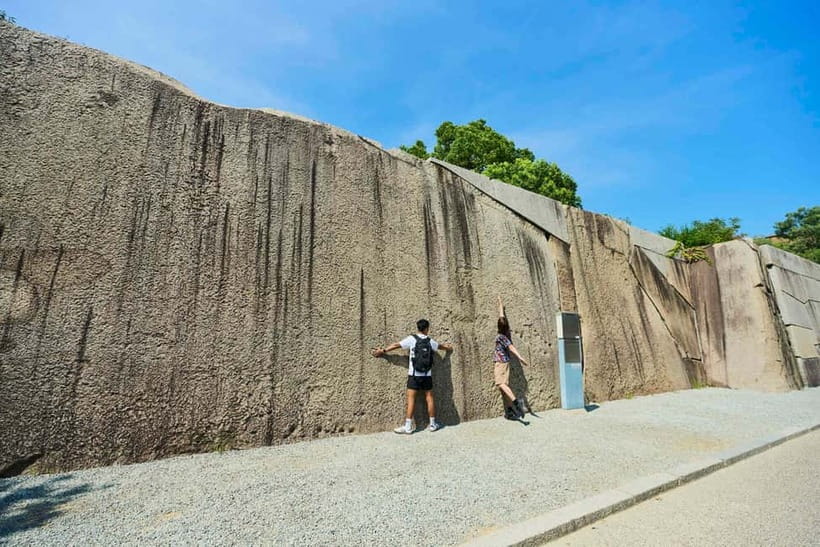
- The giant stone has a story: Learn how builders moved Osaka Castle’s largest stone in the 16th century and spot marks left by stone craftsmen.
- The tower is both museum and lookout: Enter through a separate entrance, study its military features, and reach the top for wide Osaka views.
- The ending puts the castle in perspective: The tour explains how this supposedly invincible fortress fell during the 1614 and 1615 conflicts.
- Guides add personality: Past guide names include Mao, Saya, Spike, Yuta, Kaz, Ken, Yu, and Ami, with repeated praise for clear English, warmth, and patience.
- Timing affects the value: An early start, especially around 9 a.m., may help you avoid longer queues at the castle and elevator.
Why Osaka Castle is best understood from the walls outward
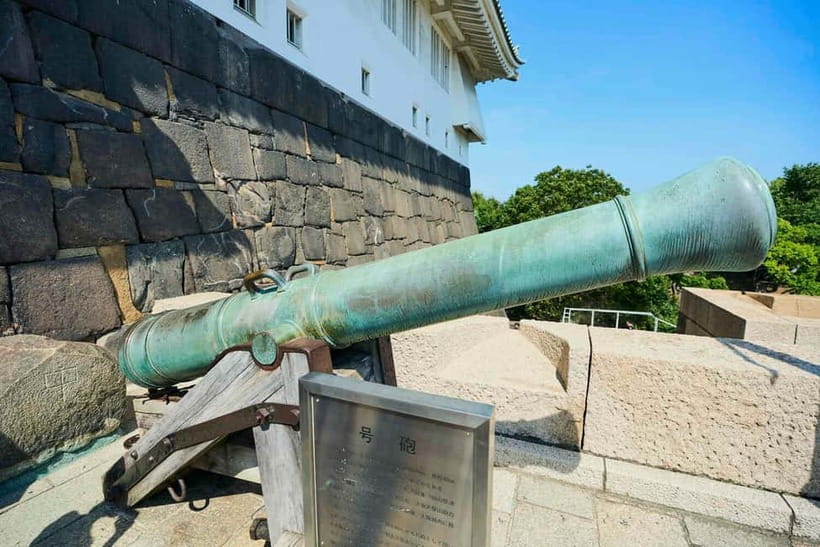
The familiar image of Osaka Castle is a bright, reconstructed tower rising above enormous gray stone walls. That picture is attractive, but it misses the point. The real story begins outside the tower, where every approach was designed to slow, redirect, expose, and divide an enemy.
This tour starts at Lawson S Otemae Rest House Store, then works toward the castle through its outer defenses. That order matters. You do not begin with a museum display and try to imagine a fortress afterward. You walk the routes an attacking force would have faced and see why the castle took so much effort to breach.
Your guide points out the triple moats and the layers of protection around the inner grounds. You will see how gates were not placed simply for convenience. The route bends and shifts, forcing anyone approaching the center to move in awkward directions while defenders watched from above.
The masugata entrance is one of the clearest examples. Its layout created a boxed or angled approach where attackers could be delayed and exposed before reaching the next gate. The route was not a straight march to the tower. It was a controlled series of obstacles.
I like this part because it turns architecture into a practical problem. Instead of hearing that the castle was heavily fortified, you can see how a hostile force would lose time and formation. The walls, moats, and gates worked together rather than acting as separate decorations.
More Castle and Palace History Tours in Japan
- Tokyo: Imperial Palace and Shogun Historical Walking Tour
★ 5.0 · 2,251 reviews - Tokyo Castle & Imperial PalaceーShogun Walking Tour
★ 4.7 · 1,068 reviews - Tokyo: Imperial Palace Japanese History Walking Tour
★ 4.9 · 987 reviews
Walking the triple moats and zigzag gates
The walking itself is manageable, but you should wear comfortable shoes. The tour moves through historical grounds, and the value comes from stopping at several points rather than standing in one room. Weather-appropriate clothing also matters because much of the explanation takes place outdoors.
The guide leads you along routes that once forced enemies to approach under fire. Here, the word military design becomes concrete. A straight road would have offered a quick path forward. A zigzag route made attackers turn, bunch together, and lose sight of the next objective.
You also learn how wall angles made climbing difficult. The stonework was not just massive. Its shape and placement denied easy handholds and made the face of the wall hard to scale. Look closely at the masonry as you walk. The guide may point out small marks connected with the master craftsmen who worked on the stones.
These details are easy to miss on a solo visit. You may notice the scale of the walls, but not understand why a particular corner turns the way it does or why a gate sits behind another defensive layer. The guide supplies the military logic without burying you in technical language.
The tour also takes you to Osaka Castle’s largest stone. This is one of the more memorable stops because it connects engineering with human labor. You learn how builders transported enormous stones during the 16th century, when there were no modern cranes or trucks to do the work.
The supplied information does not promise a reconstruction or demonstration, so expect an explanation rather than a hands-on activity. Still, the stone gives the story a physical anchor. You can look at the object while considering the planning, manpower, and organization required to move it into position.
Hokoku Shrine and the Toyotomi connection
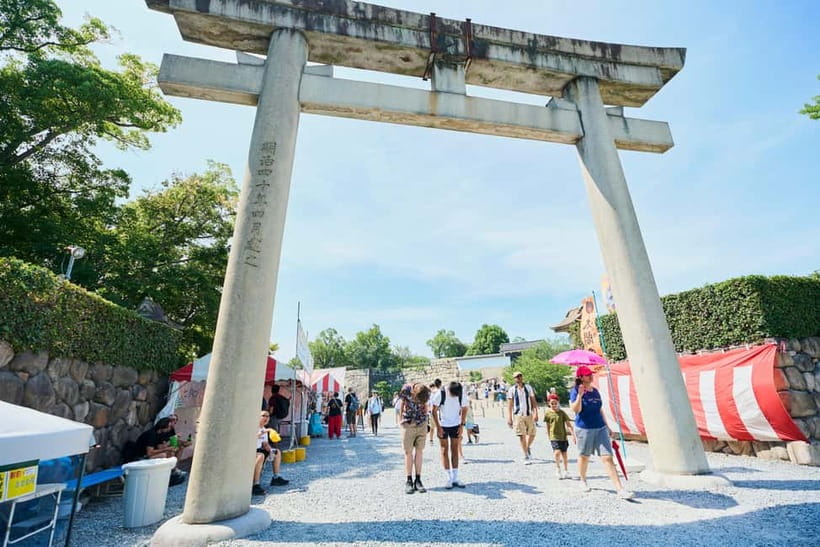
Hokoku Shrine is included as a guided stop, adding a cultural and political layer to the castle visit. The tour uses the shrine to connect Osaka Castle with Toyotomi Hideyoshi and the power struggle that followed his death.
This is useful because the castle is not only about walls and weapons. It also represents a contest over authority. Hideyoshi’s legacy shaped Osaka, while Tokugawa Ieyasu pursued a different vision of control. The tension between those two legacies helps explain why Osaka Castle became the focus of such a major conflict.
One past guide-led visit even coincided with a traditional Japanese wedding ceremony at the shrine. You should not expect a ceremony during your own visit, but the possibility illustrates why this stop can feel more like a living cultural site than a simple historical backdrop.
Your guide may also explain Japanese customs and local context here. The guides associated with this experience, including Mao, Saya, Spike, Yuta, Kaz, Yu, Ken, Ami, and others, are repeatedly described as friendly, clear, and willing to answer questions. That matters at a shrine, where a visitor may not know which details are significant or how the site connects to the castle.
The shrine stop is not the longest part of the experience, but it breaks up the military focus. I like that balance. You get fortification, political history, and present-day cultural meaning rather than one long lecture about battles.
Entering the tower through a separate entrance
The tour includes admission to Osaka Castle Tower and access through a separate entrance. This is one of the clearest practical benefits of booking a guide instead of arriving without a plan.
The exact wait will depend on the day and time, but queues can become longer later in the morning. One guest specifically recommended the 9 a.m. departure after seeing much longer lines around 11 a.m. An early start also gives you a calmer route through the grounds before food stalls and visitor traffic become more active.
The separate entrance does not mean the entire building will be empty or that every line disappears. It does mean the guide handles the admission process through the designated route, which can make the transition into the tower simpler. In a busy sightseeing day, saved time has real value.
Inside, the tower functions as a museum as well as a viewpoint. The tour explains how the castle tower served as a command post and a last defensive position. Look for the military features highlighted by the guide, including arrow slits and gun ports.
Gold decoration also gets attention. The gold was not merely an indulgent flourish. It helped project power and intimidate opponents. A fortress could send a psychological message before a battle began, and Osaka Castle’s bright, imposing appearance helped communicate authority.
The tour ends at or around the top of the castle, where you can take in the city view. Several guides have been praised for choosing strong photo locations, and the view gives you a useful final pause after the close look at walls and gates.
Remember the limitation: the guide does not lead you through every floor of the castle museum. You receive the historical explanation and tower admission, then have time to explore the indoor displays independently. That arrangement suits people who want a strong framework but still like to move at their own speed.
More History Walking Tours in Japan
- Kyoto Gion: 2-Hour Geisha Culture & History Walking Tour
★ 5.0 · 1,186 reviews - Hiroshima Historical Walking Tour – Why A-Bomb was Dropped
★ 4.8 · 893 reviews - Hiroshima Peace (Heiwa) Walking Tour at World Heritage Sites
★ 5.0 · 872 reviews - Tokyo Castle & Imperial PalaceーShogun Walking Tour
★ 5.0 · 724 reviews
How the castle fell despite its defenses
The most important historical question is also the most interesting: if Osaka Castle was so carefully designed, how did it fall?
The tour explains the conflicts of 1614 and 1615, when Tokugawa Ieyasu moved against the Toyotomi family and its stronghold. The castle’s defenses created serious problems for an attacker, but no fortress exists apart from politics, manpower, supplies, leadership, and changing military conditions.
This part gives the walls a human story. You are not simply admiring a successful structure. You are looking at a place built to protect a political order that was eventually defeated.
The rivalry between Hideyoshi’s legacy and Ieyasu’s ambition provides the main thread. Your guide may also connect the castle’s military design with the larger changes taking place in Japan at the time. The result is a clearer sense of why Osaka Castle mattered far beyond Osaka itself.
I value this historical ending because it keeps the tour from treating the castle as an unbeatable cartoon fortress. The design was powerful, but strategy and politics continued beyond the masonry. A castle can delay an enemy. It cannot make a political dynasty permanent.
What the guides add to the experience
The guide is the reason to choose this activity over a self-guided walk. Osaka Castle grounds are easy to photograph but harder to interpret. The wall stones, gate angles, hidden marks, and defensive routes need explanation at the moment you are looking at them.
The guide team has included Mao, Saya, Spike, Yuta, Kaz, Ken, Yu, Ami, Kat, Kenta, Kimie, Ukyo, and others. Individual styles will differ, but the pattern is clear: expect an English-speaking guide who explains the site, answers questions, and helps the group move through the castle without losing the main story.
Several guide styles are particularly useful for different groups. Mao and Saya are associated with friendly, energetic explanations. Spike is praised for connecting the tower with wider Japanese history. Yuta and Ken are noted for patience and clear answers, including questions about new historical findings. Kaz and Yu have been praised for helping people feel comfortable while still covering the important points.
That range matters if you are traveling with family. One guide kept a three-year-old engaged for the full experience, while another adjusted the pace for an older guest. You should not assume every group will receive a private tour, but small bookings can sometimes produce a more personal experience.
The English is intended for an international audience. The repeated comments about communication and clear explanations suggest that the tour works well for people who want history without a specialist lecture. You can ask questions, but the short duration means the guide will still need to keep the group moving.
Who will get the most from this tour
I would choose this tour if you like military strategy, architecture, political history, or any place where the physical setting explains the story. It is especially useful if Osaka Castle is one of your first major sights in the city and you want a clear introduction before exploring more on your own.
Families can benefit from the movement between moats, gates, stones, shrine, and tower. Children may not follow every date, but the idea of traps, hidden routes, giant stones, and castle defenses is easier to grasp than a long indoor museum visit.
It also suits solo visitors and couples who want company without committing to a full-day excursion. At 90 minutes, the activity fits neatly into a morning or afternoon plan.
You may prefer to visit independently if you want to spend a long time reading every museum display or taking photographs at your own pace. The guide gives you a focused route, so it is not designed as a slow, exhaustive examination of every room and exhibit.
The tour involves walking outdoors and through historical grounds. Wear comfortable shoes and dress for the weather. Anyone with limited mobility should consider the route and mention concerns to the guide, since the experience includes movement through gates, moats, and castle grounds rather than only elevator access.
Is the $33 price good value?
At $33 per person, the price covers the Osaka Castle Tower admission and a professional English-speaking guide. The admission itself is only part of the value. You are paying for the explanation of details you might otherwise walk past, plus the convenience of the separate entrance.
I consider it fair value for a first visit, particularly if you are traveling during a busy period. The time saved at the tower can protect a tightly planned day, and the guide helps you understand why the castle looks the way it does.
The value is lower if you already know Japanese castle design well or plan to spend several hours reading every museum panel independently. In that case, the guided portion may feel too short.
For most first-time visitors, though, the combination is sensible: a focused outdoor walk, a guide through the main historical ideas, entry to the tower, and time to continue alone. Free cancellation up to 24 hours before the start and the option to reserve now and pay later also make it easier to fit into a changing Osaka schedule.
Practical timing and meeting details
Meet in front of Lawson S Otemae Rest House Store. There are several Lawson stores nearby, so check the exact Google Maps location before leaving your hotel. Look for the Local Guide Stars sign at the meeting point.
Do not cut the arrival close. The meeting point is specific, and confusing one Lawson with another could create an unnecessary problem before the walk even begins.
A morning departure is worth considering. The 9 a.m. start has been singled out as a smart choice because lines may be longer around 11 a.m. You also get the castle grounds before the day becomes more crowded.
The experience is offered in English. The advertised duration is 90 minutes, and the route includes Osaka Castle grounds, Hokoku Shrine, and the castle tower. The tower museum itself is partly self-guided, so allow extra time afterward if you want to read the exhibits carefully.
Should you book it?
Book this Osaka Castle tour if you want the fortress explained as a working military system rather than a pretty tower. The best parts are the outer defenses, the giant stone, the explanation of masugata gates, and the final connection between Toyotomi power and Tokugawa victory.
I would book an early time, wear good shoes, and arrive at the correct Lawson with a few minutes to spare. Choose it with realistic expectations: you get a strong guided introduction and tower entry, not a private curator-led tour of every museum floor.
If you want to understand what you are seeing and save some time at the entrance, the $33 is well spent. If your main goal is a completely unhurried museum visit, go independently and use the money for extra time inside.
FAQ
How long does the Osaka Castle tour last?
The advertised duration is 90 minutes. The experience includes guided time around Osaka Castle and Hokoku Shrine, followed by castle tower access and some self-guided exploration.
What is included in the price?
The price includes admission to Osaka Castle Tower and a professional English-speaking guide.
Does the guide take me through every floor of the castle museum?
No. Guided tours of each museum floor are not included. The guide explains the castle’s history and military design, then you can explore the tower displays independently.
Where do I meet the guide?
Meet in front of Lawson S Otemae Rest House Store. Several Lawson stores are nearby, so confirm the exact location on Google Maps and look for the Local Guide Stars sign.
Is the tour offered in English?
Yes. The activity includes a live English-speaking guide.
What should I bring?
Wear comfortable shoes and clothing suitable for the weather. The experience includes walking through outdoor historical sites, castle grounds, gates, and moat areas.
Newest history tours we have reviewed in Japan
- [30 minutes] Rickshaw tour around Asakusa [History, sightseeing, Tokyo Skytree]★ 5.0 · 38 reviews
- Tokyo: Asakusa & Sensoji ー Oldest Temple Walking Tour (2hrs)★ 5.0 · 213 reviews
- Private sake pairing@ancient underground★ 5.0 · 27 reviews
- Private Tour Through the Tokyo National Museum & Ukiyo-e★ 4.7 · 17 reviews
- Tokyo: Customized Private Historical Guided Photoshoot Tour★ 5.0 · 25 reviews
- Tokyo: Imperial Palace, the history of Japan (ENGLISH GUIDE)★ 5.0 · 77 reviews
- Tokyo: Edo Castle & East Garden of the Imperial Palace Tour★ 4.7 · 112 reviews
- (Ticket Included) Explore Osaka Castle & Museum of History★ 4.8 · 21 reviews
Castle & Palace History Tours, compared.
Edinburgh Castle Guided History Tour with Tickets
Read our review →
Madrid Essential: Historic Center, Plaza Mayor & Royal Palace
Read our review →
Venice’s Best: Basilica, Doge’s Palace, Gondola & History Gallery
Read our review →
Imperial Palace and Shogun Historical Walking Tour
Read our review →
Saadian Tombs & Bahia Palace, Medina Guided Tour
Read our review →
Charleston historical walking tour with a Professor of History at The Citadel
Read our review →
Abu Dhabi Grand Mosque, Palace, and Heritage Village
Read our review →
Buda Castle District Dark History, Legends and Vampire Night Tour
Read our review →Browse the lists this tour appears in