
Review · LIVERPOOL HISTORY TOURS
Best Of Liverpool Heritage, History & Culture Guided Walking Tour
Liverpool’s best story is bigger than the Beatles. This walking tour connects the city’s maritime past, medieval streets, grand civic buildings, and music heritage in one easy route, beginning at the Bluecoat and ending near Mathew Street.
I like the small maximum group of 20, which makes it easier to hear a local guide, and I like the route’s range: you move from the old Ropewalks to the waterfront, then back into the historic center. Guides such as Mike, Carl, Pam, Allan, and Roy are praised for clear explanations, local pride, humor, and useful recommendations.
The main consideration is pace. You cover many sights in just over two hours, and one review noted that some listed stops were missed. The route can also change for operational reasons, and you should expect cobbles, busy streets, and occasional wet weather.
Key points to know before you book
- A strong first look at Liverpool: See the waterfront, civic center, old commercial streets, and Beatles landmarks in one outing.
- More than a Beatles tour: Maritime trade, the Titanic connection, old docks, Liverpool Castle, and wartime history all get attention.
- Local guides shape the experience: Mike, Carl, Pam, Allan, Roy, Colleen, Paul, Rob, Chris, and others are praised for humor, clarity, and personal knowledge of the city.
- A useful route for short stays: The tour takes about 2 hours 15 minutes and ends close to Mathew Street, the Cavern Club, and the city center.
- Easy in terms of hills: There are no hills or stairs, but uneven cobbles make firm, comfortable shoes a smart choice.
- A few details can change: The route may be adjusted, and access to the Andy Edwards Beatles statue is not guaranteed.
Why this Liverpool walk works so well for a first visit
Liverpool can be hard to read at first. The waterfront, business district, old lanes, shopping streets, and music quarter are close together, but each area tells a different story. This walk gives you that basic map before you set off on your own.
You begin at the Bluecoat on School Lane, a convenient central meeting point. From there, the route moves through the Ropewalks, down toward the waterfront, along the Royal Albert Dock, past the Three Graces, and back through Castle Street and the old civic center.
I like this shape because it avoids spending the whole tour in one district. You get a sense of how Liverpool grew from a medieval settlement into a major port, then into the cultural city you see today.
The tour is offered in English and uses a mobile ticket. It lasts roughly 2 hours 15 minutes, so it fits well on your first morning or afternoon in the city. You will not enter a long list of attractions, but you will see their exteriors, hear the stories attached to them, and get advice on what deserves a closer look later.
More History Walking Tours in the UK
- A History of Terror – Belfast City Centre Walking Tour
★ 5.0 · 2,883 reviews - Edinburgh: Old Town History and Tales Walking Tour
★ 4.8 · 2,361 reviews - Old Town Walking Tour History and Tales in Edinburgh
★ 5.0 · 2,168 reviews
From the Bluecoat to Liverpool’s old Ropewalks
Meet your guide in front of the gates of the Bluecoat building. The opening stop is brief, but it places you in the center of Liverpool and gives the group a clear starting point.
The next stop is the Liverpool Sailors Home Gateway. This monument recalls the Sailors Home, an institution connected with the city’s maritime community. It also offers a good early photo opportunity, including the golden Liver bird.
From here, you reach Henry Street and the Ropewalks. The name comes from the rope-making businesses that once supplied sailing ships. This is one of the tour’s useful moments because it shows how an ordinary-looking city district was shaped by the port.
You are not simply looking at attractive streets. You are learning why the streets exist and what work once took place there. That sort of context helps Liverpool’s later waterfront make more sense.
The stop at Campbell Square adds a darker note. The Bridewell, a former Victorian gaol, has been converted for modern use, and you may have a chance to see one of the original cells. Access is not guaranteed, but even from outside, the building gives the route an unusual detail that many city walks would skip.
Old docks, maritime stories, and the Royal Albert Dock
At Thomas Steers Way, the tour turns toward Liverpool’s maritime development. The area sits on the site of Liverpool’s first dry dock, and a large fountain helps tell that story.
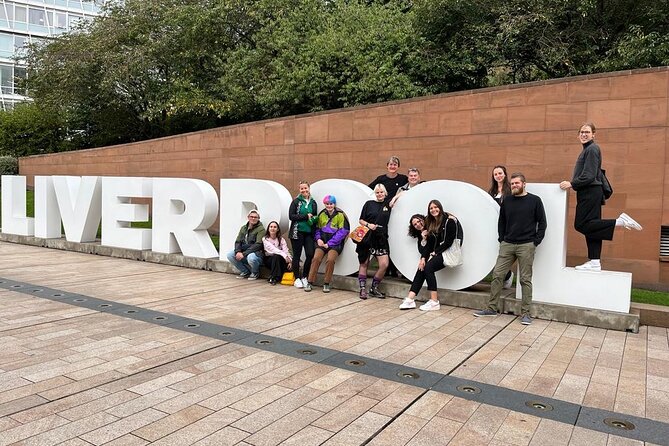
You can also look down through a port hole, a small touch that makes the dockside setting feel more connected to ships and working water. The oversized LIVERPOOL sign is here too, with colors that change for seasons or special events. It is an obvious photo stop, but it does not feel out of place on a modern waterfront.
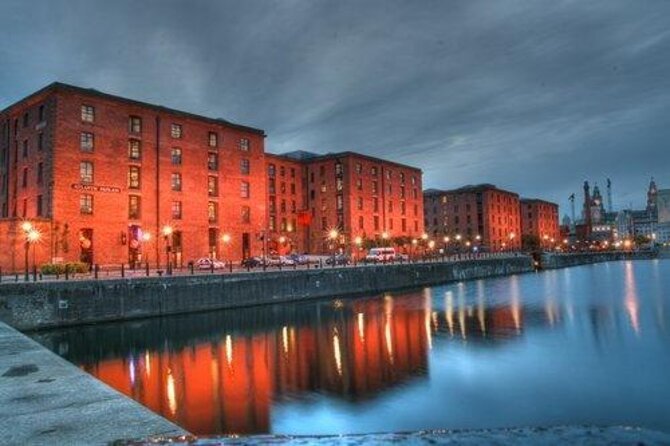
The Royal Albert Dock is the longest stop, at about 20 minutes. This is where the port’s importance becomes easiest to understand. Your guide explains how the docks shaped Liverpool and how the city’s maritime identity connects with the Titanic story.
The Titanic was registered in Liverpool, and the ship’s story remains tied to the city even though it did not sail from Liverpool on its final voyage. The tour uses that connection as part of a wider explanation of Liverpool’s port, its shipping companies, and its international links.
Look for the mix of old and new architecture around the dock. You will also pass the bronze statue of Bill Fury, which has become a shrine for his fans. It is a reminder that the waterfront is not only about warehouses and ships. It also carries more recent cultural memories.
The dock is a good place to pause and take photographs, but do not expect an indoor museum visit as part of this tour. The value here comes from the guide’s explanation and the way the buildings fit together.
Meeting the Beatles and reaching the Three Graces
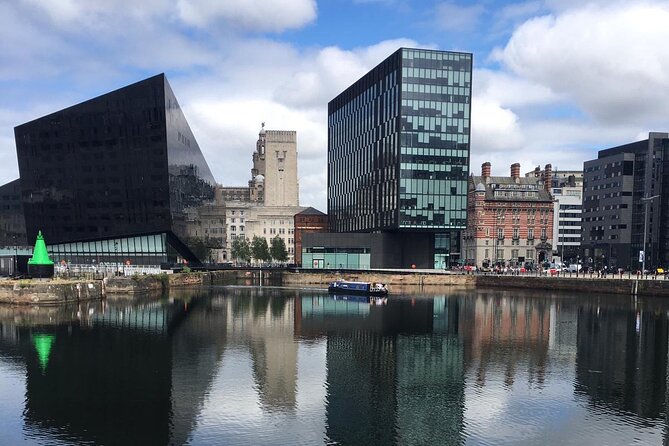
The Beatles statue is one of the most popular photo stops. The sculpture by Andrew Edwards shows the Fab Four together, giving you the familiar chance to pose beside Liverpool’s most famous musical export.
Access to the statue can occasionally be restricted. If that happens, the route may use alternative statues. That is worth knowing if this particular photograph is the main reason you are booking.
The Beatles appear during the walk, but this is not a detailed Beatles biography tour. You hear behind-the-scenes stories and pass close to the Cavern Club area, but the tour gives equal weight to shipping, architecture, politics, and city development.
For a full Beatles-focused experience, the tour ends near a separate option: a dedicated Beatles walking tour. That makes this experience a good choice if you want music as one part of Liverpool’s identity rather than the entire subject.
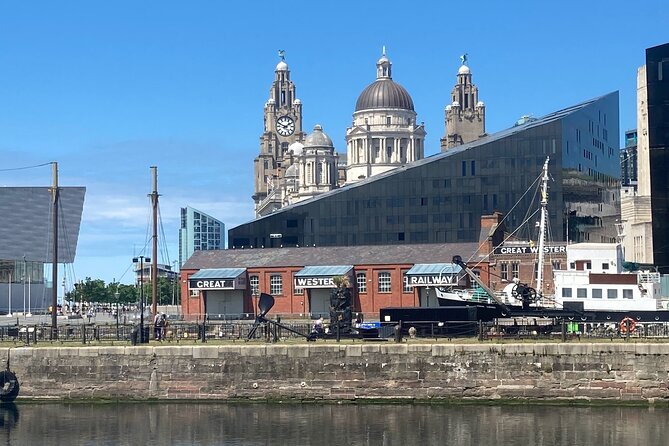
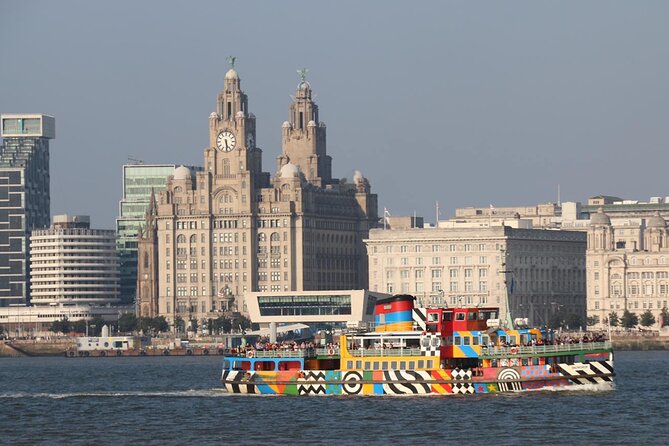
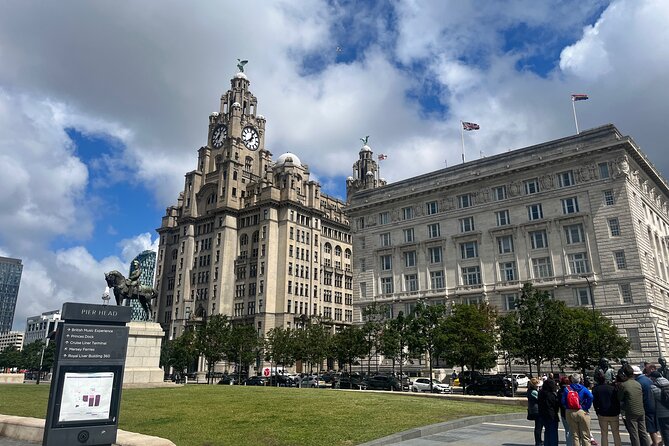
Next comes the Three Graces: the Cunard Building, the Port of Liverpool Building, and the Liver Building. These Grade II listed buildings form Liverpool’s most recognizable waterfront group, with the Liver Building usually taking center stage.
Your guide explains how the buildings reflect Liverpool’s commercial and maritime power. The two Liver birds on the Liver Building are often treated as city guardians, and the group’s position beside the Mersey gives you one of the clearest views of Liverpool’s public face.
This section works best when you look up. The scale and detail of the buildings are easy to miss if you focus only on the pavement or your camera. It is also a good point to ask your guide about the city’s links with the United States, a subject that guides may touch on through Liverpool’s international trade and its early foreign consulate.
More Local Culture and Traditions Tours in the UK:
- Belfast: Best of Belfast History, Culture & Art Walking Tour
★ 4.9 · 158 reviews - Amsterdam Food and Cultural Tour with Tastings
★ 5.0 · 4,315 reviews - Sevilla Food Tour: Tapas, Wine, History & Traditions
★ 5.0 · 3,468 reviews - Tromsø: Reindeer Camp and Sami Cultural Tour with Lunch
★ 4.7 · 3,326 reviews
Castle Street, Town Hall, and the old civic center
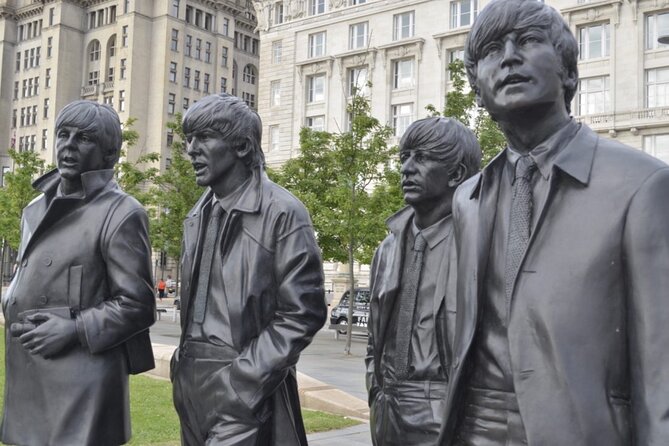
The walk then leaves the waterfront and heads along Castle Street. The street still offers a connection with Liverpool’s medieval past, framed by handsome buildings and long views toward the civic center.
At Liverpool Town Hall, you hear about the building’s predecessors and the city’s civic development dating back to the 1500s. The current Town Hall is Grade I listed and regarded as one of England’s finest surviving 18th-century town halls.
The tour does not include admission inside, so you will be learning from the outside. That is not a problem for a walking overview, but you should plan a separate visit if you want to see the interior.
Exchange Flags provides another change of mood. Its Grade II listed buildings create a courtyard facing the Town Hall. The area also carries Second World War connections and contains the large bronze Nelson Monument, dating from the early 1800s.
This is the sort of stop that benefits from a guide. Without context, a courtyard and statue can look like background scenery. With a few clear facts, the space becomes part of Liverpool’s political, military, and commercial story.
The final listed stop is Derby Square, where you hear about Liverpool Castle, which once stood here. The square is now marked by an imposing Queen Victoria monument.
One practical point: the published route includes several stops, and a review noted that Derby Square, the Queen Victoria monument, and some Beatles-related points were not reached on one occasion. The company acknowledged that guides can sometimes get drawn into a story and miss a planned location. If a particular stop matters to you, ask your guide early in the walk.
Finishing at Mathew Street and the Cavern quarter
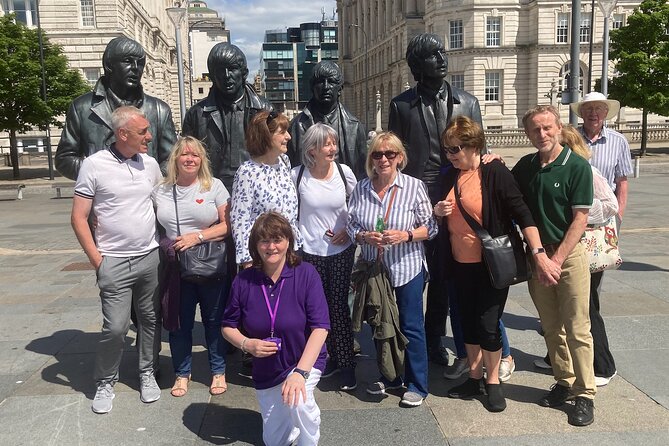
The tour ends at the entrance to Mathew Street, a useful city-center finish. You can continue into the Cavern quarter on your own, take photographs, stop for a drink, or explore the music venues nearby.
The Cavern Club is not included as an entry visit. It is close enough to make your own follow-up easy, and the end point works well if you want to continue with Liverpool’s music story.
This finish also makes the walk practical for the rest of your day. You are not left on the edge of town or required to retrace the route to reach the main center.
The guides make the biggest difference
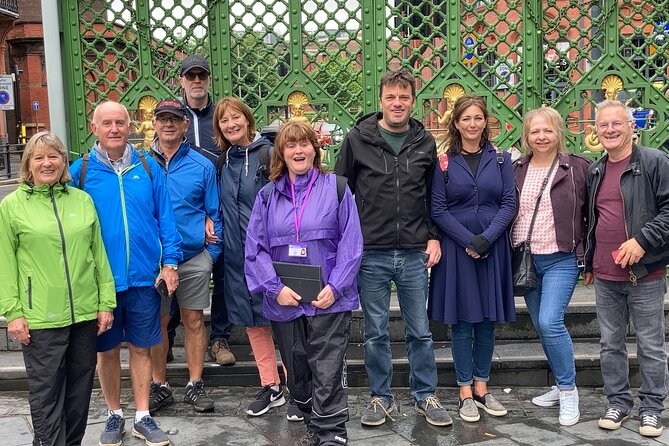
The tour company uses several local guides, and the strongest pattern in the feedback is their ability to make facts easy to follow. Mike Dowling is praised for enthusiasm, humor, and his ability to answer questions. Carl is noted for giving clear explanations and adapting well to a small group.
Pam receives strong praise for her command of Liverpool’s past, while Allan is described as considerate, funny, and good at choosing photo stops. Roy brings local humor and a distinctly Scouse personality.
Other named guides include Colleen, Paul, Rob, Chris, and Michael. The tone may vary from one guide to another, but you can expect the guide to shape the experience more than any audio device or printed handout.
One useful detail comes from a less positive comment: a participant found it hard to hear questions asked by other people and suggested earphones. The group limit is 20, which helps, but stay near the guide if you want to catch every exchange.
Price, pace, and practical value
At $31.90 per person, this is a fair price for a guided city orientation lasting more than two hours. You are paying for a local guide, not entry to attractions, food, or drinks.
I think the value is strongest if Liverpool is new to you or your time is limited. The route covers enough ground to save you the trouble of piecing together the waterfront, civic center, Ropewalks, and Beatles quarter by yourself.
It is also useful for repeat visitors. One local participant learned new details despite having visited Liverpool since the 1970s. That suggests the walk has enough lesser-known stories to reward people who already know the main sights.
The physical demands are modest. There are no hills or stairs, but you will walk for over two hours on surfaces that can include cobbles. Wear comfortable shoes with good grip and bring water.
Children under 16 must be with a responsible adult. Well-behaved dogs are welcome, and service animals are allowed, though busy streets and a moving group may not suit every dog.
The tour requires reasonable weather. If poor weather forces cancellation, you are offered another date or a full refund. You can cancel for a full refund up to 24 hours before the start time, but late cancellations and changes are not accepted.
Who should book this walk?
I would choose this tour for a first day in Liverpool, especially if you want a clear sense of the city before visiting museums, the Cavern Club, or the dockside attractions in more detail.
It also suits cruise passengers, short-break visitors, and anyone who wants to cover the main center without dealing with traffic. The walking route is more revealing than a vehicle ride because you move through the Ropewalks, squares, courtyards, and old streets at street level.
You may want something else if your main goal is an in-depth Beatles tour, an indoor architecture visit, or a slow photographic walk. This experience has a full route and a fixed timetable, so it cannot linger everywhere.
Should you book the Best Of Liverpool walking tour?
Book it if you want Liverpool’s full story in a single outing: port, docks, medieval traces, civic buildings, local characters, and the Beatles. The most valuable part is the connection between places that might otherwise seem unrelated.
Keep your expectations practical. You may not visit every listed point, the Beatles statue can sometimes be inaccessible, and no attraction admission is included. Still, with a good guide such as Mike, Carl, Pam, Allan, or Roy, this is a lively and useful introduction at a reasonable price.
FAQ
How long does the tour last?
The walking tour lasts approximately 2 hours 15 minutes.
Where does the tour start?
You meet the guide in front of the Bluecoat building on School Lane, Liverpool L1 3BX.
Where does the tour end?
The tour ends at the entrance to Mathew Street in Liverpool city center, close to the Cavern quarter.
Is the Cavern Club entry included?
No. The tour ends near Mathew Street, where you can explore the Cavern Club and surrounding area independently.
Is food or drink included?
No. Food and drinks are not included. A bottle of water is recommended for the walk.
Is the route physically difficult?
The route has no hills or stairs, but it lasts over two hours and includes areas with uneven cobbles. Comfortable, non-slip shoes are recommended.
Can I cancel for a refund?
Yes. You can cancel up to 24 hours before the start time for a full refund. If poor weather causes the company to cancel, you are offered another date or a full refund.
Newest history tours we have reviewed in the UK
- Belfast: Best of Belfast History, Culture & Art Walking Tour★ 4.9 · 158 reviews
- Belfast Walking Tour with a Local – History & Craic★ 4.9 · 130 reviews
- Belfast: Peacewall and Political History Black Taxi Cab Tour★ 5.0 · 60 reviews
- Bath : 2 Hour Historic Walking Tour With An App★ 3.6 · 19 reviews
- London: Private Landmark Tour with Professional Photographer★ 4.7 · 91 reviews
- American Heritage in London 4 Hour Private Tour in a Black Cab★ 5.0 · 64 reviews
- Private Rock n Roll History Tour of London in an Iconic Black Cab★ 5.0 · 65 reviews
- London: Medieval History Walking Tour from The Tower★ 4.9 · 318 reviews
Local Culture & Traditions Tours, compared.

Amsterdam Food and Cultural Tour with Tastings
Read our review →
Sevilla Food Tour: Tapas, Wine, History & Traditions
Read our review →
Tromsø: Reindeer Camp and Sami Cultural Tour with Lunch
Read our review →
Half Day Dominican Republic Cultural Tour : Small Group
Read our review →
Ultimate Melbourne Walking Tour: History, Laneways & Culture
Read our review →
Tromsø: Sámi Reindeer Sledding and Sami Cultural Tour
Read our review →
Kyoto Gion: 2-Hour Geisha Culture & History Walking Tour
Read our review →
Marrakech Historical and Cultural Tour – Half Day City Tour
Read our review →Browse the lists this tour appears in