
Review · LIVERPOOL HISTORY TOURS
Liverpool: Heritage, History & Culture Guided Walking Tour
Liverpool’s story comes into focus on foot, from the site of Liverpool Castle and the city’s first dry dock to the Royal Albert Dock, the Three Graces, and Mathew Street. You get far more than a Beatles stroll: the tour also addresses maritime trade, the slave trade, the Titanic connection, civic power, and the city’s changing streets.
I like the personal storytelling and the mix of famous sights with less obvious corners. I also like the way the route links Liverpool’s past to its present, so you can understand why the waterfront, commercial center, and music quarter grew where they did. The main consideration is pace: two hours covers a lot, and busy streets, cobbles, and group walking may not suit everyone.
Key points at a glance
- Liverpool’s story in two hours: Move from the reign of King John to modern Liverpool through short talks at major landmarks.
- A serious look at the waterfront: Learn about maritime trade, the slave trade, Liverpool’s first dry dock, and the Titanic connection.
- The best-known Beatles stops: Pass the Cavern Club and take a photo with the Beatles Statue.
- Grand architecture without a museum ticket: See the Royal Albert Dock, Three Graces, Town Hall, Exchange Flags, and newer city buildings.
- Guides with different personalities: Guides including Mike, Mike D, Pam, Allan, Carl, Karl, Colleen, and Alan bring local knowledge, humor, and personal stories.
- Good value for a first visit: At $31, the tour gives you a useful orientation before you decide which places deserve a longer visit.
Starting at the Bluecoat in Liverpool city center
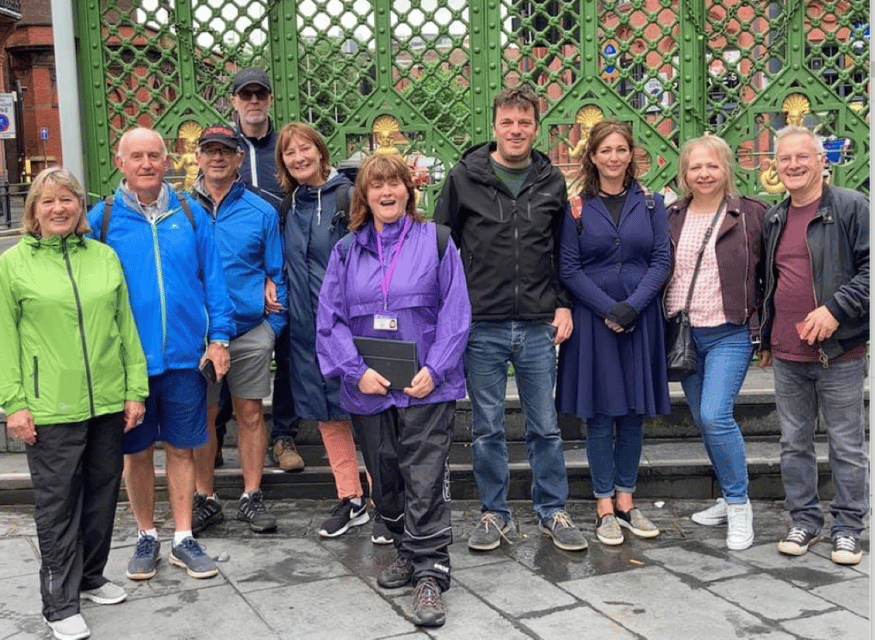
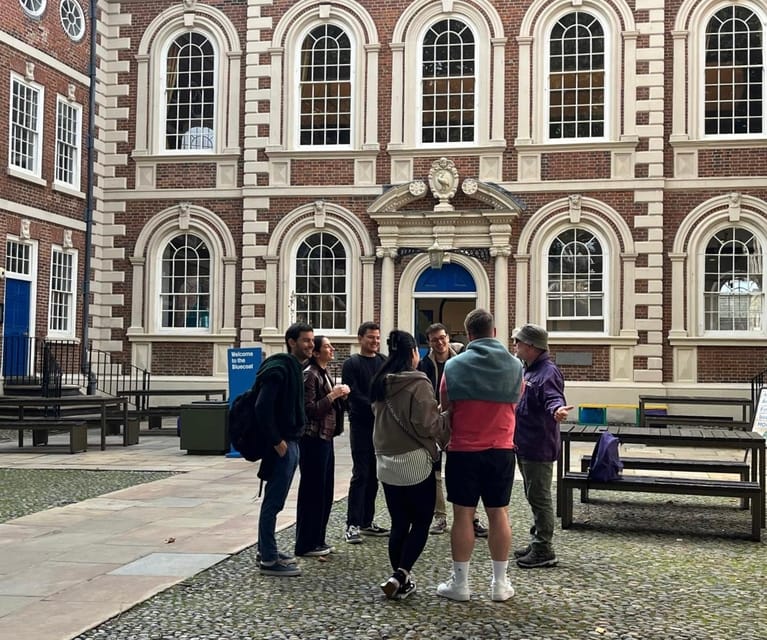
The tour begins outside the front gates of the Bluecoat Chambers on School Lane. This is a practical starting point in the center, close to Liverpool One and within easy reach of the main shopping and sightseeing area.
Look for the black metal railings and the main entrance at 8 School Lane, Liverpool L1 3BX. The meeting point is outside the gates, not at the Blue Coat School. Castle Fine Art is opposite, and the three-word location supplied for the meeting point is Soccer Trial Cuts.
The Bluecoat itself gives you an early sense of Liverpool’s age and character. From here, your guide sets the wider story in motion, covering the city from the time of King John to the present day. You are not simply collecting dates. The useful part is learning how power, trade, shipping, music, and civic life shaped the streets you are about to walk.
Guides vary, but the names that come up include Mike, Mike D, Pam, Allan, Carl, Karl, Colleen, and Alan. Their styles differ, which is normal for a local walking tour, but the common thread is a strong command of Liverpool’s story and a willingness to answer questions. Several guides are especially good at mixing facts with anecdotes and humor.
More History Walking Tours in the UK
- A History of Terror – Belfast City Centre Walking Tour
★ 5.0 · 2,883 reviews - Edinburgh: Old Town History and Tales Walking Tour
★ 4.8 · 2,361 reviews - Old Town Walking Tour History and Tales in Edinburgh
★ 5.0 · 2,168 reviews
Liverpool One and the changing city center
The first section passes through Liverpool One, the modern shopping and leisure quarter. This is a good contrast with the older buildings that follow. You see how a city center can change use over time, while still keeping its main role as a place where people meet, shop, work, and move between the commercial district and waterfront.
Your guide uses this part of the walk to explain Liverpool’s development rather than treating each stop as an isolated photo opportunity. That matters because the old port and the modern center are closely linked. The route helps you get your bearings early, which is useful if this is your first time in the city.
This portion lasts about 10 minutes, so do not expect a long architectural lecture here. Think of it as an introduction before the tour reaches its strongest historical stretch.
The first dry dock and Liverpool’s maritime past
The walk then heads toward the waterfront and a site connected with Liverpool’s first dry dock. A large water fountain marks the maritime story, and the oversized LIVERPOOL sign provides one of the tour’s easy photo stops. Its colors change with the season or special events.
The dock story is central to understanding Liverpool. The port helped drive the city’s growth, but its success also belongs to a difficult past. The tour includes Liverpool’s role in the slave trade, an important part of the city’s history that should not be skipped in favor of a purely celebratory account of ships and commerce.
I appreciate that this subject appears within the main route rather than being treated as an optional aside. You get a more honest introduction to Liverpool, including the wealth created through trade and the human cost tied to parts of that system.
The waterfront is also where the tour’s pace can become uneven. You may stop often for explanations and photos, while passing crowds and other walking groups. Wear shoes that can handle a full two hours on pavement and occasional cobbles.
Royal Albert Dock and the Titanic connection
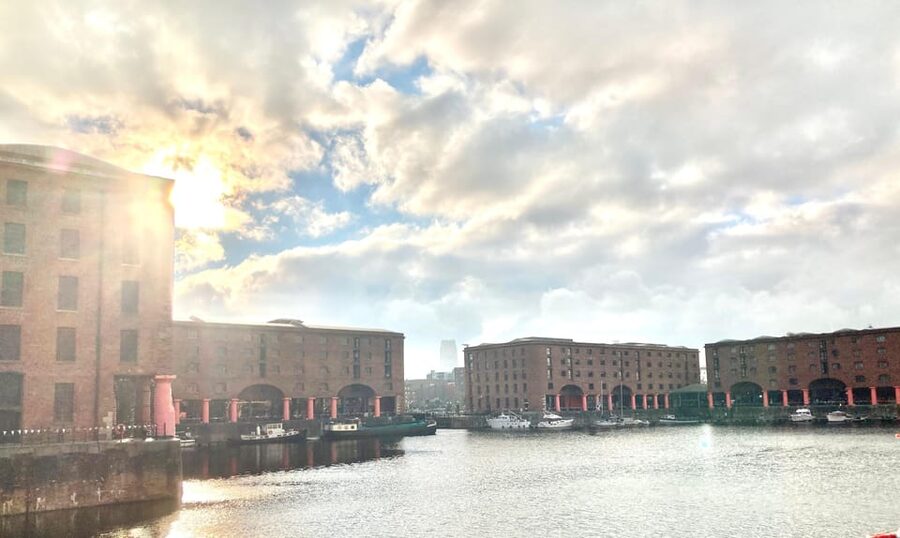
The Royal Albert Dock receives about 30 minutes, making it the longest stop on the route. That is sensible. The dock has both visual appeal and historical weight, with broad water, handsome brick buildings, and plenty of space to pause while your guide explains how the docks helped Liverpool grow.
Here you hear how the Titanic story became part of Liverpool’s maritime identity. The connection is not simply about a famous ship. It reflects the wider network of companies, workers, shipping routes, and businesses tied to Liverpool’s port.
The dock is one of the tour’s best places for photographs, but I would resist rushing off for pictures while the guide is speaking. The value of this stop comes from putting the buildings around you into context. You can return later for a closer look if your schedule allows.
The route does not include food or drinks, so bring water. The Bluecoat is open from 10 a.m. Tuesday through Saturday and has a café and toilets within the building, but those facilities are not part of the tour itself. Plan ahead, especially if you are joining an early departure or visiting on another day.
More Local Culture and Traditions Tours in the UK:
- Best Of Liverpool Heritage, History & Culture Guided Walking Tour
★ 5.0 · 539 reviews - Belfast: Best of Belfast History, Culture & Art Walking Tour
★ 4.9 · 158 reviews - Amsterdam Food and Cultural Tour with Tastings
★ 5.0 · 4,315 reviews - Sevilla Food Tour: Tapas, Wine, History & Traditions
★ 5.0 · 3,468 reviews
The Beatles Statue and Liverpool’s music story
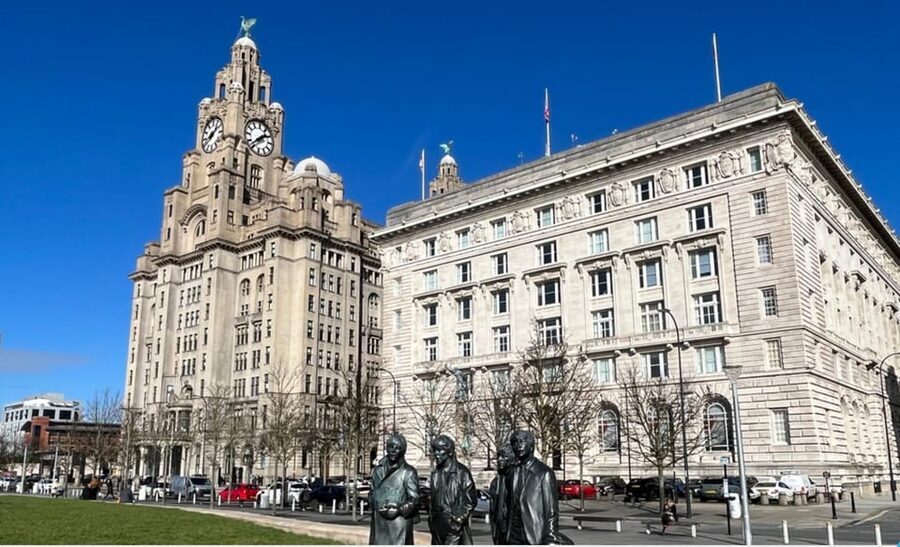
Near the waterfront, you stop at the Beatles Statue for about 10 minutes. The statue, sculpted by Andrew Edwards, gives you an obvious chance to take a photo with the Fab Four.
This is a popular moment, but the tour does not reduce Liverpool to Beatles memorabilia. The statue works best as a doorway into the city’s music story and its international identity. Your guide can connect the band to the streets and venues that made Liverpool famous, while keeping the rest of the city in view.
If you want a good photo, listen for the guide’s instructions about when the group is pausing. Public statues can attract crowds, and a two-hour walk does not leave room for everyone to linger as long as they might like.
The Beatles stop is also useful for deciding how much more music sightseeing you want to do afterward. The tour points you toward the Cavern Quarter, but it is not a full Beatles tour or a concert experience.
The Three Graces on the waterfront
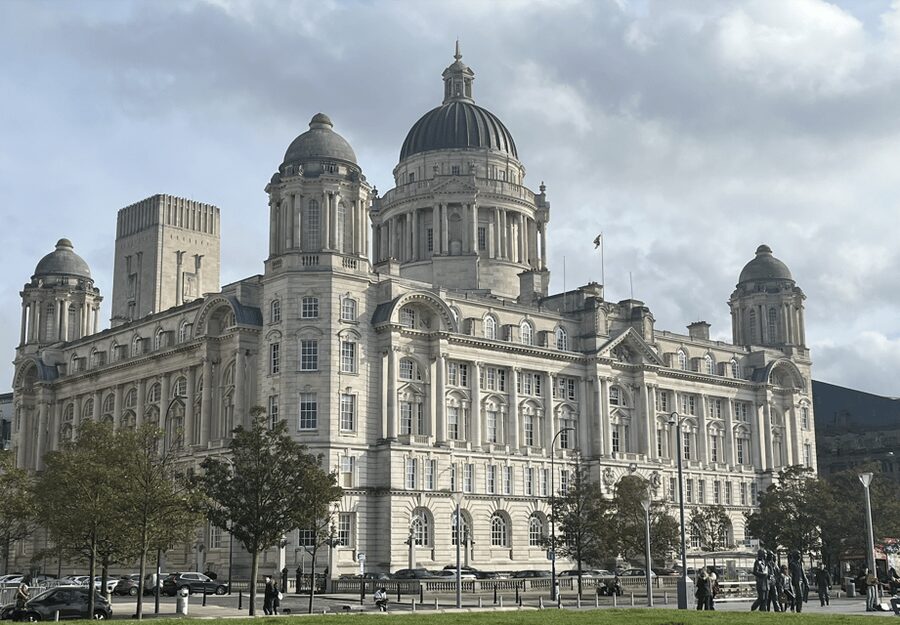
The Three Graces are among Liverpool’s most impressive buildings: the Cunard Building, the Port of Liverpool Building, and the Liver Building. Together, they form one of the city’s defining views and provide a strong lesson in the confidence and ambition of Liverpool’s port era.
The buildings are Grade II listed, and the Liver Building is the icon most people recognize first. Your guide explains the history and heritage of the group while you take photographs. This is a good place to pause and look upward, since the scale and detail are easy to miss when you are simply walking past.
The 15-minute stop is long enough for an explanation and a photo break, but not a full interior visit. That is a fair trade for a general city tour. You get the story and the exterior views, then can return independently if one building catches your interest.
Exchange Flags and the Town Hall
The route includes Exchange Flags, a Grade II listed area arranged around a courtyard facing the Town Hall. This part of Liverpool can feel more formal than the waterfront or Mathew Street, and the change in mood helps show how trade and civic authority worked side by side.
The current Town Hall is Grade I listed and is regarded as one of England’s finest surviving 18th-century town halls. Your guide also covers its predecessors, with a history reaching back to the 1500s.
This is the kind of information that makes a walking tour useful. You do not need to remember every date. What matters is seeing that the city’s government, merchants, port businesses, and public buildings developed as part of one connected story.
The itinerary allows roughly 10 minutes for this part. Expect an exterior explanation rather than a detailed tour inside the Town Hall.
Mathew Street, Cavern Quarter, and the Cavern Club
The route becomes more musical as you enter Mathew Street and the Cavern Quarter. The street is closely tied to the Cavern Club and the artists who made Liverpool a major name in popular music.
You walk in the footsteps of the city’s musical icons, but the surroundings are not presented as a polished museum display. Mathew Street is a working public street, and it can be crowded and noisy. That gives the stop some energy, though it also means you should stay close to the group and watch your footing.
About 20 minutes are set aside for this part of the walk. That gives your guide room to explain the Cavern Club and Liverpool’s music identity, while allowing time for photographs. The tour passes by the club rather than promising entry, a live performance, or a separate venue tour.
I like this stop because it puts the Beatles story in a real street setting. You can then decide if you want to return to the area later for more music-related sightseeing.
Finishing near the Eleanor Rigby Statue
The tour ends at the Eleanor Rigby Statue. This is a fitting finish because it returns the Beatles connection to public art while placing you near the central streets you have already begun to understand.
The end point is not the same as the Bluecoat starting point, so think about your onward plans. The route finishes in the city center, and you may want to continue exploring nearby sights, find a meal, or return to one of the earlier stops.
The route is designed as an overview, not a set of long visits. You will leave with a list of places to revisit, which is often the right approach for a first day in Liverpool.
How the guides shape the experience
A local guide makes the difference on this tour. The guide team includes Mike and Mike D, who are described as engaging, witty, and passionate about the city, along with Pam, Allan, Carl, Karl, Colleen, and Alan.
Expect a mixture of facts, opinions, personal stories, and answers to questions. Some guides may run beyond the planned two hours when the group is engaged, though you should not count on extra time if you have a train, reservation, or another timed activity.
The strongest feature is the human delivery. Liverpool’s past includes difficult subjects, grand civic buildings, maritime trade, and pop culture. A good guide can connect those pieces without turning the walk into a list of dates.
If you have a particular interest in the slave trade, Titanic, architecture, or the Beatles, ask about it during the tour. The guides are used to questions, and the experience is more useful when you shape part of the conversation around your own interests.
Is $31 a fair price for two hours?
At $31 per person, I consider this a fair introduction to Liverpool. You are paying for two hours with a local English-speaking guide, a planned route through several major areas, and context that is difficult to get from a quick self-guided walk.
The value is strongest if you are visiting for the first time. You see the waterfront, central shopping district, civic buildings, music quarter, Beatles statue, and Eleanor Rigby Statue without having to plan the route yourself. You also learn which sights deserve a return visit.
The price is less attractive if you already know central Liverpool well or want extended interior visits. Food, drinks, entry tickets, and longer stops are not included. It is best viewed as an orientation walk, not a complete city tour.
Practical advice before you go
Wear comfortable shoes and bring water and a camera. The route is easy in the sense that it does not involve strenuous hiking, but you will be on your feet for two hours and may cross uneven surfaces, including cobbles.
The tour is described as wheelchair accessible, while the practical information also says it is not suitable for wheelchair users or people with mobility impairments. Since the group may pass through busy areas and uneven streets, contact the provider before booking if you use a wheelchair, have limited mobility, or need a slower pace.
Strollers and well-behaved dogs are allowed according to the supplied information, but both may be awkward in crowded areas. You will be walking with a group, so keep that in mind rather than assuming every stretch will be easy to navigate.
Free cancellation is available up to 24 hours in advance, and you can reserve now and pay later. Starting times vary, so check availability before building the rest of your day around the walk.
Who should book this Liverpool walking tour?
I would choose this tour for a first visit, a short city break, or a morning when you want the main story before exploring alone. It suits you if you enjoy architecture, local history, maritime stories, and Beatles connections in one compact route.
It is also a good fit if you prefer a guide who can answer questions instead of following a fixed audio track. The range of guide personalities means the exact tone may vary, but the route and main sights remain consistent.
I would choose something else if you want a slow photography walk, a dedicated Beatles tour, or a detailed interior tour of the Royal Albert Dock and Town Hall. The two-hour format gives you breadth, not extended time at each attraction.
Should you book it?
Book this tour if you want a smart first look at Liverpool for $31, especially if you value local stories over a simple checklist of sights. The strongest parts are the waterfront, the Three Graces, the honest treatment of Liverpool’s trading past, and the walk through Mathew Street and the Cavern Quarter.
Skip it if you already know the city center well or need a fully step-free, slow-paced outing. For most first-time visitors who can manage two hours of group walking, this is a useful and fairly priced way to get oriented, gather context, and choose what to explore next.
FAQ
How long is the Liverpool Heritage, History & Culture walking tour?
The tour lasts two hours.
What language is the tour conducted in?
The live guided tour is conducted in English.
How much does the tour cost?
The listed price is $31 per person.
Where does the tour start?
It starts outside the front gates of the Bluecoat Chambers building at 8 School Lane, Liverpool L1 3BX. The meeting point is by the black metal railings at the main entrance, opposite Castle Fine Art.
Where does the tour finish?
The tour finishes at the Eleanor Rigby Statue.
Which major sights are included?
The route includes Liverpool One, the Royal Albert Dock, the Beatles Statue, the Three Graces, Exchange Flags, the Town Hall area, Mathew Street, and the Cavern Quarter near the Cavern Club.
Is food or drink included?
No. Food and drink are not included. You should bring water.
What should I bring?
Bring comfortable shoes, water, and a camera.
Can I cancel or pay later?
You can cancel up to 24 hours in advance for a full refund. Reserve now and pay later is also available.
Newest history tours we have reviewed in the UK
- Ilfracombe Seafront History Walking Guided Tour★ 5.0 · 18 reviews
- Walking Bogside History Tour in Guildhall★ 5.0 · 280 reviews
- Private tour of the stunning Cotswolds with an expert local guide★ 5.0 · 45 reviews
- Curious Cambridge – The History Tour that’s FUN!!!★ 5.0 · 80 reviews
- Birmingham Gangs Nighttime Historical Walking Tour with Pub Stops★ 5.0 · 53 reviews
- 2.5-Hours Walking Tour of Birmingham into Black Heritage Madiba★ 5.0 · 49 reviews
- Private Political History & Murals Tour Belfast★ 5.0 · 182 reviews
- Belfast Walking Tour: City Centre History, Troubles & Stories★ 5.0 · 39 reviews
Local Culture & Traditions Tours, compared.

Amsterdam Food and Cultural Tour with Tastings
Read our review →
Sevilla Food Tour: Tapas, Wine, History & Traditions
Read our review →
Tromsø: Reindeer Camp and Sami Cultural Tour with Lunch
Read our review →
Half Day Dominican Republic Cultural Tour : Small Group
Read our review →
Ultimate Melbourne Walking Tour: History, Laneways & Culture
Read our review →
Tromsø: Sámi Reindeer Sledding and Sami Cultural Tour
Read our review →
Kyoto Gion: 2-Hour Geisha Culture & History Walking Tour
Read our review →
Marrakech Historical and Cultural Tour – Half Day City Tour
Read our review →Browse the lists this tour appears in