Review · ATHENS HISTORY TOURS
Acropolis, Parthenon & Athens Old City Heritage Walking Tour
The best part of this tour is the way it links the Acropolis monuments with the streets below. You begin where ancient drama was born, climb past the Propylaea and Temple of Athena Nike, then continue through Plaka to old Roman and Ottoman sites.
I like the early Acropolis access and the wireless audio system, which make a real difference in a noisy crowd. I also like the guides’ storytelling. Michael, Kiki, Panagiota, Christina, and others have been praised for turning dry dates into clear stories, with humor, local tips, and even the occasional song.
The main drawback is the climb. The Acropolis is exposed, steep, and demanding in summer, and the full version packs a lot into three and a half hours. Also check your booking carefully: the Acropolis ticket is included only with selected options.
Key points to know before booking
- The tour begins at the Theatre of Dionysus, then follows the historic route up the south slope.
- The Parthenon and Erechtheion receive the most attention, with time for views and photographs.
- Early departures are the smart choice, especially in July and August, when heat and crowds build quickly.
- The Plaka extension adds Roman, Ottoman, and neighborhood sights, ending at Monastiraki Square.
- Wireless audio devices help you hear the guide, even when other groups crowd the site.
- The $34 starting price is good value only if your chosen option includes admission, so confirm the ticket details before paying.
From the Theatre of Dionysus to the Acropolis summit
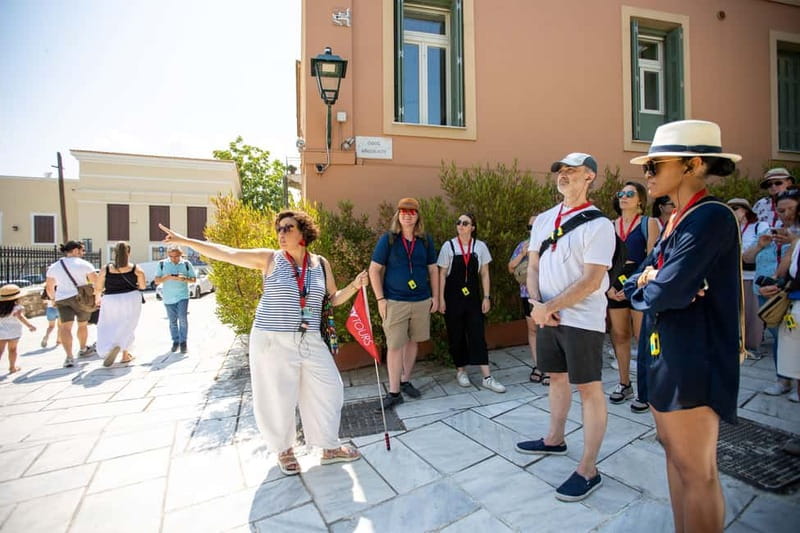
Your meeting point is the Key Tours office near Athens Gate Apt. From there, the group heads toward the south slope of the Acropolis and the Theatre of Dionysus.
This is a smart starting point. The theatre is not just another ancient ruin. It is tied to the beginnings of Greek drama, and the setting helps you understand how performance, religion, and public life once worked together. Your guide spends about 15 minutes here, setting up the story before the climb begins.
The route continues to the Odeon of Herodes Atticus. This beautifully positioned theatre is still used for performances, and its curved stone structure makes an excellent photo stop. You will hear about its role in ancient Athens and see how later buildings sit below the Acropolis rock.
The uphill walk is moderate in distance but can feel strenuous. The stone surfaces are uneven, and much of the route has little shade. I would wear shoes with a firm sole, carry water, and avoid treating this as a casual stroll. In hot weather, the climb is the physical heart of the tour.
More Ancient History Tours in Athens
- Athens: Ancient Greek Theater Performance
★ 4.7 · 2,481 reviews - Historical Delphi One Day Tour with Arachova Stop & Expert Guide
★ 4.5 · 1,247 reviews - From Athens: Ancient Corinth Day Trip with Canal & VR Guide
★ 4.6 · 1,073 reviews
The Propylaea, Athena Nike, and the first great views
At the top, the Propylaea serves as your grand entrance to the Acropolis. Its columns and monumental approach make the site feel ceremonial before you even reach the Parthenon.
The Temple of Athena Nike is a smaller stop, but do not rush past it. Its position near the entrance gives you a fine look across Athens, and its size provides a useful contrast with the much larger buildings ahead. The guide explains the temple’s place within the Acropolis complex and gives you time to look closely.
This is also where the city begins to open up. You can see the Odeon below, the Ancient Agora, and the National Observatory of Athens. Filopappou Hill, Mars Hill, and the Pnyx give the view more depth, while the city spreads out beyond them.
The guides generally keep the group moving while stopping for photographs. Kiki was especially praised for finding shade where possible and keeping people together in difficult summer conditions. That matters here, because the Acropolis can feel confusing when several groups arrive at once.
The Parthenon and Erechtheion
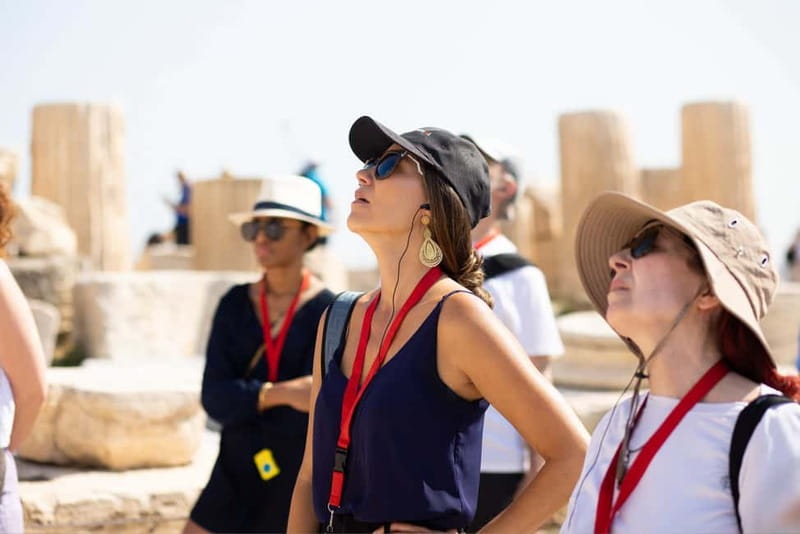
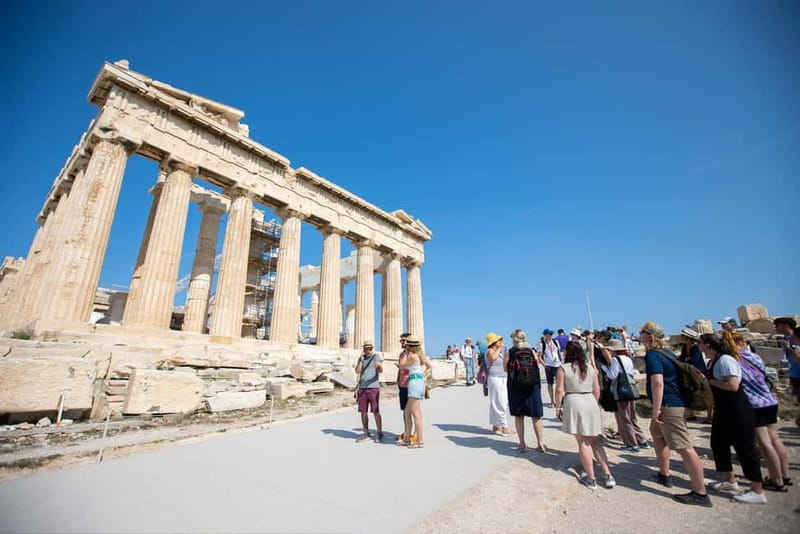
The Parthenon is the main event, and the tour gives it roughly 30 minutes. You will not simply walk up, take one picture, and leave. The guide explains the building’s purpose, design, and importance while positioning the group for clear views.
The monument is partly scaffolded at times as conservation work continues, and crowds can make the approach slow. Still, the scale of the columns and the setting on the rock are hard to grasp from photographs alone. Your guide helps you notice the details that can disappear in the excitement of being there.
The Erechtheion follows, with about 15 minutes devoted to this more complicated building. Its unusual shape and the famous Caryatid figures make it different from the Parthenon. The guide can help you understand why the Acropolis contains several sacred buildings rather than one single temple.
Expect plenty of people around both monuments. The early 8 a.m. and 9 a.m. departures receive the strongest practical recommendation because they reduce, but do not eliminate, heat and congestion. Even on an early visit, the Parthenon can already be crowded in summer.
Thirty minutes to look around and take photographs
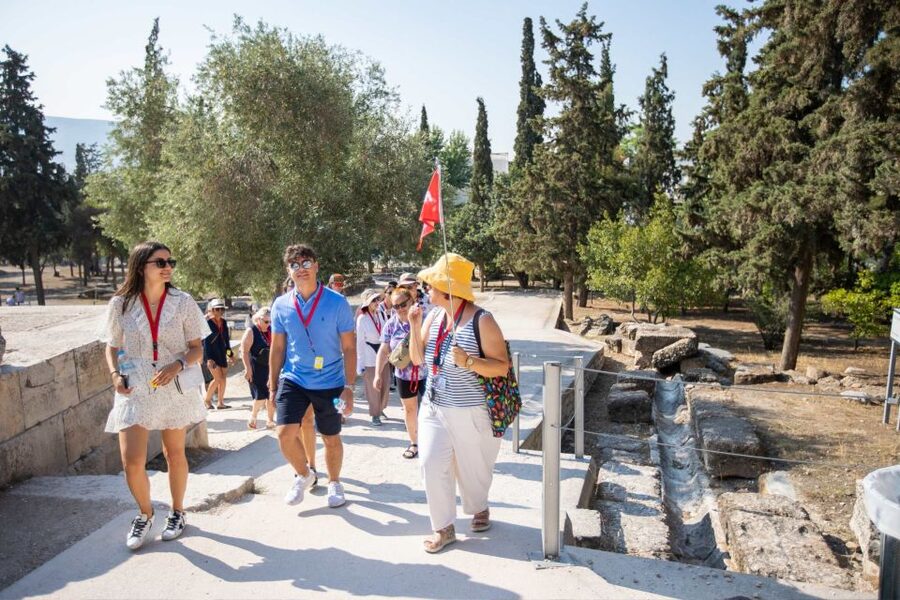
After the guided explanations, you get about 30 minutes of free time and photo stops around the Acropolis. This pause is important. It lets you look at the city at your own pace instead of listening continuously.
Use it for broad views, close architectural details, and photographs of the hills and ancient sites below. You may also want to revisit the Parthenon from a different angle or simply sit for a few minutes and take in the setting.
There is very little shade, so the pause can feel tiring in hot weather. Bring a sun hat, sunglasses, water, and a light cover-up. One visitor reported temperatures of 35 degrees Celsius at 9 a.m. in July, which gives you a fair idea of why timing matters.
More Ancient History Tours in Greece
- Private Biblical Tour Ancient Corinth & Isthmus Canal from Athens
★ 5.0 · 762 reviews - Athens: Ancient Corinth & Nafplio Full Day Trip with Swim
★ 4.8 · 531 reviews - Athens Skip the Line: Open Air Ancient Greek Theatre Performance
★ 4.5 · 520 reviews - Athens: Ancient Agora E-Ticket and Audio Tour
★ 3.9 · 413 reviews
Anafiotika and the old streets of Plaka

The Plaka option takes you downhill into Athens’ oldest neighborhood. Anafiotika is one of the most appealing parts of the walk because its lanes feel very different from the monumental Acropolis above.
The route uses cobblestone streets and narrow passages, so sensible shoes remain important after the climb. Your guide points out local details and stories that are easy to miss when walking alone. This is not a long stop at one monument. It is a guided neighborhood walk with short explanations along the way.
I like this change of pace. The Acropolis gives you the grand view of Athens, while Plaka brings you down to street level. You get a better sense of how the ancient, Roman, Ottoman, and modern parts of the city sit close together.
The walk is not designed as a long shopping or restaurant break. If you want time to browse shops, stop for coffee, or choose lunch, plan that after the tour ends at Monastiraki Square. One visitor wished for more time and more direction in Plaka, which is a fair point. The extension gives you an introduction, not a full afternoon in the neighborhood.
Roman Forum, Tower of the Winds, and the old public baths
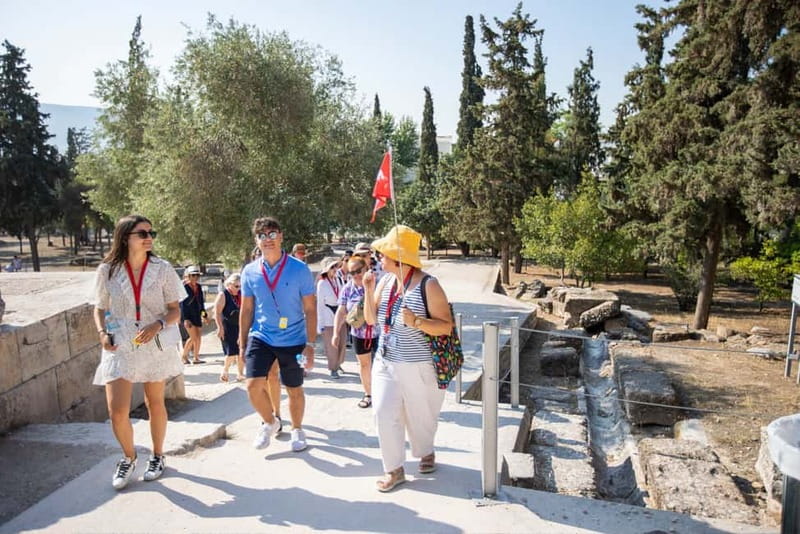
The Roman Forum of Athens comes next. It is smaller and less instantly famous than the Acropolis, but it helps show how Athens continued to function under Roman rule. The guide explains the remains as part of the city’s later story rather than treating classical Greece as the only period worth seeing.
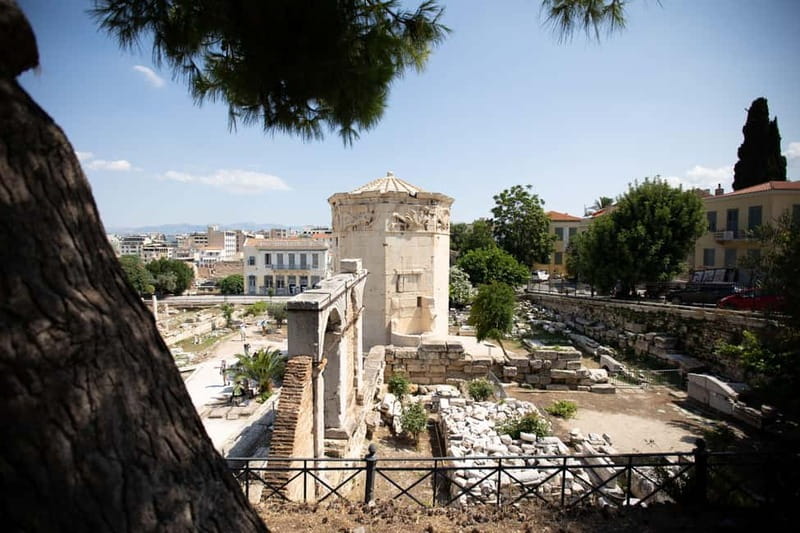
The Tower of the Winds is a quick stop, usually about five minutes. It is an elegant ancient structure with practical purposes tied to time, weather, and public life. Because the stop is brief, listen closely and take a moment to examine the building before the group moves on.
The Bathhouse of the Winds is one of the tour’s more unusual details. It is the last surviving public bath in Athens, and it offers a glimpse into everyday urban life rather than royal or religious architecture. This kind of stop gives the walking tour some variety.
You will also see the Fethiye Mosque Museum. Its presence helps explain the Ottoman layer of Athens, a period that can be overlooked when the city is presented only through ancient ruins. The visit is short, but the building adds useful context to the streets around the Roman Forum.
Hadrian’s Library and the walk to Monastiraki Square
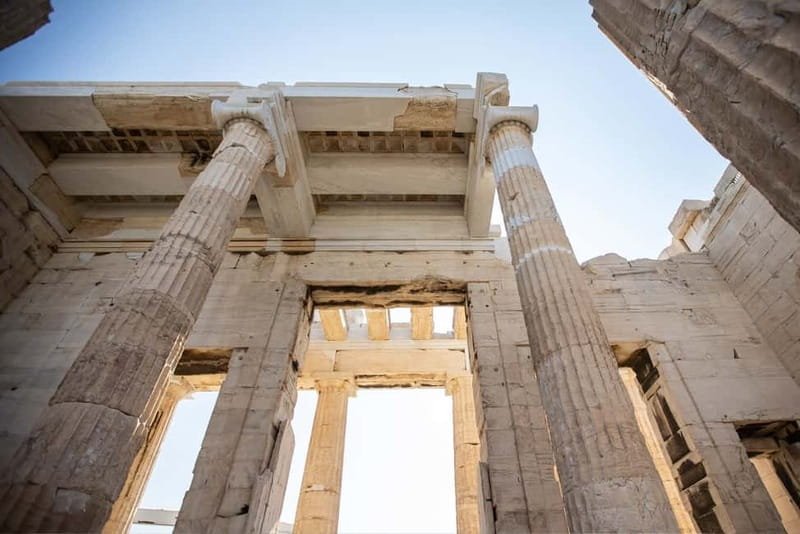
Hadrian’s Library brings you back to the Roman period and the city’s intellectual life. The guided walk takes about 15 minutes, giving you time to understand the scale and purpose of the complex.
The route then passes the Tzisdarakis Mosque before reaching Monastiraki Square. This final stretch shows how many periods of Athens share the same small area. Ancient foundations, Ottoman buildings, neoclassical streets, shops, cafés, and the modern city all appear within a short walk.
The tour finishes at Monastiraki, a useful place to continue exploring on your own. You can treat the square as the end of the experience, or use it as a base for lunch and further sightseeing.
The Plaka extension makes the $34 price more attractive if admission is included. You are getting the Acropolis, a licensed guide, audio equipment, and several additional sites in one organized walk. If your option does not include the entrance ticket, compare the final cost carefully. A separate ticket may add a noticeable amount, and you need to secure the correct timed entry before the tour begins.
The guides make the biggest difference
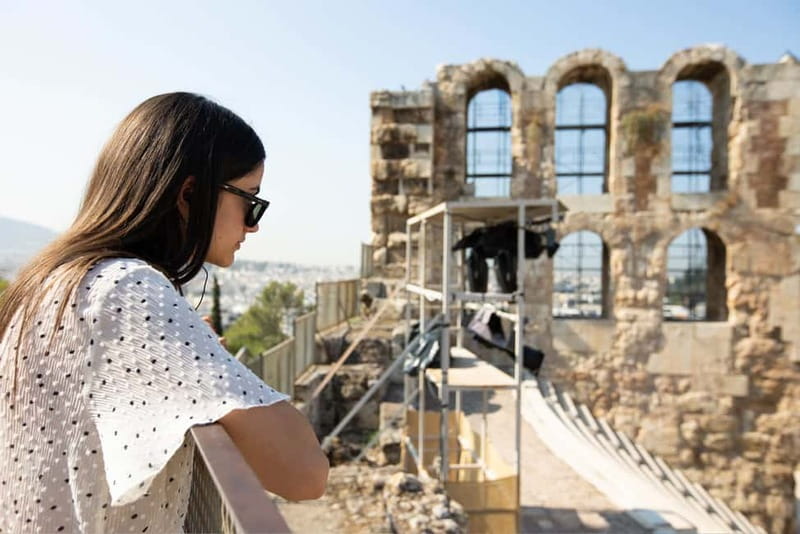
The strongest feature of this experience is the guide. The best guides combine clear facts with a sense of place, and this tour has several names associated with that style.
Michael has been praised for humor, storytelling, a strong command of English, and an impressive singing voice. He reportedly used music in Plaka to explain parts of the old neighborhood, which gives the walk a more personal touch. Kiki was noted for watching the group’s comfort, choosing shade, and adjusting for the heat.
Panagiota, also known as Yoda to her group, received praise for explaining where the group was going and how long each stop would last. Christina has been described as especially good at connecting structures with major historical events and small stories. Joanna was appreciated for lively explanations as well as food and drink suggestions in Athens.
Of course, the exact guide depends on the date and language of your booking. English and Spanish are available. The wireless audio system is a practical advantage, not a luxury. At the meeting point, several groups may gather at once, and one person found the opening organization noisy and confusing. Once underway, the earpieces make it easier to follow the guide without standing shoulder to shoulder.
Timing, group pace, and practical limits
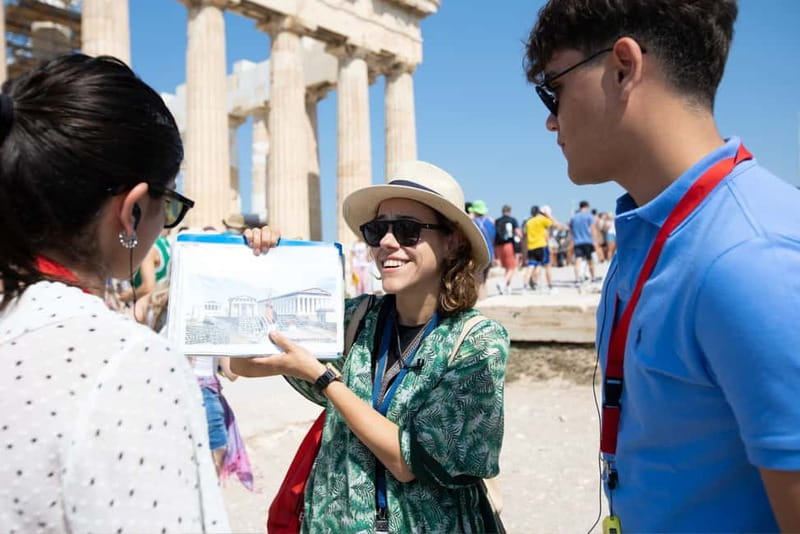
The advertised duration is 210 minutes, or three and a half hours. The Acropolis portion includes roughly two hours of guided sightseeing and free time, followed by the Plaka route if you select that option.
Some tours may finish earlier or run longer depending on crowd control, walking speed, and the guide. One past booking ended after about two and a half hours, while another lasted more than three hours. You should allow the full stated time and avoid scheduling a tight lunch reservation immediately afterward.
The meeting point can be crowded because several groups may leave around the same time. Arrive early, check the tour details, and pay attention to staff instructions. Large bags, luggage, pets, and baby strollers are not allowed, so keep what you carry small.
The route is not suitable for wheelchair users or people with mobility impairments. The climb, uneven stone, heat, and downhill cobblestones require a reasonable level of fitness. Families can manage it if everyone is prepared, but small children may need extra care on the ascent.
Cancellation is free up to 24 hours before the activity, and you can reserve now and pay later. That flexibility is useful if your Athens plans may change, but it does not remove the need to check the ticket option and entry time.
Who should book this Acropolis tour?
I would choose this tour if you want the main Acropolis monuments explained in person rather than visited with a guidebook. It suits first-time visitors, history fans, solo travelers who want a structured morning, and anyone who appreciates clear pacing and local stories.
It is also a good pick if you want more than the Parthenon. The Theatre of Dionysus, Roman Forum, Bathhouse of the Winds, Fethiye Mosque Museum, and Hadrian’s Library give you a broader picture of Athens.
I would think twice if you dislike group tours, need a slow pace, or want a long, unhurried visit in Plaka. The walk covers a lot of ground, and summer heat can make the final neighborhood section feel less appealing. If you book, choose the earliest practical departure, confirm that admission is included, and bring water and sun protection.
At $34 per person, the tour offers solid value when the ticket is part of your selected package. The guide, audio system, early access, and extra old-city walk save you from sorting out the Acropolis route alone. For a focused introduction to Athens, I would book it.
FAQ
How long does the Acropolis and Plaka tour last?
The stated duration is 210 minutes, or three and a half hours. Timing can vary with crowds, walking pace, and the specific tour option.
Is the Acropolis entrance ticket included?
The ticket is included only if you select the option that includes entrance. If you choose the option without tickets, you must purchase admission before the activity at the correct timed entry.
What happens if I qualify for free Acropolis admission?
EU citizens under 25 and non-EU citizens under 18 must obtain free admission online through the official archaeological site. Free timed slots may sell out, so securing one before the tour date is recommended.
What languages are available?
The tour is offered in English and Spanish with a live guide.
Where does the tour meet and finish?
You meet at the Key Tours office. The Acropolis and Plaka option ends at Monastiraki Square.
Is the tour suitable for people with limited mobility?
No. The activity is not suitable for wheelchair users or people with mobility impairments because of the steep ascent, uneven surfaces, and walking required.
What should I bring?
Bring comfortable shoes, water, sunglasses, a sun hat, and your passport or ID card. Pets, baby strollers, luggage, and large bags are not allowed.
More History Walking Tours in Greece
- Corfu: History and Culture Walking Tour
★ 4.9 · 55 reviews
More History Walking Tours in Athens
- Athens: History of Rebellion Walking Tour
★ 5.0 · 110 reviews - Ancient Athens for Kids 4-Hour Private Walking Tour
★ 5.0 · 66 reviews - Private Athens Walk: Ruins, Markets & Local Stories
★ 5.0 · 41 reviews - Athens:Acropolis – Historical Center Walking Tour in Spanish
★ 5.0 · 32 reviews
Newest history tours we have reviewed in Athens
- Athens: The History of Greek Mythology Private Tour★ 4.7 · 53 reviews
- Athens: Women in Ancient Greece★ 5.0 · 98 reviews
- Athens: Ancient Corinth & Nafplion Guided Premium Tour★ 4.7 · 237 reviews
- Athens: Be an Ancient Sculptor: Craft Your Greek Masterpiece★ 5.0 · 26 reviews
- Athens: Roman Agora & Ancient Agora E-ticket & 2 Audio Tours★ 4.1 · 107 reviews
- Athens: Ancient Greek Theatre Murder Mystery Experience★ 4.8 · 298 reviews
- Athens: Corinth Canal and Ancient Olympia Private Trip★ 4.6 · 21 reviews
- Athens: Kotsanas Ancient Greek Technology Museum Guided Tour★ 5.0 · 29 reviews
Ancient History Tours, compared.
Colosseum: Underground and Ancient Rome Tour
Read our review →
Colosseum & Ancient Rome with Arena Floor Option I Max 6 People
Read our review →
Colosseum, Ancient Rome Tour or AudioGuided Tour
Read our review →
Colosseum Underground & Ancient Rome Guided Tour
Read our review →
Taormina: Ancient Theater Skip-the-Line Ticket & Audio Guide
Read our review →
Discover the Ancient Ruins of Pompeii: Day Trip from Rome
Read our review →