
Review · ATHENS HISTORY TOURS
Private Athens: Historical Walking Tour Including the Changing of the Guard
The Changing of the Guard gives this private Athens walk its best opening scene. At Syntagma Square, you watch the Evzones perform their precise, unusual ceremony beside the Tomb of the Unknown Soldier, while your guide explains the uniforms, customs, and meaning behind it. It is a fine way to begin: public, traditional, and free of museum glass.
I like the mix of major sights and ordinary Athens life. You move from ancient roads and Hadrian’s Arch to souvenir shops on Adrianou Street, then into the polished cafés and boutiques of Kolonaki. I also like the private format, since guides such as Babis, Theodore, Maeva, and others can shape the walk around your questions rather than follow a fixed group pace.
The main catch is important: Acropolis admission is not included, and this experience only walks around the Acropolis area. You also pay separately for the metro and any other entrance fees, so the $149.14 per-person price is buying guiding and privacy, not a sightseeing pass.
Key points to know before booking

- The Evzones ceremony comes first, at Syntagma Square, usually with a guide explaining its military dress and ritual.
- The Acropolis is viewed from outside, so you need separate time and tickets if you want to enter the monuments.
- Ancient and modern Athens share the route, including Plaka, Hadrian’s Arch, the Panathenaic Stadium, and Kolonaki.
- This is a private three-hour walk, so only your own group participates and the guide can respond to your interests.
- Greek coffee and local advice are part of the experience, including suggestions for food, sights, and things to do later.
- The route ends at the Academy of Athens, not back at Syntagma Square, so plan your next stop from there.
Starting with the Evzones at Syntagma Square
Meet your English-speaking guide at 9:30 a.m. in Syntagma Square, the city’s central meeting place. The square is framed by grand neoclassical buildings, including the Hotel Grande Bretagne, a former royal residence now known for its luxury rooms and famous past visitors.
You get about ten minutes here to look around and hear how Syntagma fits into Athens today. It is a crowded, active square, so meeting your guide at the stated point matters. This is not a quiet corner where you can casually wait without checking your surroundings.
The first stop is the Tomb of the Unknown Soldier at the upper end of the square. Here, the Evzones guard the Greek Parliament in their traditional dress: white pleated skirts, red caps, and old rifles. The ceremony is full of measured steps and sharp movements. It can look theatrical, but it carries real national meaning, and the guide helps connect the display to Greek military tradition.
The changing takes place every hour, making the timing practical for a morning tour. Still, you should not expect a long private viewing area. Syntagma is a public square, and the ceremony draws attention. Your guide’s explanations are the real advantage, since you are not left to guess why the guards move as they do.
More History Walking Tours in Athens
- Acropolis, Parthenon & Athens Old City Heritage Walking Tour
★ 4.5 · 876 reviews - Athens: History of Rebellion Walking Tour
★ 5.0 · 110 reviews - Ancient Athens for Kids 4-Hour Private Walking Tour
★ 5.0 · 66 reviews
Riding the metro toward ancient Athens
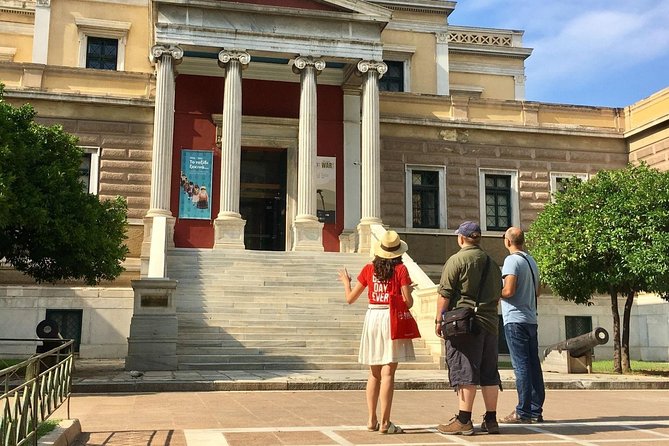
After Syntagma, you take the metro to Acropolis station. The metro ticket is not included, so keep a little cash or another accepted payment method ready. The ride is short enough to connect the two parts of the walk without turning the morning into a transport exercise.
This small transfer also gives the tour a useful shape. Syntagma shows you the political and civic heart of modern Athens. Acropolis station places you near the city’s ancient core, where old stone, later buildings, shops, cafés, and daily life all meet.
You should know exactly what happens here. You walk around the walls of the Acropolis and hear about the ancient roads, buildings, customs, and traditions connected with the area. You do not enter the Acropolis as part of this experience. If you want to see the Parthenon and the other monuments inside, you need a separate visit on your own time, with its own admission cost.
That limitation may be a deal breaker if you have only one morning in Athens and want a full Acropolis visit. On the other hand, it can be a sensible choice if you already have Acropolis tickets, prefer a separate museum visit, or want your first hours in the city to cover more than one archaeological site.
Walking past the Ancient Agora and into Plaka
The route continues through the area around the Ancient Agora. The Agora was the civic center of ancient Athens, and even a walk around its edges helps you understand how the city was organized. You get stories about the ancient streets and the way public life worked, rather than only a quick photo stop.
The experience is strongest here when you ask questions. A private guide can explain what you are seeing at your pace, and the guides praised most warmly for this walk, including Babis and Theodore, are described as bringing plenty of Greek history and humor into the conversation. Maeva is also singled out for her warm, personal way of showing the city.
You may encounter small surprises along the route. One especially unusual possibility is an underground passage beneath one of Athens’ oldest churches. That detail is not presented as a guaranteed stop, so I would treat it as a possible bonus rather than a promised part of every departure. It does show the kind of local detail a private walk can uncover when conditions allow.
Plaka follows with a change of mood. This is Athens’ old town, where narrow streets, shops, old buildings, and cafés make the city feel more intimate than the broad avenues around Syntagma. The tour gives you a taste rather than hours of free shopping, but it helps you return later with a better sense of where to wander.
Adrianou Street and the taste of local shopping
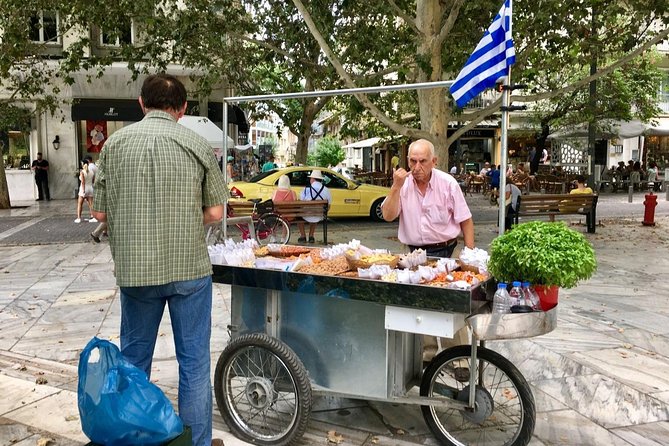
Adrianou Street is the shopping section of the walk. You can browse bottles of ouzo, olive oil, sponges, leather sandals, and bags. These are familiar Greek souvenirs, but the value here is context. Your guide can help you understand what is genuinely local in character and what may simply be convenient for tourists.
Do not expect a dedicated shopping excursion. The stop lasts about fifteen minutes, which is enough to look, ask a few questions, and note places you may want to revisit. It is not enough for a slow hunt through every shop or a serious purchase of olive oil and leather goods.
The included Greek coffee adds a small sensory pause to the morning. The supplied details do not specify exactly where or when it is served, so the timing may vary. Still, this is a welcome touch. Coffee gives you a chance to sit briefly, talk with your guide, and get suggestions for meals and later sightseeing instead of racing from monument to monument.
More History Walking Tours in Greece
- Private Athens Walk: Ruins, Markets & Local Stories
★ 5.0 · 41 reviews - Small-Group Women History in Ancient Greece Walking Tour
★ 5.0 · 38 reviews - Athens:Acropolis – Historical Center Walking Tour in Spanish
★ 5.0 · 32 reviews - Corfu: History and Culture Walking Tour
★ 4.9 · 55 reviews
Hadrian’s Arch and the Temple of Olympian Zeus

From Plaka, you continue to Diogenes Square and Hadrian’s Arch. The arch was built in honor of the Roman emperor Hadrian, one of the most celebrated rulers associated with Athens. Its location is useful because it shows how Roman Athens connected with the older Greek city.
You can view the arch without paying an entry fee. The stop is brief, around ten minutes, but the structure works well as a lesson in changing power. Athens was not frozen in its classical age. Roman rulers added their own marks, and your guide can use the arch to explain that later chapter.
Nearby, you can see the ruins of the Temple of Olympian Zeus. The remains are a good reminder of the enormous scale imagined for ancient Athens. The route lets you look at the ruins while continuing through the city, rather than asking you to spend the whole morning inside another enclosed archaeological site.
The limitation is the same as at the Acropolis: the walking experience does not include paid entry to the monuments. If you want to go inside the Temple of Olympian Zeus or any other site requiring admission, you handle that separately.
The Panathenaic Stadium in white marble
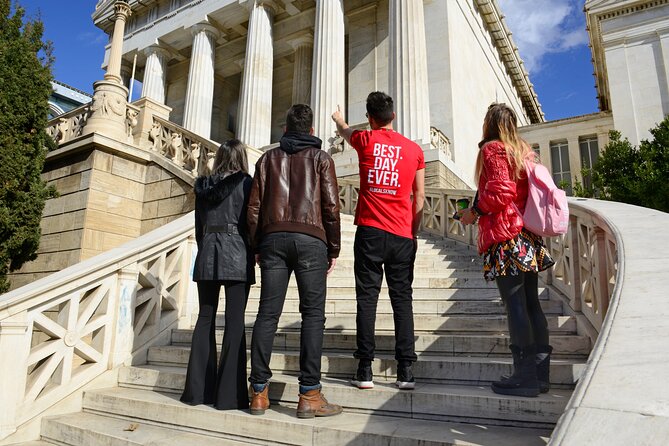
The Panathenaic Stadium is one of the most memorable stops because its shape is so easy to grasp. The bright marble seating and track create a clear link between ancient athletic contests and the modern Olympic story. It was also the finish point for the 2004 Olympic marathon, adding a recent chapter to the site.
You spend about fifteen minutes here. That is enough to admire the stadium, take photographs, and hear the basic story, but not enough for a leisurely self-guided visit if you want every detail. Admission is not included, so decide in advance if you are satisfied with an exterior look or want to pay for entry during another visit.
I like this stop because it breaks up the ancient temples and civic buildings with a place designed around the human body: running, competing, watching, and celebrating. It also gives families a concrete way to connect Greek antiquity with the Olympics they already know.
Kolonaki and the present-day city
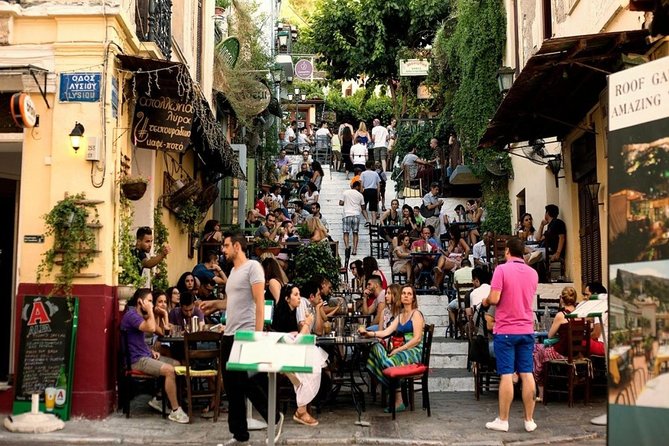
The final part moves into Kolonaki, one of central Athens’ more polished residential and shopping districts. Here, you see modern architecture, chic boutiques, cafés, and the places where local life continues after the ancient monuments close for the day.
This section is valuable because Athens is not only an archaeological park. You get a glimpse of the city as a working capital, with people shopping, meeting, and moving through their routines. The contrast with the Acropolis area helps you understand the city as a whole.
The Kolonaki walk lasts about thirty minutes, making it the longest single modern-city section of the experience. If you enjoy architecture, neighborhood life, and shopping more than extended museum time, you may find this especially useful. If your only goal is ancient ruins, you may see it as time taken away from the Acropolis.
The walk ends at the Academy of Athens on Panepistimiou Street. This is a practical endpoint for continuing into central Athens, but it is not the original meeting point. You should plan your next move from the Academy rather than assume you will be returned to Syntagma or your hotel.
What the $149.14 price really buys

At $149.14 per person, this is not a budget orientation walk. The cost makes more sense for couples, families, or small groups who want a private guide and prefer personal attention to a large shared group.
You are paying for about three hours of guiding, the local perspective, the guard ceremony, the route between several key districts, Greek coffee, and practical advice for the rest of your stay. You are not paying for hotel pickup, metro tickets, Acropolis admission, or other entrance fees.
The value improves when your group has specific interests. Ask about architecture, Greek customs, food, ancient life, or modern Athens, and your guide can spend more time on what matters to you. The private format also helps if children need a slower pace, though children must be accompanied by an adult.
The price is harder to justify if you already know Athens well, plan to visit every site independently, or mainly want entry to the Acropolis. In that case, the money may be better spent on admission and a longer visit inside the archaeological area.
Who should book this Athens walk
I would choose this experience if you want a strong first look at Athens without spending three hours inside one major archaeological site. It suits a first visit, a short stay, or a morning when you want both ancient monuments and modern neighborhoods.
It is also a good fit for people who learn best through conversation. The strongest guide experiences here depend on the individual guide, and the named guides Babis, Theodore, and Maeva receive especially warm praise for historical detail, humor, friendliness, and personal attention.
Families may like the variety: guards, metro travel, old streets, shopping, arches, a stadium, and modern boutiques. The route is still a three-hour city walk, so comfortable shoes and an honest assessment of your group’s walking ability make sense. The tour information says most people can participate, and service animals are allowed.
Winter may be a smart season for this experience if you want a calmer walk. One published comment specifically recommends winter because the city has fewer people than in summer. That does not remove the need to prepare for weather, but it can make the public squares and historic areas easier to handle.
Booking is flexible before the deadline, with free cancellation up to 24 hours before the start time. The tour is offered in English, and confirmation arrives at booking.
Should you book it?
Book this private walk if you want a well-rounded introduction to Athens, a local guide beside you, and a route that links the Evzones, Plaka, ancient sites, the Panathenaic Stadium, and Kolonaki. The 4.9 rating from 27 reviews and 96 percent recommendation fit the experience’s main strengths: strong guides, personal attention, and a useful mix of history and daily life.
Skip it if entering the Acropolis is your top priority and you have limited time. This tour only takes you around the outside, and the extra metro and admission costs add to the total. For everyone else, it is a practical way to get your bearings, learn the city’s story, and leave with good ideas for what to see and eat next.
FAQ
How long does the Athens walking tour last?
The tour lasts approximately three hours. It begins at 9:30 a.m. and ends at the Academy of Athens.
Where does the tour start and finish?
You meet your guide at Syntagma Square in Athens. The tour ends at the Academy of Athens, at 28 Panepistimiou Street.
Is Acropolis admission included?
No. The experience includes a walk around the Acropolis area, but entry inside the Acropolis is not included and must be arranged separately.
Is the Changing of the Guard ceremony included?
Yes. The route includes the traditional Evzone Changing of the Guard ceremony at the Tomb of the Unknown Soldier in Syntagma Square.
Are metro tickets and entrance fees included?
No. You pay separately for the metro ticket and any entrance fees for sites you choose to enter.
Is this a private tour?
Yes. Only your own group participates. The tour is conducted in English by a local guide, and children must be accompanied by an adult.
More Private History Tours in Greece
- Ancient Corinth, Mycenae, Epidaurus, Nafplio full day private tour from Athens
★ 5.0 · 130 reviews - Ancient Corinth and Canal half day private tour from Athens
★ 5.0 · 96 reviews - Ancient Olympia full day private tour from Athens
★ 5.0 · 83 reviews - Half Day Historical Athens City Private Taxi Service Tour
★ 5.0 · 79 reviews
More Private History Tours in Athens
- Private Biblical Tour Ancient Corinth & Isthmus Canal from Athens
★ 5.0 · 762 reviews - Private Tour of Apostle Paul’s Footsteps in Ancient Corinth
★ 5.0 · 275 reviews - Ancient Corinth, Epidaurus, Nafplio full day private tour from Athens
★ 5.0 · 206 reviews - The History of Athens: Greek Mythology Private Tour
★ 5.0 · 138 reviews
Newest history tours we have reviewed in Athens
- The original Christian tour on Paul’s footsteps in Athens and ancient Corinth★ 4.5 · 25 reviews
- Ancient Sparta & Mystras Private Day Tour from Athens★ 5.0 · 52 reviews
- Athens: Combo Ticket for Acropolis & 6 ancient sites★ 3.0 · 21 reviews
- Small-Group Women History in Ancient Greece Walking Tour★ 5.0 · 38 reviews
- Ancient Corinth, Sanctuary of Hera, Blue Lake & Canal from Athens★ 5.0 · 26 reviews
- Half Day Historical Athens City Private Taxi Service Tour★ 5.0 · 79 reviews
- Ancient Olympia & Ancient Corinth Private LuxuryTour from Athens★ 5.0 · 25 reviews
- Ancient Agora & Temple of Hephaestus Entrance Ticket★ 3.5 · 22 reviews
Private History Tours, compared.
Private Guided Historic Electric Cart Tour of St. Augustine
Read our review →
Private Full-Day Tour of Historical Alexandria
Read our review →
Private Tour of the Historic City in a Ford T Car
Read our review →
Madrid Historical Tour with Local Guide in Eco Tuk Tuk Private
Read our review →
Private Biblical Tour Ancient Corinth & Isthmus Canal from Athens
Read our review →
Private Kathmandu Sightseeing Tour | UNESCO World Heritage sites
Read our review →