
Review · ATHENS HISTORY TOURS
Small-Group Women History in Ancient Greece Walking Tour
Ancient Athens is often told through male citizens, generals, philosophers, and lawmakers. This walking tour shifts the view toward the women largely left out of that story, from mythical figures such as Athena and Penelope to real women such as Aspasia, Sappho, and Agnodice. Guide Maelle connects their lives to the streets and ruins around you.
I like two things especially: the route gives familiar Athens landmarks a fresh purpose, and the small group, capped at 12 people, leaves room for questions. The ending on Philopappos Hill, with its broad view toward the Acropolis, is another smart touch. The main drawback is that you do not enter the Ancient Agora or other archaeological sites, and the hills and uneven ground make this a poor choice if you have mobility problems.
Key points at a glance

- A rare women-focused view of Athens: The tour examines marriage, education, work, mythology, politics, slavery, and public life.
- Maelle brings a clear personal guide style: Her presentation is described as kind, funny, inclusive, well prepared, and easy to engage with.
- The route links stories to real places: You walk from Monastiraki through the Agora area, Areopago, Pnyx, and Philopappos Hill.
- A maximum of 12 people: This is small enough to hear the guide and ask questions without the feel of a large city tour.
- No archaeological-site admission is included: The Ancient Agora is viewed from outside, so plan a separate visit if you want to enter.
- Allow for uphill walking: The final sections around Pnyx and Philopappos Hill require more effort than the opening streets.
Why this Athens walk feels different
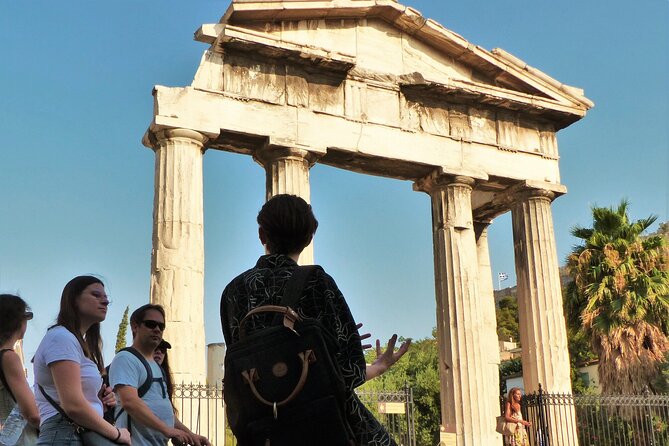
This is not a standard list of ancient monuments. Its subject is the space women occupied, or were denied, in Athenian society. That gives familiar sites a sharper meaning.
At the Ancient Agora, for example, you are not simply looking at the center of public life. You consider who was allowed into that public world, who could vote, who could shop, and whose work made the city function. At the Pnyx, the birthplace of Athenian democracy, the central question becomes direct: democracy for whom?
The tour also avoids treating women as one single group. Mythological women, citizen wives, enslaved women, courtesans, philosophers, doctors, and poets appear in different parts of the story. That range matters, since life in ancient Athens was not the same for every woman.
I also like the balance between famous names and less familiar figures. Athena and Pandora are easy to recognize, but Sappho, Aspasia, and Agnodice open different doors. You hear about women connected with poetry, philosophy, political influence, and medicine, including women who pushed against the limits set around them.
The approach is especially useful if you have already seen the Acropolis or taken a general Athens tour. It is designed to add a missing layer rather than repeat the usual account of temples and wars. One person described it as the missing piece after other Athens tours, which is a fair way to understand its purpose.
More Ancient History Tours in Athens
- Athens: Ancient Greek Theater Performance
★ 4.7 · 2,481 reviews - Historical Delphi One Day Tour with Arachova Stop & Expert Guide
★ 4.5 · 1,247 reviews - From Athens: Ancient Corinth Day Trip with Canal & VR Guide
★ 4.6 · 1,073 reviews
Starting in Monastiraki Square
The meeting point is Pl. Monastirakiou 2, in the busy Monastiraki area. This is a practical place to begin because it is close to public transportation and easy to identify, but give yourself enough time to find the guide in the square.
The opening stop lasts about 10 minutes. It is not a museum visit or a formal lecture. Instead, it gets you oriented and sets up the main question of the walk: how can you recover women’s stories when the surviving monuments and written accounts so often focus on men?
That question gives the rest of the tour a clear thread. You are not just moving from one old stone site to another. Each stop adds a piece to the social picture.
Hadrian’s Library and women’s education
The next stop is Hadrian’s Library, where the discussion turns to education for girls and women in ancient Athens. The site itself is viewed from outside, and the scheduled stop is about 10 minutes.
This is a useful early topic because education shaped everything women could or could not do. The tour does not present ancient society as a simple story of total exclusion. Instead, it looks at the limits placed on women and the exceptional figures who found ways around them.
The setting also helps you think about who had access to learning and public discussion. The library is a strong place to begin that conversation, even without entering the complex.
Marriage, Eros, and the Taxiarchs church
At the Holy Church of the All-Great Taxiarchs and the Virgin Mary Gregorousa, the focus shifts to marriage in Athens and Sparta, along with Eros, the passionate form of love. This stop lasts roughly 15 minutes.
The comparison between Athens and Sparta is one of the more useful features of the walk. It prevents you from treating ancient Greece as one uniform society. Marriage had different meanings and expectations depending on the city, and the role assigned to women could vary as well.
The discussion of Eros adds another layer. Ancient ideas about love did not always match the practical arrangements of marriage, family, status, and property. You get a chance to separate romantic mythology from the actual social rules that governed women’s lives.
More Ancient History Tours in Greece
- Acropolis, Parthenon & Athens Old City Heritage Walking Tour
★ 4.5 · 876 reviews - Private Biblical Tour Ancient Corinth & Isthmus Canal from Athens
★ 5.0 · 762 reviews - Athens: Ancient Corinth & Nafplio Full Day Trip with Swim
★ 4.8 · 531 reviews - Athens Skip the Line: Open Air Ancient Greek Theatre Performance
★ 4.5 · 520 reviews
Athena and married life at the Gate of Athena Archegetis
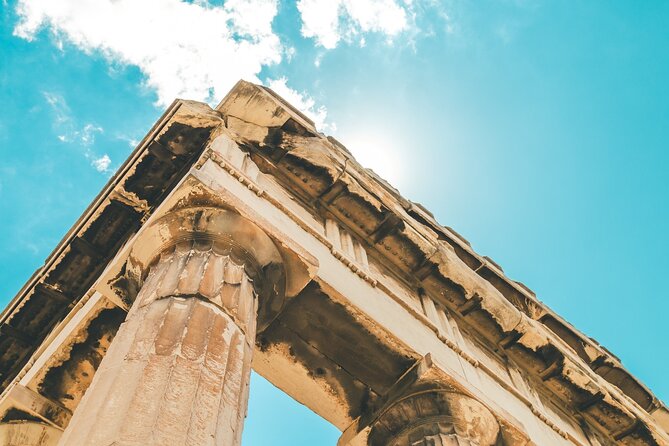
At the Gate of Athena Archegetis, the tour spends about 15 minutes on married life in Athens and Sparta, along with myths linked to Athena.
This is where the mythological and historical sides of the tour meet. Athena is not presented only as a famous goddess attached to the city. Her stories also raise questions about power, wisdom, identity, and the ways ancient culture imagined an influential female figure.
The stop also returns to ordinary married life. That contrast is important. A powerful goddess could occupy the center of civic identity, while real women lived under strict social rules. The tour uses that tension to show the difference between female figures celebrated in myth and women’s actual choices.
A women-only festival at Dioskouron
Dioskouron brings one of the more unusual subjects on the route: a mysterious ancient festival dedicated exclusively to women. The stop is planned for about 10 minutes.
This is a good reminder that women were not absent from ancient religious life. They had ceremonies, traditions, and shared spaces that did not fit the male-centered image of the city.
The subject also adds welcome variety. The tour is not only about restriction and unfairness. It also considers the occasions when women formed communities and took part in practices set apart for them. You may find this one of the most memorable stops because it deals with a lesser-known part of ancient life.
The Agora, public space, and invisible labor

The Ancient Agora is one of the strongest stops in the tour, even though you do not enter the archaeological site. From outside, you learn about the marketplace as the center of Athenian public life, then consider the role of women in that space.
The discussion includes female slaves and courtesans, which keeps the story from focusing only on citizen women. Ancient Athens relied on sharply divided social classes, and those divisions affected women in very different ways.
You also hear about the rules surrounding women’s access to markets and public places. The key point is not simply that women were restricted. It is that a city cannot be understood by looking only at its official citizens and public institutions. The people excluded from those institutions were still part of the city’s daily operation.
Since there is no entry here, you should know what you are buying. This is a guided view and interpretation, not a full archaeological visit. If the Agora is high on your sightseeing list, set aside time to return with a separate entrance ticket.
Areopago and the cost of challenging the rules
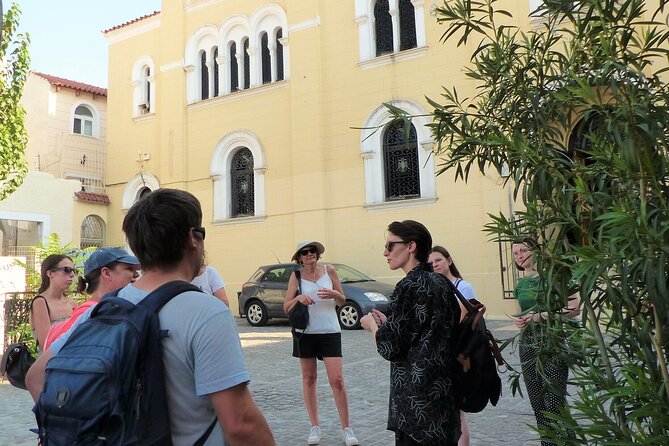
At Areopago, the tour discusses the place where serious offenders were tried in ancient times. The stop lasts about 10 minutes and introduces the story of a woman who risked a death sentence in an effort to change women’s rights.
This section brings the theme into sharper focus. The tour is not content to say that women had fewer rights. It asks what happened when a woman challenged the system, and what kind of courage that required.
Areopago is also a place where you should pay attention to your footing. The route includes historic ground and elevated sections, so sturdy shoes are sensible. The tour is not recommended for people with mobility issues, and this stop helps explain why.
The Pnyx and democracy for men
The Pnyx is perhaps the clearest place to explore the gap between democratic ideals and lived experience. This is where Athenian democracy began, but only male citizens could vote.
The tour then introduces a woman who influenced Athenian politics during the city’s Golden Age. That story complicates the simple idea that women had no political influence at all. Formal voting rights and informal influence were not the same thing.
I find this distinction valuable because it avoids a common trap in ancient-history tours. A person can lack a legal voice yet still shape conversations, relationships, and political decisions. The Pnyx gives that contrast a physical setting you can see and understand.
The open hillside also changes the feel of the walk. You are moving away from the narrow urban streets and toward a place tied directly to civic debate. Expect some uphill walking, and remember that hot Athens weather can make the final part feel harder than the two-hour schedule suggests.
Philopappos Hill and the Acropolis view
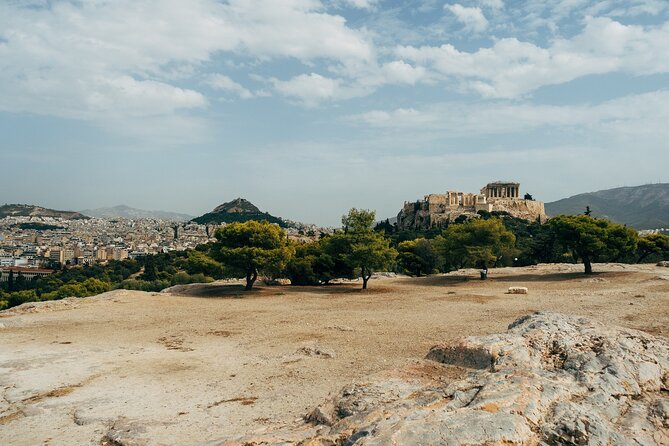
The tour ends on Philopappos Hill, also called the Hill of the Muses, after about 10 minutes at the final stop. The reward is a view toward the Acropolis, described as one of the best viewpoints in the city.
This is a thoughtful ending. After spending two hours discussing women whose names and achievements were often pushed aside, you finish in a quiet, elevated place where Athens spreads out below you. The view gives you time to connect the stories to the modern city.
The end point is at Philopappos Hill, not back at Monastiraki. That matters for your plans. The hill is close to the center on foot and has access to the metro if needed, but you should not arrange a tight appointment immediately afterward without allowing time to leave the area.
Maelle’s role and the small-group format
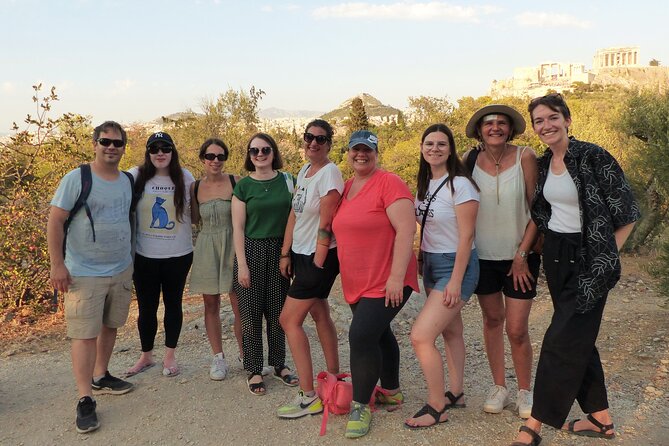
Guide Maelle is a major part of the experience. The strongest praise focuses on her preparation, warmth, humor, and ability to answer questions. Her presentation is described as clear and inclusive, with enough energy to keep the subject from feeling like a dry classroom lesson.
That matters here because the topic can become heavy. Women’s restrictions, forced social roles, slavery, and unequal rights are not light subjects. A guide who can explain them with care, while also making room for curiosity and humor, makes the walk more approachable.
The group limit is 12 people. I like that size for a city walk built around discussion. You should be able to hear the guide more easily than in a large group, and the format is better suited to questions about names, myths, and social customs.
The tour has earned a five-star rating from 38 reviews, with 100 percent recommending it. Those figures suggest a strong record, but the more useful point is what people praise: the unique subject, Maelle’s delivery, the lack of repetition with standard Athens tours, and the way the tour connects ancient themes with questions still familiar today.
Price, timing, and practical value
At $44.71 per person, this is not the cheapest way to walk around central Athens, since the stops themselves do not include admission tickets. You are paying for the guide’s research, interpretation, and the focused route rather than for entry to a monument.
I consider that a fair price if you want a specialist subject and an intimate group. The tour fills a gap that general sightseeing often leaves open, and the stories give added meaning to places you might otherwise pass without much thought.
The duration is about two hours. That makes it easy to fit into a day of sightseeing, especially early in your Athens visit when you want context for the city. It also works well after you have seen the main monuments and want a different angle.
You receive confirmation at booking, and a mobile ticket is available. Group discounts may reduce the per-person cost for some bookings. Free cancellation is offered up to 24 hours before the start time, while poor weather can lead to a different date or a full refund.
Wear comfortable shoes and plan for uneven, uphill walking. Service animals are allowed, most people can participate, and public transportation is nearby. The route is not recommended if mobility is a concern.
Who should book this walk?
I would recommend it to anyone who wants more than the usual parade of temples, battles, and famous male thinkers. It is especially well suited to history fans, families with older children, and people looking for a thoughtful first or second tour in Athens.
A 15-year-old with an interest in women’s rights could get a lot from it, since the subject connects ancient rules with questions that still matter. You do not need to arrive as an expert. The tour is built around stories, places, and discussion.
I would be more cautious if your main aim is to enter archaeological sites. You will see important locations from outside, but this is not a ticketed Acropolis or Agora tour. I would also skip it if hills, uneven surfaces, or warm-weather walking are difficult for you.
Should you book the Women’s History in Ancient Greece Walking Tour?
Book it if you want an Athens experience that adds something genuinely different to the standard sightseeing route. The combination of Maelle’s focused storytelling, a maximum group of 12, and the final Acropolis view gives the walk a clear identity.
Skip it only if you need extensive site access, a completely flat route, or a tour centered on architecture rather than social history. For everyone else, this is a thoughtful way to see Athens through the lives of women who were mythologized, restricted, overlooked, or brave enough to push back.
FAQ
How long is the Women’s History in Ancient Greece Walking Tour?
The tour lasts approximately two hours.
Where does the tour begin?
It begins at Pl. Monastirakiou 2 in Monastiraki Square, Athens.
Where does the tour end?
The walk ends at Philopappos Hill, at the viewpoint overlooking the Acropolis. The area is reachable from the center on foot and has access to the metro if needed.
Does the tour enter the Ancient Agora?
No. The Ancient Agora is viewed from outside, and the tour discusses its role as the center of public life without entering the archaeological site.
How many people can join the group?
The group has a maximum of 12 participants.
Is the tour suitable for people with mobility issues?
The tour is not recommended for people with mobility issues. The route includes walking around historic sites, Areopago, Pnyx, and Philopappos Hill, including uphill sections.
More History Walking Tours in Greece
- Private Athens: Historical Walking Tour Including the Changing of the Guard
★ 5.0 · 27 reviews - Corfu: History and Culture Walking Tour
★ 4.9 · 55 reviews - Small-group Corfu Town Historical Walking Tour
★ 5.0 · 39 reviews - Olympia’s Ancient Site and Museum Private Walking Tour
★ 4.7 · 31 reviews
More History Walking Tours in Athens
- Athens: History of Rebellion Walking Tour
★ 5.0 · 110 reviews - Ancient Athens for Kids 4-Hour Private Walking Tour
★ 5.0 · 66 reviews - Private Athens Walk: Ruins, Markets & Local Stories
★ 5.0 · 41 reviews - Athens:Acropolis – Historical Center Walking Tour in Spanish
★ 5.0 · 32 reviews
Newest history tours we have reviewed in Athens
- The original Christian tour on Paul’s footsteps in Athens and ancient Corinth★ 4.5 · 25 reviews
- Ancient Sparta & Mystras Private Day Tour from Athens★ 5.0 · 52 reviews
- Athens: Combo Ticket for Acropolis & 6 ancient sites★ 3.0 · 21 reviews
- Ancient Corinth, Sanctuary of Hera, Blue Lake & Canal from Athens★ 5.0 · 26 reviews
- Half Day Historical Athens City Private Taxi Service Tour★ 5.0 · 79 reviews
- Ancient Agora & Temple of Hephaestus Entrance Ticket★ 3.5 · 22 reviews
- Private Luxury Tour: Marathon – Battle & Run That Changed History★ 5.0 · 30 reviews
- Ancient Olympia & Ancient Corinth Private LuxuryTour from Athens★ 5.0 · 25 reviews
Ancient History Tours, compared.

Colosseum: Underground and Ancient Rome Tour
Read our review →
Colosseum & Ancient Rome with Arena Floor Option I Max 6 People
Read our review →
Colosseum, Ancient Rome Tour or AudioGuided Tour
Read our review →
Colosseum Underground & Ancient Rome Guided Tour
Read our review →

Taormina: Ancient Theater Skip-the-Line Ticket & Audio Guide
Read our review →
Discover the Ancient Ruins of Pompeii: Day Trip from Rome
Read our review →