
Review · BUDAPEST HISTORY TOURS
Buda Castle Tour: History and Architecture
Buda Castle is not just one palace. It is a whole hilltop city built, destroyed, rebuilt, and reshaped by kings, invaders, fires, wars, and modern planners. This 3.5-hour walking tour makes sense of those layers, from the Royal Palace to medieval merchant houses and the old Jewish quarter.
I like two things here. First, the route looks beyond the postcard sights and spends time on Tárnok Street, Úri Street, and the medieval Jewish chapel. Second, guides such as Matthew, also called Máté, bring archaeological detail and old images on an iPad to help you picture buildings that no longer survive.
The main drawback is clear: you do not tour the inside of the Royal Palace, Matthias Church, or the upper terrace of Fisherman’s Bastion. The route also involves substantial walking, uneven streets, and outdoor time, so it is not suited to anyone with limited mobility.
Key points to know before you book
- The tour is about the whole Castle District, not just the Royal Palace.
- The medieval Jewish prayer house is the rare interior stop, though it is closed on Saturdays and Mondays.
- Small groups are limited to 12 people, making it easier to ask questions and follow the guide.
- The route covers merchant, noble, religious, and military history, not only royal stories.
- Matthias Church and the Royal Palace require separate admission if you want to enter after the walk.
- The $43.25 price pays for interpretation and access, rather than a long list of included tickets.
Why this Buda Castle walk feels different
Many first visits to Buda Castle focus on the Royal Palace, Matthias Church, and Fisherman’s Bastion. Those landmarks matter, but they can leave you with a polished view of the hill and little sense of how people lived there.
This route spends real time on the less obvious evidence. You look at medieval foundations under later houses, old gateways, reused Gothic walls, siege damage, and traces of Jewish life. That makes the tour useful if you want to understand Buda as a working medieval town, not just a royal address.
The group size matters. With no more than 12 people, the guide can point out details that are easy to miss and respond to questions. Matthew, or Máté, is identified as having a background in archaeology and history. His approach includes architectural explanation and historical images shown on an iPad, which can help you connect present-day façades with earlier versions of the city.
The walking pace is spread across roughly 16 locations. Some stops last only three to six minutes. Others, such as the Royal Palace and the medieval Jewish chapel, receive more attention. Expect a guided story told through streets, courtyards, walls, and ruins rather than a museum-style presentation.
More Castle and Palace History Tours in Budapest:
- Buda Castle District Dark History, Legends and Vampire Night Tour
★ 4.5 · 1,240 reviews - Palace District Evening Culinary, Wine, and History Walk
★ 5.0 · 55 reviews - Segway Guided Tour In Budapest, Historical Buda Castle
★ 5.0 · 28 reviews
Beginning at the Royal Palace and Sigismund’s church
The meeting point is the Statue of Prince Eugene of Savoy in Budapest’s 1013 district. From there, the walk begins with the Royal Palace, the most obvious symbol of Buda Castle.
The palace has been built, damaged, and rebuilt many times. Its story includes medieval beginnings, royal expansion, later Baroque changes, Neoclassical work, war damage, and modern reconstruction. The useful point here is not simply that the building is old. It is that its changing appearance reflects shifts in power and taste.
You spend about 20 minutes at this first stop, but admission to the interior is not included. That distinction matters. You can examine the complex from the outside and learn how its parts fit together, then return on your own if you want museum or palace access.
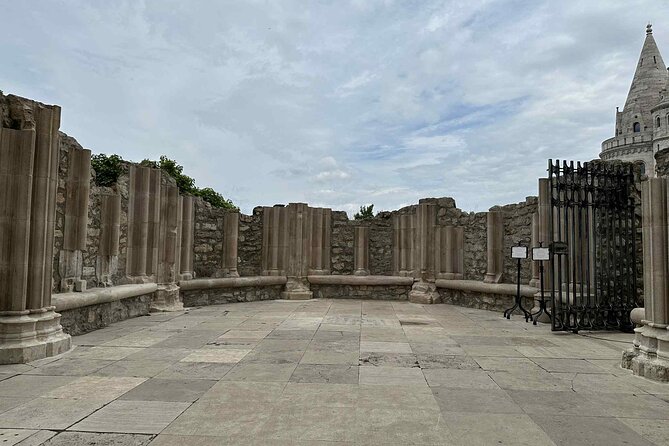
A short stop follows at the remains of the medieval Sigismund Church. Only a few minutes are scheduled here, yet the foundations help explain the palace’s early growth. King Sigismund expanded Buda in the early 15th century and aimed to turn it into an imperial residence. The remains of the Gothic royal chapel mark that effort in a direct, physical way.
Tárnok and Úri Streets, medieval Buda in everyday form
The tour then leaves the royal center for Tárnok Street, once the main commercial street of the burgher town. This is one of the strongest sections for anyone who wants more than royal anecdotes.
The lane has cobbled surfaces and old merchant houses built over medieval foundations. You learn how goods were stored, traded, and displayed, and how commercial life shaped the homes of Buda’s townspeople. Three surviving buildings are used to show how houses endured fire, siege, and later rebuilding.
I like this part because it turns architecture into evidence of daily life. Thick walls and Gothic façades were not decorative alone. They supported storage, trade, security, and household life. The stop lasts about 15 minutes, enough for the guide to connect the buildings with the people who used them.
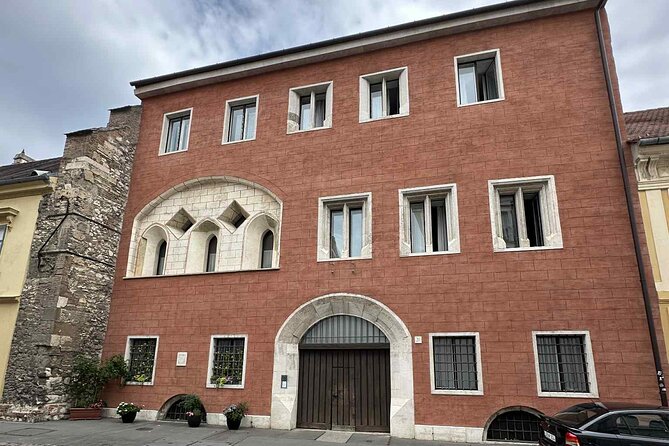
Úri Street shifts the focus from merchants to nobles. Aristocratic homes and former palaces line what was once a high-status residential quarter. Many rest on 14th and 15th-century foundations, and the street has some of the finest medieval gateways in the district.
Look closely at those entrances. They hint at status and function, but they also show how people moved between the public street and private homes. The tour spends another 15 minutes here. If you enjoy architectural details, these two streets may be more rewarding than a quick look at a grand façade.
The Magdalene Tower and the multicultural Castle District
The Church of Saint Mary Magdalene once served the Hungarian-speaking parish community on Castle Hill. Its foundations reach back to the 13th century, and the church survived for centuries before suffering major damage during the 1686 siege of Buda.
The communist government ordered the ruined church demolished in the 1950s. The medieval tower survived because archaeologists and preservationists fought to save it. Today, the solitary structure helps you see how much of the old district vanished in the 20th century, not only in medieval wars.
The tower stop takes about eight minutes. Admission is not included, so treat this as an exterior history stop rather than a church visit.
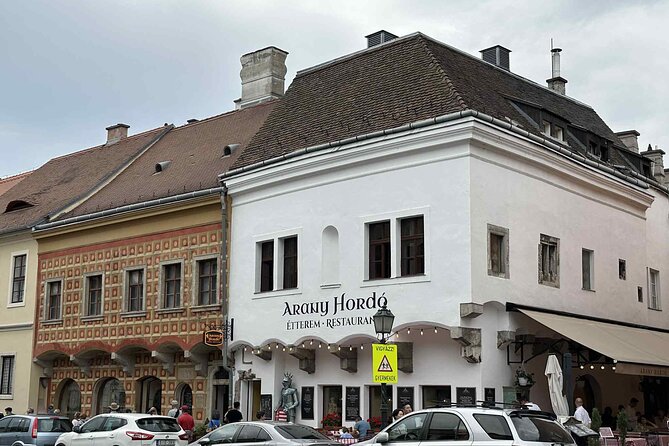
Országház Street adds another layer. In medieval times it was called Italian Street because Italian merchants lived and worked there. Their presence reflects Buda’s links with wider European trade and culture.
The street also contains the Castle District’s only surviving 16th-century sgraffito decoration. Sgraffito is a surface design made by scratching through layers of plaster to reveal contrasting material beneath. It is an easy detail to miss without a guide, and it gives the walk a useful Renaissance note among the older Gothic buildings.
More Architecture and Landmark Tours in Budapest:
- Venice: St. Mark’s Basilica Guided Tour & VR History Intro
★ 3.9 · 4,880 reviews - Venice’s Best: Basilica, Doge’s Palace, Gondola & History Gallery
★ 4.5 · 2,478 reviews - Córdoba: Skip-the-Line Great Mosque-Cathedral History Tour
★ 4.7 · 1,690 reviews - Pantheon Elite Guided Tour – Rome’s Iconic Ancient Temple
★ 5.0 · 1,447 reviews
The Finance Ministry and the official church
The former Royal Hungarian Ministry of Finance is a striking Neo-Gothic building from the early 20th century. Its construction required the demolition of several medieval structures, a reminder that heritage decisions in Buda have never been simple.
World War II caused major damage. Afterward, the ornate façade was simplified, then reconstructed in recent years to recover much of its earlier appearance. Part of one original wing was demolished during the restoration, which sparked debate about how far reconstruction should go.
The stop lasts about 10 minutes and costs nothing to view. It is useful because it adds modern heritage questions to a tour otherwise centered on medieval and Ottoman-era events.
Next comes the Church of the Assumption of the Buda Castle, commonly called Matthias Church. The official name matters because the building was originally tied to Buda’s German-speaking community, not just to King Matthias Corvinus.
The church is one of the hill’s major sights, but this tour allows only about five minutes. Interior admission is not included. If you want time to study the interior, chapels, and decoration, plan to return after the tour rather than expect a full church visit during the walk.
Fortuna Street, printing, and the old city gate
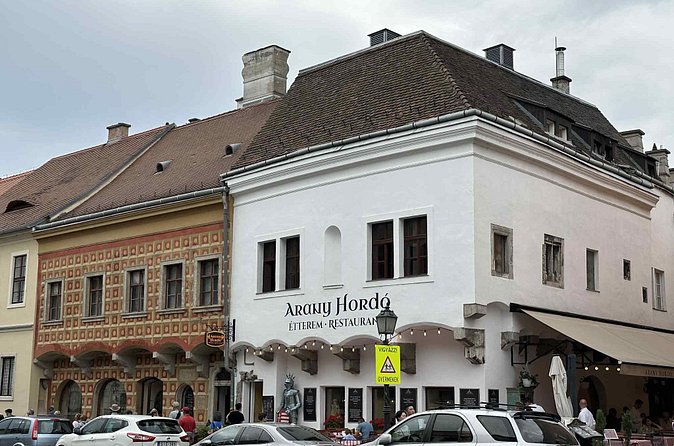
Fortuna Street now has restaurants, but its medieval past was more aristocratic and intellectual. In the 1470s, Andreas Hess, a German-born printer, produced Hungary’s first printed book here, the Chronica Hungarorum.
That detail gives the street a surprising connection to technology and communication. Buda was not only a place of royal ceremony. It was also a setting for printing, commerce, and the movement of ideas.
The nearby Red Hedgehog Inn, known in Hungarian as Vörös Sün, once welcomed merchants, travelers, and intellectuals. The stop lasts about 15 minutes. You will not simply walk past attractive façades. You will hear how the street’s role changed from noble and commercial center to modern dining area.
At Becsi Kapu Square, the story turns to public life. The square served as a marketplace and a major entrance to medieval Buda. Hungarian townspeople and members of the local Jewish community met here to trade and talk.
Only five minutes are scheduled, but the square helps connect the district’s separate communities. It was a working entrance and meeting point, not merely a scenic open space.
The National Archives and the 1686 siege
The National Archives of Hungary was built in the early 20th century in a Neo-Romanesque style. Its stonework and arched windows were designed to fit the medieval character of the Castle District, even though the building is much newer.
This is a good example of deliberate historical styling. The building was created to look at home beside older structures and to house documents covering Hungary’s written past. You spend about five minutes outside.
The route then follows the outer castle walls toward a memorial connected with the Siege of Buda in 1686. This was where Christian allied forces first breached the walls. Nearby, the Ottoman Pasha of Buda, Abdurrahman Abdi Pasha, died in battle.
The memorial honors the multinational Christian forces who fought in the city’s capture. The stop takes about 15 minutes and gives the siege a physical setting. Instead of hearing only dates and names, you can see where the battle pressed against the fortifications.
The medieval Jewish prayer house
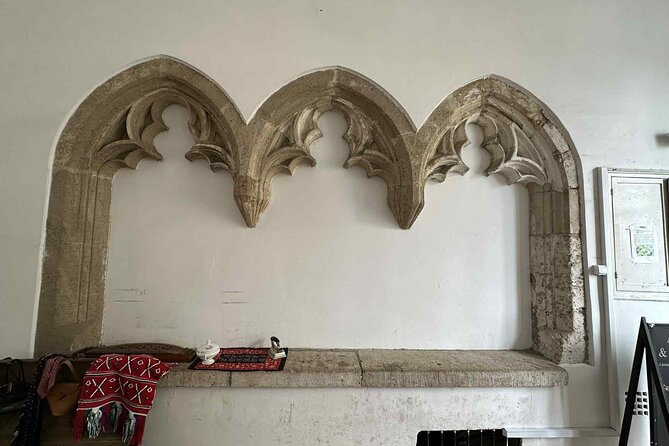
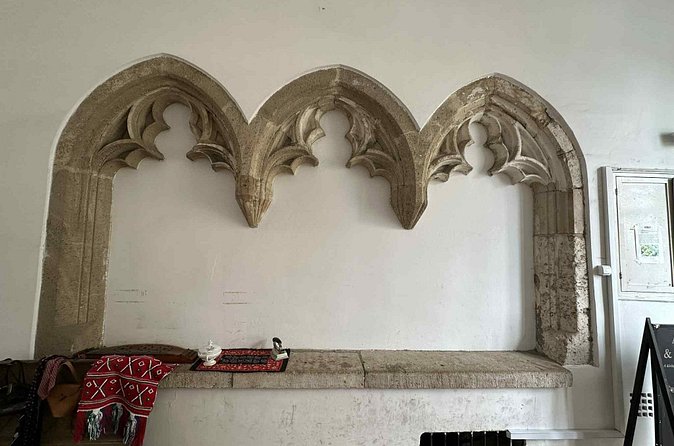
For many people, the medieval Jewish quarter is the most distinctive part of the tour. The walk pauses at the former Gothic synagogue site and then enters an excavated medieval Jewish prayer house.
This small religious building offers a rare look at Jewish life in medieval Hungary. Its modest scale is part of its power. You are not looking at a grand monument, but at a surviving place connected to worship and community life within the Castle walls.
Entrance to the prayer house is included, but there is an important restriction: it is closed on Saturdays and Mondays. If seeing the interior is a priority, choose another day.
The tour also identifies where the former Gothic synagogue once stood. That pairing, the destroyed synagogue site and the surviving prayer house, helps you understand both the strength and the losses of the medieval Jewish community.
Reused ruins, the Dominican monastery, and Fisherman’s Bastion
On Táncsics Mihály Street, old Gothic walls and cellars appear inside later Baroque and residential buildings. The point is not to admire one perfect medieval structure. It is to see how Buda was rebuilt after the Ottoman period by using what remained.
This layered construction is one of the Castle District’s most interesting features. Medieval walls became part of newer homes, and cellars preserved fragments hidden behind later façades. The stop is brief, about five minutes, but the idea helps you read the rest of the neighborhood.
At Dominikánus Udvar, you see remains of the Dominican monastery of Saint Nicholas. The Dominican order is linked with Friar Julianus, who set out on a notable 13th-century journey. The ruins later survived fire, siege, and neglect before being incorporated into the modern Hilton Hotel.
The combination of medieval stonework and 20th-century hotel construction is visually unusual and not free of controversy. It raises a fair question: how should a living city use ancient remains? The stop lasts about 12 minutes and gives you a final look at the tension between preservation and modern needs.
The route ends at Fisherman’s Bastion, one of Budapest’s most photographed landmarks. You will see the main level and the equestrian statue of King Saint Stephen, Hungary’s first Christian king.
The upper panoramic terrace is not included. You can buy access separately on site if you want the higher views. The tour spends about six minutes here, so plan to stay afterward if you want photographs or time around the monument.
What the $43.25 price really covers
At $43.25 per person, this is not an inexpensive way to buy entry tickets because most major interiors are excluded. You are paying mainly for a licensed English-speaking guide, a small group, the route design, and access to the medieval Jewish prayer house when it is open.
That can be good value if you care about context. Without guidance, it is easy to see Buda Castle as a collection of attractive streets and grand buildings. The tour connects those sights to medieval trade, royal construction, religious communities, printing, war, and modern reconstruction.
The value is weaker if you mainly want to enter Matthias Church or the Royal Palace. In that case, you should add separate admission and extra time, or treat this walk as the orientation before visiting those interiors independently.
Who should book this tour
I would choose this experience if you enjoy history, archaeology, architecture, and walking through old streets with frequent explanation. It suits adults and children aged 10 or older who can manage a 3.5-hour route and remain comfortable outdoors.
The tour is not suitable for children under 10, people with limited mobility, or anyone hoping for a relaxed sightseeing ride. You need moderate physical fitness, and poor weather can affect the schedule.
The small group and guide-led format also suit solo visitors. Matthew or Máté’s use of historical images can make the missing buildings easier to picture, and the guide’s background in history and archaeology should appeal to anyone who wants more than a surface-level introduction.
Should you book the Buda Castle Tour?
Book it if you want to understand how Buda developed from a medieval town into a royal center, Ottoman battlefield, reconstructed district, and modern Budapest landmark. The strongest parts are Tárnok Street, Úri Street, the Jewish prayer house, the siege walls, and the explanations of reused medieval remains.
Skip it if your priority is a long interior visit to the Royal Palace or Matthias Church, or if you need a low-effort route. For most history-minded visitors, the $43.25 fee is reasonable because the guide turns scattered ruins and façades into a connected story. Just avoid Saturdays and Mondays if the medieval Jewish prayer house is essential, and leave time afterward for the church, palace, or Fisherman’s Bastion terrace.
FAQ
How long is the Buda Castle Tour?
The tour lasts approximately 3 hours and 30 minutes.
Where does the tour begin?
It begins at the Statue of Prince Eugene of Savoy in Budapest, Hungary.
Where does the tour end?
The tour ends at Szentháromság Square beside Matthias Church.
Is the Royal Palace interior included?
No. The tour examines the Royal Palace from the outside. You may visit the interior independently after the tour.
Is admission to Matthias Church included?
No. Interior admission to Matthias Church is not included in the tour price.
Can I enter the upper terrace of Fisherman’s Bastion during the tour?
No. The tour visits the main level. You may purchase a separate ticket on site for the upper panoramic terrace.
Is the medieval Jewish prayer house included?
Yes. Entrance is included, but the prayer house is closed on Saturdays and Mondays.
How large is the tour group?
The tour has a maximum of 12 participants and is offered in English.
Newest history tours we have reviewed in Budapest
- Time Machine Budapest Historical Exhibition Ticket★ 5.0 · 32 reviews
- Jewish Heritage in Hungary with a Historian★ 5.0 · 37 reviews
- Budapest Jewish Heritage: Synagogues, Shoes, Secrets & Flódni★ 5.0 · 47 reviews
- Private Jewish Heritage Tour including Hotel Pickup★ 4.5 · 35 reviews
- Jewish Heritage / Full tour★ 5.0 · 59 reviews
- Michael Jackson History Exhibition Ticket★ 5.0 · 42 reviews
- HOLLÓKŐ UNESCO World Heritage site + Eger Castle Private guided tour★ 4.5 · 18 reviews
- Communist History Evening Walking Tour of Budapest★ 4.5 · 23 reviews
Castle & Palace History Tours, compared.
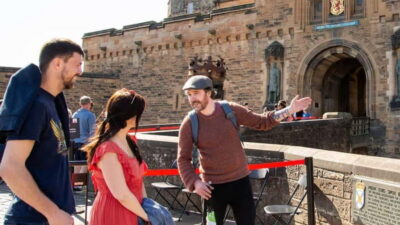
Edinburgh Castle Guided History Tour with Tickets
Read our review →
Madrid Essential: Historic Center, Plaza Mayor & Royal Palace
Read our review →
Venice’s Best: Basilica, Doge’s Palace, Gondola & History Gallery
Read our review →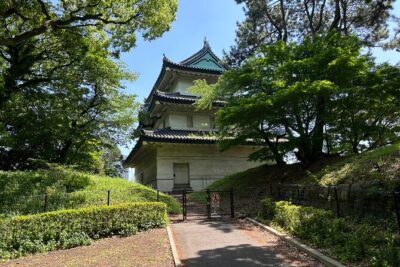
Imperial Palace and Shogun Historical Walking Tour
Read our review →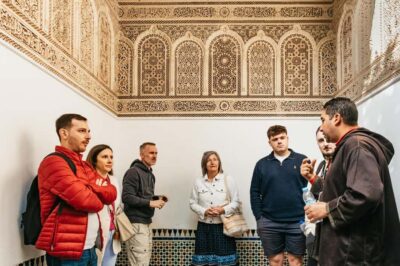
Saadian Tombs & Bahia Palace, Medina Guided Tour
Read our review →
Charleston historical walking tour with a Professor of History at The Citadel
Read our review →
Abu Dhabi Grand Mosque, Palace, and Heritage Village
Read our review →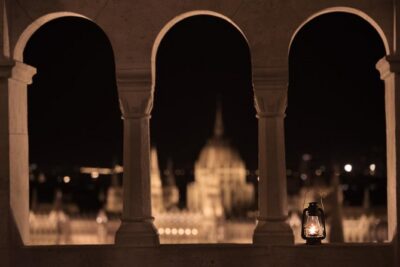
Buda Castle District Dark History, Legends and Vampire Night Tour
Read our review →Browse the lists this tour appears in