
Review · BELGIUM HISTORY TOURS
Historical Walking Tour: Legends of Gent
Ghent’s best stories are packed into a compact old centre, and this tour makes a useful two-hour introduction. You move from the canal views at St Michael’s Bridge to Gravensteen Castle, the graffiti alley, St Bavo’s Cathedral, and the Belfry, with legends and local history tying the stops together. I especially like the strong first-time orientation and the guide’s practical tips for food, beer, chocolate, and later sightseeing.
I also like the pay-what-you-want format, which keeps the advertised cost unusually low while giving you a chance to judge the tour for yourself. The main caution is that the group can reach 35 people, and you remain on your feet for about two hours over historic streets. One payment-related complaint also suggests that you should arrive with your booking confirmation and clarify the end-of-tour contribution before paying twice.
Key points at a glance
- Thirteen central stops: See the city’s main medieval sights without spending the day inside museums.
- A story-led route: Expect legends about the Belfry, St Veerleplein, St Nicholas, and Ghent’s famously stubborn character.
- Strong city orientation: St Michael’s Bridge, Graslei, Korenlei, and Korenmarkt help you understand the layout quickly.
- English-speaking local guides: Guides such as Tatiana, Kasia, Kenny, Sophia, Robin, Florian, and Camilla have led versions of this walk.
- Pay what you want: The listed price is $3.62 per person, but the tour operates around a contribution at the end.
- Mostly outdoor sightseeing: Museum and landmark admission is generally not included, so this is an introduction rather than a full interior tour.
Why this is a smart first walk in Ghent
The route is well chosen for a first visit because it links Ghent’s biggest sights in a logical loop through the centre. You begin with the city’s skyline, pass its old port, follow the water toward the castle, then continue through squares and lanes before finishing near the Belfry and St Nicholas Church.
That order matters. Ghent can feel confusing at first, with canals, tram lines, narrow lanes, and grand buildings appearing around every corner. Starting at St Michael’s Bridge gives you a clear visual reference point. From there, you can see the three famous towers that shape the skyline: St Nicholas Church, the Belfry, and St Bavo’s Cathedral.
The guides bring different personalities to the walk. Tatiana has been praised for energetic storytelling and a warm feel for the city. Kasia has been noted for her relaxed humor and care during hot weather. Kenny, Robin, Florian, Sophia, Camilla, and others have also led well-received English tours. The exact guide is not guaranteed, but the format depends heavily on a guide who can keep a group moving while making medieval politics understandable.
The pace is brisk but not described as physically hard. You should still wear sensible shoes. Cobblestones can be uncomfortable, and the walk lasts close to two hours with little chance to sit. A microphone may be used for larger groups, though you should stay close enough to hear clearly when the guide stops in busy public spaces.
More History Walking Tours in Belgium
- Historical Walking Tour: Legends of Bruges
★ 5.0 · 2,541 reviews - Historical Walking Tour: Legends of Antwerp
★ 5.0 · 1,837 reviews - Brussels: Historical Walking Tour with Chocolate & Waffle Tasting
★ 5.0 · 1,165 reviews
St Michael’s Bridge gives you the right opening view
The tour begins outside Hostel Uppelink on Sint-Michielsplein. From St Michael’s Bridge, your guide introduces Ghent as a medieval trading centre and points out the three towers that define the city skyline.
This is one of the most useful stops because it gives you a visual key for the rest of the walk. Instead of seeing three separate churches and towers, you start to understand them as a connected line through the old centre. The bridge also provides one of Ghent’s classic canal views without requiring an admission ticket.
The opening explanation sets up a central theme of the tour: Ghent was powerful, proud, and not always easy to control. That theme returns later at the Town Hall, the Belfry, and Vrijdagmarkt.
Graslei and Korenlei reveal the old port
Next, you reach Graslei and Korenlei, the waterside heart of historic Ghent. The guide explains which buildings were tied to trade when this stretch functioned as the city port.
The value here is not only the architecture. You get a reason for the buildings’ shapes and positions, rather than just a row of attractive façades for photographs. The paired quays also help you understand how commercial Ghent developed around water, goods, and access to the wider region.
You have about ten minutes at this stop, so do not expect a detailed building-by-building architectural lecture. It works better as a short introduction, with time afterward to return for photographs or a slower look.
Design Museum and Great Butchers’ Hall add darker local stories
At the Design Museum Gent, the guide points out a feature that represents the stubborn and rebellious character of the Gentenaars. The stop is brief and does not include museum admission, so you will not tour the collection as part of this walk.
That limitation is worth knowing. If design is a main interest, set aside separate time to visit the museum. On this route, it serves as a doorway into local character rather than a full cultural visit.
Across the water at Het Groot Vleeshuis, you hear darker facts connected with the medieval covered Great Butchers’ Hall. The building is impressive, but the guide adds context that keeps the stop from becoming a simple architecture photo opportunity. This is typical of the walk: a grand façade is often the starting point for a less comfortable story.
Same streets, a different century:
- Brussels: Historical Tour with Chocolate & Waffle Tasting
★ 4.8 · 1,206 reviews - THE Storytelling Tour of Bruges | First Day Must | History & Tips
★ 5.0 · 925 reviews - Historical Walking Tour: The Story of Bruges – by Legends
★ 4.7 · 483 reviews - Ghent: 40-Minute Historical Boat Tour of City Center
★ 4.3 · 430 reviews
Gravensteen is the route’s biggest visual prize
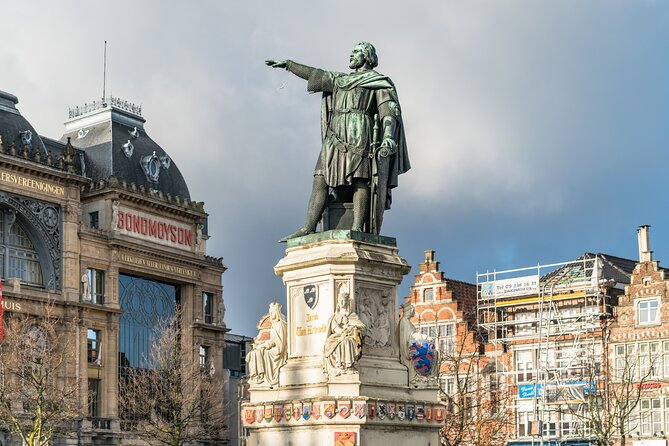
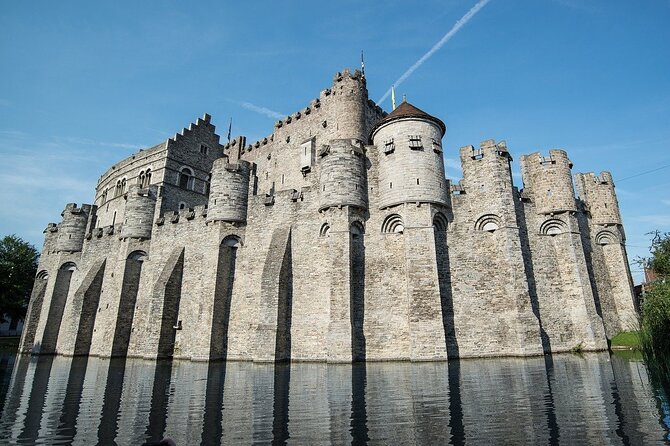
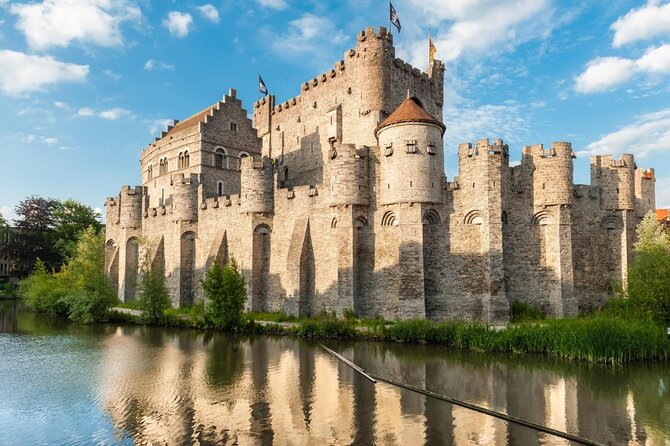
Gravensteen, the Castle of the Counts, occupies an unusual place in Ghent’s centre. Rather than sitting far outside town, this well-preserved medieval castle rises directly among the streets and canals.
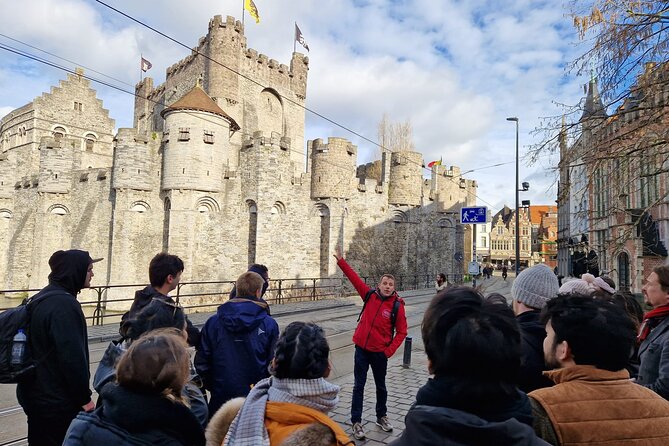
The guide explains its past from outside, with about ten minutes devoted to the site. Admission is not included, so you will need a separate ticket if you want to enter. That is not a flaw in a walking orientation, but it does mean you should not confuse this tour with a castle visit.
For many people, Gravensteen is the moment when Ghent fully clicks. The stone walls, central location, and surrounding streets make the city feel more layered than a standard canal town. I would use the tour’s explanation to decide if you want to return inside later, when you can take your time.
St Veerleplein turns a square into a story
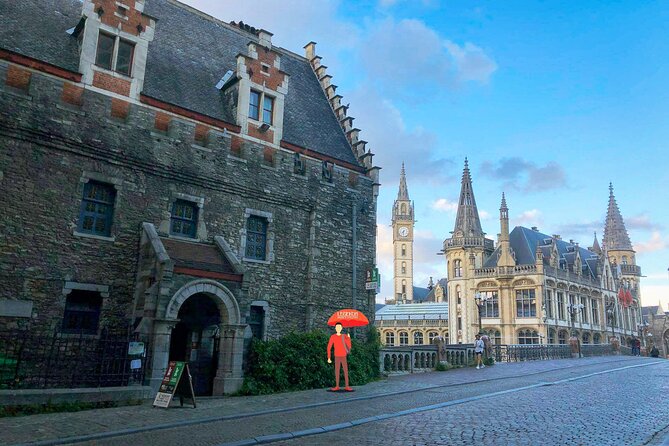
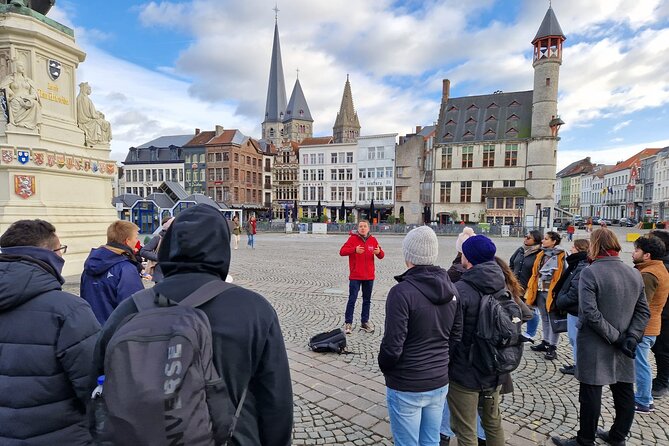
The square in front of Gravensteen is known both as the square of death and the square of life. The guide explains the reason for those contrasting names, giving you one of the tour’s clearest examples of how Ghent’s public spaces carry difficult memories.
This kind of stop is a good match for the tour’s title. You are not simply moving from landmark to landmark. The guide uses a place, a building, or a statue to explain how the city worked and how its past still shapes its identity.
Huis van Alijn shows another side of medieval Ghent
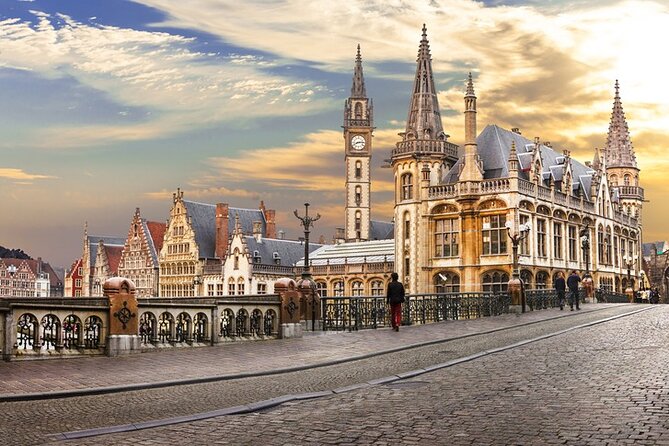
The House of Alijn was once a hospital and is the only remaining god house in Ghent. The guide tells the unfortunate story behind its use as a hospital.
You do not enter as part of the walking route, and the stop is short. Still, it adds useful social context. Castles, churches, and guild buildings can make medieval Ghent look grand and orderly. Huis van Alijn reminds you that ordinary care, illness, and charity were also part of city life.
If you want to visit the museum separately, leave room in your schedule after the tour. The walk provides the background, not a full visit.
Vrijdagmarkt connects history with public life
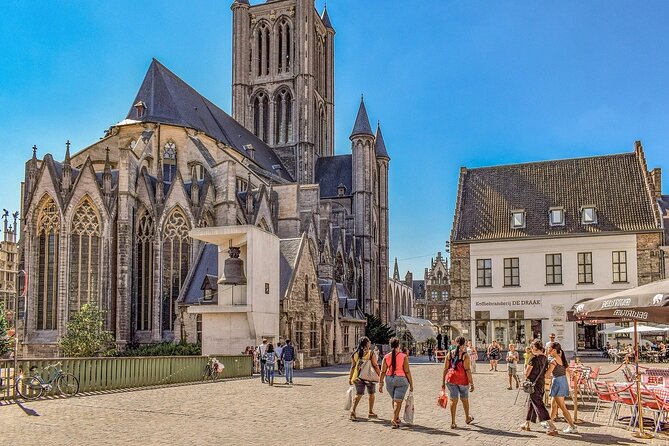
Vrijdagmarkt is one of Ghent’s major squares, and the statue in its centre gives the guide another way to explain the city’s past. This is a good place to hear about political power, public gatherings, and the figures who shaped Ghent.
The square also helps break up the sequence of churches and stone buildings. You get a broader urban setting, where the city’s history feels connected to everyday public space rather than confined to monuments.
The guide’s storytelling style matters here. Several guides have been praised for humor, clear explanations, and the ability to keep a larger group engaged. That is important in an open square, where distractions can easily pull your attention away.
Werregarenstraat is Ghent’s sanctioned graffiti lane
Werregarenstraat offers a sharp change of mood. Ghent designated this narrow passage for street artists, helping protect historic buildings from unwanted graffiti while giving artists a place to work.
The lane is a reminder that Ghent does not treat its old centre as a museum frozen in time. Medieval architecture and modern street art exist close together, sometimes uneasily. The stop is short, but it gives you a different view of the city’s approach to public expression.
Expect the artwork to change over time. The point is the lane itself and the idea behind it, not a fixed collection of murals.
Town Hall explains Ghent’s internal conflicts
Ghent Town Hall looks architecturally confused because it combines different styles and periods. The guide uses the building to explain one of the most important conflicts in the city’s history.
This is a valuable stop for anyone who likes political history. Architecture can look random until you know what pressures shaped it. Here, the mixed appearance becomes evidence of competing powers and changing priorities.
The tour does not include Town Hall admission. You see and discuss the exterior, then continue through the centre. That keeps the walk moving, but you will need another visit if you want to explore the interior.
St Bavo’s Cathedral rewards a slower return visit
St Bavo’s Cathedral is one of Ghent’s essential sights. The guide explains its past and points out its major art treasures, especially the Ghent Altarpiece by the Van Eyck brothers.
The cathedral itself is free to enter according to the tour information, but the walk gives you only about ten minutes. That is enough to understand why the building matters and to mark it for a later visit. If you want to study the altarpiece or other works carefully, do not try to do it during the group stop.
This is one of the clearest examples of the tour’s purpose. It gives you a map of Ghent’s key sights and enough background to make a later independent visit more rewarding.
The Belfry closes the historical loop
The Belfry of Ghent is described as the people’s tower, a symbol of the city’s power, independence, and stubborn streak. The façade also connects with its former use as a prison and a bizarre local legend.
The stop is not only about a tall building. It brings back the themes introduced at St Michael’s Bridge. The skyline tower you saw at the start now has a political and social meaning, and the city’s independence feels tied to a physical landmark.
Admission is not included. The tour ends at the Belfry on Sint-Baafsplein, which is convenient if you want to visit afterward, continue toward St Bavo’s, or explore the surrounding centre on your own.
St Nicholas Church ends with a merchant’s legend
The final stop is St Nicholas Church, a building dating to the early 12th century and dedicated to St Nicholas, protector of merchants and sailors. Its façade provides the setting for the final legend about the patron saint.
Ending here makes sense. The church links back to Ghent’s commercial past, the trading activity introduced at Graslei, and the city’s dependence on merchants and waterways. It also places you near Korenmarkt, one of the easiest areas from which to continue exploring.
By this point, you have seen the main central sights from several angles: trade, religion, military power, public life, art, and local folklore. The tour does not attempt to explain every street, but it gives you a useful framework for the rest of your stay.
The pay-what-you-want price needs a little care
The listed price is $3.62 per person, while the tour is presented as pay what you want at the end. That makes it one of the least expensive ways to get a guided introduction to Ghent, especially if you are traveling on a tight budget.
The low upfront cost does not mean the guide’s time is free. The guides are described as receiving payment through the contribution at the end, so bring a clear idea of what the two hours are worth to you. You can judge the pace, storytelling, and usefulness of the advice before deciding.
There is one practical wrinkle. One serious complaint involved a group being asked to pay again despite having booking proof. I cannot tell you how that particular dispute arose, but I would keep your confirmation and receipt accessible and ask the guide or organizer to explain the contribution process before handing over money. Most of the feedback is strongly positive, but this is worth checking.
The experience is recommended by 98 percent of customers and carries a 4.9 rating from 1,761 reviews. Those figures point to a dependable format, while the individual guide still matters. The strongest praise centers on clear storytelling, humor, local tips, and guides who make the two hours pass quickly.
Who will get the most from this walk
I would choose this tour if you are visiting Ghent for the first time and want a quick sense of how the centre fits together. It also suits you if you prefer stories and local character over a long lecture about dates and architectural terms.
It works well for couples, families, and solo visitors who want a social start to the day. Most people can participate, service animals are allowed, and the route is near public transportation. The maximum group size is 35, so you should not expect a private walk or a quiet pace at every stop.
You may want another option if you need extensive interior visits, dislike standing outdoors, or want a narrowly focused art tour. This experience shows you the outside of several major sights and gives you reasons to return. It does not replace visits to Gravensteen, St Bavo’s Cathedral, the Belfry, or the Design Museum.
The walk requires good weather and can be canceled if the minimum number is not reached. You can cancel free of charge up to 24 hours before the start time, but cancellations or changes inside that window are not refunded. That policy is worth remembering when planning around train arrivals or a short stay.
Should you book Legends of Ghent?
I would book it near the beginning of a Ghent visit. The route covers the city’s essential centre, the guides add humor and local advice, and the pay-what-you-want structure gives you useful flexibility.
Go in expecting an outdoor orientation, not a series of full museum visits. Wear comfortable shoes, stay near the guide in busy streets, keep your booking proof handy, and save time afterward for the cathedral, castle, Belfry, or Design Museum. If you want Ghent to make sense before you explore it alone, this is a strong-value starting point.
FAQ
Where does the tour begin?
The tour begins at Hostel Uppelink, Sint-Michielsplein 21, 9000 Gent, Belgium.
Where does the tour end?
It ends at the Belfry of Ghent, on Sint-Baafsplein.
How long does the walking tour last?
The tour lasts approximately two hours.
What language is offered?
The tour is offered in English.
How many people can join the tour?
The maximum group size is 35 people.
Is admission to the attractions included?
All fees and taxes are included, but admission to places such as the Design Museum, Gravensteen, Town Hall, and the Belfry is not included in the walking tour.
Is the tour accessible by public transportation?
Yes. The meeting area is near public transportation.
Are service animals allowed?
Yes, service animals are allowed.
Can most people participate?
Yes. Most people can participate, though you should expect to remain on your feet for about two hours.
What happens if the weather is poor?
The experience requires good weather. If it is canceled because of poor weather, you will be offered another date or a full refund.
What is the cancellation policy?
You can cancel up to 24 hours before the start time for a full refund. Cancellations and changes made less than 24 hours before the start time are not refunded.
Newest history tours we have reviewed in Belgium
- Antwerp: Private 3-Hour Historical Sightseeing Walking Tour★ 4.8 · 70 reviews
- Antwerp: Private Historical Highlights Walking Tour★ 4.9 · 36 reviews
- Private Historical Tour: Legends of Antwerp★ 5.0 · 125 reviews
- Bruges: Private Historical Highlights Walking Tour★ 4.7 · 191 reviews
- Private Historical Tour: The Highlights of Bruges★ 5.0 · 315 reviews
- Antwerp: Historical Walking Tour in the Old City★ 4.8 · 373 reviews
- Historical Walking Tour in Antwerp Old City★ 5.0 · 277 reviews
- Private tour: Highlights & History of Antwerp★ 5.0 · 299 reviews
History Walking Tours, compared.

History and Hauntings of Salem Guided Walking Tour
Read our review →

Freedom Trail History Small Group Walking Tour
Read our review →
Historic Charleston Guided Sightseeing Walking Tour
Read our review →
Tapas Walking Tour with Food, Wine, and History
Read our review →
Savannah History and Haunts Candlelit Ghost Walking Tour
Read our review →
A History of Terror – Belfast City Centre Walking Tour
Read our review →Browse the lists this tour appears in