Review · BUCHAREST HISTORY TOURS
Guided Walking Tour of Historical Bucharest
Bucharest makes the most sense when you see its grand avenues, Orthodox churches, royal traces, and communist monuments in one long sweep. This private walk connects Manuc’s Inn, Vlad the Impaler’s former court, the Palace of Parliament, and Revolution Square, giving you a clear picture of how the capital changed under princes, kings, communism, and democracy. I especially like the guide’s personal knowledge of life under Ceaușescu and the route’s mix of famous sights with tucked-away passages and old buildings. The main caution is simple: this is a serious amount of walking, and the political discussion can be strong and personal.
I like the small private format, which lets you ask questions and adjust the conversation. I also like that the tour goes beyond pretty facades, explaining why Bucharest looks so uneven today. Guides such as Alina are animated and full of stories, though English clarity can vary, and the walk may run longer than three hours if the conversation gets going.
Key points to know before booking
- About 17,000 steps: The route covers a large part of central Bucharest at a steady pace.
- A private experience: Only your group participates, making questions and schedule adjustments easier.
- Strong modern history: Ceaușescu, the Cold War, the 1989 Revolution, and post-communist change receive major attention.
- A wide architectural range: You will see princely ruins, Orthodox churches, grand banks, socialist boulevards, and restored old-town buildings.
- English-speaking guides: Alina is frequently named, while one experience also identifies Elena as a guide.
- Good first-day choice: The route gives you useful orientation for later exploring, eating, and museum visits.
Starting at Manuc’s Inn in the Old Town
The walk begins outside the main entrance of Manuc’s Inn, Hanul lui Manuc, at 62 Strada Franceză. This is a smart meeting point. The inn is one of Bucharest’s best-known historic buildings, and its former role as a trading inn helps explain the city’s position between the Balkans, the Ottoman world, and Central Europe.
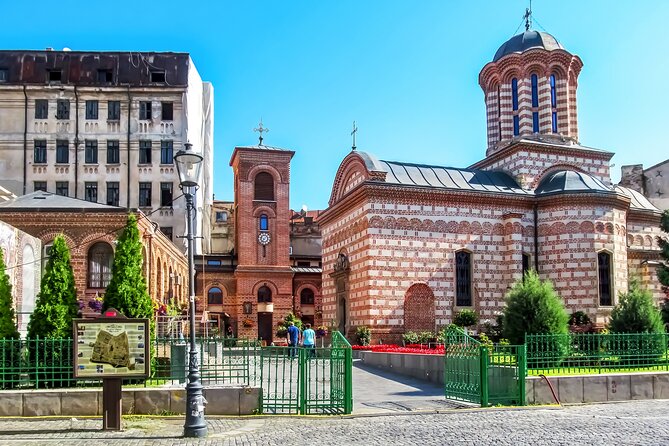
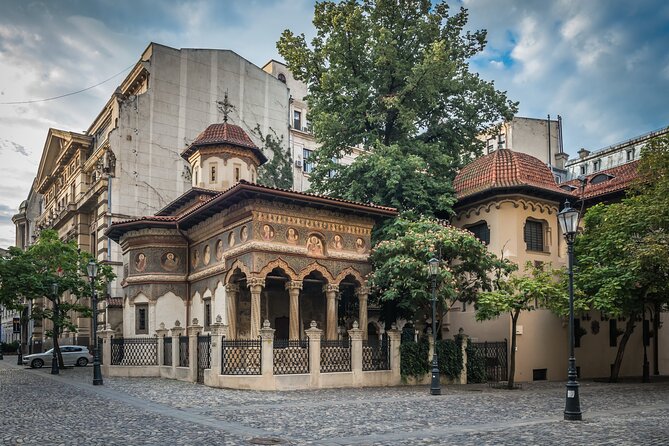
Your guide begins with the story of the inn before leading you toward St. Anton Orthodox Church. This church was once the coronation church of Wallachian rulers, so the opening section quickly places Bucharest in the age of princes and shifting regional power.
I like starting here because you are not dropped into a list of monuments without context. You begin with the old commercial city, then move into the political center. The setting is also practical for a first visit, since the Old Town is an easy place to return to for a meal or an evening walk.
The route can be confusing at first. Several walking groups may meet in the same area, so look for the guide outside the main entrance rather than assuming every group at the inn is yours. If you are arranging pickup, confirm the exact plan in advance, since the meeting information says the walk begins and ends at Manuc’s Inn, while the tour description also lists hotel pickup and drop-off.
More History Walking Tours in the world:
- History and Hauntings of Salem Guided Walking Tour
★ 5.0 · 14,564 reviews - Lisbon: History, Stories and Lifestyle Walking Tour
★ 4.8 · 10,902 reviews - Boston: Freedom Trail History Small Group Walking Tour
★ 5.0 · 6,450 reviews
Vlad the Impaler and the Old Princely Court
At the Old Princely Court, you see the remains of the palace used by Wallachian rulers. The site is closely linked with Vlad the Impaler, the medieval ruler whose name later fed the Dracula legend.
Do not expect a complete castle. The appeal is in the fragments: ruins that show where power once operated in the middle of what is now central Bucharest. The stop is short, listed at about five minutes, so the guide’s explanation matters more than the physical remains alone.
This is one of the tour’s useful habits. Instead of treating Vlad as a cartoon villain, the guide places him within the story of Wallachia and Bucharest. You get a starting point for understanding the city before the later royal, communist, and modern layers appear.
Unirii Square and the Socialist Victory boulevard
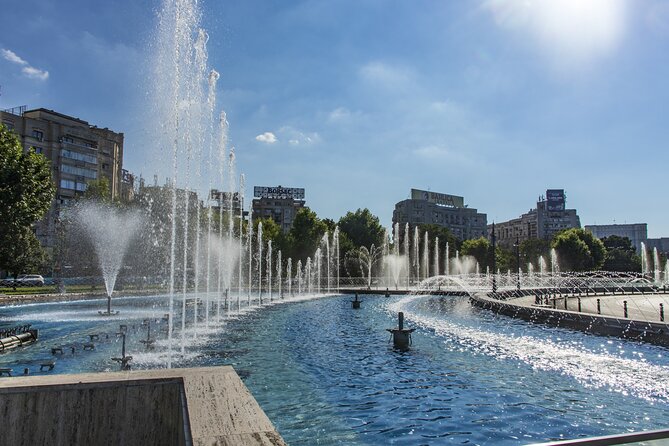
From the court, the walk moves to Unirii Square, one of Bucharest’s major urban spaces. Its refurbished fountains offer an easy photo stop, but the square is more than a place for pictures. It is a large-scale example of how the city was reshaped for traffic, ceremonies, and state power.
Bulevardul Unirii continues that lesson. Once called the Boulevard of Socialist Victory, it was built as Romania’s version of a grand ceremonial avenue, sometimes compared with the Champs-Élysées. The comparison tells you about its intended scale, but the political purpose is more important. The boulevard was designed to project the strength of the communist state.
The route is especially good here because you can see the relationship between street width, sight lines, and government architecture. Bucharest’s postwar planning was not only about transport. It was about making power visible.
The Palace of Parliament from Constitution Square
The Palace of Parliament is the visual heavyweight of the walk. From Constitution Square, you get the broadest and most useful view of the building, with Unirii Boulevard leading toward it.
The tour does not list an interior visit, so plan on seeing the palace from outside. That is still a major part of the Bucharest experience. The building represents Ceaușescu’s megalomania, the forced rebuilding of large sections of the city, and the human cost behind the monumental scale.
Your guide explains how dictatorship and the Cold War affected Bucharest, helping you read the palace as a political object rather than simply an enormous building. This is where the tour’s historical approach is strongest. You are not only told when the structure was built. You are asked to consider why this part of the city was cleared and what the building was meant to communicate.
Constitution Square provides excellent photographs, but it can also feel exposed. Carry water in warm weather and dress for several hours outside. One person recorded more than 17,000 steps on a winter walk, so the route is not a gentle stroll, even though the pace was not described as fast.
More Guided Tours in the world:
- Edinburgh: Edinburgh Castle Guided History Tour with Tickets
★ 4.8 · 9,933 reviews - Historic Charleston Guided Sightseeing Walking Tour
★ 5.0 · 6,216 reviews - Rome: Colosseum with Arena, Roman Forum and Palatine Guided Tour
★ 4.0 · 5,598 reviews - Venice: St. Mark’s Basilica Guided Tour & VR History Intro
★ 3.9 · 4,880 reviews
Churches, banks, and the old commercial city
After the Palace of Parliament area, the route turns back toward older central Bucharest. Along the way, you hear about a church built in 1724, then the CEC Palace, one of the city’s most recognizable historic financial buildings.
Victoria Avenue brings a different mood. You walk beside shops and grand facades, then enter the old center, where the street pattern becomes smaller and more varied. This is a good place to pay attention to the contrast between carefully restored buildings and facades that still show wear.
The Macca-Villacrosse Passage is one of the route’s more distinctive stops. Its covered passage and unusual shape offer a break from the grand boulevards, while the guide explains its past. You also see the National Bank of Romania and hear how the institution fits into the country’s economic story.
I like this middle section because it keeps the tour from becoming only a march between major monuments. Bucharest is at its most interesting when a formal avenue gives way to a passage, church, courtyard, or former inn. You may also be shown restored old taverns, restaurants, and less obvious buildings along the way, depending on the route and the guide.
The tradeoff is pace. There is a lot to cover, and the guide may spend more time explaining buildings than stopping for long visits inside them. If you want museum interiors or slow architectural study, this walk works best as an introduction rather than a substitute for dedicated visits.
University Square, Suțu Palace, and Colțea
University Square brings the tour into another important civic area. Here you see the University of Bucharest, founded in 1864 by Alexandru Ioan Cuza, and learn how the square has functioned as a place of education, public life, and political action.
Nearby Suțu Palace houses the history museum of Bucharest and was once the residence of Costache Suțu. Colțea Hospital and its church add another layer, linking the center to older medical and religious institutions. The National Theatre of Bucharest is also included, with an explanation of how its design changed over time.
This is a useful group of stops for understanding Bucharest as a living capital rather than a collection of old buildings. Universities, hospitals, theatres, banks, and churches all sit close together, showing how the city’s public life developed around a compact center.
The stops are generally brief. You will see the exteriors and hear the stories, but the tour is not built around long interior visits. I would note the buildings that interest you and return later if you want to enter a museum or study a church properly.
Revolution Square and the end of Ceaușescu’s rule
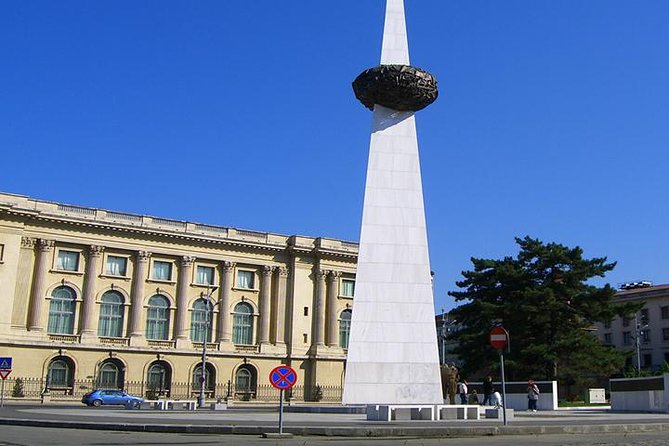
The most emotionally charged section comes at Revolution Square. The guide points out the area where the 1989 Revolution began and explains the memorials connected with those events.
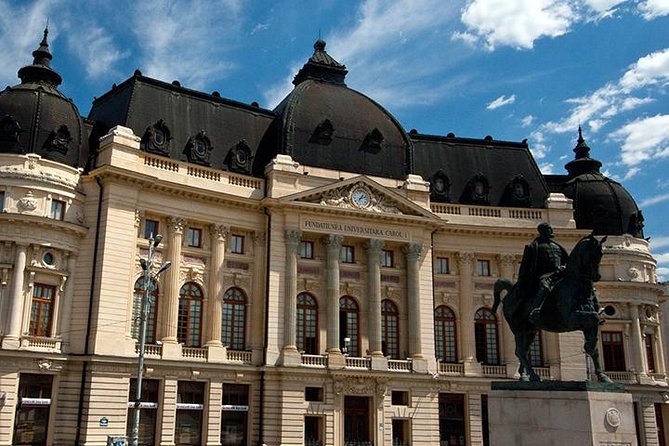
You see the balcony where Nicolae Ceaușescu gave his final speech, the former Communist Party headquarters, the Memorial of Rebirth, King Carol I’s equestrian statue, and the University Library. The 25-meter Memorial of Rebirth honors those who suffered and died during the December 1989 uprising.
This is where the tour’s modern political focus becomes unavoidable. Bucharest’s recent past is visible in its buildings and monuments, and the guide may connect the events to personal or family memories of life under communism. That can make the story more immediate than a textbook account.
It can also make the discussion less neutral than some people expect. Most of the experience is praised for its historical detail and energy, but political opinions may enter the commentary. If you prefer a strictly detached presentation, ask questions clearly and steer the conversation toward the subjects that matter most to you.
English comprehension is another consideration. The guides are described as enthusiastic and well informed, but one person found some explanations difficult to follow in English. That does not erase the value of the route, but it is worth considering if precise spoken English is essential for you.
Military Circle, Sărindar, and a full-circle finish

The walk continues to the Military Circle and the Sărindar Fountains, both useful stops for photographs and for understanding Bucharest’s ceremonial center. The final section includes a grand historical building created for the people of Bucharest more than a century ago, together with gardens and another attractive photo setting.
The activity information says the tour ends back at the meeting point. One detailed account found the route’s ending confusing when trying to connect with a bus, so keep your bearings and ask the guide to confirm exactly where you finish. If hotel drop-off is part of your booking, verify that arrangement before the walk begins.
A three-hour estimate may not be a hard limit. A guide may keep talking for an extra hour, especially with a private group asking questions. That can be a benefit if you want depth, but it may affect lunch plans or another timed booking.
What the $30.77 price buys you
At $30.77 per person, the tour offers good value if you want a broad introduction to Bucharest in one sitting. You are paying for a private English-language guide, a route through the Old Town and central districts, and interpretation that links buildings to political and social change.
The value is less obvious if you want entry tickets, long museum visits, or transport between distant sights. The listed stops are mainly viewed from outside, and the tour includes a lot of walking. You are buying orientation and explanation, not a series of paid attractions.
The private format improves the value for couples, families, or small groups. You can ask about Romanian customs, architecture, communism, religion, or places to eat and drink. One guide also offers practical food and nightlife suggestions, which can help you use the rest of your stay.
Who should book this Bucharest walk
I would choose this tour early in a Bucharest visit. It gives you a mental map of the center and helps you decide which churches, museums, passages, and squares deserve a second look.
It suits you best if you:
- Enjoy political and architectural history
- Want personal stories about Romania’s communist decades
- Prefer a private guide to a large group
- Can walk for several hours over city streets
- Want major sights and lesser-known central buildings in one route
- Like asking questions and shaping the conversation
It is less suitable if you want a relaxed pace, a food-focused walk, or a short route with frequent indoor breaks. Families can book, but children must be accompanied by an adult, and the distance may be demanding for younger walkers.
The tour is offered in English, and service animals are allowed. Public transportation is nearby, but you should have a moderate level of fitness. Free cancellation is available up to 24 hours before the start time. Poor weather can lead to a new date or a full refund.
Should you book it?
Book this walk if you want Bucharest explained rather than simply photographed. Its strongest feature is the way it links the Old Princely Court, socialist boulevards, the Palace of Parliament, churches, banks, universities, and the 1989 Revolution into one story.
Go in ready for plenty of steps and a guide who may speak with strong personal feeling about Romania’s past. Ask for clear directions at the start and end, bring water, and leave extra time after the scheduled three hours. For a first look at Bucharest, the route offers a lot for the price. For a slow, polished architecture tour, choose something narrower.
FAQ
How long does the walking tour last?
The planned duration is approximately three hours, but it may run longer if the guide spends extra time answering questions or explaining the city.
What is the price?
The listed price is $30.77 per person.
Where does the tour start?
It starts outside the main entrance of Manuc’s Inn, Hanul lui Manuc, at 62 Strada Franceză in Bucharest’s Old Town.
Where does the tour finish?
The activity information says it ends back at the meeting point.
Is hotel pickup available?
Yes. Hotel pickup and drop-off are listed as included, though the meeting details also specify Manuc’s Inn. Confirm the pickup arrangement when booking.
Is this a private tour?
Yes. Only your group participates.
What language is offered?
The tour is offered in English.
How much walking is involved?
A great deal of walking is involved. One recorded route exceeded 17,000 steps, so you should have a moderate level of fitness and carry water, especially in hot weather.
Can I cancel for a full refund?
Yes, if you cancel at least 24 hours before the experience starts. Cancellations made less than 24 hours before the start time are not refunded. If poor weather causes cancellation, you are offered another date or a full refund.
Newest history tours we have reviewed in the world
- Bilbao Historical Tour in small group★ 4.7 · 52 reviews
- Bologna: Street Food Tour in the Historic Center★ 4.8 · 125 reviews
- CEBU: Cebu City Heritage and Uphill Guided Tour★ 4.2 · 31 reviews
- Bishkek : City Tour (History, Architects, Statues & Culture)★ 4.9 · 54 reviews
- Blenheim: Omaka Aviation Heritage Centre Admission Ticket★ 4.9 · 31 reviews
- Berlin: Nazi History Walking Tour★ 4.8 · 33 reviews
- Best of Baku: 4-Hour City Tour Historic and Modern Landmarks★ 4.7 · 63 reviews
- Belfast: Best of Belfast History, Culture & Art Walking Tour★ 4.9 · 158 reviews
History Walking Tours, compared.
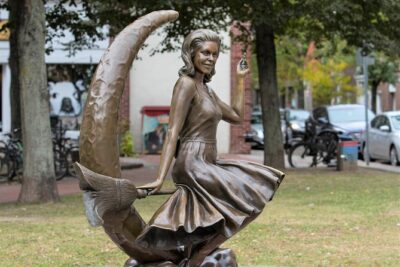
History and Hauntings of Salem Guided Walking Tour
Read our review →
Freedom Trail History Small Group Walking Tour
Read our review →
Historic Charleston Guided Sightseeing Walking Tour
Read our review →
Tapas Walking Tour with Food, Wine, and History
Read our review →
Savannah History and Haunts Candlelit Ghost Walking Tour
Read our review →