
Review · MUMBAI HISTORY TOURS
Best South Mumbai Heritage Walk
South Mumbai’s grandest sights sit close enough to connect on foot, and this tour makes that easy. In three hours, you move from the ornate Chhatrapati Shivaji Terminus area through Fort and Kala Ghoda to the Gateway of India and Colaba, while a guide explains how colonial rule shaped the city’s buildings and streets.
I like the slower pace and the chance to see architectural details you would miss from a car. I also like the choice of morning or afternoon departures, plus the small maximum group of 15. The main drawback is simple: three hours of city walking can feel long in Mumbai’s heat, and the tour is best for people who enjoy outdoor sightseeing rather than indoor visits.
Key Points
- A useful walking route: Travel from the CST area to Colaba, with major sights linked in one direction.
- Architecture takes center stage: Expect Victorian Gothic Revival, Neoclassical, and colonial-era buildings.
- Strong guide element: Aakash, Gautam, Sandesh, and Sanika are among the guides named in guest feedback.
- Good photo opportunities: The route includes the Gateway of India, Flora Fountain, Kala Ghoda, CST, and the Taj Mahal Palace.
- Small-group format: The tour accepts a maximum of 15 people, keeping the group more manageable on city streets.
- Flexible scheduling: Morning and afternoon options make it easier to fit around other Mumbai plans.
A Three-Hour Walk Through Mumbai’s Grandest District
This is a sightseeing walk with a clear geographic purpose. You begin opposite CST on Dr. Dadabhai Naoroji Road and finish near Regal Cinema, close to the Gateway of India. Instead of spending time crossing the city by taxi, you follow a compact route through Fort, Kala Ghoda, and Colaba.
That route matters. South Mumbai is filled with buildings from different periods and styles, and walking lets you stop, look up, and take photographs. A car can carry you past these sights, but it cannot give you much time to notice carved details, statues, domes, fountains, or the way one district changes into another.
The guide is central to the experience. Aakash is praised for his historical explanations and friendly manner. Gautam is noted for combining city history, photo stops, and Bollywood-related conversation. Sandesh focuses on facts about historic landmarks, while Sanika brings a broad knowledge of Mumbai and India into the conversation. Guide assignments can vary, but these names give you a sense of the personal, conversational approach to expect.
More History Walking Tours in India
- Fontainhas Heritage Walk by Make It Happen
★ 5.0 · 2,834 reviews - The Great Indian Food Tour: Old Delhi Food and Heritage Walk
★ 5.0 · 1,698 reviews - Old Goa Heritage Walk by Make It Happen
★ 5.0 · 797 reviews
Starting Opposite CST on Dr. Dadabhai Naoroji Road
The meeting point is at the McDonald’s in Empire Building, opposite CST and near Azad Maidan. This is a practical place to begin because the station itself is one of the city’s major landmarks, and the address is near public transportation.
You should allow a little time to find the exact starting point. The meeting address is detailed, with the building number, shop number, road, and nearby McDonald’s all provided. Once the group gathers, the route heads toward the historic center of South Mumbai.
The walk is not designed as a fitness challenge, but you will be on your feet for roughly three hours. Wear comfortable shoes and carry water. That advice is especially useful if you choose the afternoon departure, since the tour takes place outdoors and includes open streets and public squares.
Gateway of India: A Strong Finish or First Landmark
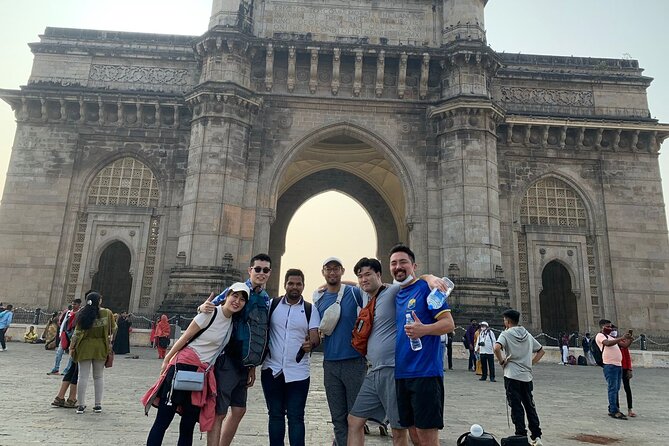
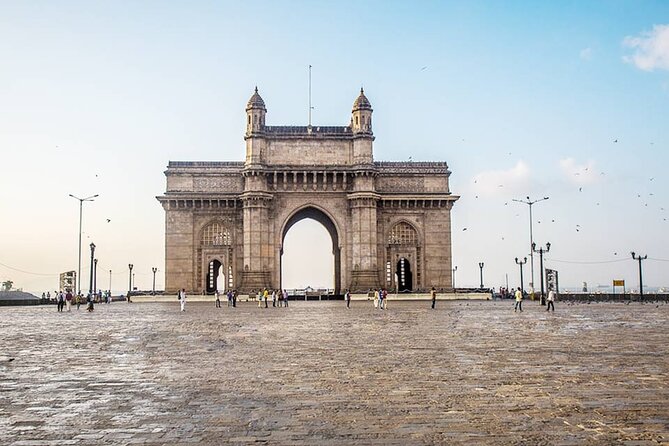
The Gateway of India is one of Mumbai’s best-known monuments, built as an arch in the early twentieth century. It is listed as the first stop, and its broad waterfront setting gives you a natural place to begin or finish your photographs, depending on the exact route used by the guide.
The monument also helps explain Mumbai’s colonial past. The tour uses South Mumbai’s buildings to show how colonialism shaped the city, and the Gateway is one of the clearest visual examples of that period.
The stop is scheduled for about 30 minutes. That is enough time to view the arch, listen to the guide, and take photographs without rushing. The area can be busy, so staying close to the guide matters. Admission is listed as free, although the experience is primarily an exterior walking visit rather than a ticketed monument tour.
Kala Ghoda and Mumbai’s Art-Focused Side
Kala Ghoda gives the walk a different feel. The district is known for its arts connection, and each February it hosts the Kala Ghoda Arts Festival. Even outside festival time, the stop helps show that South Mumbai is not only about government buildings, railway architecture, and colonial monuments.
The scheduled visit lasts about 30 minutes. This is one of the better places to ask your guide how Mumbai’s cultural districts fit into the city’s larger story. Sanika, in particular, is praised for keeping conversation broad, moving from the immediate area to wider subjects about India.
Do not expect a dedicated museum visit here. The value is in walking through the district, seeing its streets and buildings, and placing Kala Ghoda within the route between Fort and Colaba.
Same streets, a different century:
- Old Delhi Food, Heritage&Cultural Walk with Rickshaw ride to Masterji Kee Haveli
★ 5.0 · 742 reviews - Blue City Heritage Private Walking Tour With Pickup and Drop-Off
★ 5.0 · 441 reviews - Kolkata Heritage Tram Tour
★ 4.0 · 395 reviews - Private Heritage Walking Tour in Jaisalmer Fort and Old Bazaar
★ 5.0 · 306 reviews
Town Hall and the Asiatic Society’s Neoclassical Form
The Town Hall, home to the Asiatic Society of Mumbai, is a Neoclassical building in the Fort district. Its appearance differs sharply from the Victorian Gothic style associated with some other South Mumbai landmarks.
That contrast is one of the tour’s best features. You are not seeing one repeated architectural style. Instead, the route lets you compare Neoclassical design with Gothic Revival buildings, public monuments, railway architecture, and grand hotel design.
The stop lasts around 30 minutes, giving the guide time to explain the building and its place in the Fort area. The ticket information lists no admission charge, but the itinerary does not promise an interior visit. Plan to admire the exterior unless your guide says otherwise.
Flora Fountain and the Heart of Fort
Flora Fountain sits at Hutatma Chowk, at the southern end of Dadabhai Naoroji Road. It is an ornamentally sculpted heritage monument, and its location makes it a useful point for understanding the street pattern of the Fort district.
This is a good stop for photographs because the fountain is not isolated in a quiet garden. It sits among the city’s historic buildings and active streets. You get the monument itself, but also a close view of how old architecture and present-day city life occupy the same space.
The scheduled time is 30 minutes. That may seem generous for a fountain, but it gives you time to hear the story behind the site, examine the sculpted work, and photograph the surrounding architecture. The experience is about context, not simply checking off another landmark.
Horniman Circle Garden: A Short Pause in Fort
Horniman Circle Garden is a large public park covering about 2.5 acres, or 10,100 square meters, in the Fort district. It is surrounded by office buildings, so the setting shows another side of South Mumbai: formal public space framed by commercial and administrative structures.
Only about 10 minutes are scheduled here. Think of it as a brief pause and viewing point rather than a long park visit. The garden can break up the building-heavy route and help you see how open space was built into the historic district.
Because the stop is short, you should not expect an extended rest period. If you need frequent breaks, the three-hour walking format may require some planning.
The Bombay High Court and a Working Historic District
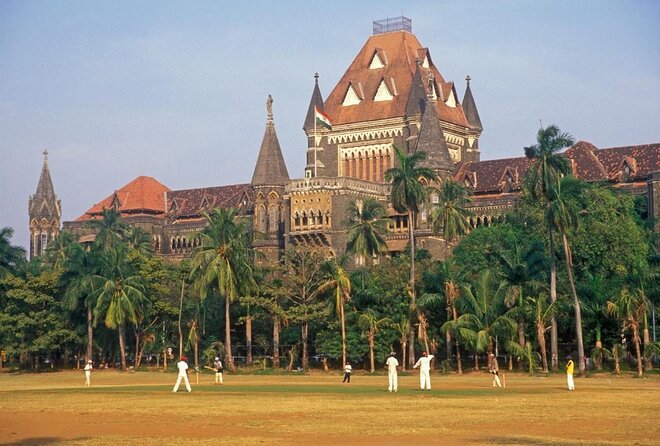
The Principal Bench of the Bombay High Court is another important South Mumbai landmark. The court serves Maharashtra and Goa, and its inclusion shows that the walk is not limited to monuments built only for display.
The route passes through a district where significant buildings still connect to public life. That gives the architecture more meaning. You are not looking at a preserved street set apart from the city. You are seeing an area that continues to function as part of Mumbai.
The stop is scheduled for about 10 minutes. The guide can point out the building and explain its role, but the short timing suggests an exterior view rather than a court visit. As with all active public institutions, follow the guide’s instructions and do not expect general entry.
The Taj Mahal Palace Near Colaba
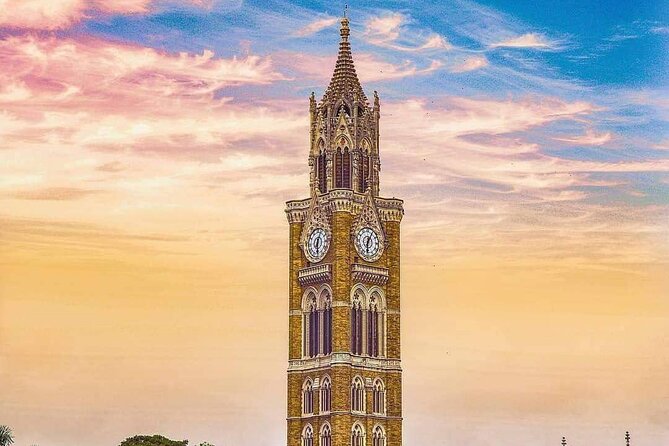
The Taj Mahal Palace is a heritage five-star hotel in Colaba and one of the most recognizable buildings on the route. Its inclusion gives you a look at the hotel architecture associated with Mumbai’s famous waterfront district.
The tour allows around 10 minutes here. That is enough for an exterior view and photographs, but not for a hotel tour or a long stop inside. You can appreciate the building as part of the streetscape while continuing toward the nearby Gateway of India and Regal Cinema area.
This is also where the route begins to feel more connected to Colaba’s visitor-friendly waterfront zone. The changing surroundings help make the walk feel like a journey through several parts of South Mumbai rather than a series of unrelated buildings.
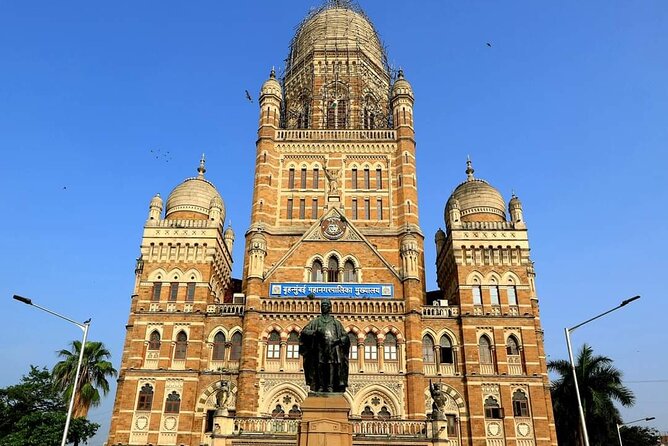
Chhatrapati Shivaji Terminus and Victorian Gothic Revival
CST is one of the tour’s major highlights. The station is a UNESCO World Heritage Site and a historic terminal railway station in Mumbai. Its elaborate design is a prime example of the Victorian Gothic Revival style highlighted by the experience.
The stop is scheduled for about 30 minutes, which gives you time to study the exterior and hear how the station fits into Mumbai’s development. It is also an effective starting-area landmark because the meeting point is opposite the station.
CST can be visually overwhelming. There is a lot to see, and the surrounding city is active. A guide helps you focus on details rather than simply taking a quick photograph and moving on. If architecture interests you, this is one of the stops where the walking format pays off most clearly.
What the Architecture Says About Mumbai
The strongest thread running through the walk is comparison. You see Victorian Gothic Revival at CST, Neoclassical design at Town Hall, a monumental arch at the Gateway of India, an ornamental fountain at Hutatma Chowk, and the grand Taj Mahal Palace in Colaba.
The guide’s job is to connect these buildings to the city’s past. The tour explains how colonialism shaped South Mumbai, but it also gives you a chance to see how those buildings fit into modern Mumbai. Offices, public institutions, transport, gardens, hotels, and tourist sights all share the same compact area.
I find this more useful than a tour that presents each monument as an isolated fact. The route shows how architecture, public space, transport, and power were tied together in the city’s development.
Price, Group Size, and Overall Value
At $17.89 per person, this is a modestly priced three-hour guided walk. You are paying mainly for the guide’s time and interpretation, not for admission to paid attractions. Each stop is listed with free admission, and the tour is built around outdoor viewing.
That makes the value depend on your interest in context. If you only want quick photographs of the Gateway of India and CST, you can see those places independently. If you want someone to connect the buildings, explain architectural styles, and add local perspective, the price is easier to justify.
The maximum group size is 15. That is not a private tour, but it is small enough to keep the guide within earshot and make questions practical. A smaller group also helps when stopping on busy streets, though city noise can still affect how easily you hear every detail.
The 96 percent recommendation rate and 4.8 rating from 122 submitted ratings suggest a strong overall record, but the experience is not free from risk. One booking was canceled without prior communication, followed by repeated calls before a refund was received. I would confirm the departure details before setting out, especially if the walk is tied to a tight sightseeing schedule.
Morning or Afternoon: Which Time Fits You?
Morning and afternoon departures are available, so you can place the walk around other Mumbai plans. A morning start may suit you if you prefer cooler conditions and want the rest of the day free. An afternoon option can work well if you arrive later or want to pair the walk with other South Mumbai sightseeing.
The exact choice depends on your tolerance for heat and your schedule. The tour does not offer an indoor escape at every stop, so bring water, wear light clothing, and choose footwear for several hours on pavement.
The route ends at Regal Cinema in Apollo Bandar, near the Gateway of India. That makes it convenient to continue exploring Colaba after the walk rather than returning to the starting point. Since the start and end points differ, plan your onward transport from Colaba rather than from CST.
Who Should Book This Walk?
I would choose this tour if you are visiting Mumbai for the first time and want a clear introduction to South Mumbai’s major landmarks. It also suits anyone interested in architecture, colonial-era city planning, public buildings, and photography.
It works particularly well for you if:
- You prefer walking to sitting in traffic.
- You want explanations rather than isolated photographs.
- You like seeing several architectural styles in one outing.
- You want a small group instead of a large coach tour.
- You can comfortably spend three hours outdoors.
- You appreciate a guide who can discuss both landmark history and broader Mumbai life.
I would think twice if you dislike walking in heat, need guaranteed indoor access, or want a tour focused on entering buildings. Most of the value comes from exterior viewing and the guide’s explanations.
The experience is open to most participants, and it is near public transportation. A mobile ticket makes entry simple. Cancellation is free up to 24 hours before the start time, with no refund for cancellations or changes made within 24 hours.
Should You Book the Best South Mumbai Heritage Walk?
Book it if you want the city explained at street level. The route links CST, Fort, Kala Ghoda, Town Hall, Flora Fountain, Horniman Circle, the High Court, the Taj Mahal Palace, and the Gateway of India in about three hours. That is an efficient way to cover South Mumbai without spending the day arranging taxis.
The best reason to go is the guide. Aakash, Gautam, Sandesh, and Sanika are all associated with especially strong guest feedback for clear facts, friendly conversation, photo help, and broad discussion. The guide you receive can vary, but the experience is designed around that human connection.
Skip it if you only want monument entry or a private, air-conditioned ride. For everyone else, $17.89 is fair value for a compact introduction to Mumbai’s historic core, especially when you want to understand how the buildings relate to one another.
FAQ
How long is the Best South Mumbai Heritage Walk?
The walk lasts approximately three hours.
Where does the tour begin?
It begins at McDonald’s in Empire Building, opposite CST Station on Dr. Dadabhai Naoroji Road in Fort, Mumbai.
Where does the tour end?
The tour ends at Regal Cinema in Apollo Bandar, Colaba, near the Gateway of India.
Are morning and afternoon departures available?
Yes. You can choose between morning and afternoon tour options.
What is the maximum group size?
The tour accepts a maximum of 15 participants.
Can I cancel for a full refund?
Yes. You can cancel at least 24 hours before the experience start time for a full refund. Cancellations or changes made less than 24 hours before the start time are not refunded.
Newest history tours we have reviewed in India
- Agra Fort: Guided UNESCO Heritage Walking Tour★ 4.9 · 21 reviews
- Private Elephanta Caves UNESCO World Heritage Site Tour★ 5.0 · 34 reviews
- World heritage Ahmedabad city tour in private car with guide and lunch★ 5.0 · 44 reviews
- Hill-station & Heritage: Lonavala & Karla Caves Tour from Mumbai★ 5.0 · 60 reviews
- Heritage Walk: Recommended by Gigi Hadid as a must-do in Mumbai★ 5.0 · 122 reviews
- Mumbai: South Mumbai Heritage Walking Guided Tour★ 4.5 · 69 reviews
- The Cultural And Historical Walking Tour in Margao★ 5.0 · 280 reviews
- Old Delhi Walking Tour: Food, Culture & Spice Bazaars★ 5.0 · 94 reviews
History Walking Tours, compared.

History and Hauntings of Salem Guided Walking Tour
Read our review →
Freedom Trail History Small Group Walking Tour
Read our review →
Historic Charleston Guided Sightseeing Walking Tour
Read our review →
Tapas Walking Tour with Food, Wine, and History
Read our review →
Savannah History and Haunts Candlelit Ghost Walking Tour
Read our review →
A History of Terror – Belfast City Centre Walking Tour
Read our review →Browse the lists this tour appears in