
Review · ROME HISTORY TOURS
Ancient Appian Way PRIVATE Bike Tour
The best part of this tour is the sudden change from Rome’s busy streets to open parkland, ancient stone roads, and towering aqueducts. You ride through a side of the city many first-time visitors miss, with a private guide who can adjust the pace and explain what you are seeing.
I like the private format, which gives your group room to ask questions and pause for photos. I also like the e-bikes, especially for a route that can cover roughly 14 miles and includes several separate archaeological sites.
The catch is the ride into and around Rome. About 20 percent may be in city traffic, and some roads are cobbled or off-road. You must already know how to ride a bike well, and the pedal-assist bikes still require real pedaling.
Key points to know before booking
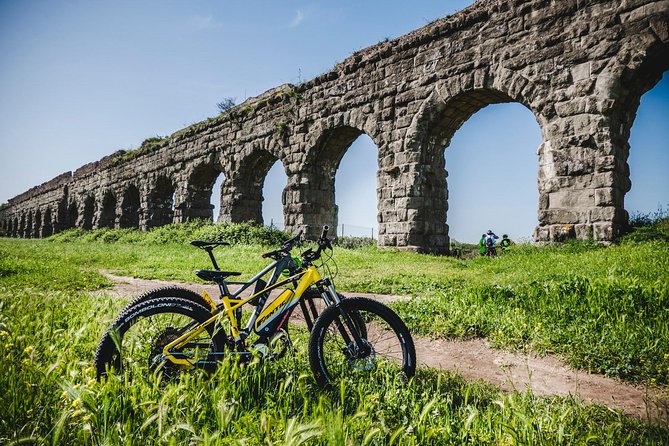
- Ride beside ancient aqueducts: The Aqueducts Park offers some of Rome’s biggest views and even includes water structures still in use.
- Private attention from your guide: Guides including Valerio, Sara, Claudio, Alex, Iman, Marco, and Nico have led this route, with history and flexibility built into the ride.
- A strong family option: Child seats are available up to 25 kilograms, and children ages 6 to 10 may use a trailer bike if they are under 143 centimeters tall.
- Expect a real bike ride: The e-bikes assist your pedaling, but they do not have a throttle. Traffic, uneven surfaces, and heat can matter.
- Eight historical stops: You see gateways, parks, a spring, aqueducts, imperial villas, tombs, a circus, and the Baths of Caracalla.
- Good value for a private half-day: At $147.54 per person, the price is easier to justify for a small group that wants transport, guiding, and a broad route in one outing.
Why the Appian Way is worth four hours
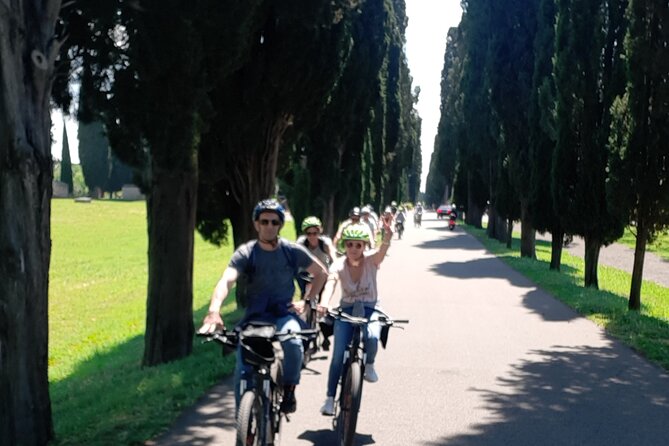
Rome can feel packed around the Colosseum, Trevi Fountain, and Vatican. The Appian Way gives you a different rhythm. Instead of moving from one crowded indoor sight to another, you pedal through trees, fields, ruins, and long stretches of ancient road.
This is not only a sightseeing ride. It is also a practical way to connect places that are spread across the southern edge of Rome. Walking between them would take far too long, while public transport does not create one simple route. The e-bike lets you cover a large area without turning the day into a hard athletic challenge.
The private setup matters here. Your guide can explain why a broken wall matters, stop when you need water, and respond to your questions without managing a large group. Guides such as Valerio, Sara, Claudio, Alex, Iman, Marco, and Nico are specifically associated with this experience, and the strongest praise has focused on their warmth, patience, historical knowledge, and ability to adapt the ride.
You should still think of this as an active tour. The motor helps when you pedal, but it does not pull you along. You will ride on city streets, cobblestones, park paths, and uneven surfaces. In hot weather, the effort becomes more noticeable.
More Ancient History Tours in Italy
- Colosseum: Underground and Ancient Rome Tour
★ 4.7 · 12,691 reviews - Colosseum & Ancient Rome with Arena Floor Option I Max 6 People
★ 5.0 · 3,306 reviews - Rome: Colosseum, Ancient Rome Tour or AudioGuided Tour
★ 4.4 · 2,879 reviews
From Porta San Sebastiano to the old road
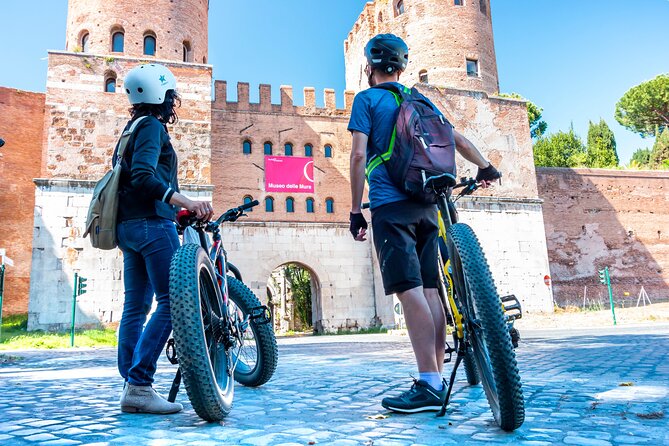
The ride begins at Porta San Sebastiano, an impressive gateway in Rome’s Aurelian Walls. Built around 275 AD, the gate marks the start of the historic Via Appia Antica, or Appian Way.
Your guide can point out medieval graffiti left by pilgrims who passed through over the centuries. That detail helps you see the gate as more than a military structure. It was also part of a long-used road system, crossed by soldiers, merchants, pilgrims, and ordinary people.
The first stop lasts about 20 minutes and has no separate admission charge. It is a good introduction to the tour because you begin with the city’s walls, then move outward toward the open country.
The transition is part of the fun, but it is also where you need the most care. Some of the route uses roads with traffic, and Rome’s drivers may make this section stressful if you are nervous on a bike. Your guide leads the way, but you remain responsible for handling your bicycle confidently.
Caffarella Park and the spring of Egeria
Parco della Caffarella is one of the largest green areas in Rome and forms part of the Appian Way regional park. Its paths and groves contain remains of ancient buildings, but the appeal is also the space itself. You get room to breathe after the traffic and stone of central Rome.
This stop lasts about 20 minutes. It is a place to look beyond a single monument and understand how much open land survives around the old roads. You might see scattered ruins rather than one neatly framed building, so your guide’s explanation adds real value.
Next comes the Ninfeo di Egeria, a spring tied to the story of the nymph Egeria and Numa Pompilius, Rome’s second king. According to the legend, Egeria’s grief after the death of her beloved became a spring.
The story is myth, not a literal account of Roman engineering, but it gives the place a human quality. You are not simply looking at water and stone. You are hearing how Romans used landscape, springs, and sacred stories to explain their world.
Aqueducts Park, where Roman engineering gets dramatic
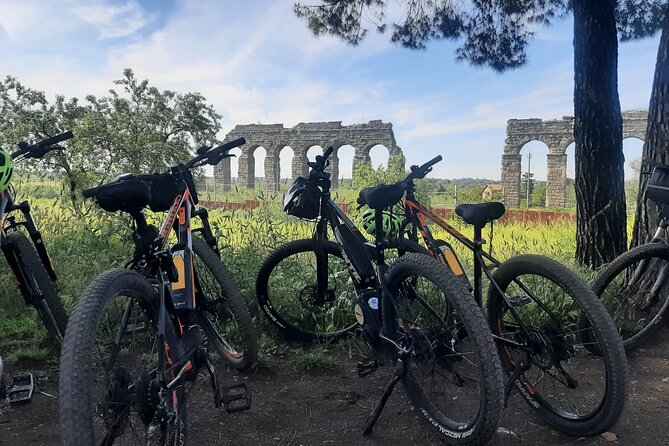
For many people, the Aqueducts Park is the high point of the ride. The park follows the old Via Latina and contains remains of the water network that supplied ancient Rome. The arches are broad, high, and easy to appreciate from a bicycle because you can move along them rather than view them from one fixed point.
Some aqueducts here are surprisingly well preserved, and some are still functioning. That makes the stop especially useful for understanding Roman engineering as working infrastructure, not just a collection of ruins.
You will have about 20 minutes at this stop, but the visual impact can last longer. The open setting lets you see the scale of the aqueducts clearly. This is also the section most likely to produce the photographs you remember later.
The ride through the park may feel quieter than the city, but do not assume the entire route is smooth. The tour includes park paths and off-road stretches. If you dislike uneven surfaces, ask about the route before booking. If you enjoy being outdoors and do not mind a little bumping, this section is a major reason to choose the tour.
More Ancient History Tours in Rome
- Colosseum Underground & Ancient Rome Guided Tour
★ 4.5 · 2,590 reviews - Pantheon Elite Guided Tour – Rome’s Iconic Ancient Temple
★ 5.0 · 1,447 reviews - Ancient Rome: Colosseum Underground Group Tour
★ 4.5 · 1,059 reviews - Colosseum Express Guided Tour and Ancient Rome Admission Included
★ 4.0 · 1,008 reviews
Imperial power at Villa dei Quintili
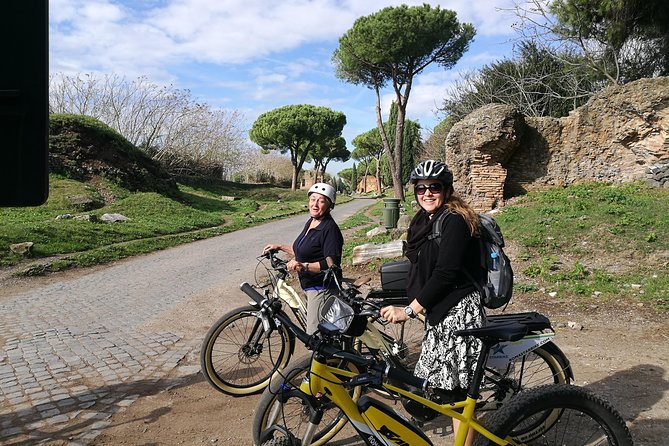
At the fifth mile of the Appian Way, the remains of Villa dei Quintili reveal the scale of elite Roman life. The villa belonged to Sextus Quintilius Condianus and Maximus Valerius, brothers who served as consuls in the second century AD.
The emperor Commodus later killed the brothers and took the property for himself. That story gives the ruins a sharp political edge. This was not simply a country retreat. It was a sign of wealth, status, and the danger of living too close to imperial power.
The stop also includes Santa Maria Nova within the Appian archaeological park. You have about 20 minutes here, enough for an overview and a chance to see how large Roman estates could be.
Do not expect the kind of complete rooms or polished displays found inside a major museum. The attraction is the scale of the remains and the setting along the ancient road. Your guide helps you picture the original complex and connect it with the wider route.
Cecilia Metella and the medieval Caetani fortress
The Mausoleum of Cecilia Metella is one of the best-preserved tombs on the Appian Way. It dates to the first century BC and was built for Cecilia Metella, a member of a powerful Roman family.
Its round form is easy to recognize, but the later medieval additions make the stop even more interesting. The tomb became part of the Castrum Caetani, a fortified complex connected with the wealthy Caetani family. You can also see the remaining perimeter walls of the church of San Nicola and traces of a medieval house.
This is a good example of how Rome keeps adding new chapters to old buildings. A Roman tomb became part of a medieval stronghold, and the result is not a single-period monument. You see ancient, medieval, and later use layered together.
The stop lasts about 20 minutes. It is one of the better places to listen closely to the guide because the building’s later use changes how you interpret the original tomb.
The Circus of Maxentius and imperial spectacle
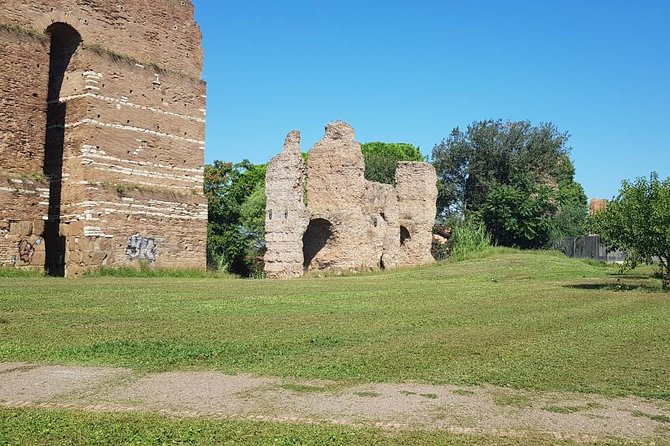
The Circus of Maxentius is considered the best surviving example of a Roman circus. Its track and central spine, known as the spina, remain visible, giving you a clearer idea of how chariot-racing venues were organized.
The obelisk that once stood on the spina was later moved to Piazza Navona, where it forms part of Bernini’s Fountain of the Four Rivers. That connection links this quieter archaeological site with one of central Rome’s famous squares.
The circus is not as instantly familiar as the Colosseum, but the preserved layout can make it easier to understand. You are looking at the space where crowds watched races, rather than only at a heavily restored facade.
Again, expect a short stop of about 20 minutes. The tour is designed to give you a broad view of the Appian Way, not a long indoor archaeological visit at each location.
Ending at the Baths of Caracalla
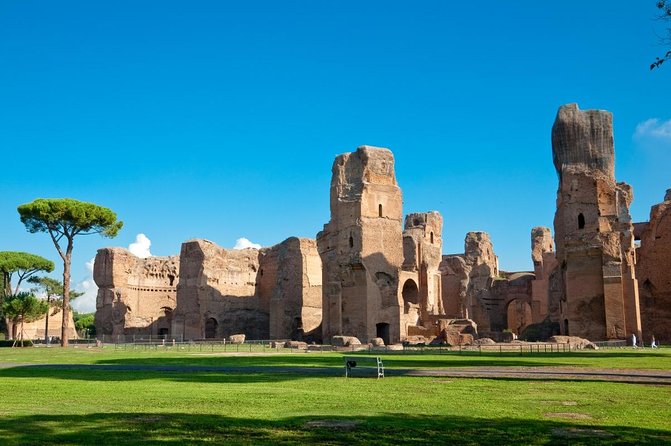
The route finishes with the Baths of Caracalla, built by the emperor Caracalla. For about a century, they were the largest public baths in the Roman world.
Much of the structure still survives, allowing you to see the scale of the complex. The baths were not merely places to wash. They were large public facilities, and their size reflects the Roman investment in water, leisure, and public life.
A branch of the Aqua Marcia supplied the baths through the Antoninian aqueduct. Small remains connected with that water system can also be seen near Porta San Sebastiano.
Ending here gives the ride a useful final theme: water. You have passed springs, aqueducts, villas, and public baths, and the route closes by showing how Roman engineering supported daily life on a huge scale.
The tour ends back at the meeting point on Via dei SS. Quattro, 58. Since the ride returns to its start, you do not need to arrange a separate pickup from the final stop.
E-bikes, children, and the effort involved
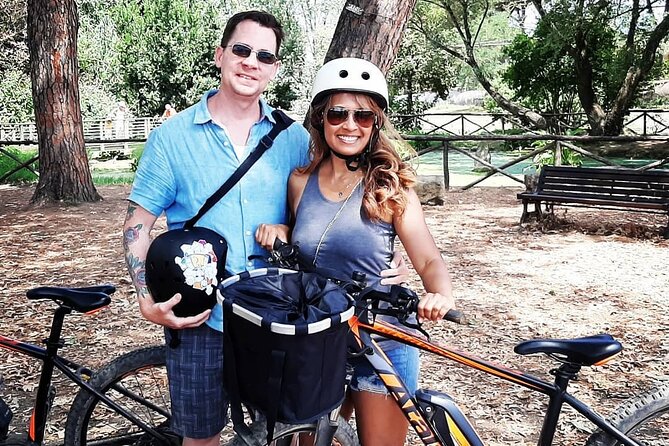
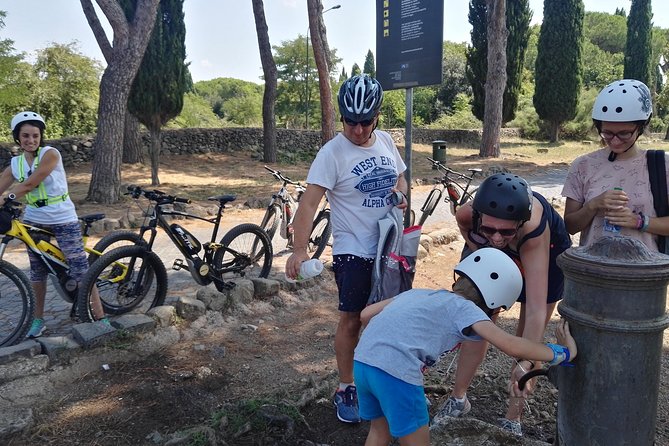
The tour includes a high-quality e-bike, helmet, mobile phone holder, and handlebar holder. A child seat is available for a child up to 25 kilograms.
Children ages 6 to 10 qualify for the reduced rate only if they are under 143 centimeters tall. At that height, they use a trailer bike rather than riding a bicycle alone. The tour has also worked well for families with children ranging from 5 to 11, but the adult booking decision should still be based on each child’s comfort and cycling ability.
The clearest warning is simple: you must know how to ride a bike well. The e-bike is pedal-assisted, not a scooter. One useful detail is that there is no throttle, so you will need to keep pedaling even when the motor is helping.
That makes the tour a good fit for active families, couples, and friends who want to cover a lot of ground. It is not a good choice for someone who rarely cycles or feels unsafe beside traffic.
Is $147.54 a fair price?
At $147.54 per person, this is not a cheap way to spend four hours. The value comes from combining transportation, equipment, a private guide, and several widely separated sites.
A private group also changes the calculation. If two people book, the cost is easier to feel, but you receive a more personal experience than you would on a large group outing. For a family or group of friends, the per-person value can improve because everyone shares the private guide.
You also avoid spending a separate day arranging transport to the aqueducts and Appian Way. The tour covers a long route in one morning or afternoon, with the e-bike doing much of the practical work.
The price is less convincing if your main goal is a slow archaeological visit inside one site. This experience favors breadth, outdoor scenery, and connection between monuments.
Practical details that can make or break the ride
The activity is offered in English and confirmation arrives at booking. It is near public transportation, but the meeting point is on Via dei SS. Quattro, 58, in central Rome, so allow time to reach it.
Wear clothes suited to cycling and bring water, especially in hot weather. The tour is about four hours, and the route includes traffic, cobblestones, and park paths. A moderate level of physical fitness is expected.
You can cancel for a full refund up to 24 hours before the start time. Changes or cancellations made inside that period are not accepted.
The tour has a 5.0 rating from 89 ratings and is recommended by 99 percent of customers. That strong record fits the experience’s clearest strengths: the guides, the scenery, the private format, and the chance to see the aqueducts without spending the whole day in central Rome.
Should you book the Ancient Appian Way Private Bike Tour?
Book it if you want Rome’s ancient past with more fresh air and less time in queues. You will see an unusual mix of city walls, sacred springs, green parkland, imperial villas, tombs, a circus, aqueducts, and public baths in one ride.
I would choose it for a family that cycles confidently, a repeat visitor who has already seen the main center, or anyone who wants a guide-led route through the aqueducts. I would skip it if heavy traffic makes you anxious, if you cannot pedal for several hours, or if you want long visits inside each archaeological site.
For the best experience, treat this as a serious sightseeing ride rather than a motorized shortcut. The e-bike saves energy, but you still need to ride. If that sounds appealing, the Appian Way offers one of Rome’s most memorable changes of pace.
FAQ
How long is the Ancient Appian Way private bike tour?
The tour lasts approximately four hours.
Where does the tour start?
It starts at Via dei SS. Quattro, 58, 00184 Rome, Italy.
Where does the tour end?
The activity ends back at the meeting point.
Is this a private tour?
Yes. Only your group participates in the activity.
What language is the tour offered in?
The tour is offered in English.
What equipment is included?
The price includes a high-quality e-bike, helmet, mobile phone holder, and handlebar holder.
Are child seats available?
Yes. A child seat is available for children up to 25 kilograms.
Can children ride their own bikes?
Children ages 6 to 10 can receive the reduced rate only if they are under 143 centimeters tall. They use a trailer bike rather than a bicycle alone.
Do I need to be an experienced cyclist?
Yes. You must know how to ride a bike well, and you should have a moderate level of physical fitness. The e-bikes are pedal-assisted and have no throttle.
More Private History Tours in Italy
- Ancient Ostia Antica Semi-Private Day Trip from Rome by Train with Guide
★ 4.5 · 579 reviews - Colosseum & Ancient Rome Semi-Private Tour
★ 5.0 · 208 reviews - Private Rome Food Tour in the Historic Centre with 8+Tastings
★ 5.0 · 135 reviews - Ancient Pompeii Private Tour: Skip the Line & Kid-Friendly Option
★ 5.0 · 167 reviews
More History Bike, Segway and Tuk-Tuk Tours in Rome
- Golf Cart Tour Rome: Glide By Ancient Wonders & Hidden Gems
★ 5.0 · 256 reviews - Ancient Rome Tour in a Golf Cart
★ 4.5 · 72 reviews - Rome in Golf Cart 4 Hours History & have Fun
★ 5.0 · 37 reviews - Ancient Rome Half-Day Segway Tour
★ 4.8 · 25 reviews
Newest history tours we have reviewed in Rome
- Ancient Rome: Archeological area Largo Argentina★ 3.9 · 49 reviews
- Ancient Rome Half-Day Segway Tour★ 4.8 · 25 reviews
- Colosseum Forum Ancient Rome Small Group Tour for Kids Families★ 5.0 · 198 reviews
- VIP Colosseum Underground and Ancient Rome Small Group Tour★ 4.5 · 332 reviews
- Colosseum & Ancient Rome Semi-Private Tour★ 5.0 · 208 reviews
- Small-Group Rome to Pompeii & Amalfi: Day of History & Sea★ 5.0 · 239 reviews
- Colosseum & Ancient Rome Guided Walking Tour★ 5.0 · 332 reviews
- Ancient Rome at Twilight Walking Tour★ 5.0 · 276 reviews
Ancient Rome & Colosseum Tours, compared.
Colosseum: Underground and Ancient Rome Tour
Read our review →
Colosseum with Arena, Roman Forum and Palatine Guided Tour
Read our review →
Colosseum with Arena, Roman Forum and Palatine Hill Guided Tour
Read our review →
Colosseum & Ancient Rome with Arena Floor Option I Max 6 People
Read our review →
Colosseum, Ancient Rome Tour or AudioGuided Tour
Read our review →
Colosseum Underground & Ancient Rome Guided Tour
Read our review →
Colosseum Arena, Roman Forum & Palatine Hill Tour
Read our review →
Colosseum, Roman Forum & Palatine Hill Guided Tour
Read our review →Browse the lists this tour appears in