

Review · FLORENCE HISTORY TOURS
Essential Florence Walking Tour to discover its history
Florence comes alive when you connect its streets, palaces, churches, and family rivalries into one story. This three-hour walk starts with the Roman founding of the city, then follows Florence through its medieval rise, Renaissance glory, Medici power, and artistic revolutions.
I like the wide historical sweep, from Piazza della Repubblica to the Oltrarno, and I like the stop for Italian gelato, a small pleasure that breaks up a serious dose of art and architecture. The main caution is physical: uneven cobblestones, steps, and three hours on foot make this a poor match for anyone with mobility limits, back problems, or recent surgery.
Key points
- Roman origins to Medici power: The route gives you a useful timeline rather than a random parade of sights.
- Outdoor Florence in one walk: See the Duomo, Ponte Vecchio, Pitti Palace, Dante’s home, Via Tornabuoni, and more from the street.
- A rare interior visit: Santa Trinita includes a look at Ghirlandaio frescoes.
- Story-led guiding: Becky, Lisa, and Andrea have each brought history, art, and local detail to the walk.
- Gelato included: The tasting adds a distinctly Florentine pause.
- English only with headsets: You can follow the guide clearly, even while moving through busy streets.
Florence’s story begins in Piazza della Repubblica
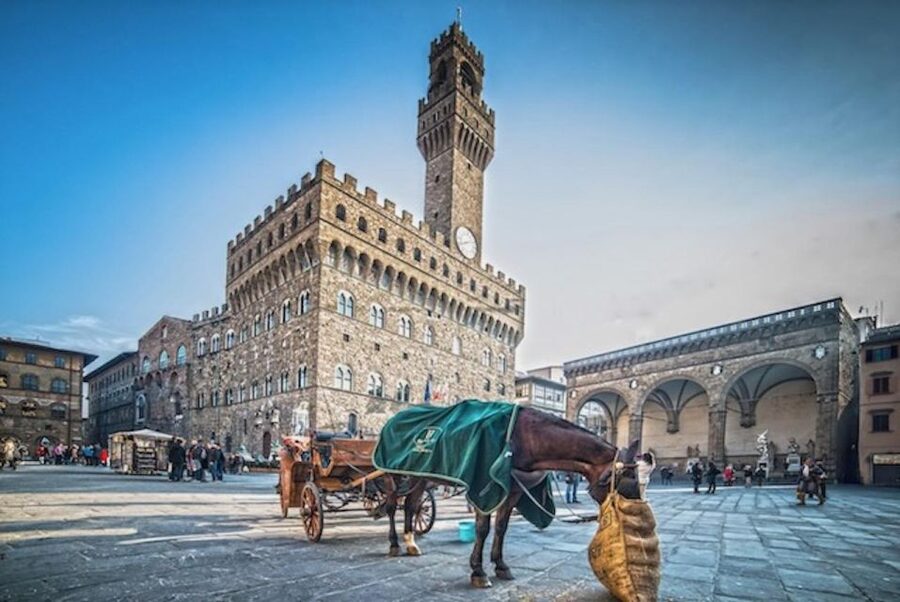
The tour begins at Piazza della Repubblica, a fitting place to start because Florence’s modern center sits over the city’s ancient foundations. Here, you learn about the Roman settlement and how the city’s position helped shape its future.
From there, the walk moves into medieval Florence. You see how the city grew wealthy through trade, banking, and political influence, and how that money changed the streets. The guide explains the forces behind Florence’s rise instead of treating each building as an isolated photo stop.
That order matters. If you first understand Florence as a Roman town, then a medieval power center, the later palaces and churches make more sense. You can see why a compact city produced such a large share of Europe’s art and political drama.
The guide also brings in the less polished side of the past: murder, betrayal, family competition, and political maneuvering. This keeps the tour from becoming a string of dates and names. Florence’s great families were not simply generous patrons of art. They were also ambitious political operators.
More History Walking Tours in Italy
- Venice: City Center Historical Guided Walking Tour
★ 4.2 · 1,873 reviews - Palermo: Street Food and History Walking Tour
★ 4.9 · 1,486 reviews - Verona: History and Hidden Gems Guided Walking Tour
★ 5.0 · 1,379 reviews
Orsanmichele and the city’s working streets
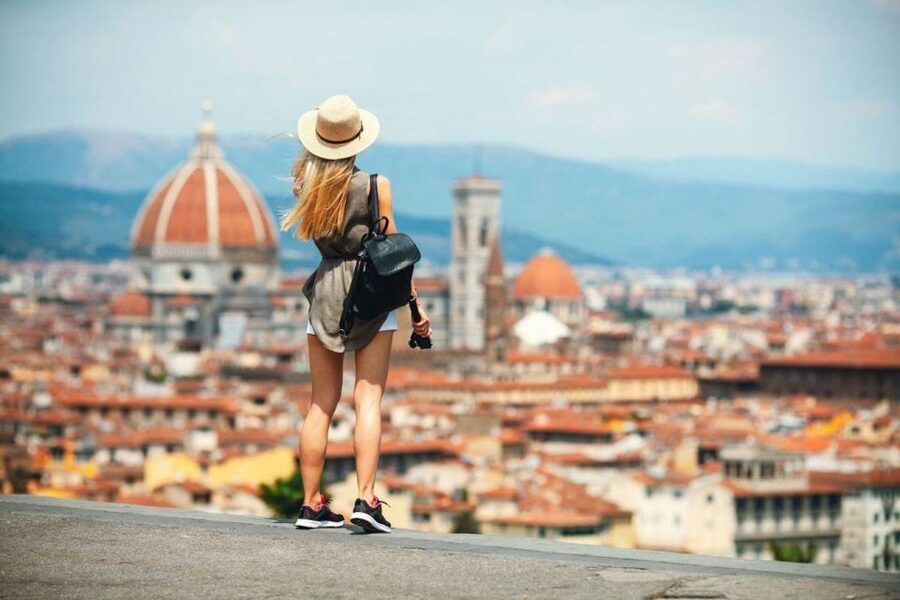
Orsanmichele is one of the most interesting outdoor stops because its decoration reflects the strength of Florence’s guilds. The building is associated with statues by major artists, including Donatello and Ghiberti, and the guide uses those works to show how commerce, religion, and civic pride overlapped.
You will not be touring every interior on this route, so the value here comes from the explanation. A guide can point out details that are easy to miss while you are hurrying toward the Duomo. You learn how Florence’s public art was tied to powerful groups and how sculpture helped turn ordinary streets into political statements.
The tour also passes Dante’s house. The stop gives you a chance to connect Florence’s medieval world with one of Italy’s most famous writers. It is another example of the tour’s strength: you are not only seeing monumental buildings, but also tracing the people and ideas that shaped the city.
The Duomo, Baptistery, and Campanile from outside
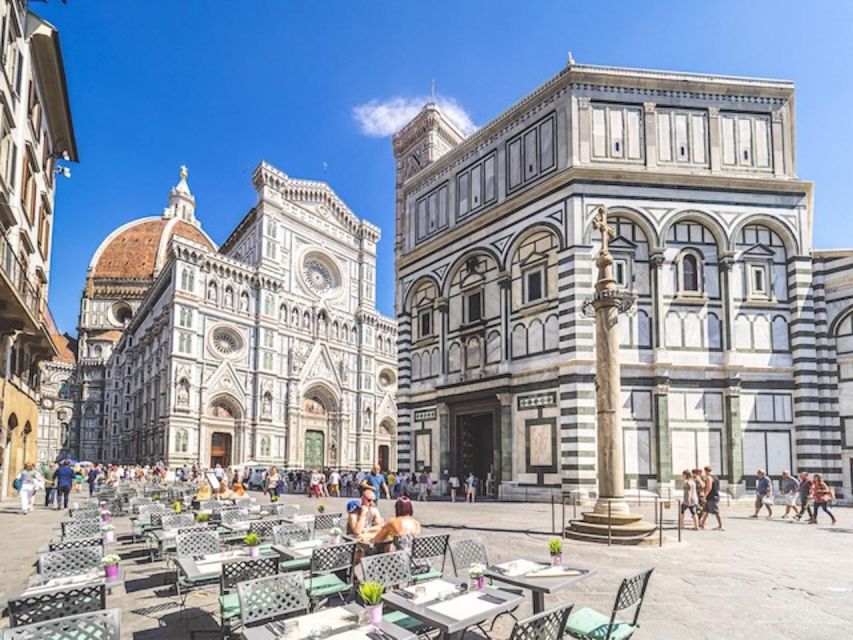
Florence’s religious center is one of the route’s major highlights. You see the Duomo, Baptistery, and Campanile from outside, with the guide explaining their place in the city’s religious and civic life.
The exterior view is useful for orientation. Florence’s cathedral complex is visually overwhelming, and a guide helps you separate the individual buildings and understand how they relate to one another. You also hear about the way religion touched daily life, politics, public ceremony, and personal identity.
The important limitation is clear: this is an outside visit. You should not book this walk expecting entry to the Duomo or its related buildings. If climbing the dome, entering the cathedral, or viewing a particular artwork inside is a priority, you will need separate plans.
Still, this stop works well in a first visit. The guide can give you the background you need before you return on your own for an interior visit, if your schedule allows.
Santa Maria Novella and Renaissance architecture
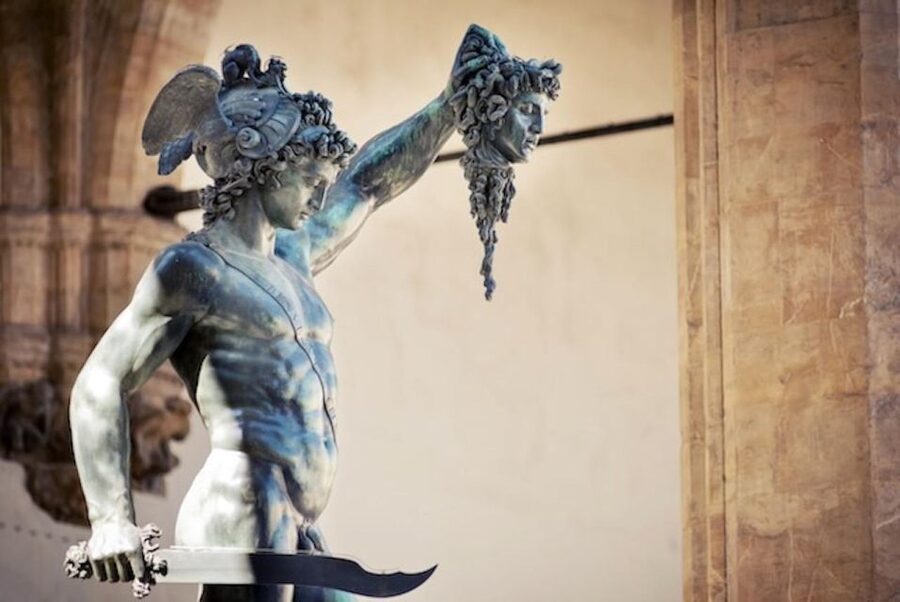
Santa Maria Novella is viewed from outside, but it adds another layer to the story of Florence’s religious and artistic life. The church helps show how a major religious center could also shape the city’s appearance and public identity.
The route then brings you past palaces such as Ruccellai Palace and Strozzi Palace. These are not just grand façades. Their proportions, materials, and restrained design show how Renaissance architecture differed from the defensive look of medieval tower homes.
This is one of the places where the guide’s art history background can make a real difference. Becky, who has an art history background, has been especially noted for explaining medieval, Renaissance, and High Renaissance architecture in a way that clarifies what you are seeing.
You do not need to arrive with an art degree. The guide points out visual changes and explains why they matter. That makes the city easier to read for the rest of your trip.
Same streets, a different century:
- Colosseum: Underground and Ancient Rome Tour
★ 4.7 · 12,691 reviews - Rome: Colosseum with Arena, Roman Forum and Palatine Guided Tour
★ 4.0 · 5,598 reviews - Venice: St. Mark’s Basilica Guided Tour & VR History Intro
★ 3.9 · 4,880 reviews - Colosseum with Arena, Roman Forum and Palatine Hill Guided Tour
★ 4.5 · 3,526 reviews
Via Tornabuoni and Via Maggio: style, shopping, and old Florence
Via Tornabuoni brings you through Florence’s best-known designer shopping street. The polished storefronts offer a sharp contrast with the older lanes and stone buildings elsewhere on the route.
The street is useful for more than shopping. It shows how Florence remains a city where historic architecture and modern luxury share the same narrow center. Even if you have no interest in buying designer goods, the buildings and urban setting are worth noticing.
Via Maggio offers a different mood, with its association with antique shopping and historic architecture. The route uses these streets to show how Florence’s identity changes from one block to the next.
I like this part because it keeps the walk from becoming museum-like. You are not simply studying the past in a sealed setting. You are seeing a living city where old palaces, shops, churches, workshops, and everyday foot traffic occupy the same small area.
Ponte Vecchio and Santa Trinita
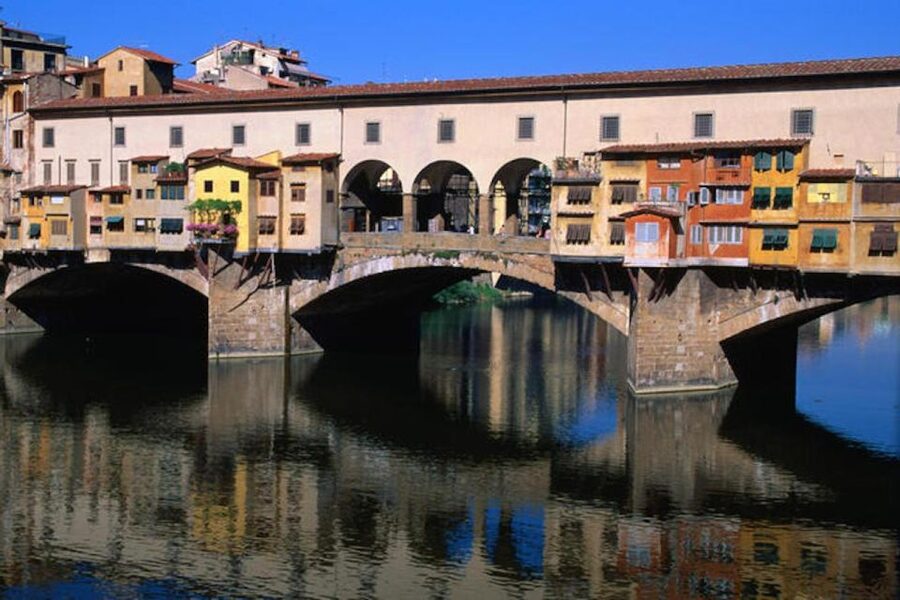
Crossing Santa Trinita and Ponte Vecchio gives the walk a strong visual center. The bridges are not just scenic crossings. They help you understand how the Arno connects Florence’s historic center with the Oltrarno district.
Ponte Vecchio is the more famous of the two, but Santa Trinita adds a quieter architectural moment. The tour includes an interior visit to Santa Trinita, where you can admire magnificent frescoes by Ghirlandaio.
That interior stop is an important part of the route. Much of the tour is viewed from the street, so entering one church gives you time to examine actual artwork rather than only hearing about it from a pavement. The frescoes also help connect the names of Renaissance artists with the spaces they decorated.
The bridges can be busy, and the cobblestones require sensible shoes. You should expect to pause, listen, and keep moving rather than settle into one spot for a long lecture.
Oltrarno, Pitti Palace, and the Medici connection
On the Oltrarno side, the atmosphere changes. The route takes you through cobblestone streets, past artisan workshops, notable churches, Medici mansions, and historic squares.
Pitti Palace is viewed from outside. Its scale helps explain the reach and ambition of the Medici family, whose influence shaped Florence’s politics, art, and architecture for generations. The guide also discusses the Vasari Corridor, the elevated passage associated with the Medici route between important residences and offices.
You should understand that the tour does not include entry to Pitti Palace or the Vasari Corridor. Their presence still makes sense in the larger story, and the exterior gives you useful context if you later visit either attraction separately.
Santa Felicita is another notable stop. It is one of Florence’s oldest churches, and its place in the Medici story adds to the sense that this district was not simply a residential extension of the historic center. It was tied to power, worship, trade, and artistic patronage.
The Oltrarno section is also where the tour feels most connected to working Florence. Artisan workshops and smaller streets offer a contrast with the grander palaces and shopping avenues.
Guides who make the history stick
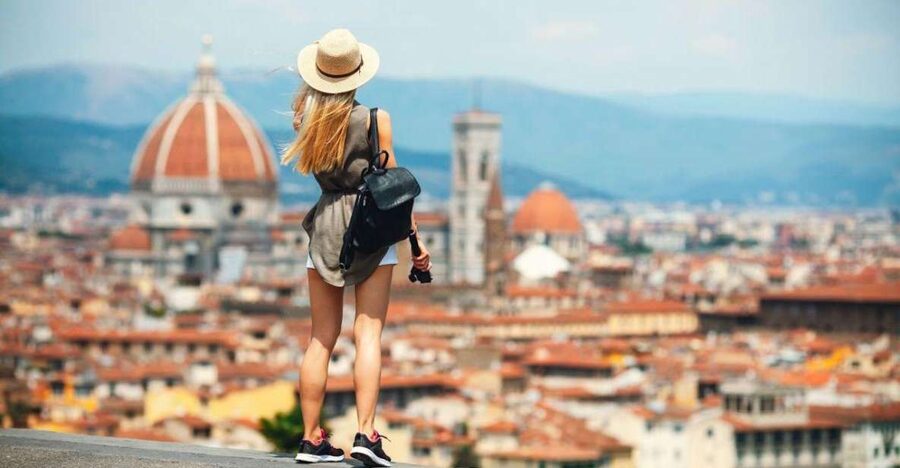
The strongest part of this experience is the guide. Becky has led several tours and is praised for making Florence feel personal, lively, and easy to understand. Her storytelling covers art, architecture, political conflict, and the colorful incidents that give old buildings a human face.
Lisa has also guided the walk with an informative and interactive approach. Andrea has been described as fantastico, and the available guides may vary by date, so you should not assume a particular person when booking.
The tour is in English only. Headsets are included, which matters in a city where traffic, crowds, and hard stone walls can swallow a guide’s voice. You can focus on the building in front of you instead of standing shoulder to shoulder just to hear.
The group size is not specified, so you should not count on a private or very small tour. Still, the strongest feedback points to an intimate feel on some departures, especially compared with much larger groups moving through Florence.
Three hours on foot and what to wear
Three hours is enough time to cover a lot of ground, but it also demands stamina. Florence’s center is compact, yet the route includes cobblestones, bridges, streets, church access, and possible steps.
Wear comfortable clothes and sturdy walking shoes. Sandals and flip-flops are not allowed, which is sensible given the uneven surfaces and the amount of walking.
This is not a good choice for children under eight, people with back problems, people with mobility impairments, wheelchair users, or anyone recovering from recent surgery. The walking format and steps make that restriction practical, not merely formal.
If you tire easily, think carefully before booking. The tour does not appear designed around long seated breaks. Its appeal comes from moving through the city and linking one place to the next.
Does the $41 price make sense?
At $41 per person, the tour offers solid value if you want a guided introduction to Florence rather than a simple list of landmarks. You get three hours with a live English-speaking guide, headsets, a gelato tasting, and an organized route through several centuries of history.
The value is strongest for first-time visitors. Florence can feel confusing because its major sights are close together, yet each belongs to a different period and story. A good guide saves you from seeing only attractive façades and gives you a framework for the rest of your stay.
The price is less compelling if you mainly want interior access. The Duomo complex, Pitti Palace, Vasari Corridor, Santa Maria Novella, and most other listed sights are viewed from outside. You are paying for interpretation, route planning, and local context, not admission tickets.
Free cancellation up to 24 hours before the start and the option to reserve now and pay later add useful flexibility. Check the available starting times before you commit, since the exact schedule is not fixed in the tour details.
The gelato stop is a small but welcome finish
The included Italian gelato tasting gives the tour a relaxed pause. It is not the main reason to book, but it adds flavor to an otherwise information-heavy morning or afternoon.
A gelato stop also fits the subject. Food, streets, churches, family politics, and art all belong to the experience of Florence. The tasting gives you a simple local pleasure while keeping the walk from feeling like a three-hour classroom.
Do not treat it as a meal replacement. It is a tasting, not a full lunch or dinner.
Who should book this Florence walk?
I would recommend this tour to first-time visitors who want a strong overview before choosing which museums and churches to visit in more detail. It suits adults and older children over eight who enjoy stories, architecture, and history but do not want a formal lecture.
It is also useful for anyone who likes to understand a city through its streets. You move from Roman foundations to medieval towers, Renaissance palaces, designer avenues, bridges, churches, and artisan workshops. That range gives you a clear sense of how compact Florence became so influential.
You may want something else if your main goal is the Uffizi, the Accademia, the Duomo interior, or Pitti Palace. Those attractions are part of Florence’s story, but this tour does not include their interiors.
FAQ
How long does the Essential Florence Walking Tour last?
The tour lasts three hours.
What language is the tour offered in?
The live tour guide and included audio support are in English only.
What is included in the price?
The experience includes an expert local guide, headsets, and a tasting of Italian gelato.
Does the tour enter the Duomo?
No. The Duomo, Baptistery, and Campanile are visited from outside.
Which site includes an interior visit?
The tour includes an interior visit to Santa Trinita to see frescoes by Ghirlandaio.
What should I wear?
Wear comfortable clothes and comfortable shoes. Sandals and flip-flops are not allowed.
Is the tour suitable for wheelchair users?
No. The tour is not suitable for wheelchair users, people with mobility impairments, people with back problems, or people with recent surgeries.
Should you book it?
Book this walk if you want Florence explained as one connected story. The mix of Roman beginnings, medieval power, Medici politics, Renaissance art, churches, bridges, palaces, and gelato gives you a useful first look at the city.
The best reason to go is the guiding. Becky, Lisa, and Andrea have each brought strong energy and clear explanations to the route, with Becky especially praised for making architecture and art easier to read. Just remember that this is a walking introduction, not an admission tour. If you can manage the cobblestones and want context more than ticketed interiors, $41 is a fair price for three focused hours in Florence.
Newest history tours we have reviewed in Italy
- Guided Cultural Tour of the Godfather Film in Messina★ 5.0 · 31 reviews
- SU NURAXI BARUMINI Unesco World Heritage Site★ 5.0 · 129 reviews
- Picnic aperitif in the vineyard of an ancient trullo in Martina Franca★ 5.0 · 21 reviews
- Brescia the Unexpected: History, Local Stories & a drink★ 5.0 · 31 reviews
- Bologna historical art walking tour with hidden gems and tastings★ 5.0 · 108 reviews
- Bolognese Cooking Class with Margherita in the Historic Center★ 5.0 · 26 reviews
- Best of Bologna in one day : Food, architecture, art and history★ 5.0 · 27 reviews
- Private or semi-private tour of the historic center of Bologna★ 5.0 · 34 reviews
History Walking Tours, compared.
History and Hauntings of Salem Guided Walking Tour
Read our review →
Freedom Trail History Small Group Walking Tour
Read our review →
Historic Charleston Guided Sightseeing Walking Tour
Read our review →
Tapas Walking Tour with Food, Wine, and History
Read our review →
Savannah History and Haunts Candlelit Ghost Walking Tour
Read our review →
A History of Terror – Belfast City Centre Walking Tour
Read our review →Browse the lists this tour appears in