

Review · VIENNA HISTORY TOURS
Vienna: Ticket to the Museum of Natural History
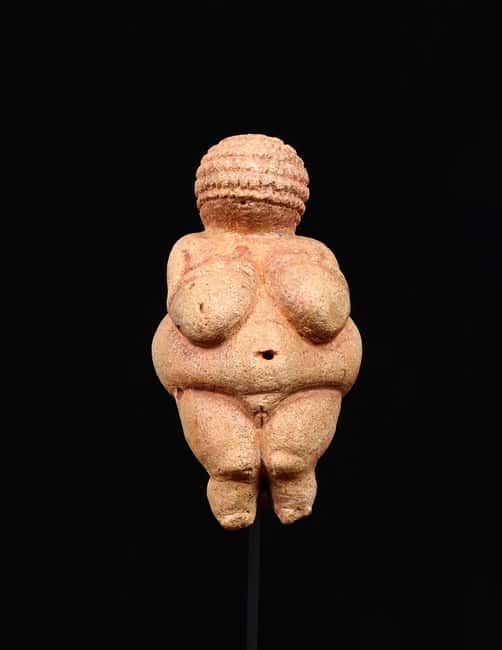
The Venus of Willendorf is the museum’s small but mighty star. At about 29,500 years old, this tiny stone figure gives you a direct link to prehistoric Europe, while the grand building around it feels more like an imperial palace than a science museum. You can spend a full day here moving from meteorites and dinosaur fossils to extinct birds, precious stones, and human origins.
I like the museum’s unusual mix of serious science and theatrical rooms, especially the gemstone bouquet given by Maria Theresa to her husband and the enormous meteorite collection. I also like the chance to see Vienna from the rooftop on a guided visit. The main drawback is focus: one Italian review noted that there are only a few rooms devoted to dinosaurs, so you should not book this expecting a dinosaur-only museum.
Key points to know
- The Venus Cabinet holds two exceptional prehistoric figures: the 29,500-year-old Venus of Willendorf and the 36,000-year-old Venus of Galgenberg.
- The museum occupies a grand Ringstrasse palace: its architecture is part of the experience, not just a backdrop.
- The lower floor covers minerals, fossils, meteorites, dinosaurs, archaeology, and human origins.
- The upper floor presents the animal world: from marine organisms to rare and extinct mammals, birds, amphibians, and reptiles.
- A $21 ticket gives you one full day: that is strong value if you take time with both floors.
- The rooftop visit is a separate highlight to investigate: it offers views over Vienna’s center and the Ringstrasse buildings.
Why the Ringstrasse building matters
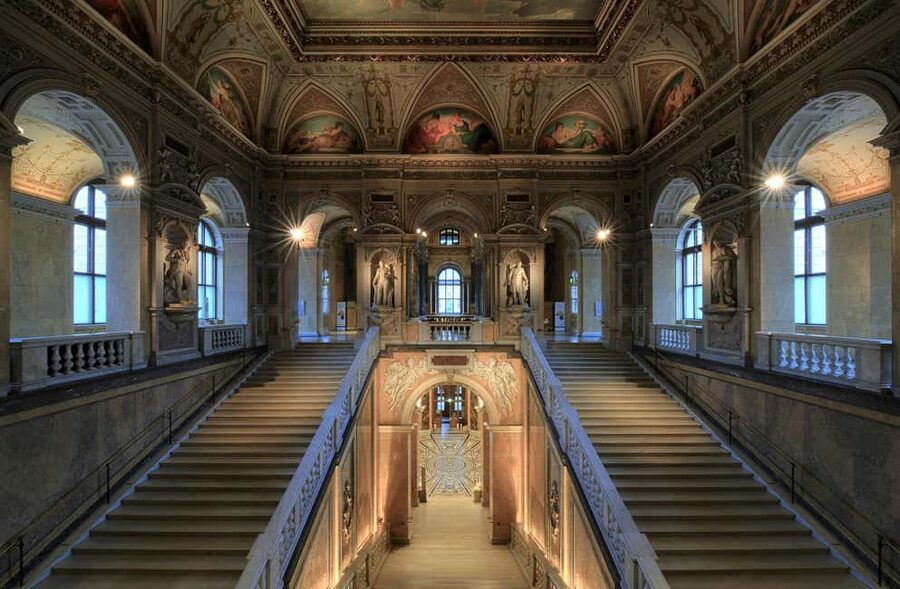
Start outside. The Museum of Natural History is one of the grandest buildings along Vienna’s Ringstrasse, and the exterior tells you what the imperial city thought a museum should be. Architects Gottfried Semper and Carl von Hasenauer designed it as a Palace of Natural Science and Evolution.
The museum opened on August 10, 1889, under Emperor Franz Joseph I. That date matters because this is not a modern science center placed inside a neutral box. The halls, scale, and historic setting reflect a period when museums were meant to display the world in an orderly, impressive way.
I suggest taking a few minutes to look closely at the exterior before going in. You will understand the museum better once you see the contrast between its formal imperial shell and the huge span of subjects inside. The building alone makes the admission feel different from a simple visit to a collection of cases.
Inside, 39 exhibition halls spread across two floors. The arrangement gives you a clear route, but the collection is so broad that you should not expect to absorb everything in one pass. A full day is available, yet you will still need to choose where to slow down.
More Museum and Gallery History Tours in the world:
- New York City: American Museum of Natural History Ticket
★ 4.5 · 15,447 reviews - Paris: Louvre Museum Entry with History of Mona Lisa
★ 3.9 · 2,823 reviews - Venice’s Best: Basilica, Doge’s Palace, Gondola & History Gallery
★ 4.5 · 2,478 reviews
The lower floor, from meteorites to prehistoric gold
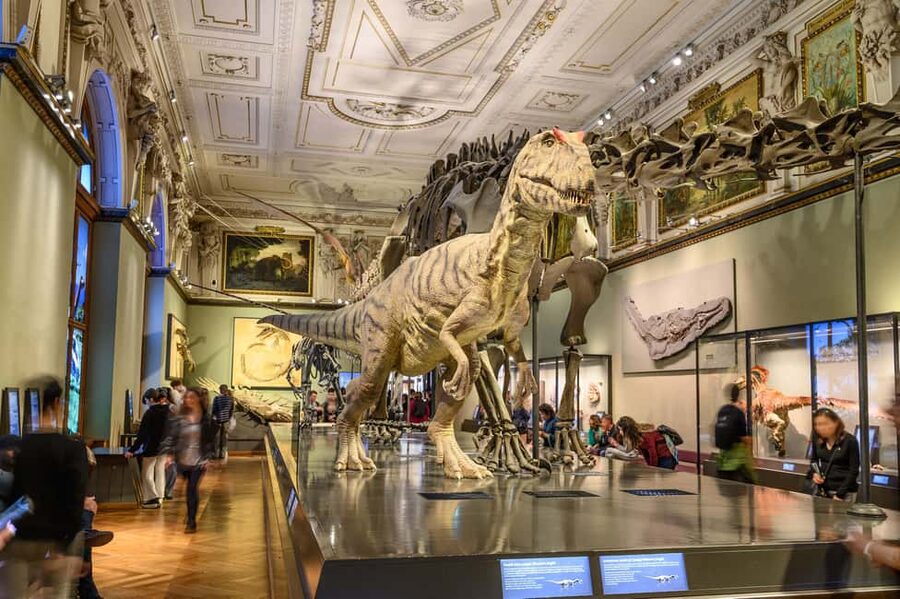
The lower floor is the strongest section if you like earth science, archaeology, and the story of early humanity. You move among precious stones, minerals, fossils, giant dinosaurs, meteorites, and changing special exhibitions.
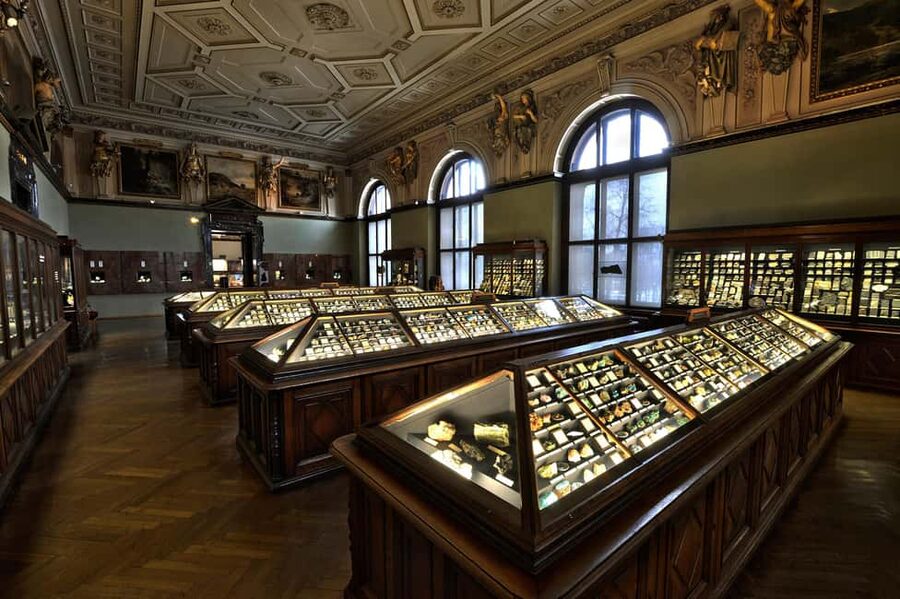
The meteorite collection is a major reason to make time here. It is described as the largest and oldest collection of meteorites in the world, giving you a chance to see material that came from beyond Earth rather than simply reading about it in a display panel.
The mineral and gemstone rooms add a different mood. Look for the gemstone bouquet, a remarkable object presented by Maria Theresa to her husband, Emperor Franz I Stephan of Lorraine. It is a reminder that natural objects were once also court treasures, gifts, and symbols of status.
You will also find rare fossils and dinosaur material on this floor. Keep your expectations in check, though. The museum has dinosaurs, but it is not organized around a long dinosaur trail. One Italian-language comment singled out the small number of dinosaur rooms. If your main goal is a large dinosaur collection, this may feel limited. If you want dinosaurs as one part of a much wider natural history visit, the balance works well.
The lower floor also presents an exhibition on the origin and development of mankind. This connects the fossil and archaeological material to the human story, rather than leaving you with separate rooms of objects that never relate to one another.
The Venus Cabinet and two ancient human figures
The Venus Cabinet deserves unhurried time. The Venus of Willendorf is world famous, but its size may surprise you. At about 29,500 years old, it is a small figure with enormous historical importance. Its survival gives you a rare physical link to the people who made art in prehistoric Europe.
The cabinet also contains the Venus of Galgenberg, dated to about 36,000 years ago. It is described as the oldest known human figure made of stone. Seeing both figures together gives the room extra force. You are not looking at one isolated celebrity object. You are looking at two very early examples of human representation, separated by thousands of years.
The displays are especially valuable if you are interested in anthropology, but you do not need specialist knowledge to appreciate them. Take time to consider what it means for a small carved figure to remain recognizable across such a long span of time. The museum lets you ask that question without turning the visit into a lecture.
This is also one of the places where the museum’s age works in its favor. The objects sit within a historic setting that feels suitably weighty. The room is not just a stop on a checklist. It is one of the main reasons to visit.
The Gold Cabinet and the Hallstatt finds

The Gold Cabinet displays prehistoric gold and silver treasures, including what is described as the second oldest gold find in the world. For you, the value is not only the shine. These objects show how early societies handled rare materials, made decoration, and marked importance.
A separate room focuses on finds from the prehistoric mine and burial ground at Hallstatt. The site is linked to 7,000 years of uninterrupted salt mining, and the objects reveal how much archaeological evidence can survive around a major working site and burial ground.
I find this section useful because it broadens the usual idea of natural history. The museum is not only about animals, rocks, and fossils. It also shows the human use of the natural world, especially salt, metal, stone, and other materials.
The Hallstatt room should appeal to you if you plan to visit Austria for its archaeology as well as its art and music. It provides a direct connection between natural resources and human settlement. You can see how geology, work, trade, ritual, and burial become part of one story.
More Entry Tickets in the world:
- Edinburgh: Edinburgh Castle Guided History Tour with Tickets
★ 4.8 · 9,933 reviews - Taormina: Ancient Theater Skip-the-Line Ticket & Audio Guide
★ 4.5 · 2,412 reviews - Historic Milan Tour with Skip-the-Line Last Supper Ticket
★ 4.5 · 1,976 reviews - American Museum of Natural History Admission Ticket
★ 4.0 · 1,931 reviews
The upper floor, where the animal world takes over
The upper floor shifts from ancient objects and earth materials to the range of animal life. The displays move from simple marine organisms to more developed mammals, giving you a broad view of biological variety.
You will find mounted specimens of amphibians, reptiles, mammals, and birds. Some are extremely rare or extinct, and many are historical treasures. That age is part of the appeal, but it also affects how you experience the exhibits. This is a historic natural history collection, not a hands-on modern science center.
The upper floor works best if you enjoy comparing forms. You can move from small marine life to larger animals and consider how bodies adapt to different environments. The museum gives you the basic visual scale of the animal world, from simple organisms to highly developed mammals.
Rare and extinct specimens add a note of loss. You are not simply seeing a catalog of living creatures. Some of the animals represented here no longer exist, which gives the displays a quiet connection to conservation and environmental change.
The museum’s scientists work on current questions in human, earth, and life sciences, including environmental and climate concerns. Their research happens largely behind the scenes, but the institution says that new knowledge continues to shape the public displays. That link matters: the museum is not frozen in 1889, even though much of its setting and collection has a historic feel.
How much time should you allow?
The ticket is valid for one day, and that is useful because the museum covers 39 halls on two floors. I would not rush through it in an hour. You can make the visit worthwhile with a shorter stop, but the $21 price makes more sense when you give yourself time for both floors.
I would plan your visit around three main blocks:
- Begin with the lower floor, especially the meteorites, gemstones, Venus Cabinet, Gold Cabinet, and Hallstatt material.
- Move upstairs for the animal displays and rare mounted specimens.
- Finish by checking whether a guided rooftop visit is available and fits your schedule.
You do not need to treat every case as an obligation. Choose the subjects that matter most to you, then allow extra time for the architecture and the best-known objects. The museum rewards a slower pace, but it can also overwhelm you if you try to read every label.
The one-day validity gives you flexibility, though the supplied details do not specify entry times or whether leaving and returning is allowed. Check the available starting information when you book if your schedule is tight.
The rooftop view over Vienna
One of the museum’s special opportunities is a guided tour to the rooftop. From there, you can look over central Vienna and the grand buildings along the Ringstrasse.
This is a fine way to connect the interior displays with the city outside. Inside, you are studying specimens, minerals, and traces of early humanity. Upstairs, you see the urban setting that made the museum part of Vienna’s imperial city plan.
The rooftop tour is not described as part of the basic admission ticket, so you should treat it as a possible add-on rather than a guaranteed inclusion. The available information also does not give the tour time, cost, group size, or guide name. Ask about those details before relying on it as the main reason for your visit.
If the rooftop visit is available during your stay, it could be especially worthwhile after you have seen the Ringstrasse from street level. The view gives you a clear sense of how the museum fits among Vienna’s formal public buildings.
Is the $21 ticket good value?
At $21 per person, the ticket is reasonably priced for a full day in a museum with 30 million objects in its wider collection and 39 public exhibition halls. You are paying for access to a major institution, not a small gallery that can be finished in half an hour.
The value depends on your interests. You are likely to feel the price is well spent if you enjoy:
- Prehistoric art and archaeology
- Meteorites, minerals, fossils, and gemstones
- Rare or extinct animals
- The history of science and collecting
- Historic Vienna architecture
- A museum visit that can fill most of a day
The value is less clear if you want only dinosaurs. The museum includes dinosaur material, but the available feedback specifically points to few dinosaur rooms. For that purpose, you may want to compare it with a museum designed around paleontology before booking.
A strong 4.8 out of 5 rating from 426 reviews suggests that the overall experience is working well for most people who choose it. Still, the useful lesson is to match the museum to your own priorities. Its strength is range, setting, and the quality of individual objects, not one narrow subject.
Accessibility and booking flexibility
The museum is wheelchair accessible, which makes the broad two-floor visit easier to consider for more people. The supplied details do not explain which routes, lifts, or rooftop arrangements are accessible, so you should confirm those points directly if they matter for your visit.
You can cancel up to 24 hours in advance for a full refund. You can also reserve now and pay later, which helps if you are planning several days in Vienna and do not yet want to lock in every detail.
The entry is valid for one day. No transport, guide, meal, or other extra is included in the stated ticket, so plan the visit as museum admission rather than a guided city tour.
Who should book this museum ticket?
I would recommend it to you if you want one Vienna stop that brings together art, archaeology, geology, anthropology, and zoology. Families with different interests may also find the range useful, since one person can focus on animals while another spends time with prehistoric figures or minerals.
It also suits you if grand public buildings are part of your Vienna plans. The exterior and interior architecture add real weight to the visit, and the rooftop possibility gives you another reason to look beyond the display cases.
I would hesitate if your only goal is dinosaurs. The collection includes them, but the dinosaur area is limited enough that the visit may not meet that specific expectation. I would also think twice if you dislike large collections with many subjects competing for attention.
For most other museum fans, the $21 ticket offers a full and varied day. Book it if the Venus of Willendorf, meteorites, Hallstatt archaeology, rare animals, and Ringstrasse architecture all sound appealing. Skip it only if you want a tightly focused dinosaur attraction or a short, highly guided experience.
FAQ
Where is the Museum of Natural History located?
It is in Vienna, Austria, on the Ringstrasse. The museum is one of the major historic buildings in that area.
How much does admission cost?
The listed price is $21 per person.
How long is the ticket valid?
The ticket is valid for one day.
What is included with the ticket?
The ticket includes admission to the Museum of Natural History in Vienna.
Can I see the Venus of Willendorf?
Yes. The Venus of Willendorf is displayed in the Venus Cabinet. It is dated to about 29,500 years ago.
Does the museum have dinosaur exhibits?
Yes. The lower floor includes giant dinosaur material and fossils. The available information notes that the dinosaur section has only a few rooms.
Is the museum wheelchair accessible?
Yes, the activity information states that the museum is wheelchair accessible.
Can I cancel my booking?
Yes. You can cancel up to 24 hours in advance for a full refund.
Newest history tours we have reviewed in the world
- Bilbao Historical Tour in small group★ 4.7 · 52 reviews
- Bologna: Street Food Tour in the Historic Center★ 4.8 · 125 reviews
- CEBU: Cebu City Heritage and Uphill Guided Tour★ 4.2 · 31 reviews
- Bishkek : City Tour (History, Architects, Statues & Culture)★ 4.9 · 54 reviews
- Blenheim: Omaka Aviation Heritage Centre Admission Ticket★ 4.9 · 31 reviews
- Berlin: Nazi History Walking Tour★ 4.8 · 33 reviews
- Best of Baku: 4-Hour City Tour Historic and Modern Landmarks★ 4.7 · 63 reviews
- Belfast: Best of Belfast History, Culture & Art Walking Tour★ 4.9 · 158 reviews
Museum & Gallery History Tours, compared.
Louvre Museum Entry with History of Mona Lisa
Read our review →
Venice’s Best: Basilica, Doge’s Palace, Gondola & History Gallery
Read our review →
American Museum of Natural History Admission Ticket
Read our review →
Guided African American History Tour with Reserved Museum Entry
Read our review →
POLIN Museum of the History of Polish Jews Ticket
Read our review →
Bell Tower & St Mark’s Square History Gallery Ticket
Read our review →
Field Museum of Natural History Ticket or VIP Tour
Read our review →Browse the lists this tour appears in