
Review · HISTORY TOURS
Yerevan: Garni, Geghard, Symphony of Stones & Lavash Baking
Garni and Geghard give you a quick, rewarding look at Armenia’s sacred buildings, pagan past, and dramatic mountain country. The best part is the contrast: Geghard Monastery is carved into rock, while nearby Garni Temple is a neat Greco-Roman structure from the first century.
I like the Mount Ararat viewpoint at Charents Arch and the chance to taste lavash soon after seeing it baked. I also like the price: at $23 per person, transport, a guide, and the bread demonstration make this a strong budget outing. The catch is that the $23 price does not cover entry to Garni or the Symphony of Stones, and the bilingual group format or a long restaurant stop can affect the pace.
Key points to know before booking
- Mount Ararat view: Charents Arch is the opening stop, though clouds can hide the mountain.
- Two very different monuments: Geghard offers medieval religious architecture, while Garni represents pre-Christian Armenia.
- Symphony of the Stones: The basalt columns are striking, but the 300 AMD entry fee is extra.
- Lavash finale: You watch Armenian bread being made and usually get to taste it, but this is not always a hands-on class.
- Small to medium group: The maximum is 20 people, with transport by vehicle from central Yerevan.
- Good budget value: The tour lasts about six hours and includes transport and guiding for $23, before entrance fees.
Why this six-hour trip works so well from Yerevan
This is the classic first outing from Yerevan. In half a day, you reach a royal-era temple, a UNESCO-listed monastery, a basalt canyon, and a working food tradition. You are not spending hours crossing Armenia, so the day feels manageable even if you are in the capital for only a short visit.
The tour begins at 9:00 am near the Komitas Yerevan State Conservatory on Sayat-Nova Avenue. It returns to the same meeting point. That fixed start and finish suit you if you are staying in central Yerevan and want a simple day without arranging a private car.
The advertised group limit is 20 people. That is small enough for a guide to speak to the whole group, but it can still feel crowded at busy sights. Transport has generally been described as a comfortable minibus, though vehicle comfort has not been perfect on every departure. Air conditioning and group organization have drawn some criticism, so I would keep expectations practical rather than assuming a polished private tour.
Guides vary. Yegor, Hasmik, Igor, Anna, Mery, Ani, Taku, and others have led departures. The strongest part of the experience is usually the guide’s explanation of Armenian culture, symbols, and religion. Yegor, in particular, has been praised for using Armenian music during the drives and for making the long story of Armenia easier to follow.
Other history walks and heritage tours readers book in the world:
- New York City: American Museum of Natural History Ticket
★ 4.5 · 15,447 reviews - History and Hauntings of Salem Guided Walking Tour
★ 5.0 · 14,564 reviews - Colosseum: Underground and Ancient Rome Tour
★ 4.7 · 12,691 reviews
Charents Arch and the first view of Mount Ararat
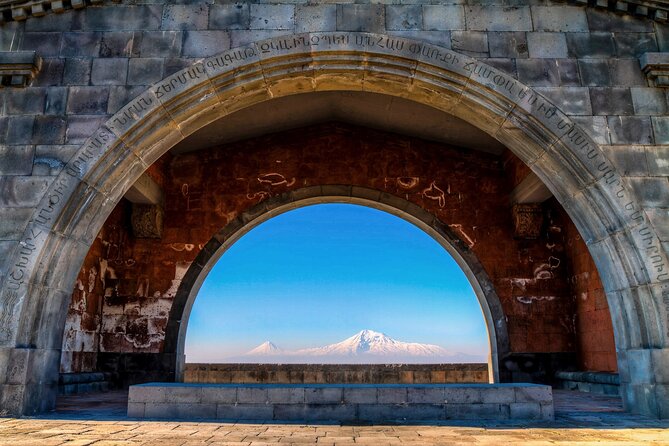
The first stop is Charents Arch, also called the Mount Ararat Temple. It sits near Voghjaberd and was completed in 1957 by architect Rafael Israelyan. The arch frames a view toward Mount Ararat, Armenia’s most powerful national symbol.
A line from poet Yeghishe Charents is carved into the structure. The words express love for Masis, the Armenian name commonly used for Ararat. You do not need a long visit here to understand the point. The stop connects the physical mountain with poetry, national memory, and Armenian identity.
The view is the main reason to stop. On a clear day, Ararat gives the outing its postcard moment. On hazy or cloudy days, you may see only fields and distant ridges. One guide adjusted the route because of snow, and another departure could not see Ararat because of unclear skies. This is a weather-dependent stop, not a guaranteed mountain photograph.
You have about an hour here according to the planned schedule, though the exact time can shift. Bring a phone or camera, but do not let the viewpoint overshadow the rest of the day. The major monuments ahead offer more to examine.
Geghard Monastery, where stone becomes architecture
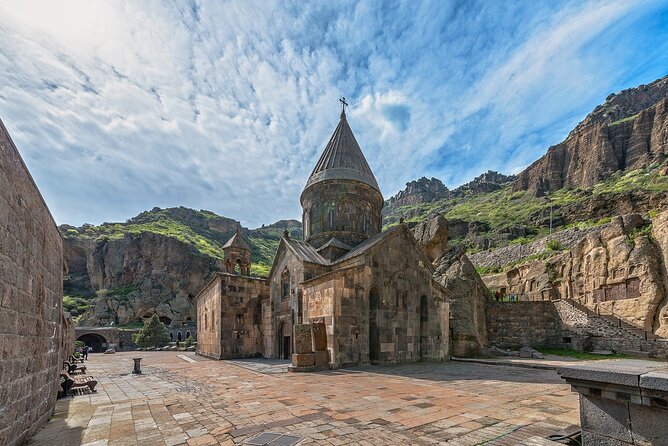
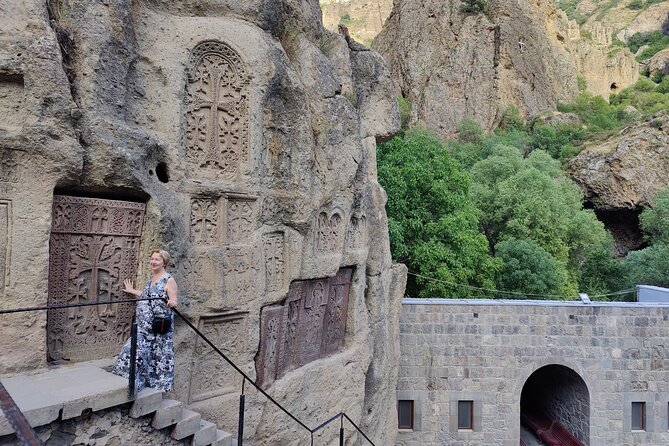
Geghard is the spiritual center of the outing. The medieval monastery is partly carved into the surrounding mountain, with cliffs pressing close around the complex. The setting feels enclosed and quiet, quite different from the open viewpoint at Charents Arch.
The name Geghardavank means Monastery of the Spear. Armenian tradition connects the monastery with the spear said to have wounded Jesus during the Crucifixion. The relic is now displayed in the treasury at Echmiadzin, but the story helps explain why this place has such importance in Armenian Christianity.
Give yourself time to look beyond the main facade. The rock-cut chambers are the special feature, and the dark stone interiors reward slow attention. Visitors have also encountered spiritual singing inside the monastery, which can add a memorable sound to the visit, though the tour does not promise a musical performance.
Geghard is protected as a UNESCO World Heritage Site. The label matters less than the actual experience: this is a functioning place of faith and a remarkable example of architecture shaped by the mountain itself. Your guide will usually explain the religious symbols and historical background before giving you time to walk around.
Wear shoes with a decent grip. The ground and stone surfaces can be uneven, especially in poor weather. The tour is generally suitable for most people, but anyone who dislikes steps or rough surfaces should move at an easy pace.
The Symphony of Stones and Azat Canyon
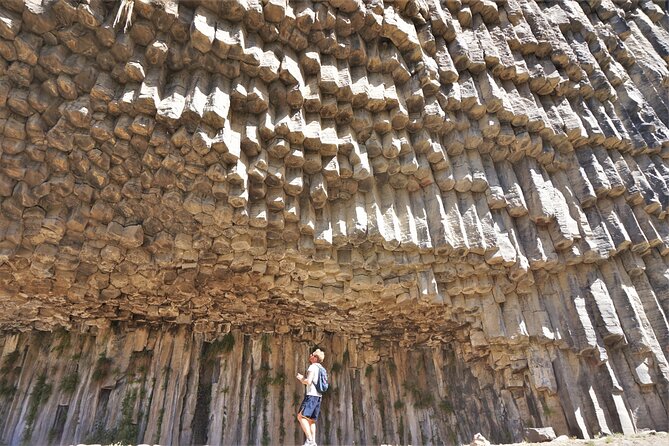
The Symphony of Stones is a natural formation of tall basalt columns in Azat Canyon. The stones are cut into regular hexagonal shapes and line up like the pipes of a giant organ. That resemblance gives the site its musical name.
This is one of the most visually unusual stops. The columns look almost built rather than formed by nature, which makes the short walk and canyon setting worthwhile. You get a change of mood after Geghard: from enclosed sacred rooms to open rock and air.
The planned stop lasts about an hour. The attraction has a separate entry fee of 300 AMD, not included in the tour price. Keep a little local currency available, since the advertised $23 does not cover this charge.
The main weakness is commentary. Some departures have offered only a brief explanation here, so you may get more from looking carefully than from a long talk. If your guide is strong, you can expect useful context about the basalt and the canyon. If the group is split between languages, the explanation may be shorter and the movement between stops less tidy.
Weather matters at this site. Snow, ice, rain, or poor visibility can change the route or make the walk less comfortable. The operator requires good weather and offers another date or a full refund if the tour is canceled for that reason.
Same streets, a different century:
- Lisbon: History, Stories and Lifestyle Walking Tour
★ 4.8 · 10,902 reviews - London Small Group Tour of Historical Pubs
★ 5.0 · 10,422 reviews - Prague: Oldtown, Medieval Underground & Dungeon History Tour
★ 4.3 · 10,277 reviews - Charleston’s Old South Carriage Historic Horse & Carriage Tour
★ 5.0 · 10,023 reviews
Garni Temple and pre-Christian Armenia
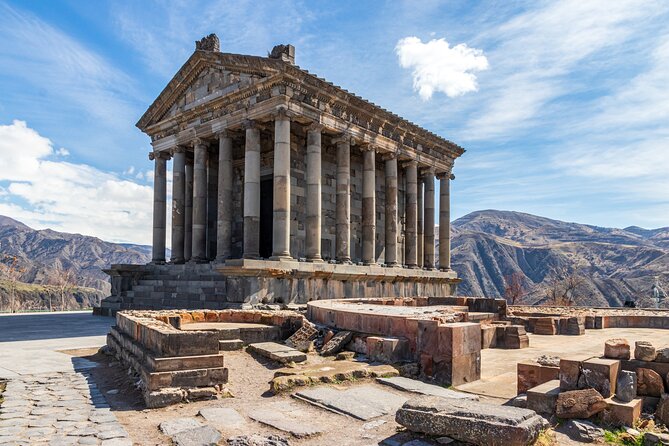
Garni is the historical counterpoint to Geghard. The temple was built in the first century and dedicated to Mithra, the sun god. It is the only preserved pagan temple in Armenia and in the former Soviet Union, giving it a special place in the country’s story.
The building looks unmistakably classical, with columns and a clean geometric design. Its survival is even more striking because an earthquake destroyed it in 1679. Restoration took place from 1968 to 1975, over about eight years. The result is not an untouched ancient ruin, but it still gives you a clear sense of pre-Christian Armenia.
The temple entry fee is 1,500 AMD and is paid separately. That cost is modest, but add it to the 300 AMD Symphony of Stones fee when comparing this trip with a tour that includes all admissions.
Your guide’s explanation makes a real difference at Garni. The temple is easy to photograph, but its importance can be missed if you only see it as a small classical building. Ask about Mithra, the earthquake, and the change from pagan worship to Christianity. Guides such as Hasmik, Igor, Mery, and Yegor have been praised for making these connections clear.
The schedule allows about an hour. That is enough for the main temple and nearby views, but not for a slow archaeological study. If you want every inscription and stone examined in detail, a private tour with more time would suit you better.
Lavash baking, the most human part of the day
The final stop is a lavash baking demonstration in Garni. Lavash is Armenia’s famous thin flatbread, and watching it made adds a practical, everyday element to a day otherwise filled with monuments.
The bread is baked in a traditional underground oven called a tonir. The exact format can vary, but the advertised activity is a master class rather than a full cooking workshop. In practice, you should expect to watch the bread being prepared and baked, hear some explanation, and taste the result. It may not involve you shaping and baking your own loaf.
This distinction matters. Some visitors found the short demonstration fascinating, while others expected more hands-on participation and felt disappointed when the actual baking portion lasted only a few minutes. If you mainly want to understand how lavash is made and sample it fresh, the stop should satisfy you. If you want a structured cooking lesson, ask for clarification before booking.
The food stop can be pleasant, with a family-run setting, a courtyard, and sometimes fruit from the surrounding trees. Lunch is not included in the tour price. Some departures have included a restaurant stop lasting around an hour and 45 minutes, while others found the food acceptable but overpriced. You should not assume that lunch is part of the published six-hour sightseeing schedule or that the restaurant will suit your budget.
If you prefer to keep moving, ask the guide how much time will be spent eating before you order. One useful point from the experience is that the lavash demonstration itself may be the better value than a long restaurant meal.
Guides, languages, and the pace of the day
The guide is the key variable here. The best departures are led by people who can explain Armenian history without turning every stop into a lecture. Yegor has been singled out for humor, music, patience, and clear explanations. Hasmik has been praised for warm storytelling, while Igor is known for strong knowledge of Armenian culture and history.
The tour may combine English and Russian or Armenian-speaking groups. That can work when the guide keeps everyone together, but it can also stretch the timing. One departure had confusion at stops because the group was not always gathered before explanations began. If you need every detail in English, confirm the language arrangement when booking.
Most departures take about six hours. The plan looks full, but the sites are close enough to Yerevan for the day to feel efficient. The main risk is not too much driving. It is time lost to meals, late departures, weather, or translation.
Drivers have often been praised for handling difficult roads and winter conditions, but one complaint described unsafe driving. Conditions and individual drivers vary. If the vehicle feels too warm, cold, or uncomfortable, speak up early rather than waiting until the next stop.
Is $23 a good value?
Yes, for most people. The price covers transport, guide service, and the lavash activity. Even after adding 1,800 AMD for the two listed admissions, you are paying a low price for a full half-day outside Yerevan.
The value comes from variety. You get a mountain viewpoint, a medieval monastery, a natural formation, an ancient temple, and a food tradition. A private car would give you more control, but it would cost much more. This group tour is a practical way to cover the area if you are traveling alone or do not want to manage local transport.
The low price also explains some limits. You may share the vehicle with up to 19 other people. You may need patience during a bilingual explanation. Restaurant timing may not match your ideal schedule. The lavash activity is a demonstration, not necessarily a cooking class.
Free cancellation is available until 24 hours before the start time. The operator may cancel for poor weather or if the minimum number of participants is not reached, offering another date or a full refund.
Who should book this Garni and Geghard tour?
I would choose this tour if you want a well-priced introduction to Armenia outside Yerevan and prefer having transport and explanations arranged for you. It is especially useful for solo visitors, first-time visitors, and anyone who wants both culture and scenery without giving up a whole day.
It suits you if you enjoy moving between several short stops. You will get more from it if you listen to the guide, ask questions, and accept that the schedule is shared with a group.
I would hesitate if you want a quiet private outing, a guaranteed view of Mount Ararat, a long archaeological visit, or a hands-on bread class. In that case, a private vehicle or a more specialized food experience would give you better control.
For the price, I think the combination is hard to beat. Book it with realistic expectations, carry money for the two entrance fees, allow for a flexible meal stop, and treat the lavash session as a cultural demonstration. Then you get a compact, memorable look at Armenia’s monuments, scenery, and daily traditions.
FAQ
How long does the Garni and Geghard tour last?
The tour lasts approximately six hours. It starts at 9:00 am and ends back at the Komitas Yerevan State Conservatory meeting point.
What is included in the $23 price?
The price includes guide service, transport, and the lavash baking master class or demonstration. Entrance to Garni and the Symphony of Stones is extra.
How much are the entrance fees?
Garni costs 1,500 AMD, and the Symphony of Stones costs 300 AMD. These fees are not included in the tour price.
Will I see Mount Ararat?
Charents Arch offers a viewpoint toward Mount Ararat, but visibility depends on weather and sky conditions. Clouds or haze may block the mountain.
Is the lavash activity hands-on?
The advertised activity is a lavash baking master class. You should expect to watch the bread being baked and taste it, but hands-on participation is not guaranteed.
What happens if bad weather cancels the tour?
If poor weather leads to cancellation, you will be offered another date or a full refund. The experience requires a minimum number of participants as well, and the same options apply if that minimum is not reached.
Newest history tours we have reviewed in the world
- Bilbao Historical Tour in small group★ 4.7 · 52 reviews
- Bologna: Street Food Tour in the Historic Center★ 4.8 · 125 reviews
- CEBU: Cebu City Heritage and Uphill Guided Tour★ 4.2 · 31 reviews
- Bishkek : City Tour (History, Architects, Statues & Culture)★ 4.9 · 54 reviews
- Blenheim: Omaka Aviation Heritage Centre Admission Ticket★ 4.9 · 31 reviews
- Berlin: Nazi History Walking Tour★ 4.8 · 33 reviews
- Best of Baku: 4-Hour City Tour Historic and Modern Landmarks★ 4.7 · 63 reviews
- Belfast: Best of Belfast History, Culture & Art Walking Tour★ 4.9 · 158 reviews