Review · DUBROVNIK HISTORY TOURS
Dubrovnik Old Town History Walking Tour
Dubrovnik’s Old Town is easy to admire and surprisingly easy to misunderstand. This 90-minute walk gives you the story behind the polished stone, from the medieval water system at Large Onofrio’s Fountain to the trade routes, religious life, wartime damage, and modern recovery that shaped the city.
I like two things right away: the route covers a lot without charging separate entry fees, and the local guides add personal details rather than simply reciting dates. Guides such as Ivana, Jelena, Sara, Joseph, and Ermina have been praised for their humor, family stories, and clear explanations. The main consideration is pace. You see many major sights, but you do not enter most of them, and a group of up to 30 people can make close listening harder.
Key points to know before booking
- The route begins and ends at Large Onofrio’s Fountain, next to the Hard Rock Cafe and the red umbrella meeting point.
- You cover the main Old Town landmarks, including Stradun, the Franciscan Monastery, Rector’s Palace, the Cathedral, the Old Port, and Luža Square.
- The tour connects grand sights with everyday life, including the market at Gundulić Square, local traditions, religion, food, and family stories.
- Recent history is part of the walk, with attention to the end of the Ragusa Republic, Yugoslavia, and the Homeland War of the 1990s.
- The 90-minute length works well on your first day, giving you a map in your head before you explore alone.
- The group can reach 30 people, so ask questions promptly and stay close to the guide.
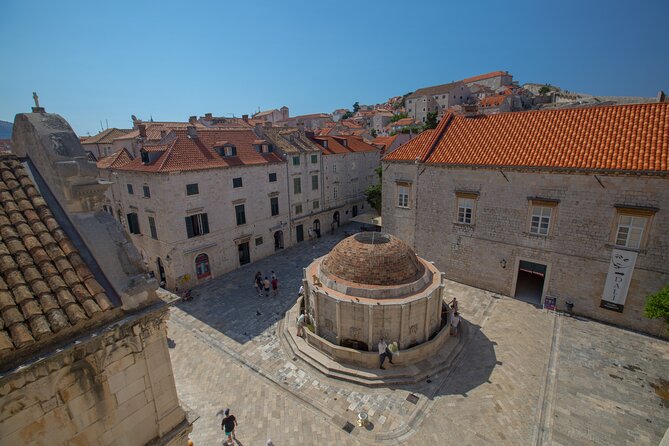
Starting beneath Dubrovnik’s aqueduct
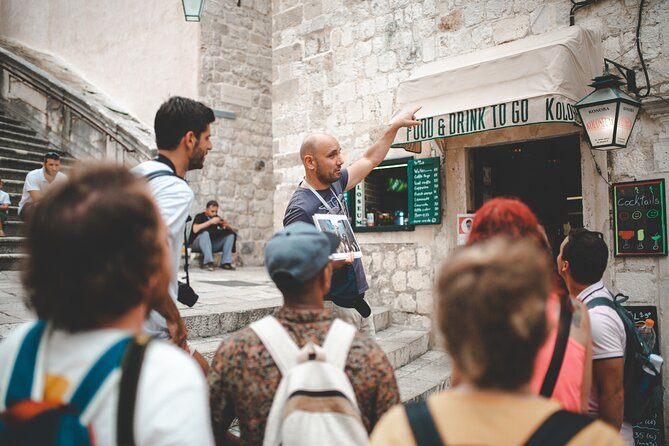
Meet at Large Onofrio’s Fountain, on Poljana Paska Miličevića, beside the Hard Rock Cafe. Look for the red umbrella. The guide introduces the group, then sets off into the Old Town.
This is more than a convenient meeting point. The fountain helps explain why Dubrovnik became such a successful maritime city-state. Its water arrived through an innovative aqueduct system, a major achievement for a medieval trading center. Your guide uses the fountain to sketch the rise of Ragusa, the old name for the Dubrovnik republic, before the walking begins in earnest.
I like this opening because it gives you a useful frame. Dubrovnik is not simply a pretty walled town. It was a small state that relied on diplomacy, shipping, trade, and careful planning to survive between larger powers. The fountain is a practical object, but it also introduces the city’s ability to solve difficult problems.
The first section takes about 10 minutes, including the initial orientation. You will want to arrive a few minutes early. The meeting point is central, but the Old Town can be crowded, and finding the guide while a departure is forming may take a moment.
More History Walking Tours in Croatia
- Dubrovnik: Ancient City Walls & Wars Walking Tour
★ 5.0 · 1,270 reviews - Zagreb: City & History Walking Tour & WW2 Tunnels
★ 4.9 · 1,202 reviews - Walking Tour of Split with a ‘Magister’ of History
★ 5.0 · 1,122 reviews
From the Church of Holy Savior to the Franciscan Monastery
The walk heads down the main street past the small votive Church of Holy Savior. Here the guide explains how strongly religion shaped public life and the appearance of Dubrovnik. Churches were places of worship, but they also reflected the city’s values, fears, ceremonies, and social structure.
The Franciscan Church and Monastery comes next. This large complex includes a church, monastery, library, and pharmacy. The pharmacy dates to 1317 and is described as the third-oldest functioning pharmacy in the world. The library contains more than 20,000 books, including 1,200 valuable old manuscripts.
You should treat this stop as an exterior introduction rather than a museum visit. The tour includes no admission tickets, and the schedule allows about 10 minutes here. That is enough to understand why the complex matters, but not enough for a full visit to every interior space.
The guide also brings in local customs and traditions that have lasted for centuries. This is one of the strongest features of the walk. Facts about buildings are useful, but small stories about how people worshipped, worked, and marked important days help the Old Town feel like a lived-in place rather than a collection of stone facades.
Walking the full length of Stradun
Stradun, also called Placa, is Dubrovnik’s main pedestrian street. It cuts across the Old Town from west to east and divides the city’s northern and southern sections. It is the place for public celebrations, religious processions, business, and casual strolling.
The route spends about 10 minutes here, using the broad street to explain the city’s layout. Look around as you walk. Side streets climb away from Stradun on one side and lead toward the water on the other. This is a good moment to notice how the city’s plan balances a grand central avenue with narrow residential lanes.
The history then moves from the old republic toward more recent events. You hear about the fall of the Republic of Ragusa in 1808, the later period within Yugoslavia, and the damage and hardship of the Homeland War in the 1990s.
I especially value this part because it keeps the tour from becoming a medieval-only portrait. Dubrovnik’s beauty can make it easy to forget that the city suffered serious shelling and disruption in living memory. The guides are also praised for handling the war period with respect, while explaining how the city rebuilt.
Stradun can be busy, particularly during the main season. Keep one ear on the guide and avoid drifting behind the group while looking up at the buildings. The smooth main street is easier underfoot than many side lanes, but crowds can slow the pace.
Narrow lanes, different faiths, and Gundulić Square

The group turns off Stradun toward the port, using narrower streets inside the Old Town. The change is useful. Stradun shows Dubrovnik’s public face, while the inner lanes give you a better sense of its compact daily life.
At the Church of the Holy Annunciation, the guide explains how Orthodox Christian, Jewish, and Muslim communities influenced the city. This broadens the story beyond the dominant Catholic buildings. Dubrovnik’s position as a trading republic brought contact with many cultures, and the tour points out how those communities fit into the city’s past.
The walk continues to Gundulić Square and its green market. Here you can look at local produce while hearing about food, customs, and stories tied to everyday life. This is a small but welcome shift from palaces and churches. It gives you something to watch as well as something to hear.
A guide who enjoys personal anecdotes can make this section particularly memorable. The guides associated with the experience include local residents such as Ermina, whose family connection to the Old Town adds a human scale to the steep lanes and old houses. You should not assume you will have a particular guide, but the tour’s strongest accounts consistently point to local voices and personal storytelling.
More Old Town and Historic Centre Walks in Croatia
- Dubrovnik Combo: Old Town & Ancient City Walls
★ 5.0 · 1,019 reviews - Dubrovnik: Old Town History Walking Tour
★ 4.9 · 474 reviews - SPLIT-PRIVATE Walking Tour of Diocletian’s Palace & Old Town
★ 5.0 · 467 reviews - Dubrovnik Old Town: Small-Group Walking Tour With A Local
★ 5.0 · 123 reviews
Rector’s Palace and the machinery of government
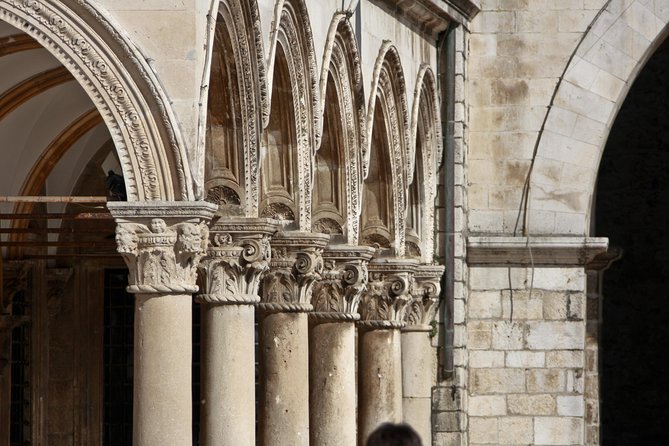
Near Gundulić Square stands Rector’s Palace, one of Dubrovnik’s most important civic buildings. It served as the seat of the Rector of the Republic of Ragusa from the 14th century until 1808. The building also housed the Minor Council and state administration.
Its working roles tell you a great deal about the old republic. This was not just an elegant residence. It included an armoury, powder magazine, watch house, and prison. Government, security, and punishment all operated within the same complex.
The tour discusses the palace from the outside and does not include museum admission. If the building catches your interest, save it for a separate visit after the walk. The short stop gives you the political background you need before the route moves on.
I like this stop because it corrects the idea that Dubrovnik’s old rulers lived only in comfort. The Rector’s Palace represents the careful, sometimes severe system that helped a small state protect its independence. Your guide can also connect the building to the republic’s broader habit of balancing commerce, diplomacy, and defense.
The Cathedral and the Richard the Lionheart legend
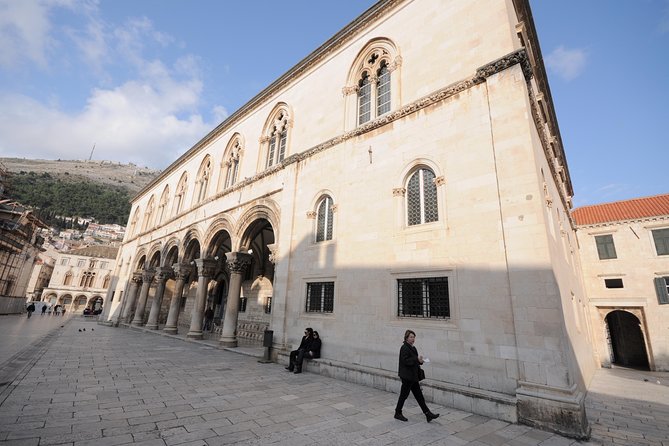
The Cathedral of the Assumption of the Virgin Mary is the next major landmark. The guide introduces its place in Dubrovnik’s religious and civic life and shares the local legend connected with Richard the Lionheart.
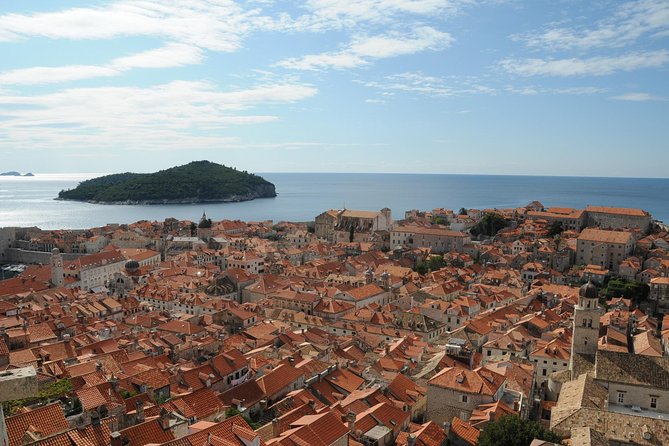
According to the story, Richard was returning from the Crusades in 1192 when a storm wrecked his ship and left him on Lokrum Island, just off Dubrovnik. Legends are not the same as documented fact, and a good guide should help you enjoy the story without confusing it with certainty. It is a memorable way to connect Dubrovnik to the wider medieval world.
The scheduled time here is about five minutes, so expect a quick explanation rather than a detailed cathedral visit. If you want to study the interior, art, or treasury, plan a separate visit. The walking tour works best as an introduction that helps you decide where to spend more time later.
Old Port, Arsenal, quarantine, and sea power
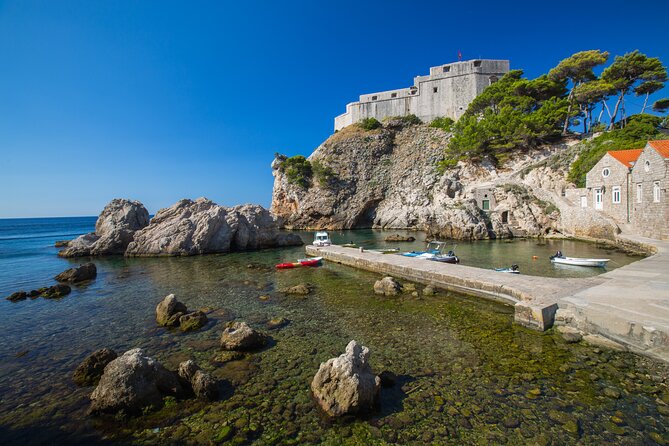
The route reaches Dubrovnik’s City Harbor, one of the most useful stops for understanding the republic’s strength. Ships from Dubrovnik sailed throughout the Mediterranean, and galleons built in the city served in naval fleets across Europe and beyond.
The guide explains the Arsenal, where ships were built and loaded, along with the old quarantine system. The nearby fortresses of St. Luke and St. John helped protect the harbor. This is a good place to pause and consider how much of Dubrovnik’s success came from the sea rather than the land.
The harbor stop lasts about 15 minutes, giving it more time than some of the earlier landmarks. That makes sense. The waterfront ties together commerce, shipbuilding, disease control, military defense, and geography in one view.
The route also offers a break from the tight streets. You can look across the water and see why the port mattered. Do not expect a boat ride or a visit inside the fortresses. The value here is the explanation of how the harbor functioned as part of a working state.
Luža Square and the final cluster of landmarks
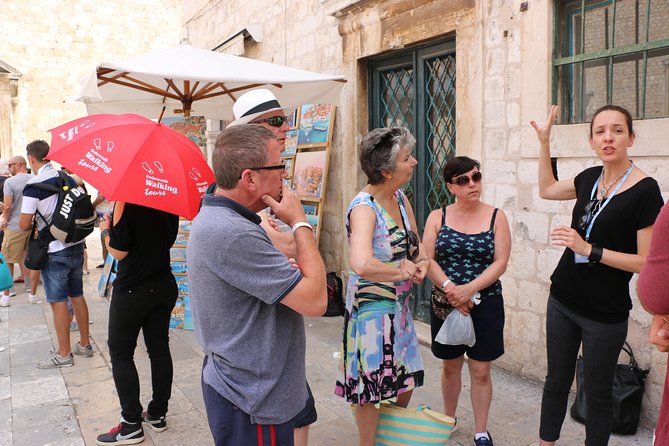
Leaving the port, you return toward the eastern end of Stradun and Luža Square, beneath the City Bell Tower. Several major sights gather in this final section.
The guide points out the Church of St. Blaise, Dubrovnik’s patron saint, and explains the legend of the knight Orlando and his column. You also see Sponza Palace, Small Onofrio’s Fountain, and the high bell tower. This concentration of monuments makes the last 15 minutes feel full.
Sponza Palace is especially useful for understanding the commercial side of the city. The nearby column and church bring in civic identity, legend, and patronage, while the bell tower helps you read the shape of the square. Taken together, these sights show how public space worked in the old republic.
The tour returns to the starting point. That is convenient if you want to continue exploring from a familiar location. It also means you can easily revisit Stradun, the Franciscan complex, or the western gate without needing to find your way across town.
What the $24.19 price really buys you
At $24.19 per person, the tour is priced as an affordable orientation rather than a full attraction pass. You receive a local guide and all taxes, fees, and handling charges. There are no separate entry tickets included because the experience mainly explains the sights from the streets.
I think the value is strongest if you are visiting Dubrovnik for the first time. In 90 minutes, you get a usable map of the Old Town, a timeline from medieval Ragusa to the 1990s, and ideas for what to revisit. The tour can save you from spending your first day wandering past important buildings without knowing why they matter.
The value is weaker if you want long interior visits, museum time, or a private conversation with the guide. The group may contain up to 30 people, and the listed price is for a shared walk. A small group can feel personal, but a full group requires you to stay close and ask questions when there is room.
The tour is offered in English, with departure times chosen to suit your schedule. It is also offered with group discounts, though the exact discount is not specified. Hotel pickup and drop-off are not included, but that is not a major issue because the meeting point is within the Old Town area and near public transportation.
Timing, weather, and comfort
This is a walking tour, so wear shoes you can use on polished stone. The experience includes the main streets and narrower inner lanes, and Dubrovnik has plenty of steps in other parts of the Old Town. One useful distinction is that the introduction itself is largely step-free, but less mobile visitors may still find the wider city difficult because of steps and crowded areas.
Most people can participate, and service animals are allowed. The tour requires good weather. If poor weather forces cancellation, you are offered another date or a full refund.
You can cancel for a full refund up to 24 hours before the start time. Cancellations or changes made within 24 hours are not refunded or accepted. Since the experience averages booking about 37 days ahead, reserve early if your schedule is fixed, then keep the cancellation deadline in mind.
November may be a particularly pleasant time to use this format. A local guide can still lead the walk after rain or under an overcast sky, and the Old Town may feel less crowded than in summer. Weather remains a real factor, so bring a light layer and check the forecast.
Who will get the most from this walk
I would book this tour for a first visit, especially if I planned to spend several days in Dubrovnik. Starting with the walk helps you understand the city before deciding how to use your time at the Rector’s Palace, Cathedral, walls, harbor, or nearby Lokrum.
Families can also benefit from the 90-minute length. It is long enough to cover the main story but short enough to avoid turning the day into a history lecture. Several guides are praised for keeping a light tone, adding humor, and adjusting the pace to the group.
This is also a good choice for anyone interested in the 1990s war, religious communities, maritime trade, or local customs. It is less suitable if your main goal is a detailed architectural tour or a series of interior visits.
The guide makes a real difference. Ivana is associated with clear explanations, local insight, and practical suggestions. Jelena is noted for combining history and culture with humor. Sara brings personal stories and a relaxed pace, while Joseph and Pero are known for an engaging, friendly delivery. Guide assignments can change, but the experience is built around local guides rather than an audio recording.
Should you book the Dubrovnik Old Town History Walking Tour?
Book it if you want a well-priced first orientation that covers Dubrovnik’s essential landmarks and explains how the city worked. The route is efficient, the return to the fountain is convenient, and the combination of medieval history, local traditions, harbor life, and recent war history gives you a fuller picture than a quick stroll alone.
Skip it if you want to enter every major building or prefer exploring at your own pace from the start. For most first-time visitors, though, 90 minutes is a smart investment. Take the tour early in your stay, note the guide’s suggestions, then return to the places that deserve more time.
FAQ
Where does the Dubrovnik Old Town History Walking Tour start?
It starts at Large Onofrio’s Fountain on Poljana Paska Miličevića, next to the Hard Rock Cafe. Look for the red umbrella meeting point.
Where does the tour finish?
The activity ends back at the meeting point near Large Onofrio’s Fountain.
How long does the tour last?
The tour lasts approximately 1 hour and 30 minutes.
What language is the tour offered in?
The tour is offered in English.
What sights are covered?
The route includes Large Onofrio’s Fountain, the Church of Holy Savior, the Franciscan Church and Monastery, Stradun, the Church of the Holy Annunciation, Gundulić Square, Rector’s Palace, the Cathedral, City Harbor, Luža Square, Orlando Column, Sponza Palace, Small Onofrio’s Fountain, and the bell tower.
Is hotel pickup included?
No. Hotel pickup and drop-off are not included.
What happens if the weather is poor?
The experience requires good weather. If it is canceled because of poor weather, you can choose another date or receive a full refund.
Newest history tours we have reviewed in Croatia
- Split History and Gastro Small-Group Tour with Food and Drinks★ 5.0 · 375 reviews
- Dubrovnik: Game of Thrones and History Small Group Tour★ 5.0 · 76 reviews
- Dubrovnik Old Town: Small-Group Walking Tour With A Local★ 5.0 · 123 reviews
- History Split Walking Tour in French -Small group★ 5.0 · 41 reviews
- Dubrovnik Jewish Heritage Private Walking Tour★ 5.0 · 121 reviews
- Private History Split Walking Tour in English★ 5.0 · 159 reviews
- Split: Historical Tour of Salona, Klis Fortress and Trogir★ 4.1 · 108 reviews
- History & Cultural Walking Tour of Split and Diocletian’s Palace★ 5.0 · 104 reviews
Old Town & Historic Centre Walks, compared.

Madrid Essential: Historic Center, Plaza Mayor & Royal Palace
Read our review →
Live Fado Show with Port Wine in Historic Center
Read our review →
Valencia Old Town Tour with Wine & Tapas in 11th Century Historic Monument
Read our review →
Prague Old Town, Medieval Underground and Dungeon Historical Tour
Read our review →
Cartagena: Historic Center and Getsemaní Shared Walking Tour
Read our review →
Old Town Walking Tour History and Tales in Edinburgh
Read our review →