
Review · ITALY HISTORY TOURS
Bologna historical art walking tour with hidden gems and tastings
Bologna’s story comes alive through its art, food, university, and working streets, not just through a checklist of famous buildings. This 3 to 4 hour walk links the grand Piazza Maggiore with medieval market lanes, Renaissance rooms, old canals, churches, and the city’s long tradition of scholarship.
I like two things in particular: Riccardo Bacchi gives the tour a clear historical thread, and he points out details most people would pass without noticing, from guild marks to the old silk canals. The chance to taste local food and wine adds a welcome connection to everyday Bologna.
The main drawback is pace. There is a lot to cover, and a group of up to 25 can make some stops feel brisk. If you want long, quiet time inside each church or palace, you may need to return on your own.
Key points to know before you book
- Riccardo Bacchi brings art and history together, with special attention to medieval, Renaissance, and Baroque Bologna.
- The route covers major sights and overlooked details, including Piazza Maggiore, San Petronio, the Archiginnasio, Santo Stefano, and the medieval canals.
- You see Bologna through several lenses, including religion, science, trade, education, architecture, and food.
- Tastings may include local wine and rice cake made from a medieval recipe, adding a small but memorable food lesson.
- The walk is full and fast-moving, lasting about 3 to 4 hours and ending where it begins.
- The price is $175.36 per person, so the tour makes the most sense if you want a serious introduction rather than a quick orientation walk.
Why this Bologna walk feels different
Many city walks stay on the main square and point out the obvious landmarks. This one uses central Bologna as a classroom. You move from the seat of civic power to a major church, an old university complex, a market district, a group of historic churches, and the remains of the city’s industrial water system.
That range is the real strength. You are not only looking at pretty facades. You are learning how Bologna worked. Its public life took shape in Piazza Maggiore. Its university shaped science and medicine. Its guilds controlled trade. Its churches preserved art and local devotion. Its canals helped produce silk and hemp textiles.
Riccardo Bacchi is the guide named for this experience, and the tour depends heavily on his ability to connect those subjects. He is described as especially strong on medieval, Renaissance, and Baroque art, as well as local architecture and politics. You can expect plenty of explanation rather than a simple list of dates.
The tour is offered in English and accepts mobile tickets. It meets at Bar Vittorio Emanuele at Piazza Maggiore, 1, then returns to that same meeting point. That makes it easy to fit into a first full day in Bologna, when you want a framework for later exploring.
More History Walking Tours in Italy
- Venice: City Center Historical Guided Walking Tour
★ 4.2 · 1,873 reviews - Palermo: Street Food and History Walking Tour
★ 4.9 · 1,486 reviews - Verona: History and Hidden Gems Guided Walking Tour
★ 5.0 · 1,379 reviews
Piazza Maggiore and the city’s public face
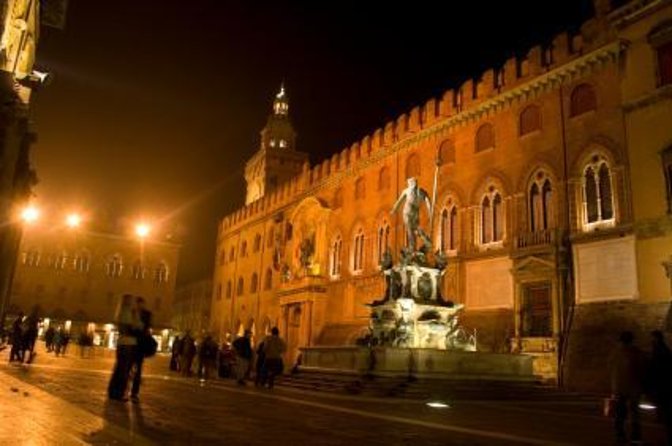
Begin in Piazza Maggiore, Bologna’s grand medieval civic square. This is the right place to start because so many parts of the city’s story meet here: government, religion, commerce, public art, and urban power.
Look closely at the old medieval buildings around the square. Riccardo explains the four speaking corners, the old textile market, the Renaissance Fountain of Neptune, and the clock facade of the Council Palace. These details show how the square was not merely decorative. It was a place where business, law, ceremony, and daily life met.
The stop lasts about 20 minutes, which is enough for a strong introduction but not for a slow architectural study. I would pay attention to the orientation here, since the square will help you understand the route that follows.
Palazzo d’Accursio and civic power
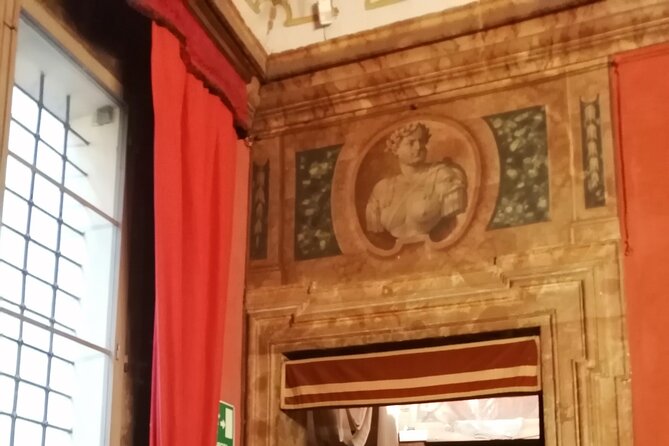
The next stop is Palazzo d’Accursio, where the focus shifts from the public square to the rooms behind the facade. You see noble rooms on the first and second floors, frescoes, a private bishop’s chapel, and the large Bramante staircase designed for horses.
That staircase is an excellent example of the kind of detail that gives this tour its character. It helps explain how grand buildings functioned in earlier centuries, when horses and formal movement were part of palace life.
The tour also covers the room of the seniors and Francesco Francia’s Earthquake’s Virgin. The art is placed within the setting that commissioned and used it, so you are not simply looking at isolated works.
Plan on about 30 minutes here. The schedule is fairly tight, and the exact amount of time spent in each room may depend on access and the group. Still, this stop adds welcome depth after the open space of Piazza Maggiore.
San Petronio, sundial, and major paintings
Basilica di San Petronio receives about 35 minutes. This is one of the tour’s central art stops, with time devoted to the church’s huge sundial, the medieval frescoes of the Cappella Bolognini, four ancient crosses, and paintings linked to Parmigianino and Lorenzo Costa.
The sundial is described as the largest in the world. Rather than treating it as a quick photo point, the guide explains its place in the church and in the history of measurement and astronomy. That is typical of this experience: science and art are treated as parts of the same city story.
The Bolognini Chapel adds a more dramatic medieval note, while the later paintings show how Bologna’s artistic life changed over time. If you care about Italian art, this is one of the stops that justifies the tour’s higher price.
You should also expect this part to be visually dense. San Petronio contains more than one story, and 35 minutes will give you a guided introduction rather than enough time to examine every image. If a particular painting or chapel catches your attention, note it and return later.
Same streets, a different century:
- Colosseum: Underground and Ancient Rome Tour
★ 4.7 · 12,691 reviews - Rome: Colosseum with Arena, Roman Forum and Palatine Guided Tour
★ 4.0 · 5,598 reviews - Venice: St. Mark’s Basilica Guided Tour & VR History Intro
★ 3.9 · 4,880 reviews - Colosseum with Arena, Roman Forum and Palatine Hill Guided Tour
★ 4.5 · 3,526 reviews
The Archiginnasio and Bologna’s university tradition
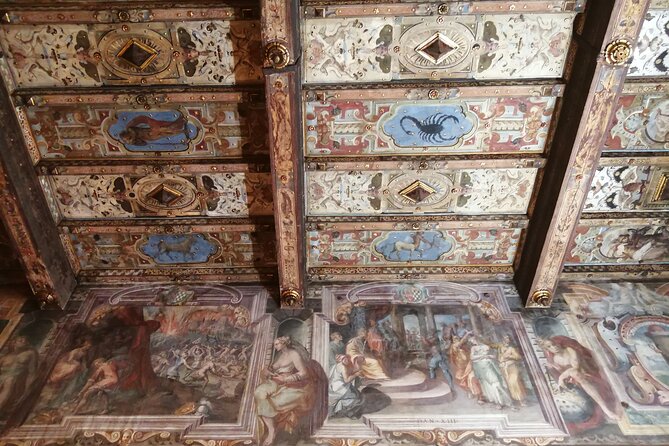
The Archiginnasio is one of the most unusual stops because it brings education, medicine, art, and power into one Renaissance palace. It served as the headquarters of Europe’s oldest university, and the building’s huge collection of coats of arms records the students and institutions connected to that world.
Riccardo explains the signs of secretive medical practice and takes you into the wooden anatomical theater. This room gives the university story a physical setting. You can picture the study of the human body taking place in a space built for teaching, display, and ceremony.
The Stabat Mater room and the long hall for books and old codes add another layer. The tour also points to precious material such as Leonardo da Vinci’s Flights of the Birds. The key value here is context. You see how Bologna’s academic life shaped the city and how knowledge was stored, taught, and guarded.
Allow about 30 minutes. This stop rewards people who like architecture, science, old books, and the history of education. It may be less satisfying if you prefer a tour focused only on food or street life.
The Quadrilatero and Bologna’s working market
After the grand interiors, the route heads into the Quadrilatero, the medieval market district. This is where Bologna feels most connected to daily trade. You walk through a maze of lanes lined with old food shops and market stalls.
The guide points out ancient coats of arms and signs connected with the guilds. That turns a simple market stroll into a lesson in how work was organized. You begin to see the old city not as a preserved stage set, but as a place shaped by butchers, merchants, textile makers, and other trades.
The stop lasts about 20 minutes. Since it is a functioning district, the experience is more about reading the street than entering a formal attraction. You may want to return later for a meal or a closer look at the food shops.
Food is part of the tour’s promise, though the detailed route gives only one clear example of a tasting: medieval-style rice cake and local wine. That tasting was included during one especially customized experience. The tour is best understood as an art and history walk with food touches, not as a full food tour.
Santo Stefano and Bologna’s layered religious past
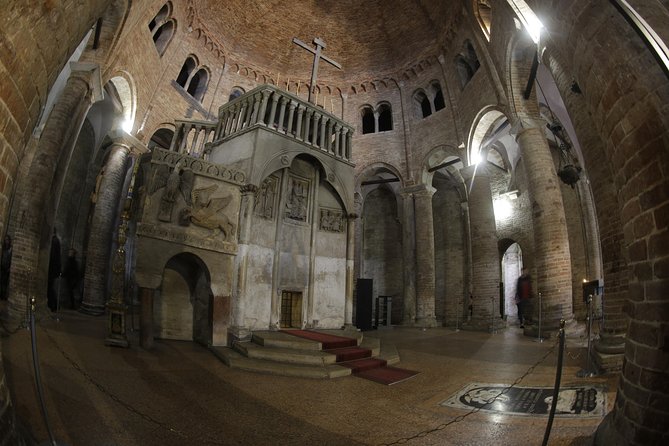
The Basilica and Santuario di Santo Stefano receives the longest scheduled stop, about 40 minutes. It is a group of connected churches, and the site is presented as a compact record of Bologna’s past.
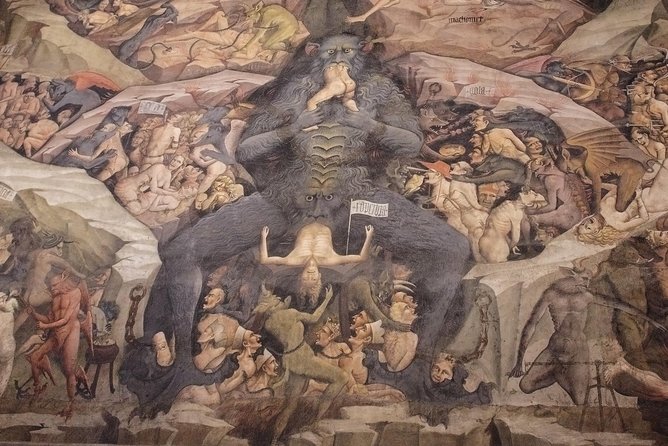
The story reaches back to a Roman temple built over a natural spring. It continues through the churches, the monks’ cells, the cloister associated with Dante Alighieri, and capitals carved with animal faces. The result is less a single grand interior than a sequence of spaces, each carrying a different period and mood.
This is one of the best places to appreciate the tour’s broad approach. You are not only studying church art. You are looking at changing religious practices, older building layers, monastic life, and the way legends and literature attach themselves to places.
Give yourself room to look up and around. The animal-headed capitals are easy to miss if you hurry. The 40-minute slot should provide the most breathing space on the route, though a full private visit would still require more time.
Santa Maria della Vita and expressive terracotta
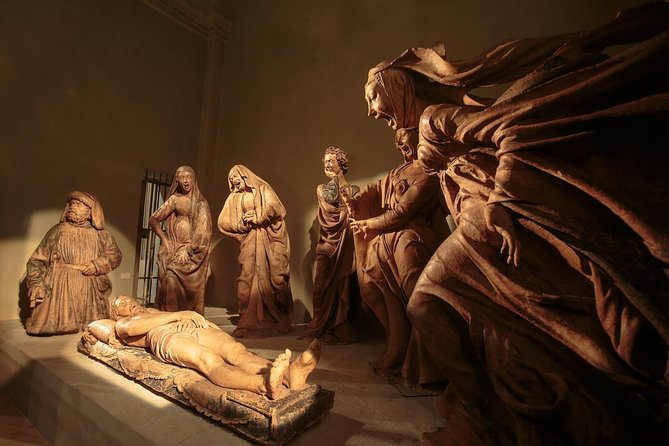
Chiesa di Santa Maria della Vita brings the tour back to a focused work of art. Inside is Niccolò dell’Arca’s terracotta masterpiece, sculpted around 1470. Its force comes from the treatment of movement and emotion.
The figures do not sit quietly in a formal arrangement. Their gestures and expressions create a strong sense of shock and grief. The guide treats this work as an advanced, almost forward-looking interpretation of emotion, which helps you see why it matters beyond its date and material.
The visit lasts about 20 minutes and includes admission. This is a short stop, but it may be one of the most memorable for anyone drawn to sculpture. The church also offers a useful change of scale after the large civic and university buildings.
The Two Towers, wooden houses, and the old canals
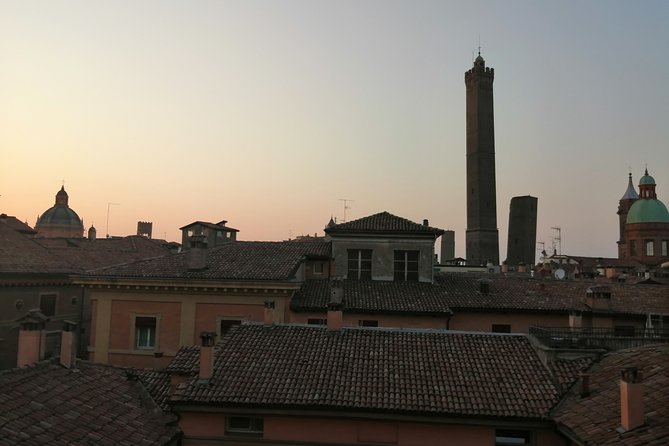
The route gives you a street-level view of Bologna’s famous towers, the 98-meter Asinelli Tower and the leaning Garisenda Tower. You do not need a tower climb to understand their role in the city skyline. Their height and tilt make a quick pause worthwhile.
You also see a surviving example of a 13th-century house with its original wooden pillars. This small detail says a great deal about how much of medieval Bologna is tucked into ordinary-looking streets. Keep your eyes open between the formal stops, since some of the most interesting details are outside the ticketed buildings.
At Finestrella, the tour explains Bologna’s medieval canals. These waterways were designed to supply silk and hemp textile production. Today, the canal view offers a glimpse of the city’s former industrial system, a side of Bologna that can be easy to miss if you focus only on churches and porticoes.
The canal stop takes about 10 minutes. It is brief, but it helps complete the story begun at the textile market in Piazza Maggiore. Bologna’s art and architecture were supported by practical systems of trade, water, and manufacture.
Palazzo Comunale and a final look back
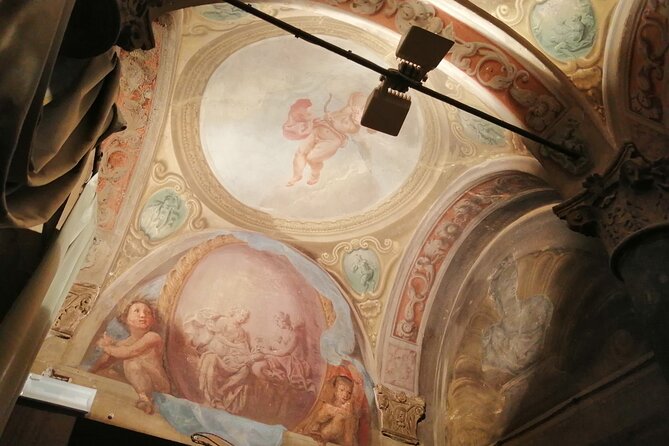
The final listed stop is Palazzo Comunale, with Renaissance and Baroque ceilings, frescoes, sculptures, and another Bramante staircase built for horsemen. The visit lasts about 10 minutes, so expect a concise final look rather than a long interior study.
Ending near the civic center works well. The route has moved through church, university, market, canal, and palace, then returns to the city’s public heart. Since the activity ends back at the meeting point, you can continue from Piazza Maggiore without needing to find your way across town.
Pace, group size, and practical value
The maximum group size is 25. That is not a tiny private walk, and you should expect to stay reasonably close to Riccardo in busy streets and interiors. The schedule includes many stops, so the pace is best described as active rather than relaxed.
Most people can participate, and the route is near public transportation. The supplied information does not specify accessibility details, so anyone with mobility concerns should confirm the route before booking. Several stops involve historic buildings, and historic interiors can vary in ease of movement.
At $175.36 per person, this is a substantial purchase for a 3 to 4 hour walk. I see the value if you want a guide who can connect art, architecture, politics, education, science, commerce, and food in one continuous story. It is less compelling if you mainly want a cheap orientation stroll or a dedicated tasting tour.
The reported rating is 4.9 from 108 reviews, with 98 percent recommending the experience. The strongest praise centers on Riccardo’s passion, detailed explanations, flexible response to interests, and ability to point out things that are easy to miss. Several people found the walk so useful on their first day that they used his suggestions to plan additional time in Bologna.
That first-day timing is good advice. You will get more from later visits to churches, markets, and museums once you understand how the city fits together. The tour is also booked an average of 54 days ahead, so popular dates may require planning.
Who should book this Bologna experience?
I would choose this walk if you like art but want more than a gallery lecture. It suits you if medieval streets, old universities, church interiors, architecture, and the connection between food and city life all sound appealing.
It also works well for a first visit because the route covers a large part of central Bologna and returns to the starting square. The tour can be especially useful for anyone who wants local recommendations for the rest of a stay. Riccardo has provided additional suggestions to people who wanted to keep exploring after the walk.
You may want something else if you prefer a slow food crawl, a small private group, or long periods inside each attraction. The route is full and information-heavy. That is its strength, but it can also feel like a lot in one morning or afternoon.
Free cancellation is available up to 24 hours before the start time. Changes or cancellations made later are not refunded, so keep that deadline in mind when fixing your Bologna plans.
Should you book it?
Book this tour if you want Bologna explained rather than simply photographed. Riccardo Bacchi’s approach connects the city’s famous sights with its less obvious evidence: wooden pillars, guild symbols, anatomical rooms, medieval canals, old market trades, and expressive terracotta sculpture.
I would especially recommend it for an early day in Bologna, for art and architecture fans, and for anyone who feels the city deserves more than a quick stop between Florence and Venice. The price is high, but the range of material and the guide’s strong local focus make it worthwhile for the right audience.
If your priority is a relaxed meal-by-meal food tour or a quiet private museum visit, choose a more focused experience. If you want the city’s many parts to make sense in a few energetic hours, this is a strong choice.
FAQ
How long does the Bologna historical art walking tour last?
The tour lasts approximately 3 to 4 hours.
Where does the tour begin?
It begins at Bar Vittorio Emanuele, Piazza Maggiore 1, Bologna.
Where does the tour end?
The activity ends back at the meeting point in Piazza Maggiore.
What language is the tour offered in?
The tour is offered in English.
How large can the group be?
The maximum group size is 25 people.
What major sights are included?
The route includes Piazza Maggiore, Palazzo d’Accursio, Basilica di San Petronio, the Archiginnasio, the Quadrilatero, Santo Stefano, Santa Maria della Vita, Finestrella, the Two Towers area, and Palazzo Comunale.
Can I cancel for a full refund?
Yes. You can cancel at least 24 hours before the experience starts for a full refund. Cancellations or changes made less than 24 hours before the start time are not refunded.
Newest history tours we have reviewed in Italy
- Guided Cultural Tour of the Godfather Film in Messina★ 5.0 · 31 reviews
- SU NURAXI BARUMINI Unesco World Heritage Site★ 5.0 · 129 reviews
- Picnic aperitif in the vineyard of an ancient trullo in Martina Franca★ 5.0 · 21 reviews
- Brescia the Unexpected: History, Local Stories & a drink★ 5.0 · 31 reviews
- Bolognese Cooking Class with Margherita in the Historic Center★ 5.0 · 26 reviews
- Best of Bologna in one day : Food, architecture, art and history★ 5.0 · 27 reviews
- Private or semi-private tour of the historic center of Bologna★ 5.0 · 34 reviews
- Tuk Tuk tour in Bergamo, Città Alta and the ancient Venetian walls★ 5.0 · 32 reviews
History Walking Tours, compared.
History and Hauntings of Salem Guided Walking Tour
Read our review →
Freedom Trail History Small Group Walking Tour
Read our review →
Historic Charleston Guided Sightseeing Walking Tour
Read our review →
Tapas Walking Tour with Food, Wine, and History
Read our review →
Savannah History and Haunts Candlelit Ghost Walking Tour
Read our review →
A History of Terror – Belfast City Centre Walking Tour
Read our review →Browse the lists this tour appears in