
Review · FRANCE HISTORY TOURS
2-Hour Walking Tour of the City’s Iconic Sights and History
Bordeaux reveals itself through grand squares, river views, elegant façades, and stories of revolution, trade, and old civic power. This two-hour walk links the city’s headline sights, from the Monument aux Girondins to the Grand Théâtre and Place de la Bourse, giving you a useful first look before you explore on your own.
I like the low price, about $17.37 per person, and the route’s smart mix of major landmarks and smaller historic corners. I also like the chance to hear local stories from guides such as Bruno, Christine, Hubert, and Jenny, who have been praised for warmth, humor, and strong command of Bordeaux’s past.
The main caution is the bilingual format. The tour is offered in English, but commentary is often given in both French and English, and some English-speaking participants have received much shorter explanations. You should also expect a group of up to 25 and a walk that may include more standing and listening than continuous strolling.
Key points to know before booking
- The route covers Bordeaux’s postcard sights: You’ll see the Monument aux Girondins, Allées de Tourny, Grand Théâtre, Place du Parlement, and Place de la Bourse.
- The tour begins at the Bordeaux Tourist Office: Arrive inside the office at 12 Cours du 30 Juillet by 10:30 am and listen for the guide’s call.
- English and French are both used: The balance can vary, so this matters if you want detailed English commentary.
- The itinerary changes: Weather, group size, and the guide can alter the route, and the finish may not be at the listed endpoint.
- It is good value for first-time visitors: For less than $20, you get two hours with a licensed local guide and a useful introduction to central Bordeaux.
- You need comfortable walking shoes: You must be able to walk for about two hours, with no hotel pickup, food, or drinks included.
A useful first look at Bordeaux’s historic center
This tour works best as an opening chapter, not the whole Bordeaux story. In two hours, you can see several famous landmarks and learn how Bordeaux grew into a wealthy port city, but you will not enter every monument or cover every corner of the old center.
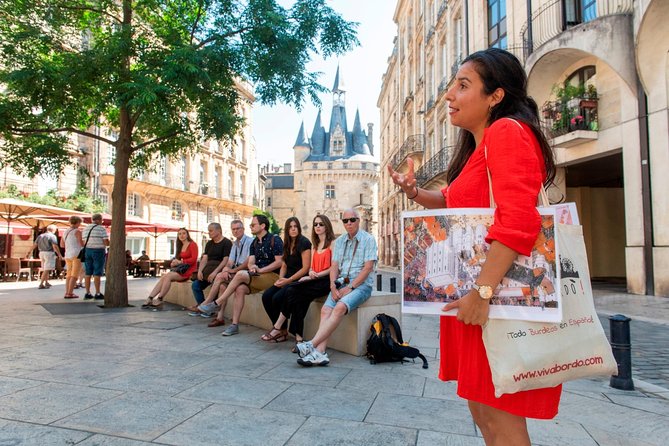
The route begins in central Bordeaux, where the city’s broad 18th-century planning quickly comes into view. Your guide sets the pace and explains the city’s political and cultural past while leading you between squares, grand streets, and the riverfront.
The exact order may shift. Rain, group size, local events, and the guide can all affect the route. That flexibility is useful, but it also means you should not treat every listed stop as a guaranteed long visit.
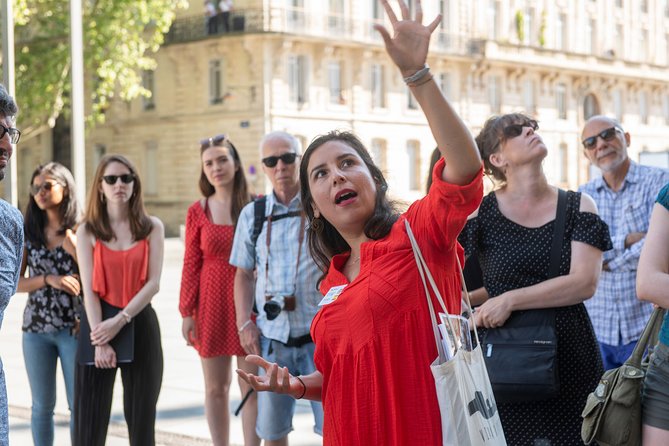
Some of the best moments come from the guides themselves. Bruno has been singled out for his humor and charm, while Christine has been praised for pointing out architectural details and moving easily between French and English. Hubert has been described as particularly good at pitching the two-hour format at the right level.
Those names do not guarantee who will lead your walk. They do show the sort of guide you may get: a local professional who can turn façades, fountains, and public squares into stories rather than simply pointing at them.
More History Walking Tours in France
- Paris: Dark History and Ghostly Guided Walking Tour
★ 4.7 · 1,000 reviews - Vieux Lyon Cultural & Historical Walking Guided Tour (English)
★ 5.0 · 942 reviews - Strasbourg: Guided Historical Neighborhoods Walking Tour
★ 4.9 · 275 reviews
Monument aux Girondins and the city’s revolutionary past
The first major stop is the Monument aux Girondins in Place des Quinconces. It is difficult to miss. A tall column rises above dramatic fountains and bronze sculptures, topped by a winged figure that resembles a Statue of Liberty.
The monument honors the Girondists, a group of relatively moderate National Assembly deputies who were executed in 1793 during the French Revolution for counter-revolutionary activity. That background gives your guide a chance to explain Bordeaux’s political character and its place in the upheavals of revolutionary France.
You spend about five minutes here, with free admission. That short timing is enough for an introduction and photographs, but not for a detailed examination of every sculpture. Look up at the column and down at the fountain figures, then let the guide connect the monument to the city’s wider political story.
Place des Quinconces is one of Bordeaux’s major open spaces, so this stop also helps you understand the city’s scale. It is a broad beginning to a tour that later moves through tighter streets and smaller squares.
Allées de Tourny and Bordeaux’s polished public face
From the monument, the walk continues toward the Allées de Tourny. This elegant promenade is lined with 18th-century buildings, cafés, boutiques, and carefully arranged façades.
Here you get a sense of Bordeaux’s refined side. The avenue reflects the city’s period of urban improvement and growing wealth, when planners created grand spaces for commerce, civic life, and display.
The stop is brief, around five minutes, so think of it as an orientation point rather than a full architectural lesson. Your guide may draw attention to the uniform façades or explain how the promenade fits into the design of the central city.
The Allées de Tourny can also be busy during seasonal events, including the Christmas market and summer activities. If you are taking the tour during one of those periods, the atmosphere may be less quiet than the architecture suggests.
Notre-Dame de Bordeaux, a compact Baroque pause
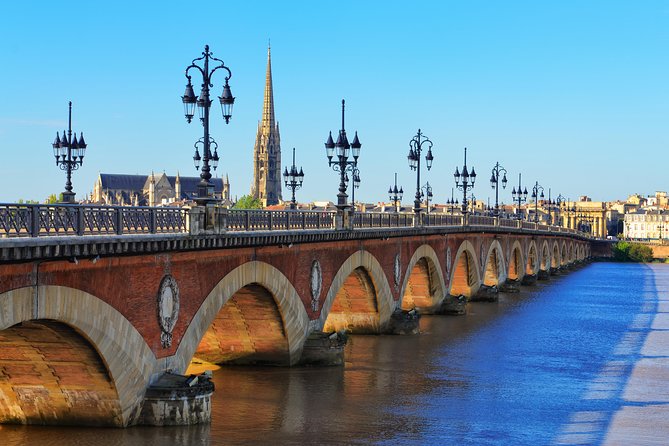
The Church of Notre-Dame de Bordeaux provides a change of scale. Its exterior has a richly carved Baroque façade, while the interior is known for a vaulted ceiling and decorative detail.
The planned stop lasts about five minutes. That is enough to see the church and hear why it matters, but you should not expect an extended interior visit or a long religious-art lecture.
This is one reason the tour is useful early in your stay. You get a quick architectural survey of Bordeaux, moving from monumental civic spaces to a church with a more intimate feel. Later, you can return to the places that deserve more time.
If churches are a major reason for your visit, note that this walk does not promise a full tour of Bordeaux’s religious buildings. Some participants have wished for more attention to Saint-André Cathedral, which is not listed as a formal stop.
Same streets, a different century:
- Paris: Louvre Museum Entry with History of Mona Lisa
★ 3.9 · 2,823 reviews - Bordeaux: Historic Center & Chartrons District Bike Tour
★ 4.8 · 709 reviews - From Strasbourg: Best Of Alsace Historical Day Trip
★ 4.7 · 633 reviews - Toulouse Food & History Tour with a Chef (in English)
★ 5.0 · 503 reviews
Place de la Comédie and the Grand Théâtre
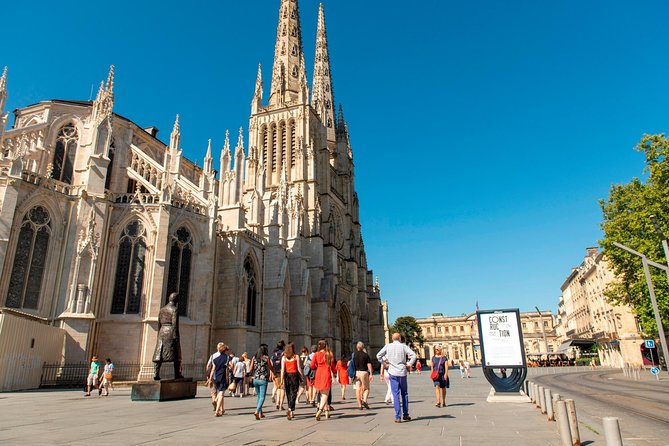
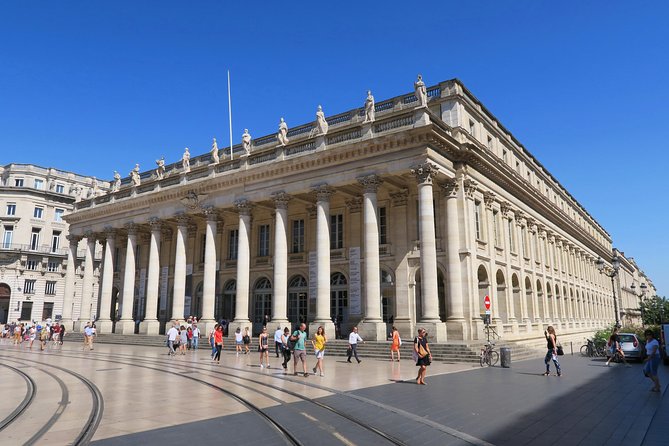
Place de la Comédie is one of the tour’s strongest stops. The square is dominated by the Grand Théâtre, whose neoclassical façade is fronted by a sweeping portico and a row of columns.
You get about ten minutes here, the longest scheduled pause on the route. That makes sense. The Grand Théâtre is not just photogenic. It also tells the story of Bordeaux’s 18th-century wealth and ambition.
The building was completed in 1780, at a time when Bordeaux’s rising merchant and bourgeois classes had the money and influence to commission grand public architecture. Your guide explains how the theatre became a symbol of that confidence.
The site also has an older layer. The square once held a Roman temple, so you are looking at a place where ancient Bordeaux and modern civic Bordeaux overlap. You may not see physical remains of the temple, but the story adds useful depth to the elegant scene.
You can pose for photos beneath the portico and study the balanced façade. The tour does not include a performance or a full interior visit, so anyone hoping to see the auditorium should plan a separate visit.
Place du Parlement and the pleasures of a small square
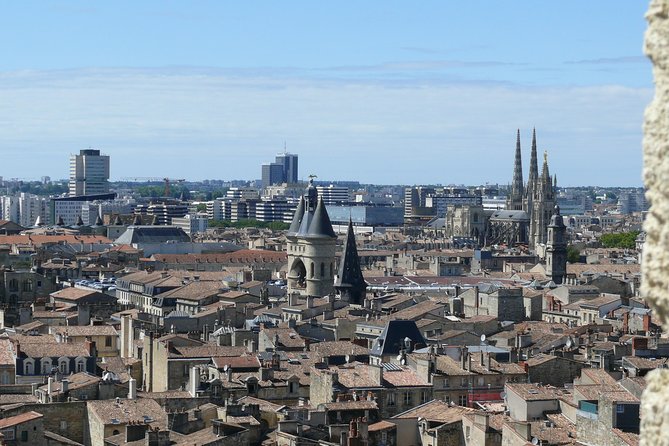
Place du Parlement offers a more relaxed stop. Its 18th-century buildings surround a picturesque square filled with cafés and everyday city life.
After the scale of the Grand Théâtre and Place des Quinconces, this smaller setting helps you see how Bordeaux’s architecture works at street level. The square is not simply a backdrop. It is a place where residents sit, eat, meet, and pass through.
The scheduled visit lasts about five minutes. You will likely hear about the buildings and the square’s place in Bordeaux’s development, then continue toward the river.
This is also a good point to ask your guide for practical suggestions. Guides have offered tips about local food and traditional cake, and they can often help you decide where to continue after the walk. The tour ends near the city center, so you can easily turn the rest of the day into your own exploration.
Place de la Bourse and the Garonne waterfront
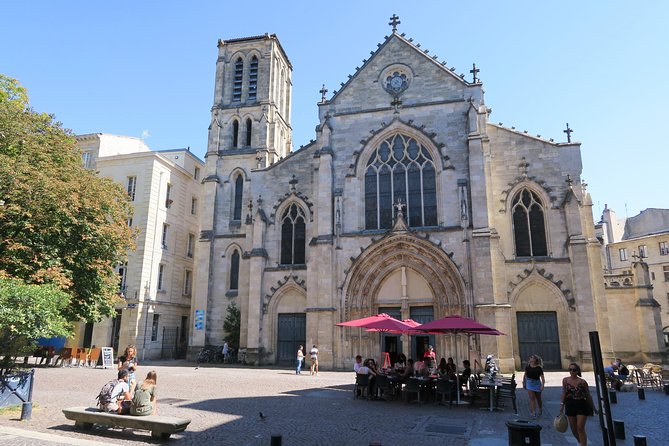
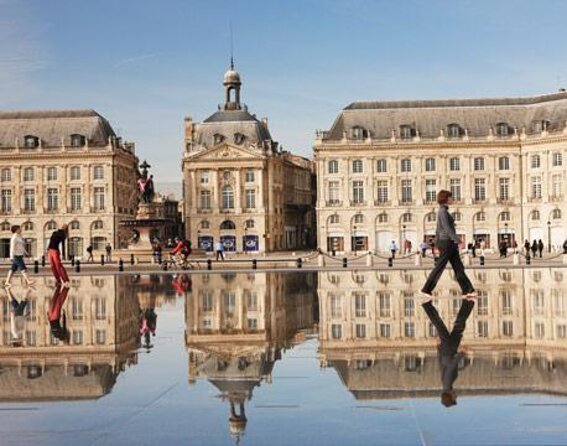
The final major highlight is Place de la Bourse, one of Bordeaux’s most recognizable spaces. Created in the 18th century by Ange-Jacques Gabriel, chief architect to Louis XV, the square opens toward the Garonne River.
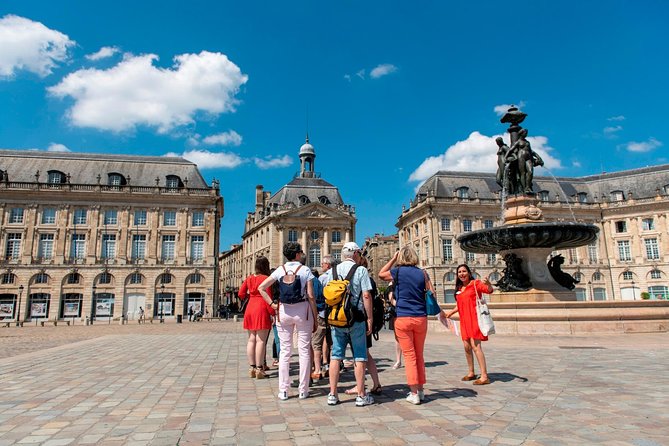
The Stock Exchange, or Bourse, gives the square its formal character. The Fountain of the Three Graces adds sculpture and movement, while the broad riverfront gives you a clear sense of Bordeaux’s historic connection to trade and shipping.
The nearby Miroir d’eau is another visual draw. Its reflective surface can turn the classical façades into a shimmering scene, although its operation and appearance can vary. The square is worth revisiting later when you have time to slow down and take photographs.
This stop is listed as the endpoint, but do not rely on that completely. The finish can change with the guide, weather, and group size. Ask your guide how to return to the Tourist Office if you need to retrieve something or continue from the original meeting point.
Rue Sainte-Catherine and the city as it feels today
The route also takes in Rue Sainte-Catherine, Bordeaux’s long pedestrian shopping avenue. Chic shops and restaurants line the street, giving you a look at the modern commercial center rather than the formal monuments.
This section helps prevent the tour from becoming a parade of statues and façades. You see how the historic center functions now, with shopping, dining, and daily foot traffic woven into old streets.
The walk may not spend a long, separate period here. Depending on the guide and the group, Rue Sainte-Catherine can be part of the connection between larger landmarks. Still, it is a useful place to orient yourself if you plan to shop, eat, or return later without a guide.
The bilingual format is the key decision
The tour is advertised in English, but the commentary is bilingual in French and English. This is the single most important point to understand before you pay.
When the guide serves a mixed group, each explanation may be repeated in both languages. That can make the tour slower, especially at stops where the group gathers around a guide. In some cases, the French explanation has been much longer, leaving English-speaking participants with a short summary.
Other guides have handled the two languages well, switching regularly and making sure everyone can hear. Audio devices have also been used for larger groups, with mixed results. One delayed departure involved faulty equipment, while another participant found the earphones helpful.
If you speak some French, the bilingual structure may be an advantage. You will hear more of the guide’s full explanation and may find the rhythm less frustrating. If you speak only English and want a detailed, uninterrupted talk, this is a real risk.
Before the tour begins, confirm that you are with the correct group and ask how the language will be handled. This is especially important because the Tourist Office may have several people arriving for different walks.
Group size, timing, and meeting point
The advertised start time is 10:30 am. Meet inside the Office de Tourisme et des Congrès de Bordeaux Métropole at 12 Cours du 30 Juillet, rather than simply waiting somewhere vague outside.
The maximum group size is 25. That is not a tiny walking group, and it affects how easily you can hear, ask questions, and gather around a monument. Larger groups are the reason audio equipment may be supplied.
Arrive early enough to find the office and listen for the guide’s call. One person missed the departure after waiting at the wrong spot near the office, while the reception team could have helped direct the group. The practical lesson is simple: go inside, check with staff, and make your presence clear.
You should be able to walk for two hours. Wear comfortable shoes, and bring weather protection. The tour continues in wet conditions, and Bordeaux’s open squares and riverfront can feel exposed in rain or wind.
There is no hotel pickup or drop-off, and food and drinks are not included. The tour is near public transportation, so reaching the start is straightforward, but you handle your own transport.
Is $17.37 good value?
At about $17.37, the tour is inexpensive for two hours with a licensed local guide. If you are new to Bordeaux, that price buys useful orientation: you learn where the principal squares are, hear key stories, and get ideas for the rest of your stay.
The value drops if you expect entry inside every monument or a full tour of the old city. Admission is free at the listed stops because the experience is an outdoor walking tour, not an attraction package.
I would judge the price mainly by the guide and the language balance. With a strong guide such as Bruno, Christine, Hubert, or Jenny, the walk can be a lively introduction to the city’s architecture, politics, and culture. With a replacement guide who is less comfortable in English, the same route may feel slow and uneven.
Free cancellation is available if you cancel at least 24 hours before the start time. Changes or cancellations inside that window are not accepted for a refund.
Who should book this Bordeaux walk?
I would choose this tour if you are visiting Bordeaux for the first time and want a quick map of the center. It suits you if you like history, architecture, and city stories, but do not need long interior visits.
It is also a good fit for anyone who wants practical suggestions at the start of a stay. Ask the guide where to return for photographs, which streets deserve another look, and where to find local food.
You may want a different option if your main goal is a detailed English-only experience. The bilingual setup can limit the amount of English commentary, particularly when the French-speaking part of the group is large.
It may also disappoint you if you want to cover every major sight. Saint-André Cathedral and other important buildings may not receive much attention, and the route can change. Treat the walk as a broad introduction, then plan your own second pass through Bordeaux.
Final verdict: book it for orientation, not exhaustive coverage
I would book this tour for the price, central route, and chance to hear Bordeaux explained by a local guide. The Monument aux Girondins, Grand Théâtre, and Place de la Bourse give you an excellent framework for understanding the city, and the two-hour length fits neatly into a first morning.
I would book with realistic expectations. You may walk less than you expect, spend time listening in one place, and hear more French than the English description suggests. Confirm the meeting point inside the Tourist Office, arrive ready for a bilingual tour, and ask about the endpoint before you leave.
For a first look at Bordeaux, it is a sensible buy. For an English-only, highly detailed architectural tour, the language arrangement makes it a less certain choice.
FAQ
How long does the Bordeaux walking tour last?
The tour lasts approximately two hours, and you must be able to walk for the full period.
Where does the tour start?
It starts at the Office de Tourisme et des Congrès de Bordeaux Métropole, 12 Cours du 30 Juillet, 33000 Bordeaux. The start time is 10:30 am.
Where does the tour finish?
Place de la Bourse is listed as the endpoint, but the finish can change with the guide, weather, and group size. Ask the guide how to return to the Tourist Office if needed.
Is the tour conducted in English?
The tour is offered in English, but commentary is bilingual in English and French. The amount of detail in each language can vary.
What landmarks are included?
The route can include the Monument aux Girondins, Allées de Tourny, Church of Notre-Dame de Bordeaux, Place de la Comédie, Grand Théâtre, Place du Parlement, Place de la Bourse, and Rue Sainte-Catherine.
Is the tour suitable for most people?
Most people can participate, but you must be able to walk for about two hours. The tour has a maximum of 25 participants.
What is included in the price?
A local professional licensed guide is included. Hotel pickup and drop-off, food, and drinks are not included.
More Two-Hour Tours in France
- Paris Jewish History 2-Hour Private Guided Walking Tour
★ 4.6 · 32 reviews - 2-Hour Gettysburg Battlefield Guided History Bus Tour with a National Park Guide
★ 4.5 · 2,201 reviews - Kyoto Gion: 2-Hour Geisha Culture & History Walking Tour
★ 5.0 · 1,186 reviews - 2 Hour LoDo Historic Walking Tour in Denver
★ 5.0 · 1,106 reviews
Newest history tours we have reviewed in France
- Small-Group Full-Day Tour of Côte de Nuits, Côte de Beaune Vineyards and Beaune Historical District★ 5.0 · 364 reviews
- Private Bordeaux History Tour with a glass of Bordeaux wine.★ 5.0 · 28 reviews
- Bordeaux Historic and Gourmet Food Walking Tour★ 4.5 · 82 reviews
- Bordeaux’ Best Boulangeries & History Tour★ 5.0 · 126 reviews
- Historical Center, Bordeaux Food Tour★ 5.0 · 33 reviews
- Private Walking Guided Tour of Historic Bayeux English or French★ 5.0 · 36 reviews
- Historic Bayeux Daily Group City Tour In English 2 hrs (Apr-Sept)★ 5.0 · 220 reviews
- Enchanting Historical Walking Tour in Avignon★ 5.0 · 53 reviews
History Walking Tours, compared.

History and Hauntings of Salem Guided Walking Tour
Read our review →

Freedom Trail History Small Group Walking Tour
Read our review →
Historic Charleston Guided Sightseeing Walking Tour
Read our review →
Tapas Walking Tour with Food, Wine, and History
Read our review →
Savannah History and Haunts Candlelit Ghost Walking Tour
Read our review →
A History of Terror – Belfast City Centre Walking Tour
Read our review →Browse the lists this tour appears in