
Review · FRANCE HISTORY TOURS
Enchanting Historical Walking Tour in Avignon
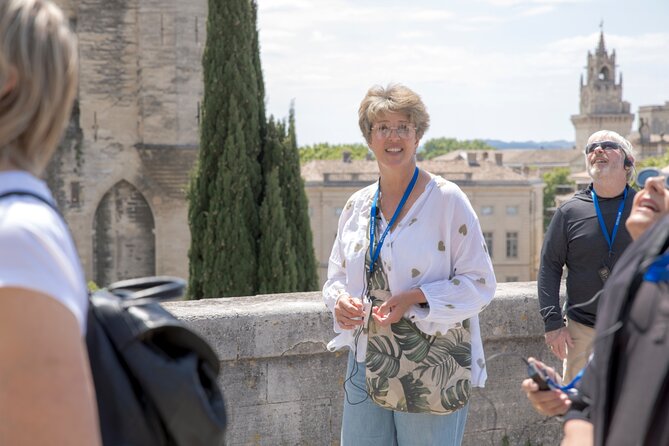
The best thing about this walk is its sense of proportion. In about two hours, you move from the massive Palace of the Popes to quiet churches, busy squares, and the ordinary streets that link Avignon’s big sights. Guide Ana Maria keeps the story moving with dates, local details, and a little humor.
I like the comfortable pace and the useful orientation. You get a clear picture of where everything sits before deciding which monuments deserve a longer visit. I also like the whispering boxes, since they let you hear the guide in busy streets without gathering around her. The main catch is simple: admission is not included, and church visits depend on opening schedules. On Mondays, some churches may be closed.
Key points at a glance
- The Palace of the Popes anchors the walk: You learn why Avignon became the seat of the papacy and how the palace shaped the city.
- The route stays mostly flat: There are some steps, including a short flight near the Palace of the Popes, so moderate mobility is needed.
- Two church visits are included when open: The exact churches can change with the day’s schedule.
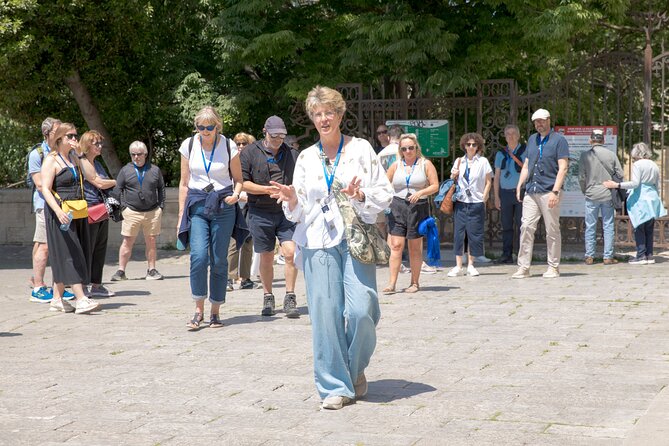
- Ana Maria leads in English: Her approach mixes dates, stories, local suggestions, and light humor.
- You pay for major sights separately: The tour gives you context, but palace and museum tickets are not part of the $24.03 price.
- The walk ends on Rue de la République: You finish near the fountain, well placed for further exploring.
Why this Avignon walk works as a first-day tour

Avignon can feel confusing at first. The Palace of the Popes dominates the skyline, the old city is enclosed by walls, and several important churches and squares sit close together but are easy to miss when you explore alone.
This walk gives you a usable map in your head. You start at 16 Place Crillon and finish by the fountain on Rue de la République, the city’s main street. Along the way, you pass the major landmarks in the historic center rather than spending the whole time inside one paid attraction.
That choice matters. A visit to the Palace of the Popes can easily fill several hours, but you may not yet know how it fits into Avignon’s wider story. This tour gives you that setting first. Afterward, you can return to the palace, a museum, or one of the churches with a better idea of what you want to see.
The walk lasts about one and a half to two hours. The route is generally easy underfoot, though you will go up and down some steps. One account describes the main physical challenge as a short flight of about 15 steps near the Palace of the Popes. You should have a moderate level of mobility.
More History Walking Tours in France
- Paris: Dark History and Ghostly Guided Walking Tour
★ 4.7 · 1,000 reviews - Vieux Lyon Cultural & Historical Walking Guided Tour (English)
★ 5.0 · 942 reviews - Strasbourg: Guided Historical Neighborhoods Walking Tour
★ 4.9 · 275 reviews
Starting at the Palace of the Popes
The Palace of the Popes is the natural star of the route. Built in the 14th century, it is one of Europe’s largest Gothic buildings and the clearest reminder that Avignon was once a major center of Western Christianity.
You will learn about the period when the popes lived in Avignon rather than Rome. The palace was not simply a church residence. It was a seat of political power, administration, ceremony, and diplomacy. Its size makes more sense once you understand that the popes needed a court, offices, chapels, apartments, and spaces for formal visitors.
The stop is scheduled for around 10 minutes, so do not expect a full interior visit. The admission ticket is not included. The guide uses the palace as a setting for explanation, while you decide later if you want to pay to explore its grand halls, papal rooms, chapels, courtyards, and frescoes.
That arrangement is good value for a short introductory walk, but it is important to set your expectations correctly. If you want to inspect the palace’s rooms in detail, budget extra time and money for a separate visit. The walking tour provides background, not entry.
Notre-Dame des Doms and the upper city
Next comes the Cathedral of Notre-Dame des Doms, directly beside the palace. Its Romanesque form is older and more restrained than the Gothic palace, which makes the pair useful for comparing two major periods of Avignon’s building history.
Look up at the gilded Virgin Mary on the bell tower. The statue is one of the city’s most recognizable markers and can be seen from across Avignon. Inside are religious artworks, frescoes, and the tombs of popes connected with the Avignon papacy.
The cathedral visit is listed as free, though opening hours can affect access. The nearby gardens also offer views over the city, making this one of the more rewarding pauses on the route even if you spend only a short time inside.
The stop is planned for about 10 minutes. That is enough for an introduction and a quick look, not a careful study of every chapel. If the cathedral catches your interest, note it as a place to revisit after the tour.
Place de l’Horloge and the everyday city
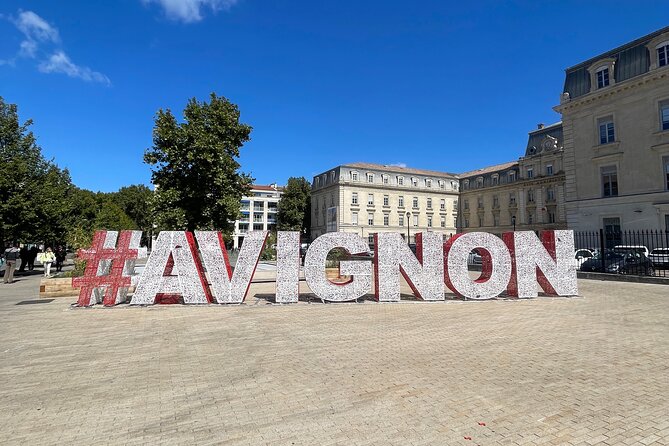
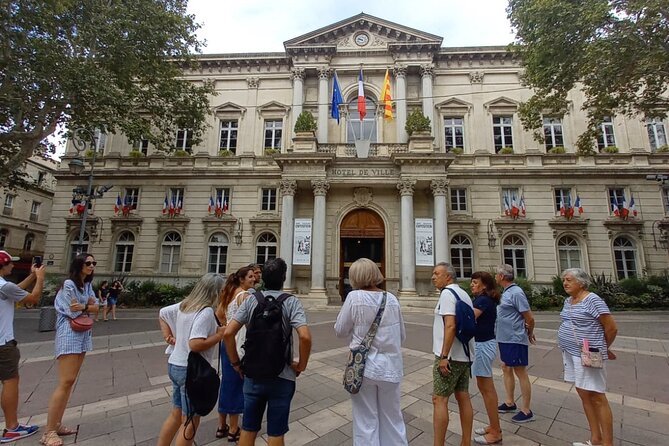
Place de l’Horloge changes the mood. After the solemn palace and cathedral, you arrive at one of Avignon’s main public squares, surrounded by cafés, restaurants, the City Hall, and the opera house.
The name comes from the clock tower that once belonged to the medieval bell tower of the City Hall. The square also gives you a feel for present-day Avignon, with its cafés, events, markets, and street activity. This is not just a photo stop. It helps connect the medieval city to the place people use today.
You will spend about 10 minutes here. Admission is not needed, but food and drinks are personal expenses. If you want a café break, I would save it for after the walk so you do not lose track of the group.
The nearby Opéra d’Avignon gets a shorter stop of around five minutes. Its 19th-century neoclassical façade brings another period into view. The building has hosted opera, ballet, and concerts for more than 150 years, though this walking tour focuses on the exterior rather than a performance or interior visit.
Same streets, a different century:
- Paris: Louvre Museum Entry with History of Mona Lisa
★ 3.9 · 2,823 reviews - Bordeaux: Historic Center & Chartrons District Bike Tour
★ 4.8 · 709 reviews - From Strasbourg: Best Of Alsace Historical Day Trip
★ 4.7 · 633 reviews - Toulouse Food & History Tour with a Chef (in English)
★ 5.0 · 503 reviews
Two churches, when the doors are open
Church visits are one of the most appealing parts of the walk, but they are also the least certain. The experience includes visits to two churches when schedules allow, and the exact choice may change.
The first possibility is Collégiale Saint-Agricol, one of Avignon’s older churches. Its Romanesque and Gothic features, stained glass, carvings, altar, and religious art offer a quieter counterpoint to the palace. It sits near Rue Saint-Agricol, where the surrounding streets are more active.
You may also visit Basilique Saint-Pierre. Its 14th-century Gothic design is especially notable from the outside, with a carved façade and bell tower. Inside, you might see decorated chapels, stained glass, and religious artworks connected with the city’s spiritual life.
The route can also include Collégiale Saint-Didier. This church combines Romanesque and Gothic elements, with vaulted ceilings, stone carvings, stained glass, and an impressive altarpiece. It also has links to important religious and civic events in Avignon’s past.
The information for this experience lists two church visits, not a guaranteed visit to all three. Opening hours control the final choice. Monday can be a problem, and one scheduled walk had churches closed that day. The guide still provided the city walk, but anyone booking on a Monday should be ready for a more exterior-focused experience.
Pets can accompany you outdoors, but they must wait outside while the group enters a church. Children under 12 do not receive whispering boxes.
The Petit Palais and Avignon’s art collection
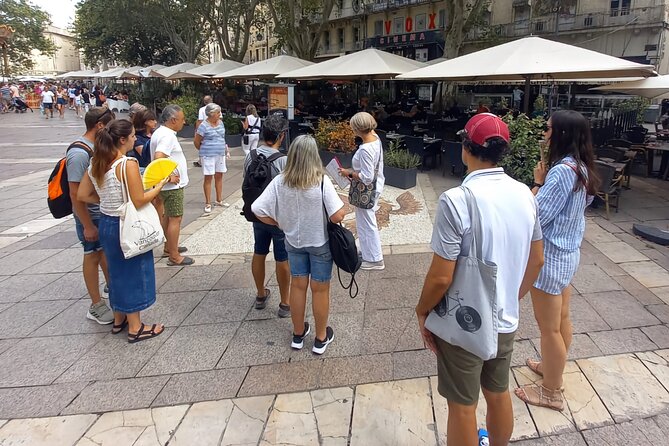
The Musée du Petit Palais is another highlight on the route, though the museum ticket is not included and the planned stop is only about five minutes.
The museum occupies a 14th-century Gothic palace that once housed Avignon’s archbishops. Its collection includes medieval and Renaissance paintings, with works associated with artists such as Botticelli, Raphael, and Jean-Baptiste-Camille Corot.
Five minutes is enough to point out the building and explain why it matters. It is not enough for a meaningful museum visit. I would treat this stop as a recommendation for later, especially if you care about painting or want a quieter indoor activity.
The museum’s restored rooms and garden are part of its appeal. You can return independently after the tour and give the collection the time it deserves. This is one of the clearest examples of how the walking tour works best as an introduction rather than a complete sightseeing day.
What the whispering boxes add
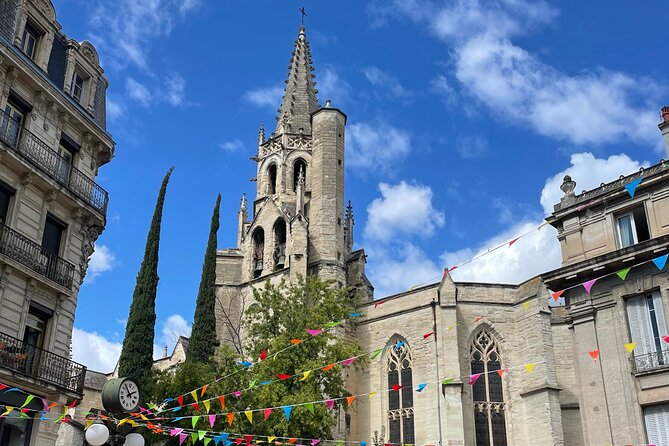
The supplied equipment includes whispering boxes, and you can bring your own 3.5-millimeter earphones. The guide speaks into a microphone while you listen through the small receiver.
This can be useful in streets where traffic, café noise, or other groups make normal conversation hard. You do not need to stand shoulder to shoulder with the guide, and you can keep looking at a building while still following the explanation.
The system is not perfect for everyone. One person found the earpiece less satisfying, while most of the available comments praised the clear sound and comfortable spacing. If you dislike audio equipment, this may be the one feature that feels less natural.
Still, for a group of up to 25 people, it solves a real problem. A larger group can spread out a little without losing the thread of the story. Bring your own compatible earphones if you prefer them, and remember that children under 12 do not receive the devices.
Ana Maria’s guiding style
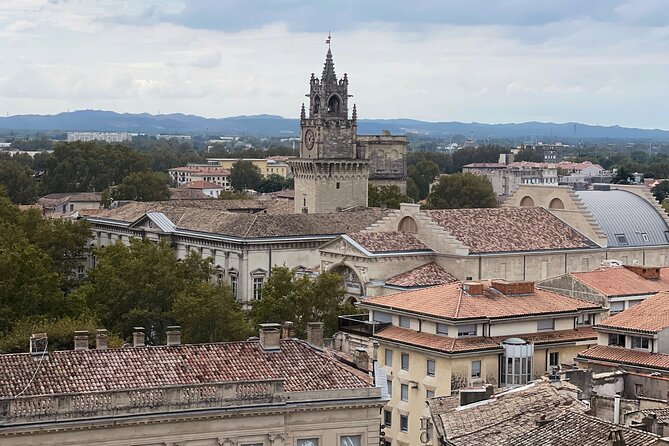
The guide is identified in the feedback by several versions of the name Ana Maria, including Ana and Ana-Marie. Her style comes through clearly: she explains Avignon’s past in a friendly way, answers questions, and adds current local suggestions rather than reciting dates without context.
Her strongest quality is balance. She gives you historical facts, but the walk is not presented as a heavy lecture. Stories, humor, and practical ideas help keep the pace light. One particularly useful suggestion was the local library, which makes this experience feel connected to the living city rather than limited to famous monuments.
You should also feel free to ask questions during or after the walk. Some people want more detail about the popes, while others care more about food, streets, architecture, or what to revisit later. The format leaves room for that kind of conversation.
Is $24.03 a fair price?
At $24.03 per person, this is a reasonable price for a guided orientation walk in central Avignon. You are paying for the guide, the route, the stories, the communication equipment, and visits to two churches when open.
You are not paying for entry to the Palace of the Popes, the Petit Palais Museum, or other museums and monuments. That keeps the base price low, but you need to add admission costs if you want to go inside the major paid sights.
I see this as good value if you are new to Avignon and want help deciding how to spend the rest of your stay. It is less useful if you already know the old city well or want a detailed interior visit at every landmark.
The average booking lead time is about 14 days, so popular dates may fill ahead of time. Free cancellation is available until 24 hours before the start time. Bad weather or failure to reach the minimum group size can lead to a different date or a full refund.
Who should book this walk?
I would choose this tour at the start of a stay, especially if you have several days in Avignon. It gives you enough context to make later visits to the palace, cathedral, museum, and churches more rewarding.
It also suits first-time visitors who prefer a gentle pace. The route is mainly flat, and the walking is not described as strenuous, though steps and some mobility are required. Families can join, but young children will not receive whispering boxes.
This is a good fit for anyone who wants history without a formal classroom feel. Ana Maria’s approach combines dates and architecture with humor and local suggestions. You will hear enough to understand the city, but not so much that every building becomes an academic exercise.
You should think twice if your main goal is a full tour of the Palace of the Popes. The palace is only one short stop, and its admission is separate. You should also check the day carefully if entering churches matters to you, since schedules can change and Mondays may limit access.
Should you book the Enchanting Historical Walking Tour in Avignon?
Book it if you want a friendly first look at Avignon, a clear route through the walled center, and useful background before choosing which sights to visit in depth. The price is modest, the walk is manageable, and the whispering boxes help you follow the guide in crowded places.
Do not book it expecting a palace tour, museum visit, or guaranteed access to every church. Those are separate experiences. Think of this as a well-priced introduction led by Ana Maria, with enough history and local flavor to help you plan the rest of your time.
FAQ
How long does the Avignon walking tour last?
The tour lasts approximately one and a half to two hours.
What language is the tour offered in?
The tour is offered in English.
Where does the tour begin?
It begins at 16 Place Crillon, 84000 Avignon, France.
Where does the tour end?
It ends by the fountain on Rue de la République, at 35 Rue Théodore Aubanel, 84000 Avignon.
Is admission to the Palace of the Popes included?
No. Admission to the Palace of the Popes is not included in the tour price.
Are museum tickets included?
No. Tickets and visits to museums are not included.
Does the tour enter any churches?
The tour includes visits to two churches when schedules allow. The churches may vary, and access can be affected by opening hours.
Is the tour suitable for people with limited mobility?
You need a moderate level of mobility because the route includes going up and down some steps. One part near the Palace of the Popes includes about 15 steps.
Are pets allowed?
Pets are welcome on the walk, but they must wait outside while the group visits churches.
What happens if the tour is canceled because of bad weather?
You will be offered a different date or a full refund if poor weather causes the tour to be canceled.
Newest history tours we have reviewed in France
- Small-Group Full-Day Tour of Côte de Nuits, Côte de Beaune Vineyards and Beaune Historical District★ 5.0 · 364 reviews
- Private Bordeaux History Tour with a glass of Bordeaux wine.★ 5.0 · 28 reviews
- Bordeaux Historic and Gourmet Food Walking Tour★ 4.5 · 82 reviews
- Bordeaux’ Best Boulangeries & History Tour★ 5.0 · 126 reviews
- Historical Center, Bordeaux Food Tour★ 5.0 · 33 reviews
- 2-Hour Walking Tour of the City’s Iconic Sights and History★ 4.0 · 207 reviews
- Private Walking Guided Tour of Historic Bayeux English or French★ 5.0 · 36 reviews
- Historic Bayeux Daily Group City Tour In English 2 hrs (Apr-Sept)★ 5.0 · 220 reviews
History Walking Tours, compared.
History and Hauntings of Salem Guided Walking Tour
Read our review →
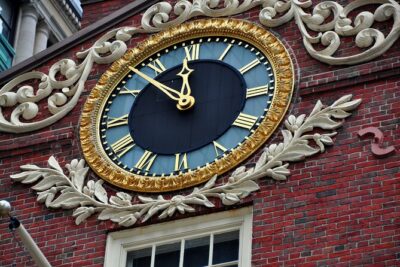
Freedom Trail History Small Group Walking Tour
Read our review →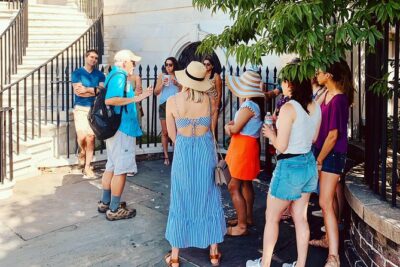
Historic Charleston Guided Sightseeing Walking Tour
Read our review →
Tapas Walking Tour with Food, Wine, and History
Read our review →
Savannah History and Haunts Candlelit Ghost Walking Tour
Read our review →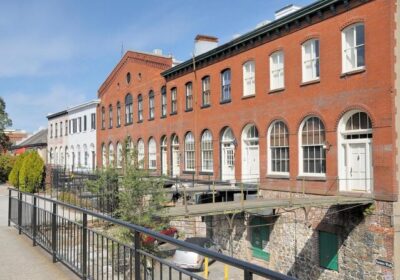
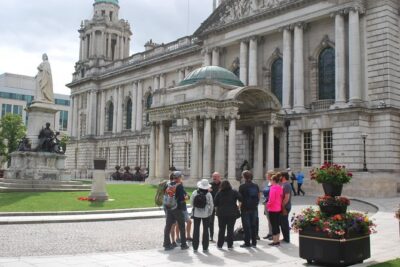
A History of Terror – Belfast City Centre Walking Tour
Read our review →Browse the lists this tour appears in