
Review · UK HISTORY TOURS
Belfast Political/history/troubles private taxi/cab tour
The most striking part of this Belfast tour is the quick shift between the Falls Road and Shankill Road, two communities separated by politics, religion, memory, and still-visible walls. Your guide drives through both areas, explains the conflict, and stops at murals, gates, and the Peace Wall rather than leaving you to puzzle out their meaning alone.
I like the private taxi format, which gives you room to ask blunt questions without a large group listening in. I also like the local voices, including guides such as Caolan and Diarmaid, who have personal connections to Belfast and can explain how public history affected ordinary families. The main drawback is the short advertised length: 90 minutes can introduce the subject, but it cannot explain every turn in Northern Ireland’s complicated past.
Key points to know
- Falls Road and Shankill Road: See both sides of Belfast’s divided communities in one compact trip.
- Local guides: Guides including Caolan, Diarmaid, Caolan, and others are praised for personal stories, humor, and clear explanations.
- Peace Wall stop: You can stop, take photographs, and write your name or a message on the wall.
- Private vehicle: Only your group takes part, making it easier to ask questions and control the pace.
- Good use of limited time: The 90-minute route fits neatly into a busy Belfast visit.
- Central pickup: Meet at Great Victoria Street or arrange pickup in central Belfast. Locations outside the center cost a small extra taxi fee.
What this Belfast taxi tour is really about
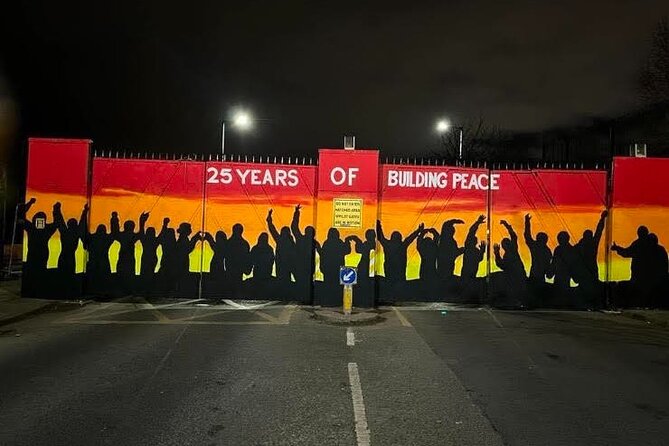
This is not a general city sightseeing ride. It is a focused look at Belfast’s political past, especially the period known as the Troubles, when nationalist and unionist communities were caught in decades of violence.
The route takes you through the Catholic community around Falls Road and the Protestant community around Shankill Road. Those labels are useful shorthand, but they do not tell the whole story. Your guide’s job is to connect the streets, murals, memorials, gates, and walls with the larger political story.
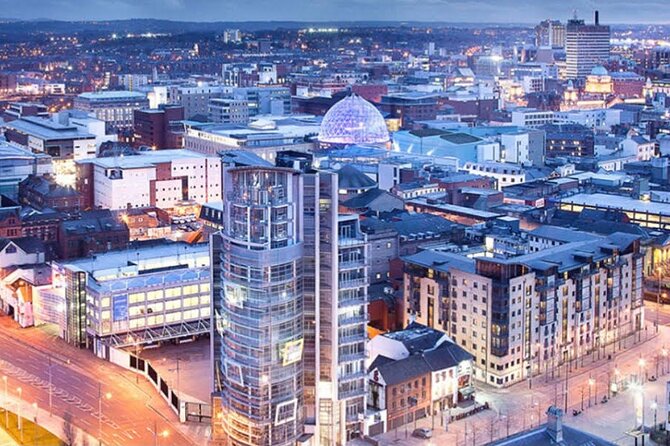
That matters because Belfast can look like a normal modern city at first glance. The shopping streets, hotels, and restaurants do not always show how close the old divisions remain. A short drive can take you from the city center to streets where political identity is still displayed on walls and painted gables.
I find a taxi tour especially useful here because the sights are spread across neighborhoods. You do not have to work out which murals or barriers matter most. The driver brings you directly to the key places and gives you context while moving between them.
More Private History Tours in the UK
- Private Historical Walking Tour of York
★ 5.0 · 1,324 reviews - Private Group: Historical Pub Walking Tour of London
★ 5.0 · 660 reviews - Private Political History & Murals Tour Belfast
★ 5.0 · 182 reviews
Falls Road and Shankill Road, two sides of one city
The tour begins with Belfast’s divided communities, generally taking in Falls Road on the Catholic, largely nationalist side and Shankill Road on the Protestant, largely unionist side.
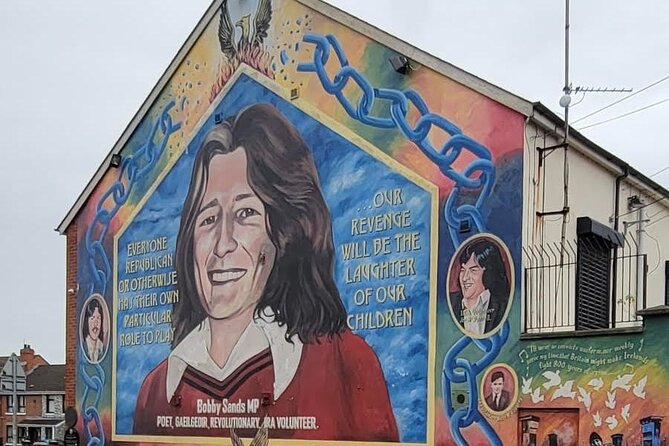
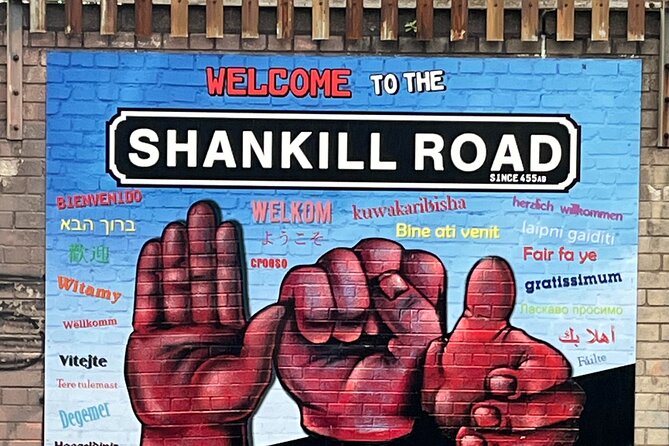
On Falls Road, murals and memorials reflect Irish nationalism, republican politics, hunger strikes, and the struggle for Irish unity. On Shankill Road, murals and memorials reflect British identity, unionism, loyalty to the United Kingdom, and the experience of the Protestant working-class community.
Your guide explains how these positions developed and how they shaped daily life. The best guides do not reduce the story to heroes and villains. Several guides named by customers, including Caolan and Diarmaid, are praised for explaining both communities and answering difficult questions in a direct, human way.
You should still listen carefully to the language used. Words such as Catholic, Protestant, nationalist, republican, unionist, and loyalist describe different things, and they do not always fit neatly into two boxes. A good question to ask is how political identity, religious background, neighborhood, and personal experience overlapped. This tour gives you the chance to ask that sort of question in the moment.
The strongest part of the route is the contrast between the two districts. The drive is not simply a trip from one photo stop to another. You are seeing how nearby neighborhoods developed separate symbols, memorials, and public memories.
Murals that need explanation
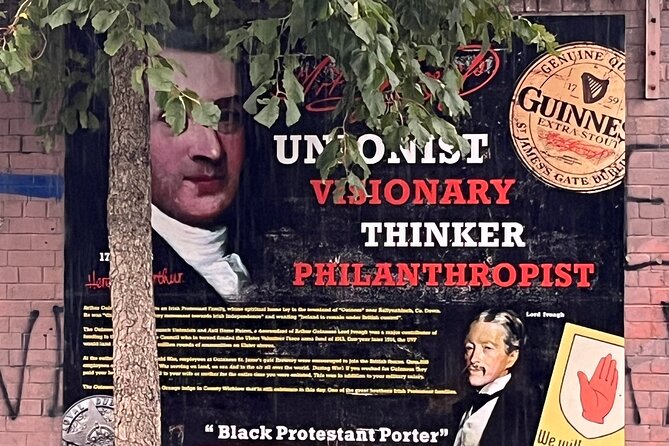
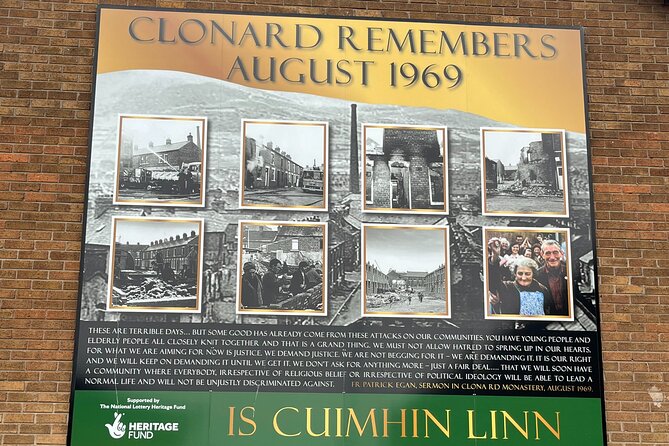
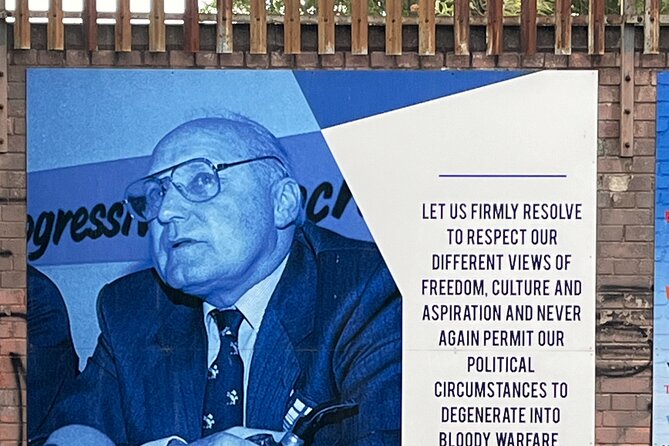
Belfast’s murals are not mere street decoration. They are political statements, memorials, community markers, and reminders of past events.
Your taxi stops at selected murals so you can get out, take photographs, and look closely. That stop-and-explain approach is far better than racing past painted walls while a guide talks over the engine noise. You can ask what a symbol means, who is remembered, and how the mural fits into the community around it.
Some murals concern armed groups or political leaders. Others remember people killed during the Troubles, political prisoners, hunger strikers, marches, or local events. The subject matter can be painful. You may see images that feel proud, angry, mournful, or openly partisan.
That is why the guide matters so much. A well-presented explanation can show what the mural means to the people who live nearby without asking you to approve of every message. Several guides are praised for being frank and fair, while one customer felt the presentation leaned too heavily toward the nationalist side. That difference is worth keeping in mind. The company describes the tour as balanced, but any account of Belfast’s past is shaped by the guide’s experience and interpretation.
You can help keep the conversation useful by asking for the unionist view as well as the nationalist view. Ask what each community feared, what each side wanted, and how ordinary residents experienced the violence. The private setting makes this easier than it would be on a large coach.
The Peace Wall and the gates
The Peace Wall is the emotional center of the tour. It is a physical barrier between communities, but it also represents how a ceasefire and peace process do not instantly erase fear or separation.
You stop at the wall to take photographs and have the chance to write your name or a message on it. That sounds like a small detail, yet it gives you a moment to pause rather than simply collect another picture.
The tour also takes in gates that separate the communities. Their presence can be startling, especially when you consider that some gates are still closed at night. The point is not to treat them as a dramatic backdrop. They show that security concerns and community mistrust did not disappear when the worst violence ended.
I would give the wall and gates your full attention. Murals can be colorful and visually striking, but the barriers are harder to dismiss. They bring the story into the present and make clear that peace is a process, not a clean finish line.
Same streets, a different century:
- London Small Group Tour of Historical Pubs
★ 5.0 · 10,422 reviews - Edinburgh: Edinburgh Castle Guided History Tour with Tickets
★ 4.8 · 9,933 reviews - A History of Terror – Belfast City Centre Walking Tour
★ 5.0 · 2,883 reviews - Edinburgh: Whisky Tasting with History and Storytelling
★ 4.9 · 2,451 reviews
A local guide makes the difference
This experience depends heavily on who drives the taxi. The most praised guides include Caolan, Diarmaid, Caolan, Kieghlan, Calum, and Cillian, with spellings varying in customer comments. Some are described as having grown up in Belfast or in the communities along the route. That personal connection can add texture to the history.
A local guide may explain not only what happened, but how people remember it now. You might hear about marches, hunger strikes, political campaigns, family stories, and the work of building peace. One guide even gave a list of books, podcasts, and other material for further study. That is a useful touch because 90 minutes can only give you a framework.
The humor also matters. The subject is heavy, and a guide who can be warm and relaxed helps the conversation remain human. Several guides are praised for being funny, personable, and easy to talk to while still treating the subject with care.
Do not confuse a personal connection with perfect neutrality. A guide who lived through the period may offer insight that a textbook cannot, but that person also has a point of view. I would listen for what is presented as fact, what is personal memory, and what is interpretation. Then ask for the other community’s account when you need more balance.
One customer felt the tour was too sympathetic to Catholic separatists and did not give enough weight to other views. That is the main caution in an otherwise very strong set of comments. If you want a strictly academic account with equal time assigned to every argument, this may not fully satisfy you. If you want a direct local explanation and are willing to ask questions, it is a strong introduction.
Why the private taxi format works
A private vehicle gives this tour several practical advantages. Your group rides alone, so you can ask questions without worrying about a busload of strangers. You can also discuss a sensitive subject at your own comfort level.
The taxi format is also efficient. Belfast’s political sites are not all in one compact square. Moving between Falls Road, Shankill Road, the murals, gates, and Peace Wall by taxi lets you cover more ground than a walking route in the same time.
The advertised duration is about 90 minutes from pickup to drop-off. That is enough for a useful introduction and several stops, but do not expect a full study of the Troubles. Some customers received much longer tours when the guide had no later booking, including one that lasted nearly three hours. You should regard that as an occasional bonus, not part of the promised service.
A short tour works well if you have a tight schedule, a cruise-day visit, or only one day in Belfast. It also suits families and mixed-age groups because you can ask the guide to explain difficult topics in a way that fits your group. One customer specifically found the presentation suitable for a six-year-old.
Price, timing, and practical details
The listed price is $90.19 per person. That is not the cheapest way to see Belfast, but the value depends on your group size and interest in the subject.
For one person, the price buys a compact private experience with a dedicated driver-guide. For two or more people, the cost can make more sense because you are sharing the vehicle and guide rather than paying separately for several activities. You are also paying for local interpretation, stops at meaningful sites, and the chance to ask questions directly.
The central meeting point is on Great Victoria Street, with the Leonardo Hotel given as the chosen destination for arranged pickup. You can request pickup from another location in Belfast. Pickup outside Belfast city center brings a small additional taxi charge.
The tour is offered in English and uses a mobile ticket. Confirmation arrives when you book. Service animals are allowed, and the activity is near public transportation. Most people can participate, although the supplied information does not give a detailed mobility plan for every stop, so it is sensible to ask ahead if you have specific access needs.
Alcohol is not included. That is hardly a surprise for a political history tour, but plan any drinks separately.
The cancellation policy is useful if your plans are uncertain. You receive a full refund when you cancel at least 24 hours before the start time. Cancellations or changes inside that 24-hour window are not refunded or accepted, and the cut-off uses Belfast local time.
Who should book this tour?
I would choose this tour if you want to understand Belfast beyond its center and museums. It is especially useful for first-time visitors who know little about Northern Ireland’s political history and want a clear starting point.
It also suits you if you prefer conversation to a scripted group presentation. The private taxi gives you time to ask about identity, religion, political goals, family experience, and the meaning of the murals.
This is a good fit for:
- Couples or families who want a private vehicle
- History fans who want real sites rather than only exhibits
- Visitors with about 90 minutes available
- People who want to compare Falls Road and Shankill Road directly
- Travelers who value a local guide’s personal perspective
- Anyone willing to ask respectful questions about both communities
You may want something else if you need a long, formal academic lecture, a guaranteed three-hour tour, or a fully fixed script with identical treatment of every political viewpoint. The tour is personal and guide-led. That is its strength, but also its limitation.
Should you book the Belfast political taxi tour?
Yes, if your goal is a focused, personal introduction to Belfast’s Troubles-era history. The route covers the places you most need to see: Falls Road, Shankill Road, murals, community gates, and the Peace Wall. The private setting adds real value, and guides such as Caolan and Diarmaid are praised for warmth, humor, personal experience, and clear explanations.
Go in ready to listen and ask for more than one perspective. The subject is painful, and no 90-minute tour can settle every argument. But if you want to see the physical marks of division and begin making sense of Belfast’s past, this is a practical use of a short block of time.
FAQ
How long does the Belfast political taxi tour last?
The advertised tour lasts about 90 minutes, including pickup and drop-off. A longer tour may sometimes be possible if the guide has no later booking, but that is not guaranteed.
Where does the tour start?
The main meeting point is on Great Victoria Street in Belfast. The Leonardo Hotel on Great Victoria Street is given as the chosen destination for arranged pickup.
Can I be picked up from my hotel?
Yes. Pickup can be arranged from your location in Belfast. Pickup destinations outside Belfast city center include a small extra taxi charge.
Is this a private tour?
Yes. Only your group participates, and you travel in a private vehicle with the tour guide and driver.
Which Belfast areas does the route visit?
The route takes you through Falls Road, associated with Belfast’s Catholic community, and Shankill Road, associated with its Protestant community. It also includes murals, community gates, and the Peace Wall.
Can I take photographs during the tour?
Yes. The driver stops at selected murals and other points so you can take photographs and see the sites in person.
Can I write on the Peace Wall?
Yes. You have the opportunity to write your name or a message on the Peace Wall during the stop.
Is the tour available in a language other than English?
The tour is offered in English.
Newest history tours we have reviewed in the UK
- Ilfracombe Seafront History Walking Guided Tour★ 5.0 · 18 reviews
- Walking Bogside History Tour in Guildhall★ 5.0 · 280 reviews
- Private tour of the stunning Cotswolds with an expert local guide★ 5.0 · 45 reviews
- Curious Cambridge – The History Tour that’s FUN!!!★ 5.0 · 80 reviews
- Birmingham Gangs Nighttime Historical Walking Tour with Pub Stops★ 5.0 · 53 reviews
- 2.5-Hours Walking Tour of Birmingham into Black Heritage Madiba★ 5.0 · 49 reviews
- Private Political History & Murals Tour Belfast★ 5.0 · 182 reviews
- Belfast Walking Tour: City Centre History, Troubles & Stories★ 5.0 · 39 reviews
Private History Tours, compared.
Private Guided Historic Electric Cart Tour of St. Augustine
Read our review →
Private Full-Day Tour of Historical Alexandria
Read our review →
Private Tour of the Historic City in a Ford T Car
Read our review →
Madrid Historical Tour with Local Guide in Eco Tuk Tuk Private
Read our review →
Private Biblical Tour Ancient Corinth & Isthmus Canal from Athens
Read our review →
Private Kathmandu Sightseeing Tour | UNESCO World Heritage sites
Read our review →
Historic Porto by Private Electric Tuk Tuk to Top Landmarks
Read our review →Browse the lists this tour appears in