
Review · ITALY HISTORY TOURS
Rimini: Guided Walking Tour of the Historic City Center
Rimini is much more than a seaside resort. This short walk takes you from Roman gates and bridges to Renaissance churches, a restored theater, and colorful murals honoring filmmaker Federico Fellini. The Roman-to-Fellini route gives you a useful first look at a city many beach visitors miss.
I like the low price and the smart mix of major sights. I also like the way the tour links Rimini’s buildings to its changing role as a Roman town, medieval port, Renaissance court, and modern film city. The main consideration is pace: in 90 minutes, you get a strong introduction, not a detailed visit inside every monument.
The tour is conducted in Italian, and guide Francesca has been praised for clear organization, humor, and strong storytelling. One important caution: the activity is described as wheelchair accessible, yet it is also marked unsuitable for people with mobility impairments. I would confirm the route conditions before booking.
Key points at a glance
- Roman Rimini comes first: See the Arch of Augustus, Surgeon’s Domus, and five-arch Ponte di Tiberio.
- The route crosses many centuries: Medieval Galliana Gate, Malatesta Temple, Castel Sismondo, and modern cultural sites all fit into one walk.
- Fellini gets a proper ending: Cinema Fulgor and San Giuliano’s murals connect Rimini to its most famous filmmaker.
- The tour is short and affordable: At $15 for 1.5 hours, it works well as a first orientation to the old center.
- Italian is the tour language: Ask about this before booking if you do not understand Italian.
- Comfortable shoes matter: The walk runs in rain or shine, and the order of sights may change.
Why this Rimini walk is worth your time
I like this tour because it corrects a common mistake: treating Rimini as only a beach destination. The historic center has a compact string of major landmarks, and a guide helps you see how they fit together instead of meeting them as isolated photo stops.
At $15 per person, the value is strongest if this is your first visit. You get a live guide, a planned route, and historical context for less than the cost of many longer city walks. You will not get museum admission, food, drinks, or hotel pickup, but the tour is priced as a focused introduction rather than a full-day cultural program.
The 1.5-hour length is another advantage. You can fit it before lunch, after arriving in town, or into a day that includes the coast. The tradeoff is clear: the guide must keep moving. You should see the walk as a best of Rimini route, then return later to the places that catch your interest.
More History Walking Tours in Italy
- Venice: City Center Historical Guided Walking Tour
★ 4.2 · 1,873 reviews - Palermo: Street Food and History Walking Tour
★ 4.9 · 1,486 reviews - Verona: History and Hidden Gems Guided Walking Tour
★ 5.0 · 1,379 reviews
Beginning at the Arch of Augustus
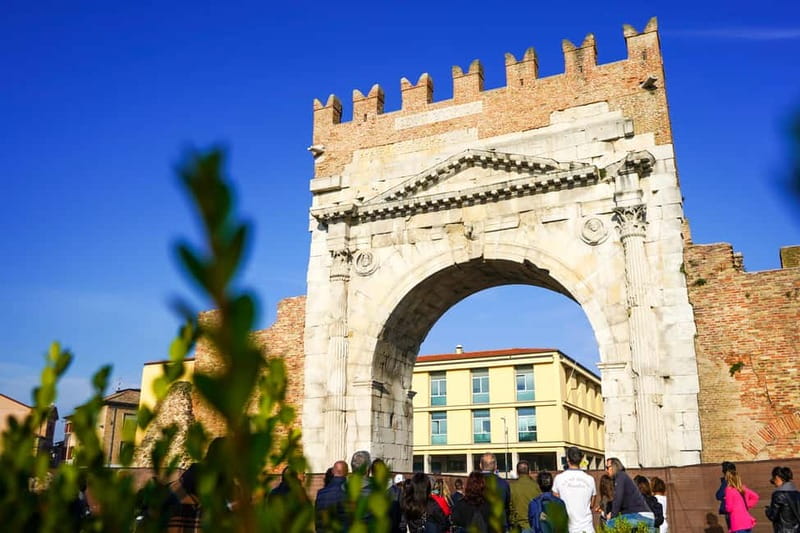
Meet inside the tourist office at Corso d’Augusto 152. The tour begins with the Arch of Augustus, an ideal starting point because it marks the main entrance to Rimini’s old center and immediately places the city in its Roman setting.
The arch gives you a sense of scale and purpose. This was not simply a decorative gateway. It announced arrival and connected Rimini to the wider Roman road system. Your guide can use it to explain the city’s ancient origins before leading you into streets shaped by later periods.
Take a moment to look closely at the structure before following the group. With only 90 minutes, the schedule may not allow long pauses at every stop, so quick attention to details helps. Comfortable shoes are essential, especially since the route continues through old streets and public squares.
The Surgeon’s Domus and Roman engineering
The walk passes the Surgeon’s Domus, an important archaeological complex. This stop adds a human scale to the Roman story. The Arch of Augustus shows the city’s public face, while the Domus points toward daily life, medicine, and the remains of a working settlement.
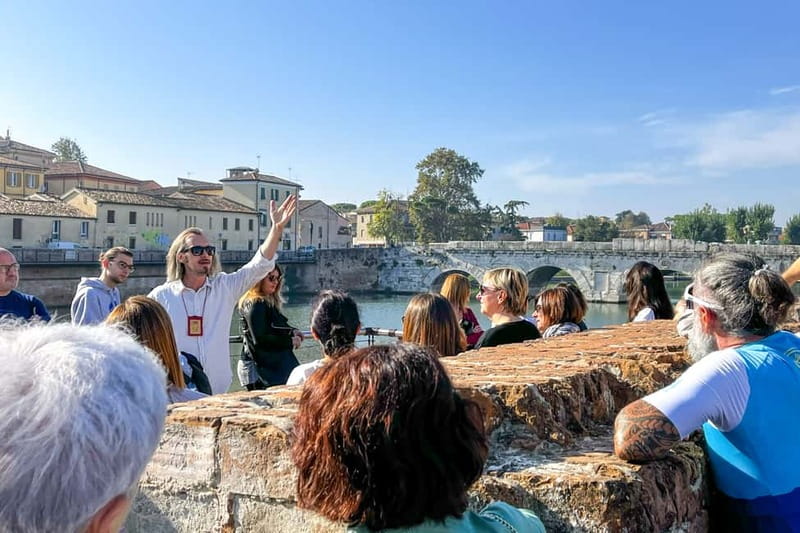
The tour then reaches the Ponte di Tiberio, or Tiberius Bridge. Its five arches are among the clearest reminders that Rimini was a serious Roman building project, not just a modern resort with a few old stones left behind.
I like this part of the route because the bridge makes Roman engineering easy to understand. You do not need a long lecture to appreciate the purpose of a strong crossing over the water. The stone structure also gives the tour a good visual pause before it turns toward medieval and Renaissance Rimini.
Your guide may adjust the order of stops, so the bridge could appear at a slightly different point in the walk. That flexibility is normal for a guided city route and does not change the main sights promised.
Galliana Gate and Rimini’s medieval edge
The Galliana Gate introduces a different period. It once formed part of Rimini’s defensive wall and connected the city with the port area. Compared with the grand Roman arch and broad bridge, this site feels more connected to the practical needs of a medieval town.
Here, I find the value of a guide especially clear. A defensive gate can be easy to pass without noticing, particularly when later buildings have grown around it. The explanation helps you read the old center as a layered place, where roads, walls, waterways, and commercial links shaped the city over time.
The route uses narrow streets lined with old buildings. These lanes are part of the appeal, but they also mean you should stay close to the guide. One person had trouble when a faster member of the group drew the guide ahead, leaving slower walkers behind. That is a useful warning: if you walk slowly, tell the guide early and remain visible to the group.
Same streets, a different century:
- Colosseum: Underground and Ancient Rome Tour
★ 4.7 · 12,691 reviews - Rome: Colosseum with Arena, Roman Forum and Palatine Guided Tour
★ 4.0 · 5,598 reviews - Venice: St. Mark’s Basilica Guided Tour & VR History Intro
★ 3.9 · 4,880 reviews - Colosseum with Arena, Roman Forum and Palatine Hill Guided Tour
★ 4.5 · 3,526 reviews
Malatesta Temple and Castel Sismondo
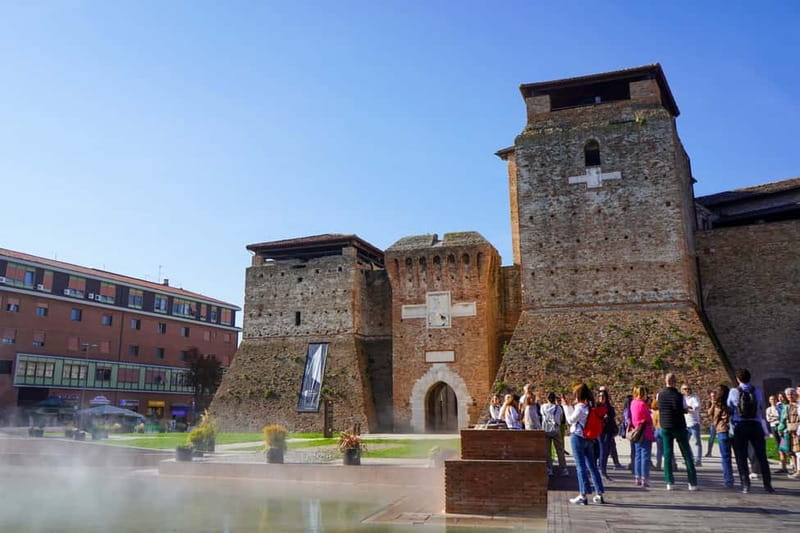
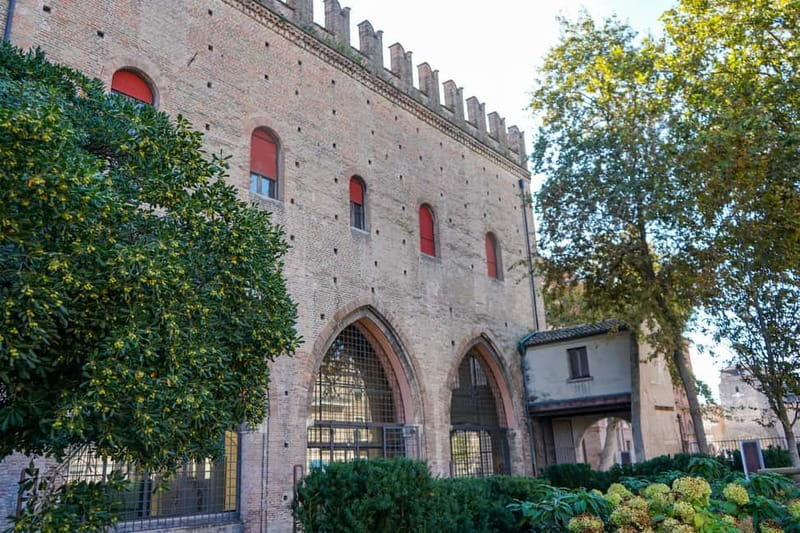
Rimini’s Renaissance chapter arrives with the Malatesta Temple and Castel Sismondo. These are among the strongest architectural stops on the route, and they show how the city changed from Roman settlement to the seat of the powerful Malatesta family.
The Malatesta Temple is a church with an imposing Renaissance identity. Castel Sismondo brings the defensive and political side of that period into view. Seeing both on the same walk gives you a clearer idea of how religion, power, and architecture worked together in Renaissance Rimini.
You should not expect an extended interior visit or a museum-style treatment of either monument. The tour is designed to explain the sights as part of the city walk. If one of these buildings interests you most, make a note and return with more time after the tour.
This is also where the changing architectural styles become most obvious. Roman structures, medieval remains, and Renaissance buildings are not separated into tidy museum rooms. They sit within the same urban fabric, often only a short walk apart.
Piazza Cavour, Teatro Galli, and Cinema Fulgor
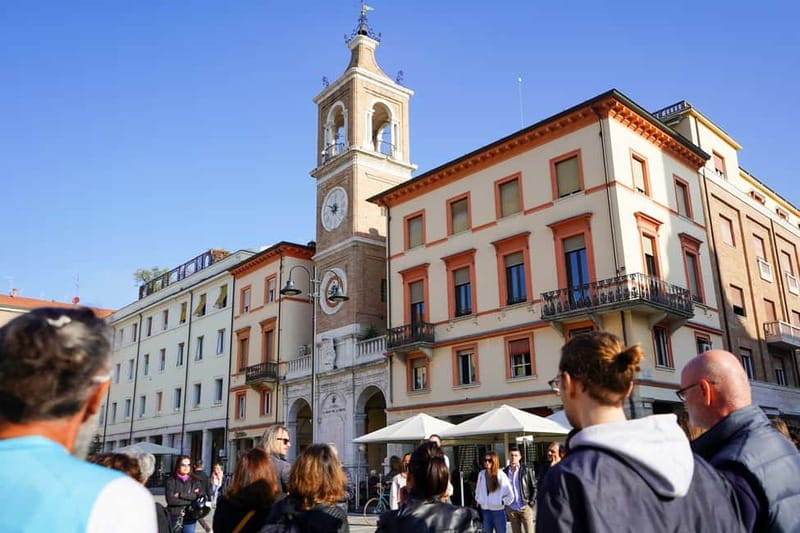
Piazza Cavour was once the heart of the city, and it remains one of the route’s key public spaces. The square brings together Rimini’s civic identity and its cultural life, with the renovated Teatro Amintore Galli and the Cinema Fulgor nearby.
The restored theater adds a sense of modern renewal to the older center. It also helps show that Rimini’s historic core is not frozen in the past. Buildings are repaired, cultural venues return to use, and public spaces continue to serve the city.
Cinema Fulgor gives the tour a personal link to Federico Fellini, who was born in Rimini. The ornate Art Nouveau theater is dedicated to the director and connects the city’s streets with his films and imagination.
I like this shift from stone bridges and defensive gates to cinema. It keeps the walk from becoming a list of Roman and Renaissance monuments. Rimini’s identity includes ancient engineering, courtly architecture, public theater, film, and neighborhood art.
San Giuliano’s murals and the Fellini connection
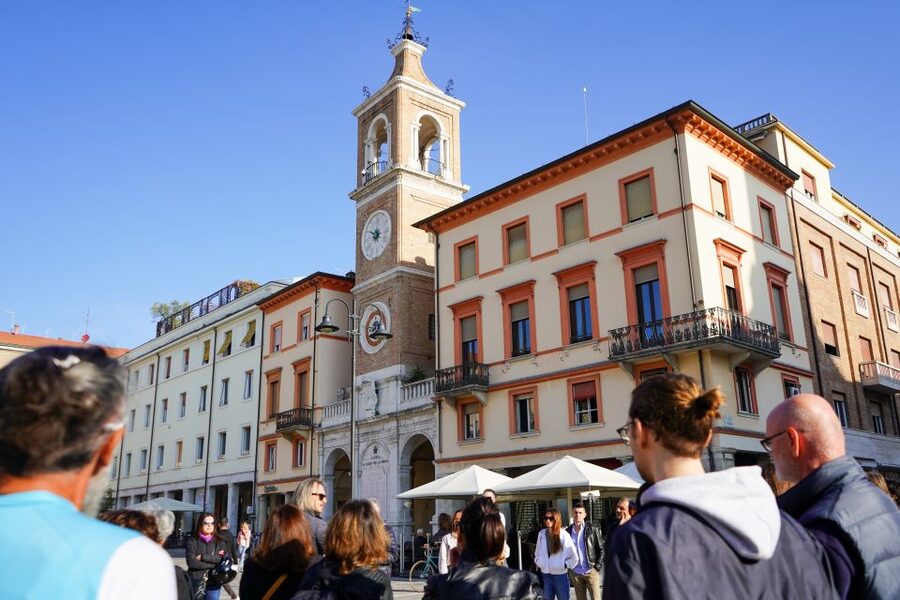
The final section leads through the San Giuliano district, where colorful murals show scenes from Fellini’s best-known work along with portraits of Fellini and his wife. These murals offer a more informal finish than the grand monuments earlier in the route.
This is one of the most memorable parts for many visitors because the art is tied directly to the city’s famous son. Instead of only reading about Fellini, you see how his image and films have become part of Rimini’s public spaces.
The murals also give the walk a neighborhood feel. They are not presented as a formal gallery collection, and their setting matters. You finish by moving through streets where local identity is expressed on walls, not just in churches, palaces, and monuments.
Keep your camera ready here, but do not expect a long stop at every mural. The guide may point out the main scenes and portraits while keeping the group moving toward the end of the route.
The guide and the Italian-only format
The live guide is Italian-speaking, and this matters more than the low price. A good guide can make the difference between simply seeing a bridge and understanding why it was built, or passing a gate and recognizing its connection to the port.
Francesca has been described as well organized, engaging, and able to add just the right amount of humor. That kind of delivery suits a short walking tour, where too many dates can make the route feel heavy. Other feedback points to strong historical preparation, though one participant felt the information was not communicated well.
The practical lesson is simple: book this if you can follow Italian comfortably. The supplied details do not promise English or multilingual guiding. If you need another language, confirm before paying.
Group dynamics can also affect the experience. Stay near the guide, especially on narrow streets, and speak up if you need a slower pace or a repeat explanation. The route is short, so losing contact for even a few minutes can mean missing useful context.
Timing, weather, and walking comfort
The tour lasts 1.5 hours and runs rain or shine. Bring comfortable shoes and dress for the forecast. There is no indication of a dedicated weather break, and the route includes streets, squares, and outdoor monuments.
The order of the sights may change. That is worth knowing if you plan to meet someone at a specific location or want to photograph a particular monument at a certain time. The meeting point remains the tourist office at Corso d’Augusto 152.
Hotel pickup and drop-off are not included. You need to make your own way to the tourist office and continue independently after the walk. Food and drinks are also not included, which is reasonable for a short city-center tour.
The accessibility information needs clarification. The activity is marked wheelchair accessible, but it is also listed as unsuitable for people with mobility impairments. Since the route uses old streets and narrow lanes, contact the provider before booking if you use a wheelchair, walker, or have trouble walking.
Children under five are not suitable for this activity. Older children who can manage a 90-minute historical walk may find the Roman bridge and Fellini murals engaging, but the experience is mainly aimed at adults and older children interested in the city’s story.
Who gets the most from this tour
I would choose this walk during a first stay in Rimini, especially if you have limited time or arrived expecting only beaches. It gives you enough structure to decide where you want to spend more time later.
It also suits anyone who likes seeing several periods in one route. You move from ancient Rome to the Middle Ages, the Renaissance, civic culture, Art Nouveau cinema, and modern street art without needing transport between every stop.
The tour is less suitable if you want lengthy interior visits, a relaxed photographic pace, or guiding in a language other than Italian. It may also frustrate you if you need frequent pauses or have mobility concerns that have not been checked with the provider.
A flexible booking policy helps if your plans are uncertain. You can cancel up to 24 hours in advance for a full refund, and the reserve-now, pay-later option lets you hold a place without paying immediately. Those terms are useful, but they do not replace checking the language and accessibility details first.
Should you book the Rimini historic center walk?
Book it if you want an inexpensive, fast orientation with real historical range. At $15, the tour is a sensible way to connect the Arch of Augustus, Ponte di Tiberio, Galliana Gate, Malatesta Temple, Castel Sismondo, Piazza Cavour, Cinema Fulgor, and San Giuliano’s Fellini murals.
Go in with the right expectation: this is a guided overview, not a series of long monument visits. Confirm that Italian works for you, wear good shoes, and ask about the conflicting accessibility information if needed. If those points fit your plans, this walk can turn Rimini from a beach stop into a city worth exploring on its own.
FAQ
How long does the Rimini walking tour last?
The tour lasts 1.5 hours.
What language is the tour conducted in?
The live tour guide speaks Italian.
Where is the meeting point?
Meet the guide inside the tourist office at Corso d’Augusto 152.
What sights are included?
The route includes the Arch of Augustus, Surgeon’s Domus, Ponte di Tiberio, Galliana Gate, Malatesta Temple, Castel Sismondo, Piazza Cavour, Teatro Amintore Galli, Cinema Fulgor, and the San Giuliano murals.
Does the tour run in bad weather?
Yes. The tour takes place rain or shine.
Is the tour wheelchair accessible?
The activity information says it is wheelchair accessible, but it also says it is not suitable for people with mobility impairments. Contact the provider to confirm whether the route meets your needs.
Can I cancel the booking?
You can cancel up to 24 hours in advance for a full refund. A reserve-now, pay-later option is also available.
Newest history tours we have reviewed in Italy
- Guided Cultural Tour of the Godfather Film in Messina★ 5.0 · 31 reviews
- SU NURAXI BARUMINI Unesco World Heritage Site★ 5.0 · 129 reviews
- Picnic aperitif in the vineyard of an ancient trullo in Martina Franca★ 5.0 · 21 reviews
- Brescia the Unexpected: History, Local Stories & a drink★ 5.0 · 31 reviews
- Bologna historical art walking tour with hidden gems and tastings★ 5.0 · 108 reviews
- Bolognese Cooking Class with Margherita in the Historic Center★ 5.0 · 26 reviews
- Best of Bologna in one day : Food, architecture, art and history★ 5.0 · 27 reviews
- Private or semi-private tour of the historic center of Bologna★ 5.0 · 34 reviews
History Walking Tours, compared.
History and Hauntings of Salem Guided Walking Tour
Read our review →
Freedom Trail History Small Group Walking Tour
Read our review →
Historic Charleston Guided Sightseeing Walking Tour
Read our review →
Tapas Walking Tour with Food, Wine, and History
Read our review →
Savannah History and Haunts Candlelit Ghost Walking Tour
Read our review →
A History of Terror – Belfast City Centre Walking Tour
Read our review →Browse the lists this tour appears in