
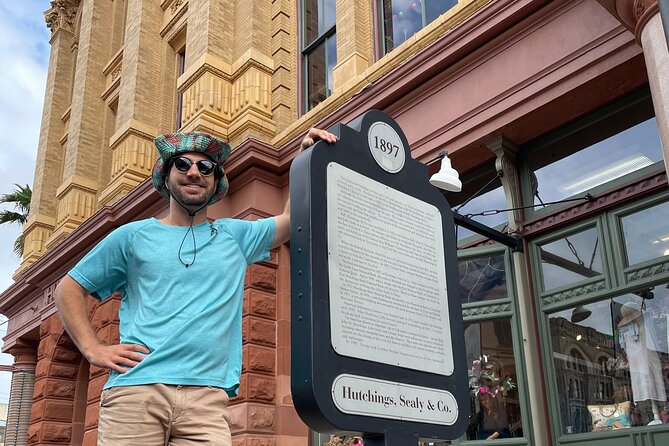
Review · USA HISTORY TOURS
The Galveston Walking History Tour
Galveston’s past comes in several distinct chapters: railroads, port commerce, Juneteenth, opera, Mardi Gras, and a long-running vice district. This 90-minute walk ties those pieces together around the Strand instead of treating the city as just a collection of old buildings.
I like the relaxed pace and the way each stop gives you time to look around and take photos. I also like the range of subjects, from the Absolute Equality Mural to the old red-light district, rather than hearing the same hurricane story from start to finish. The main drawback is that one person reported a late start caused by a mix-up, and the tour may feel too short if you want to enter every attraction.
Key points to know before you book
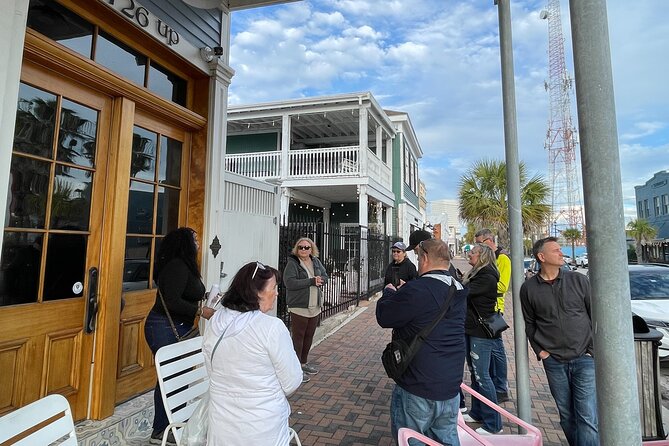
- Six stops in 90 minutes: The route covers the Railroad Museum, Saengerfest Park, the Absolute Equality Mural, Hendley Green, the Grand 1894 Opera House, and Red Light Coffee Roasters.
- A leisurely walking pace: The route involves about six short discussion periods, each lasting roughly 15 minutes, with limited walking between them.
- Guides with strong local preparation: Noelle and Nicole are specifically praised for their energy, research, and ability to answer questions beyond a memorized talk.
- A broad view of Galveston: You hear about the Strand, Mardi Gras, Juneteenth, the 1900 hurricane, the opera house, and the city’s vice era.
- Good value for a short introduction: At $33 per person, the tour works best as a first look before you explore the area on your own.
- Simple logistics: It begins and ends at 123 Rosenberg St., is offered in English, uses mobile tickets, and accepts up to 30 people.
A short walk through Galveston’s complicated past
Galveston is easy to underestimate. At first glance, the Strand can seem like a neat row of old commercial buildings, attractive but quiet. The point of this tour is to show you what powered the district, who shaped it, and how many different lives the city has had.
You begin near the Galveston Railroad Museum at 123 Rosenberg St. The opening talk sets out basic Galveston history and explains the museum’s place in the city. That is a sensible starting point because rail travel helped connect Galveston to the wider region, while the Strand grew as a major center of trade and business.
From there, the route moves through several blocks of the historic district. You are not spending hours on your feet or racing from one landmark to another. The walking is broken into short sections, with about 15 minutes at each stop for stories, questions, and photographs.
That format suits you if you want an introduction rather than a full-day historical program. It also leaves time afterward to return to a building that caught your eye, visit the railroad museum, or continue through the Strand independently.
More History Walking Tours in the USA
- History and Hauntings of Salem Guided Walking Tour
★ 5.0 · 14,564 reviews - Boston: Freedom Trail History Small Group Walking Tour
★ 5.0 · 6,450 reviews - Historic Charleston Guided Sightseeing Walking Tour
★ 5.0 · 6,216 reviews
The Railroad Museum gives the tour its starting point
The Railroad Museum is more than a meeting place. It gives the guide a useful way to explain how transportation affected Galveston’s growth and why the island became such an important commercial center.
The museum itself is not included as a separate attraction visit during the walking portion. The discussion takes place outside or around the meeting area, with the museum’s history included in the introduction. If you want to see more, you can add a visit after the walk.
Parking deserves attention here. Finding a space near the start can take time, so arriving early is a good idea. One practical approach is to use the railroad museum parking area and purchase a pass there. That gives you a straightforward place to leave the car and the option of visiting the museum after the tour.
The opening is also where you can get a feel for your guide. Noelle is praised for doing more than delivering a fixed speech. She has spent time researching Galveston and can follow related questions, which matters in a city where one topic quickly leads to another.
Saengerfest Park and the Strand’s commercial power
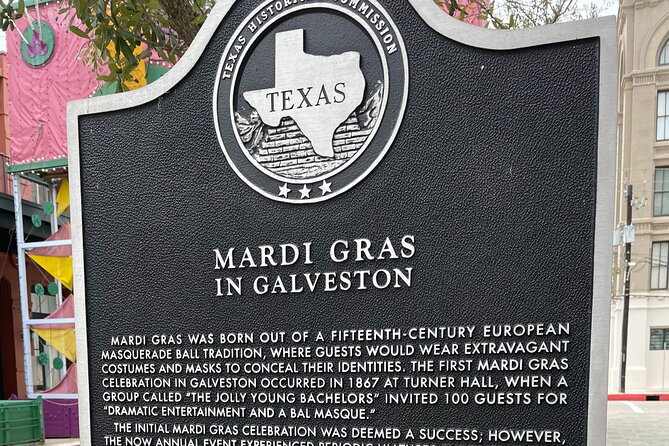
Saengerfest Park is the next major stop. Here, the focus shifts toward the Strand, Galveston’s Mardi Gras tradition, and the district’s earlier role as the Wall Street of the South.
That nickname helps explain why the Strand matters. The area was not simply a pretty historic street. It was tied to money, trade, business, and the movement of goods and people through Galveston.
The discussion of Mardi Gras adds a later chapter to the story. Galveston’s celebration is part of the city’s modern identity, and the tour connects it to the older commercial district rather than treating it as a separate party tradition.
This is a good point to slow down and look at the buildings around you. The tour does not require you to enter each one, so you get the exterior details and the stories that give them meaning. If you enjoy architecture, you will want to make mental notes of the places you might revisit after the walk.
The stop also helps break up the historical timeline. You move from railroads and commerce to public celebration, showing how the Strand has kept changing while remaining central to Galveston’s identity.
The Absolute Equality Mural adds a vital Juneteenth chapter
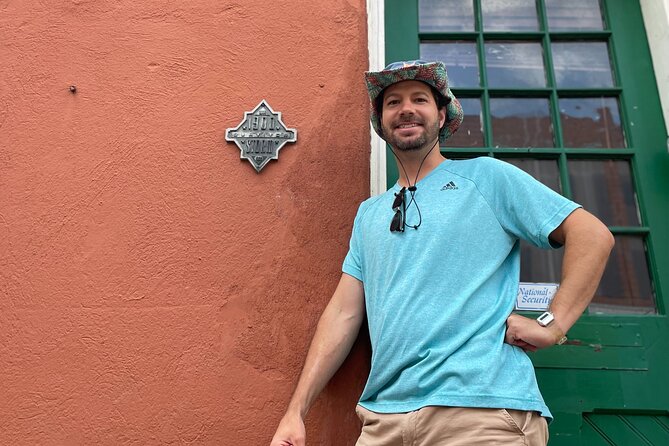
The Absolute Equality Mural gives the tour one of its most important stops. Here, the guide explains Galveston’s role in the history of Juneteenth and the significance of the mural itself.
This section widens the story beyond business leaders, grand buildings, and famous storms. Galveston’s past also involves the struggle for freedom and the events connected with the holiday now known as Juneteenth.
The mural is especially effective as a stopping point because public art can make a historical subject immediate. You are looking at a modern work while discussing events that remain important in American life today. The result is less abstract than hearing a date and moving on.
I would pay close attention here, even if your main reason for booking is architecture. This is the kind of stop that makes the walk feel more complete. It reminds you that the Strand is not only a preserved commercial district. It is also a place where major national stories intersect with local ones.
Same streets, a different century:
- New York City: American Museum of Natural History Ticket
★ 4.5 · 15,447 reviews - Charleston’s Old South Carriage Historic Horse & Carriage Tour
★ 5.0 · 10,023 reviews - Beneath The Streets Underground History Tour
★ 4.5 · 8,006 reviews - Big Island in a Day: Volcanoes Waterfalls Sightseeing and History
★ 5.0 · 6,569 reviews
Hendley Green and the surviving Rosenberg Fountains
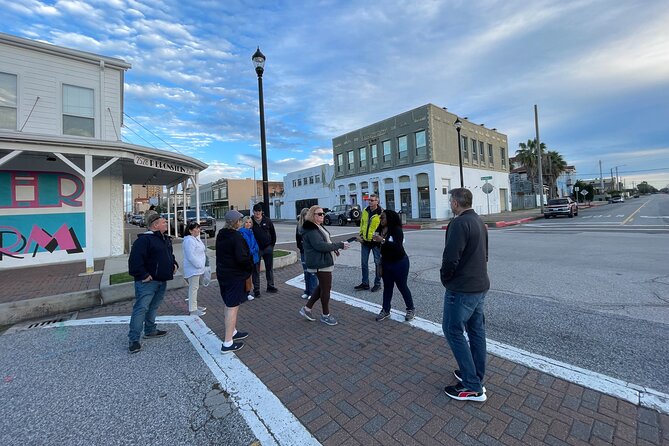
At Hendley Green, the guide returns to the Strand’s past and discusses the surviving Rosenberg Fountains. These details are easy to miss when you are walking on your own, especially if you are focused on storefronts and traffic.
The fountains offer a physical link to an earlier Galveston. They help you see how public spaces and city improvements once fit into daily life. Their survival also gives the guide something specific to point out, rather than relying only on broad historical dates.
This stop is likely to appeal to anyone who likes small details. The biggest stories can tell you why Galveston mattered, but features such as fountains show how that importance appeared on the street.
The route remains manageable here. You are moving through a compact part of central Galveston, and the guide pauses often. One person described the amount of walking as comfortable, which matches the structure: the experience is a series of short walks and talks rather than a strenuous march.
The Grand 1894 Opera House reveals another side of the city

The Grand 1894 Opera House adds culture and entertainment to the tour’s portrait of Galveston. The guide shares the building’s history and explains why the opera house matters in the city’s story.
The stop works well because it shows that Galveston’s ambitions were not limited to shipping and commerce. A major opera house suggests a city with money, confidence, and a desire for the same forms of entertainment found in larger urban centers.
You may find that this stop raises questions you want to pursue later. Since the tour is only about an hour and a half, the guide can introduce the building without giving you every detail of its long history. That is both a strength and a limit. You get a useful framework, but you will need a separate visit if you want a fuller look inside.
The opera house also gives the walking route a change of mood. After discussing business, public art, and fountains, you reach a place tied to performances and civic pride.
Red Light Coffee Roasters and Galveston’s vice era

The final stop, Red Light Coffee Roasters, covers the city’s red-light district and the vice era that affected Galveston for more than 70 years. This is the tour’s most scandalous subject, but it is also one of the most revealing.
A port city with money, sailors, workers, entertainment, and weakly controlled vice developed a very different side from the one suggested by restored facades and formal public buildings. The talk gives you a way to understand that contrast.
Using a coffee shop as the setting makes the stop feel connected to present-day Galveston. You are not examining a preserved district frozen behind glass. You are standing in a working part of the city while hearing about activities that once shaped its reputation.
This subject may not suit anyone looking only for a polite architectural walk. For most people, though, it adds useful honesty. Cities are rarely built from respectable stories alone, and Galveston’s long vice era is part of what made the Strand a complicated place.
What the guide style adds
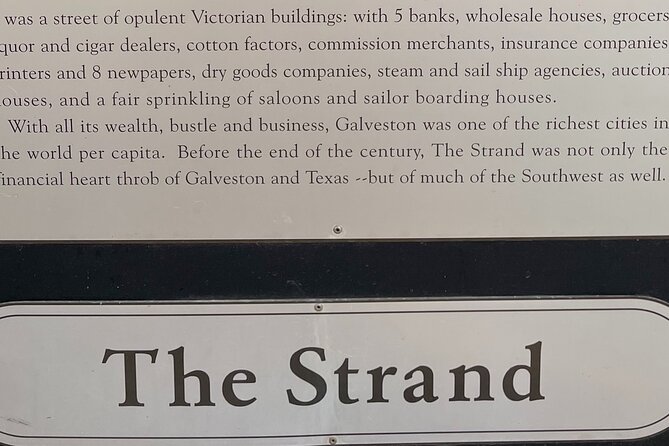
The strongest part of this experience depends on the guide. Noelle is described as cheerful, energetic, and well prepared, with enough command of the subject to handle questions without sounding tied to a script. Nicole is also praised for her warm energy and clear grasp of the city’s past.
That matters because the route covers a lot in a short time. A flat presentation could make the six stops feel like unrelated facts. A guide who can connect the railroad, commerce, Juneteenth, public fountains, the opera house, and vice gives the walk a clear shape.
You should also expect a conversational experience. The route allows time for questions, and the pace is slow enough for photos. If you want a formal lecture with dates delivered without interruption, this may not be the ideal format. If you like asking why a place matters, the approach is more appealing.
The score of 4.8 from 52 ratings, with 96 percent recommending it, points to a consistently strong experience. Still, the score is not perfect. One person felt the tour was not what they expected, and another noted a late start caused by a communication problem. I would arrive early, confirm the meeting point, and allow a little flexibility at the beginning.
Is $33 a fair price?
At $33 per person, this is not the cheapest way to take a walk through the Strand. You can walk the streets yourself for nothing. The price pays for local interpretation, a planned route, and someone who can explain why ordinary-looking places matter.
The value is strongest if you are new to Galveston or have only a short time in the city. In 90 minutes, you get six focused stops and several different parts of the city’s story. That can save you from wandering without context.
The value is weaker if you already know the Strand well or want long interior visits. Admission tickets at the stops are listed as free, but this is a guided walking experience, not a package that includes entry into multiple attractions.
I would treat the tour as a useful orientation. Book it early in your stay, then use what you learn to choose where to spend more time. The timing is also practical for a day when you have other plans. Since it ends at the original meeting point, you are returned to the same central area rather than being left somewhere unfamiliar.
Who should take this Galveston walk?
This tour suits you best if you want a short introduction with several themes and a relaxed pace. It is a good match for people who enjoy local stories, historic buildings, public art, and the less polished parts of a city’s past.
It also works well for visitors who have a free hour and a half before or after another Galveston activity. The route is not built around heavy exertion, and most people can participate. Service animals are allowed, and the activity is near public transportation.
Families may appreciate the short stops, though the subject matter ranges from civic history to the red-light district. Anyone traveling with children should decide if that mix fits their group.
The maximum group size is 30. That is small enough to feel organized, though the experience may be less intimate when it reaches the maximum. The mobile ticket and English-language format keep the booking simple.
Practical planning for the day
Arrive early, especially if you are driving. Parking near the railroad museum can fill or take time to sort out, and a late arrival could mean missing the introduction.
Wear comfortable shoes and plan for outdoor walking. The tour requires good weather, so poor conditions may lead to a different date or a full refund. It is also subject to a minimum number of participants.
You can cancel for a full refund up to 24 hours before the start time. Changes or cancellations within 24 hours are not accepted for a refund. Cutoff times use Galveston’s local time, so check the clock carefully if your plans are changing.
The tour is typically booked about 11 days ahead. That does not guarantee it will sell out, but it is a useful sign to avoid leaving the decision until the last moment if your schedule is fixed.
Should you book the Galveston Walking History Tour?
Book it if you want Galveston explained through a mix of landmarks and human stories. The Juneteenth stop, the long vice era, the railroad connection, and the Strand’s Mardi Gras tradition give you more than a basic old-building walk.
I would especially recommend it as a first activity in Galveston. The tour gives you a map in your head, points out details you might otherwise miss, and leaves you close to places you can explore afterward.
Skip it if you want extensive time inside attractions, a longer route, or a tightly scripted start with no chance of delay. At $33, it is worth the money for guided context, not for admission to monuments.
For most people, the combination of manageable walking, strong guide preparation, and varied subject matter makes this a sound way to get oriented. Arrive early, bring questions, and save time afterward for the Strand places that catch your attention.
FAQ
Where does the Galveston Walking History Tour begin?
The tour begins at 123 Rosenberg St., Galveston, Texas 77550, near the Galveston Railroad Museum.
Where does the tour end?
The activity ends back at the original meeting point.
How long does the tour last?
The tour lasts approximately 1 hour and 30 minutes.
What language is the tour offered in?
The tour is offered in English.
How much does the tour cost?
The listed price is $33 per person.
What places are included on the walking route?
The route includes the Galveston Railroad Museum, Saengerfest Park, the Absolute Equality Mural, Hendley Green, the Grand 1894 Opera House, and Red Light Coffee Roasters.
How large can the group be?
The tour has a maximum of 30 participants.
Can I cancel for a refund?
You can cancel at least 24 hours before the start time for a full refund. Cancellations or changes made less than 24 hours before the start time are not refunded. If poor weather or an insufficient number of participants cancels the activity, you will be offered another date or a full refund.
Newest history tours we have reviewed in the USA
- Gettysburg Historic Downtown Food Tour By Junket★ 4.5 · 36 reviews
- Skip the Line: Gettysburg Heritage Center and Museum Admission Ticket★ 4.5 · 203 reviews
- The Historic Welty House Ghost Hunt with Equipment★ 4.5 · 91 reviews
- Historic River Town Ramble★ 5.0 · 40 reviews
- Magical History Segway Tour★ 5.0 · 109 reviews
- Historic Galveston Red Light District Tour★ 5.0 · 24 reviews
- Historical Tour of Galveston by Air-Conditioned Bus★ 4.5 · 221 reviews
- Galveston’s Best Pub Crawl Tour and Guided History Walk★ 4.5 · 69 reviews
History Walking Tours, compared.

History and Hauntings of Salem Guided Walking Tour
Read our review →

Freedom Trail History Small Group Walking Tour
Read our review →
Historic Charleston Guided Sightseeing Walking Tour
Read our review →
Tapas Walking Tour with Food, Wine, and History
Read our review →
Savannah History and Haunts Candlelit Ghost Walking Tour
Read our review →
A History of Terror – Belfast City Centre Walking Tour
Read our review →Browse the lists this tour appears in