Review · SEVILLE HISTORY TOURS
Seville: Historic Center Bike Tour
Seville’s old defensive line gives this bike tour a clear story and a useful route. You’ll ride past sections of the walls, old gates, the Macarena, Puerta de Córdoba, and the Alcázar while your guide connects Roman Seville with the Almoravid period and the riots of 1868. I like the wall-and-gate focus because it turns scattered monuments into one readable picture, and I like the $35 price, which includes the bicycle, guide, water, and map for two and a half hours.
The main drawback is that the bikes may not all be in perfect shape. One recent rider found a bicycle near the end of its working life, though not bad enough to spoil the outing. This is also not a good choice if you have a mobility impairment, and you’ll want to be comfortable riding through the city before booking.
Key points to know before you ride
- Trace Seville’s former defenses: Follow surviving sections of the city walls and see how the gates controlled movement in and out.
- Visit several historic gates: The route includes Puerta Carmona, Puerta Osario, Puerta Triana, and Puerta de Córdoba.
- Connect many eras in one ride: The guide covers Tartessians, Carthaginians, Romans, the Almoravids, and the events of 1868.
- Expect multilingual guidance: Tours are offered in Spanish, English, and French, with guides such as Luca, Daniel, and Sébastien praised for clear and attentive guiding.
- Pack very little: A bicycle, water bottle, map, and children’s helmet rental are included.
- Allow two and a half hours: The length gives you time to cover a broad part of central Seville without turning the outing into a full-day commitment.
Why Seville’s walls make a good bike route
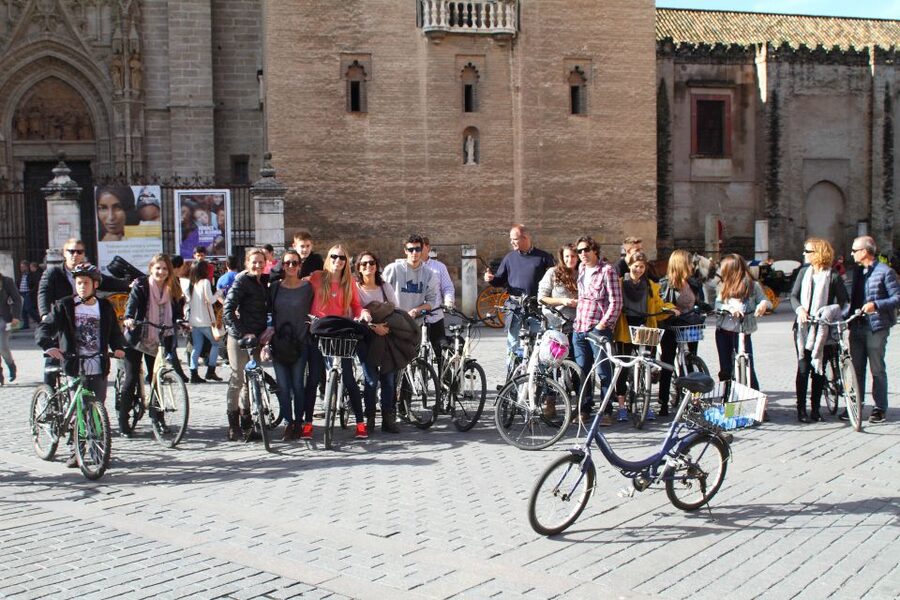
Seville is easy to admire one building at a time, but the old walls give you a stronger way to understand the city. Instead of simply stopping at famous sights, you follow the rough outline of the place that once had to protect itself.
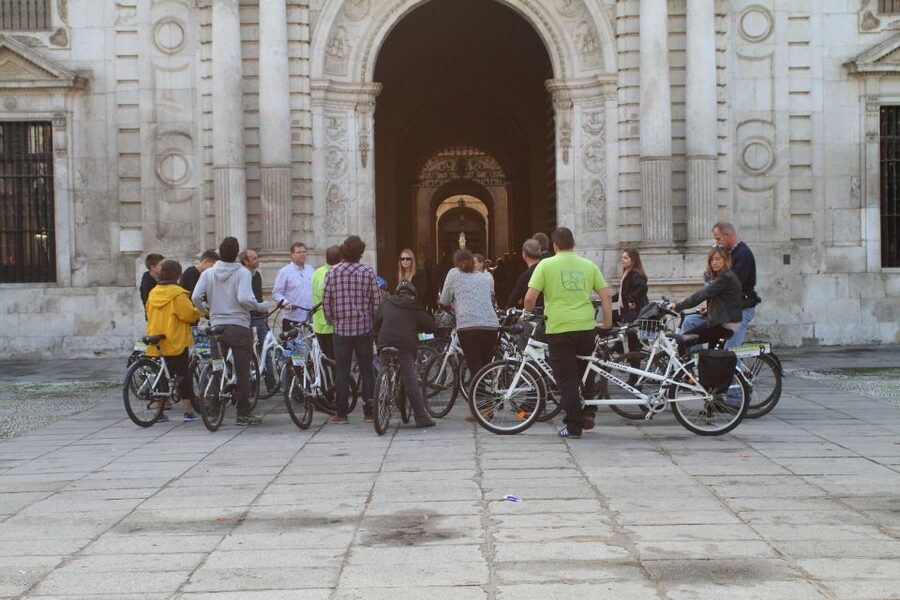
The tour begins at Centerbici Store on C/ Espronceda, 5, in central Seville. From there, you meet your guide, collect your bicycle, and set off toward the old defensive route. The exact order of the stops can vary, but the central idea remains the same: the city’s gates and walls become the thread tying the ride together.
That approach matters. Seville grew through several major periods, and each one left a mark. The route introduces the area’s Tartessian and Carthaginian roots, then explains the Roman role in its growth. Later, the Almoravids made Seville one of Europe’s best-walled cities. You do not need prior knowledge to follow the story, but the sequence helps you see that Seville was not built in one grand sweep. It changed hands, expanded, defended itself, and adapted.
A bicycle also helps you cover ground without spending the whole tour on foot. You can move from one gate or wall section to the next while keeping the city around you in view. The ride is less about speed than about linking places that might otherwise seem separate.
More History Bike, Segway and Tuk-Tuk Tours in Spain
- Barcelona: 2.5-Hour Bike or E-Bike Historical Tour
★ 4.5 · 1,262 reviews - Madrid Historical Tour with Local Guide in Eco Tuk Tuk Private
★ 5.0 · 876 reviews - San Sebastian E-bike trour: Basque History and Cultural.
★ 5.0 · 367 reviews
The Macarena and Puerta de Córdoba
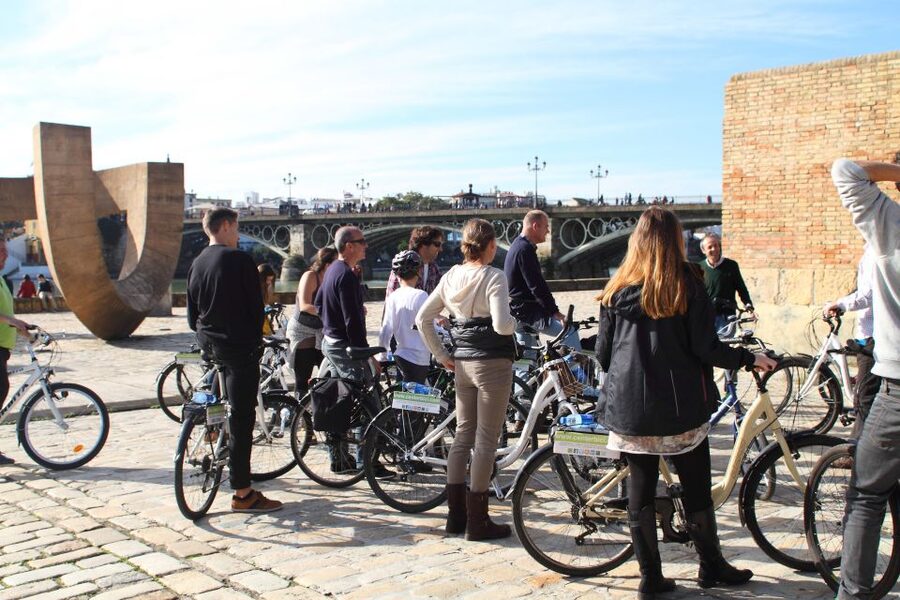
The Macarena area is one of the most useful stops for understanding Seville’s old defenses. Here, the route points out surviving parts of the walls and brings the city’s fortified past into view.
The wall was not just a backdrop. It marked a boundary and helped control access to Seville. As your guide explains the Almoravid period, you can picture the city as a defended urban center rather than only the open, monument-filled place you see today.
Puerta de Córdoba adds another layer. A gate was a practical point of entry, but it was also a place where movement could be watched and regulated. The tour’s focus on gates helps you think about who entered, who left, and how a major city managed traffic before modern streets and vehicles.
This part of the ride is especially useful early in your stay. You get a broad sense of Seville’s structure before spending time inside individual monuments. If you plan to visit the Alcázar, cathedral, or other major sites later, the cycling route can help you place them within the older city.
From Puerta Carmona to Puerta Osario
The tour continues through more of Seville’s former gateways, including Puerta Carmona and Puerta Osario. These names can blur together during a short city break, so seeing them as part of one defensive system gives them more meaning.
Puerta Carmona is tied to the movement of carriages and the practical business of entering the city. The route uses the gates to tell smaller human stories as well as major political ones. Carriages were stopped, travelers passed through, and local mysteries gathered around these controlled openings in the walls.
Puerta Osario offers another chance to see how Seville’s old access points shaped daily life. The guide’s job here is not simply to point at a place and name it. The better part of the experience is hearing how each gate worked within the city and how its role changed over time.
You should expect frequent stops for explanation rather than a nonstop ride. That makes the tour more useful for history-minded visitors, but it also means you are not booking a fast cycling excursion. The bicycle is your way of getting between the stories.
Puerta Triana and the western side of the city
Puerta Triana brings the route to another important entrance. This gate was associated with movement toward the Triana side of Seville, and it fits the tour’s wider look at the city’s boundaries.
The guide uses places like Puerta Triana to explain how Seville’s gates were more than architectural features. They were points where goods, people, and news passed through. Stories unfolded at these crossings, and the city’s authorities could monitor access.
This is where the route’s theme becomes clear: you are not just visiting isolated old structures. You are following the lines that once shaped how people experienced Seville. A short stop at a gate can explain far more about the city than a quick photograph alone.
The ride also gives you a change of pace from indoor sightseeing. Seville has major monuments that deserve time, but a bike tour lets you see the spaces between them. You get a sense of how the historic center fits together, even when you are not entering every building.
More Old Town and Historic Centre Walks in Spain
- Madrid Essential: Historic Center, Plaza Mayor & Royal Palace
★ 5.0 · 6,416 reviews - Valencia Old Town Tour with Wine & Tapas in 11th Century Historic Monument
★ 5.0 · 3,234 reviews - Madrid Historic Centre Food Tour with Authentic Tapas & Wines
★ 5.0 · 814 reviews - Madrid in a Day Tour:Royal Palace, Historic Center & Prado Museum
★ 5.0 · 628 reviews
The Alcázar and the events of 1868
The Alcázar appears as part of the route’s look at the remaining walls and historic structures. This is not presented as a full Alcázar visit, so you should not book the cycling tour as a substitute for touring the palace complex itself.
Instead, you see the Alcázar in relation to Seville’s defenses and political past. The route also explains what remained after the riots of 1868 and the Glorious Revolution. Those events changed the city and affected the survival of parts of its older defensive system.
That historical link is one of the tour’s strongest features. Many city tours stop with the medieval period, but this one carries the story forward into the nineteenth century. You hear how political unrest affected old walls, gates, and structures that had already survived centuries of change.
The explanation may be most valuable if you like seeing how a city’s past is not frozen. Seville’s defensive walls were once essential. Later, they became obstacles to expansion or symbols of an older city. The events of 1868 help explain why only certain sections remain.
What the guide adds to the ride
A bike and route map can show you where to go, but the guide supplies the connections. The tour is offered in Spanish, English, and French, so you should choose your language when booking and confirm that it suits your group.
The guides named in recent feedback include Luca, Daniel, and Sébastien. Luca was especially praised for clear French, Italian, and Spanish, with English also available. Another French-speaking rider described a guide who worked hard to make the explanation understandable in English and used phone translation when needed.
That gives you a useful sense of the guiding style to expect: personal and flexible, rather than a recorded commentary. English may be the shared language for some groups, and the guide may adjust explanations when a group has mixed language skills.
Several guides were also praised for taking time with the group and paying attention to comfort. That matters on a two-and-a-half-hour ride. A guide who notices when people need a pause or a clearer explanation can make the experience much easier than a rigid, rushed route.
Still, the actual guide depends on the date and schedule. You may not get Luca, Daniel, or Sébastien, so treat those names as examples of the guiding experience rather than a guarantee.
Bikes, comfort, and the practical side
Your bicycle rental is included, as are a water bottle and map. Helmets are available for children. Those inclusions keep the price simple and mean you do not need to arrange a separate rental before arriving.
The one practical concern is bicycle condition. A recent assessment found some bikes near the end of their useful life. That did not make the tour impossible, but it is worth checking your bicycle before setting off. Test the brakes, saddle, and gears, and mention any problem immediately.
You should also bring comfortable clothes and shoes suitable for cycling. The tour is not suitable for people with mobility impairments, and the historic center includes a mix of streets and stops rather than a controlled cycling track.
The map is a small but useful extra. You can mark the gates or areas you want to revisit later, especially if you plan to explore Seville on foot after the tour. The water bottle is practical in a city where a two-and-a-half-hour ride can feel longer than the clock suggests.
The tour is guided, so you do not need to plan the route yourself. That is a good fit if you want an introduction to Seville rather than a freewheeling rental session.
Is $35 a fair price?
At $35 per person, the value is good if you want history and orientation in one outing. The tour lasts 2.5 hours, which works out to roughly $14 per hour before considering the bike, water, map, and guide.
You are paying for more than a rental bicycle. A separate rental would let you ride independently, but it would not give you the explanation of the walls, gates, Roman origins, Almoravid defenses, or the 1868 upheavals. For a first look at central Seville, that combination makes the price reasonable.
The value is strongest if you are staying only a short time. You cover several parts of the historic center in one morning or afternoon and gain a route for later exploration. It is also useful if you want to avoid spending every sightseeing hour inside major monuments.
The value is weaker if you already know Seville well or want a long, relaxed visit inside the Alcázar and other buildings. This tour passes historic structures and explains them, but it is not an entry ticket for a full interior visit.
Free cancellation up to 24 hours before the start and the option to reserve now and pay later also reduce the risk of fitting it into a changing schedule. Starting times vary, so check availability before you plan the rest of your day.
Who should book this Seville bike tour?
I would choose this tour for a first visit, especially if you want a quick sense of how the old center fits together. It suits adults and families who can ride comfortably and who enjoy stories about urban change, military walls, and old gateways.
It is also a strong choice for anyone who wants a guide in French, English, or Spanish. The individual guides may vary, but the experience has shown that the team can adapt when language becomes a problem.
You may prefer a walking tour if cycling is uncomfortable for you or if you want to stop often for detailed photography. The bicycle helps cover ground, but it also means you must keep moving between stops.
I would not choose it as your only historic visit in Seville. Pair it with time inside the Alcázar or another major monument if you want a fuller look at the city’s architecture. Think of this ride as the connecting framework, not the entire sightseeing program.
Should you book it?
Book this tour if you want to see Seville’s historic center through its walls and gates rather than only through its grandest buildings. The route gives you a clear story from Roman origins to the Almoravids and the political upheavals of 1868, with enough cycling to cover a useful part of town.
The $35 price is fair, the essentials are included, and the strongest guides appear to bring real care to the experience. Check the bicycle before leaving, accept that the tour is not designed for mobility impairments, and book it early in your Seville stay so the route can guide your later sightseeing.
FAQ
How long is the Seville Historic Center Bike Tour?
The tour lasts 2.5 hours.
How much does the tour cost?
The listed price is $35 per person.
Where does the tour meet?
You meet at Centerbici Store, C/ Espronceda, 5, 41004 Sevilla.
What languages are available?
The live tour guide can provide the tour in Spanish, English, or French.
What is included in the price?
The price includes the Seville tour, bicycle rental, bilingual guide, water bottle, and map. Helmet rental is included for children.
Which historic places are covered?
The route includes sections of Seville’s former defensive walls, the Macarena, Puerta de Córdoba, the Alcázar, Puerta Carmona, Puerta Osario, and Puerta Triana.
Is the tour suitable for people with mobility impairments?
No. The activity is not suitable for people with mobility impairments.
Can I cancel the booking?
Yes. You can cancel up to 24 hours in advance for a full refund. You can also reserve now and pay later.
Newest history tours we have reviewed in Spain
- Visita Guiada Por El Casco Histórico De Cuenca Y Su Catedral★ 5.0 · 45 reviews
- Mosque of Cordoba History Tour in English Tickets included★ 5.0 · 257 reviews
- Jerez de la Frontera History and Art Walking Tour★ 4.5 · 49 reviews
- 2 Hours Tour around Cádiz: History, anecdotes and curiosities★ 5.0 · 89 reviews
- The Authentic Bilbao Pintxos, Food & Wine Tour with a Local★ 5.0 · 360 reviews
- Bilbao Historical Small Group Tour★ 4.5 · 159 reviews
- Barcelona Jewish & Gothic Tour★ 5.0 · 18 reviews
- Andorra Original History and Sightseeing Tour (Private, Pickup)★ 5.0 · 350 reviews
Old Town & Historic Centre Walks, compared.
Madrid Essential: Historic Center, Plaza Mayor & Royal Palace
Read our review →
Live Fado Show with Port Wine in Historic Center
Read our review →
Valencia Old Town Tour with Wine & Tapas in 11th Century Historic Monument
Read our review →
Prague Old Town, Medieval Underground and Dungeon Historical Tour
Read our review →
Cartagena: Historic Center and Getsemaní Shared Walking Tour
Read our review →
Old Town Walking Tour History and Tales in Edinburgh
Read our review →