
Review · USA HISTORY TOURS
Self Guided Detroit’s Spirit and History Solo Walking Tour
Detroit’s story comes into focus along this short downtown walk, from Parker’s Alley and its connection to a free Black landowner to the art-filled Guardian Building and the city’s beloved Spirit of Detroit statue. The route gives you a compact look at how Detroit has changed, struggled, and rebuilt.
I like the freedom to pause and restart whenever you want, and I like the price. At $9.75, this is a practical way to get oriented without committing to a long group tour. The main drawback is that you must use a smartphone and the WalknTours app. Setting it up can be frustrating if you are not comfortable downloading apps or creating accounts.
Key details before you start

- Seven downtown stops in about an hour: The route covers Parker’s Alley, The Belt, Campus Martius Park, the Penobscot Building, the Guardian Building, the Spirit of Detroit, and the Joe Louis Monument.
- A private experience without a live guide: You walk only with your own group, following audio and directions in the WalknTours app.
- Start with Detroit food nearby: The meeting point is Buddy’s Pizza at the Madison Building, a useful place to begin with a meal or snack.
- End at Hart Plaza: The route finishes beside the Detroit River at a large public plaza used for festivals and special events.
- Pause for real city stops: You can stop for cocktails, lunch, dinner, shopping, photographs, or a second look at a building, then continue where you left off.
- One low-cost option for a group: The experience is listed at $9.75 per person, and only one tour is needed per group according to the tour details.
Why this walk works as a first look at Detroit
This is not a full survey of Detroit. It is a focused downtown introduction that fits into a morning, afternoon, or early evening. In roughly 45 minutes to an hour, you move through public art, major architecture, civic spaces, and stories about race, industry, boxing, and urban renewal.
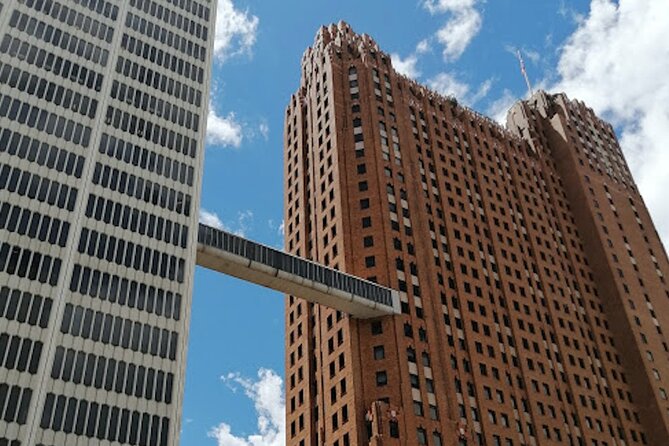
I like the way the route links the city’s past with its present. Parker’s Alley recalls Detroit’s Black history and early property ownership. The Belt shows how an overlooked alley became an art space. Campus Martius Park points to downtown’s recovery, while the Guardian Building and Penobscot Building show the ambition of an earlier Detroit.
You also get a practical advantage that a fixed group tour cannot offer. If you want to linger inside the Guardian Building, stop at a restaurant, or take a break because of the weather, you can pause the audio. One person used the flexibility to stop for drinks along the way, and another paused the route for food before continuing.
The walk is also private. There is no guide managing a crowd, no need to keep up with strangers, and no concern about missing a comment in street noise. That said, you are responsible for opening the app, following the directions, and keeping your phone charged.
More History Walking Tours in the USA
- History and Hauntings of Salem Guided Walking Tour
★ 5.0 · 14,564 reviews - Boston: Freedom Trail History Small Group Walking Tour
★ 5.0 · 6,450 reviews - Historic Charleston Guided Sightseeing Walking Tour
★ 5.0 · 6,216 reviews
Getting started at Buddy’s Pizza and Parker’s Alley
The official start is Buddy’s Pizza at the Madison Building, 1565 Broadway Street. This gives you an easy way to pair the tour with a Detroit meal, though the food is not included in the tour price. You can begin when it suits your schedule rather than arriving for a tightly timed departure.
The first stop is Parker Street, commonly known here as Parker’s Alley. Its brick paving gives it a different feel from a standard downtown street, but the important part is the person behind the name. Thomas Parker was a free Black man and one of Detroit’s first Black landowners.
The stop lasts about three minutes. That may sound brief, but the story gives the walk an important starting point. Detroit’s past is not only about factories, skyscrapers, and famous businessmen. It also includes Black property ownership and the people who helped shape the city long before today’s downtown revival.
Take a moment to look around rather than treating this as a quick audio checkpoint. The route is at its best when you connect the spoken history with the actual place under your feet.
The Belt turns an alley into a public art stop

The second stop is The Belt, another short three-minute visit. Its name comes from its location in Detroit’s former garment district, where the alley sat in an area shaped like a belt.
The Belt is part of a larger Library Street Collective project that reimagines underused city spaces. That makes it useful beyond its murals and installations. You see a small example of how downtown spaces can be given a new purpose without erasing their earlier identity.
I would not rush through this stop. Public art rewards a slower look, and the audio cannot replace seeing the work for yourself. Take photographs if you wish, and use the pause feature if a particular installation catches your attention.
This is also one of the places where the route may lead you somewhere you would not have chosen on your own. The stop is central, but an alley can easily be missed when you are walking toward larger landmarks.
Campus Martius Park and Detroit’s public comeback
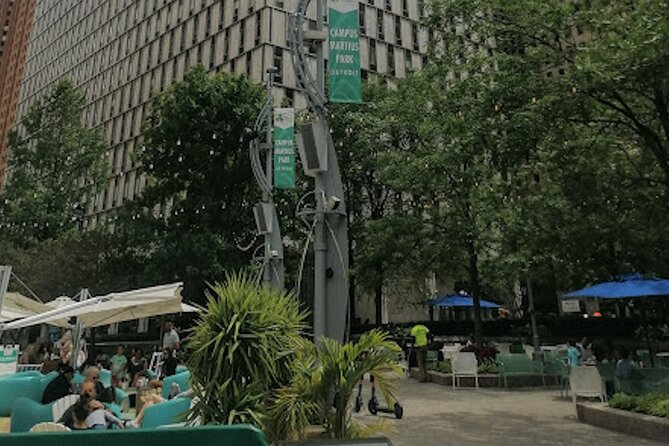
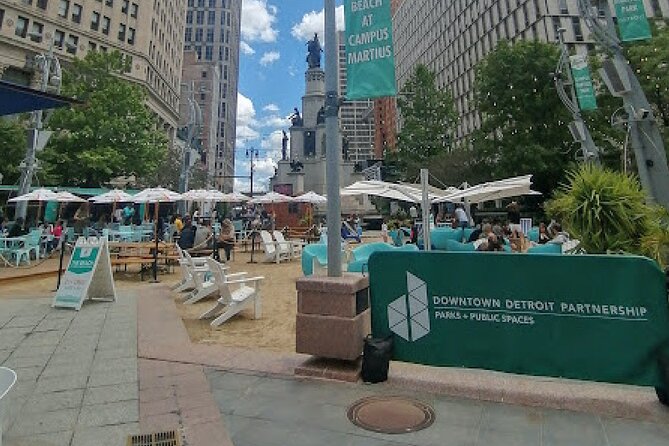
Campus Martius Park is the third stop and gets about five minutes of attention. The park was created in 2004 and now serves as one of downtown Detroit’s main gathering places. USA Today named it one of the top 10 public squares in the United States.
The more interesting point is the change in how the area is used. Two decades ago, few people felt comfortable walking here. Today, it is a central public space for meeting, resting, and city events. The tour uses the park to explain Detroit’s recovery without pretending that the city’s problems disappeared overnight.
Campus Martius is a good place to pause the tour. You might find seasonal activity, shops, or nearby places to eat, though the exact scene will depend on the day and time. One person specifically used the stop to visit Christmas shops, while another praised the ability to stop for food and resume the route later.
The park is also a useful midpoint. If you are testing your energy, time, or phone setup, this is a sensible place to decide if you want to continue toward the larger buildings and monuments.
More Self-Guided History Audio Tours in the USA:
- Salida History Audio Tour l A Self-Guided Wild West Experience
★ 5.0 · 41 reviews - Historic Bar Harbor Self-Guided Walking Audio Tour Guide
★ 4.5 · 38 reviews - Historic Dallas Downtown Solo Self Guided Walking Tour
★ 4.5 · 32 reviews - Baltimore Walking & Driving Self-Guided Audio Tour
★ 3.5 · 30 reviews
Looking up at the Penobscot Building
The Penobscot Building receives about three minutes. When it opened in 1928, it was the fourth-highest building in the United States and the eighth-highest in the world.
Its design is easy to recognize from street level. The upper section rises through a series of setbacks, giving the building the appearance of a sharp urban cliff. The tour encourages you to look upward, which is useful in a downtown area where it is easy to focus only on street signs and phone directions.
This stop is brief, so the value comes from combining the audio with your own observation. Check the building’s vertical lines, the changing width of the upper levels, and the way it towers over the surrounding streets.
If you enjoy architecture, you may want to pause here longer than the suggested time. The route does not require you to move on immediately.
The Guardian Building is the architectural highlight
The Guardian Building is one of the strongest stops on the route. The audio gives it about five minutes, but you may want extra time, especially if you appreciate Art Deco design.
Completed in 1929, the building was originally called the Union Trust Building. It became known as the Cathedral of Finance, a fitting nickname for a place designed to make banking feel grand and powerful.
The inside is the real prize. The Guardian Building is filled with decorative details that make it more than a tall office building. One person called its interior a favorite part of the walk, and another specifically praised the chance to see it while exploring downtown.
I recommend treating this as a place to look closely rather than simply check off. Notice the color, ornament, and sense of ceremony. The tour gives you context, but your own eyes do the rest.
There is one small point to note: one piece of feedback said the Guardian Building was not included, while the stated route does include it. Since the supplied itinerary places it between the Penobscot Building and the Spirit of Detroit, confirm the current app directions when you begin. The building is important enough that you should not skip it if it appears in your route.
The Spirit of Detroit and the meaning behind the statue
The sixth stop is the Spirit of Detroit, with about five minutes of audio. This large civic statue is one of the city’s best-known symbols, and its image appears throughout Detroit.
The audio explains the statue’s symbolism. The sun-like form represents rays coming from God, while the people held in the other hand represent human relationships. Those details give you a better reason to look at the sculpture than simply recognizing it from photographs.
This is a good stop for understanding how Detroit presents itself. The Spirit is not only public art. It is a civic image tied to faith, community, and the city’s sense of identity.
The stop is close to other downtown attractions, so you may want to linger for photographs. Since this is a self-guided route, you can also stop listening while you take in the area and restart when you are ready.
Joe Louis brings civil rights into the walk
The final listed stop is the Joe Louis Monument, with about three minutes of audio. Joe Louis is remembered as one of boxing’s greatest figures, but the tour focuses on his role beyond the ring.
Louis opposed segregation and Jim Crow laws. During World War II, he encouraged young African American men to join the US Army even though the military remained racially segregated. When asked why, he gave a pointed answer about America’s problems and Hitler not solving them.
That context changes the way you see the monument. It is not simply a tribute to athletic fame. It connects sports, racism, patriotism, and public responsibility.
The stop also helps the walk finish on a human story rather than only an architectural one. After buildings and parks, you end with a figure whose public life reflected some of the same conflicts that shaped Detroit and the country.
Finishing at Hart Plaza
The route ends at 1 Hart Plaza. Opened in 1975, the plaza hosts festivals and special events. Its large ring, called Transcending, honors the working men and women who built Detroit.
This is a fitting endpoint because the walk begins with a story about land ownership and ends with a monument to labor. Along the way, you pass through art, finance, civic space, and public memory.
Hart Plaza is also a practical place to finish. You can stop once the audio ends, continue exploring on your own, or use the riverfront setting as a transition to another downtown activity. The listed hours are daily from midnight to 11:30 p.m., giving you a wide window for starting and finishing.
App setup, timing, and comfort
The tour includes a smartphone-guided walk in the WalknTours app, not a live person leading you through the streets. A virtual walk is also included for use after the in-person route.
You receive confirmation when booking, but the app itself is separate from the booking platform. You need to register an account in WalknTours, and one person had trouble because the app did not recognize a Canadian email address. The provider explained that the WalknTours account is separate and offered a refund after the problem.
That is the main practical weakness. Several people found the app easy to use, with clear directions and a useful pause function. Another person found downloading and accessing the required apps difficult. If you are less comfortable with smartphones, set it up before reaching the starting point rather than trying to solve everything on the sidewalk.
The route is listed as 45 minutes to one hour, but your actual time can be longer. Add time for photos, food, drinks, shopping, or a closer look at the buildings. The route is also private, and most people can participate. Service animals are allowed, and the start is near public transportation.
Weather matters. Rain caused one person to stop after the first location, so check the forecast and bring suitable clothing. There is no in-person guide to adjust the route or keep you moving when conditions change.
Who gets the best value from $9.75
At $9.75 per person, this is a low-cost introduction to downtown Detroit. Its value comes from the combination of narration, directions, and flexibility. You are not paying for a long guided production, but you are getting a route that connects several major places in a logical order.
I think it works especially well for:
- First-time visitors who want a quick downtown orientation
- Couples and families who prefer to move at their own pace
- Solo visitors who do not want to join a group
- People who enjoy architecture and public art
- Anyone who wants to pause for meals or drinks
- Detroit residents who want to notice places they may have passed before
The price is less compelling if you want a person to answer questions, adjust the route, or provide live local conversation. It is also not the right choice if you dislike app-based tours or have unreliable phone access.
The tour is listed as an economical option for a group because only one tour is needed per group. Check the booking terms carefully for how your party is charged, but the basic appeal is clear: you get a private walk without paying for a full private guide.
Should you book this Detroit walking tour?
I would book it if you want a short, inexpensive introduction to downtown Detroit and you are comfortable using a smartphone. The route covers meaningful ground without taking over your day, and the pause function makes it easy to fit around meals, shopping, weather, and your own energy.
I would skip it if you want a detailed citywide history, a live guide, or a tour built around long conversations. Before booking, install the WalknTours app, create the required account, and confirm that the audio and directions work.
For most people, the best plan is to start near Buddy’s Pizza, allow about an hour, and leave extra time for the Guardian Building and The Belt. You will get the most from the tour when you treat it as a flexible introduction, not a race from one audio marker to the next.
FAQ
How long does the Detroit Spirit and History Solo Walking Tour take?
The walk takes approximately 45 minutes to one hour. You can spend longer if you pause for food, drinks, photographs, shopping, or extra time at a landmark.
Is there a live tour guide?
No. The tour is self-guided through the WalknTours app. There is no in-person guide accompanying your group.
Where does the tour begin?
The tour begins at Buddy’s Pizza at the Madison Building, 1565 Broadway Street, Detroit, Michigan 48226.
Where does the tour end?
The route ends at Hart Plaza, 1 Hart Plaza, Detroit, Michigan 48226.
What landmarks are included?
The route includes Parker’s Alley, The Belt, Campus Martius Park, the Penobscot Building, the Guardian Building, the Spirit of Detroit, and the Joe Louis Monument.
Can I pause the tour?
Yes. You can pause the audio and continue later, making it possible to stop for meals, drinks, shopping, or a longer look at a location.
What is included in the booking?
The booking includes the smartphone-guided walking tour in the WalknTours app and a virtual walk that you can take after the in-person route.
Can I cancel for a refund?
You can cancel at least 24 hours before the experience start time for a full refund. Cancellations or changes made within 24 hours are not refunded or accepted.
Newest history tours we have reviewed in the USA
- Best Downtown Detroit Historical Walking Tour★ 5.0 · 56 reviews
- Detroit’s Hidden History Guided Walking Tour★ 5.0 · 48 reviews
- Private Nightlife Tour in Denver: Culture, History, and Cocktails★ 5.0 · 48 reviews
- Historical Walking Tour Of Denver With A Haunting Twist★ 5.0 · 19 reviews
- Tip Based: Capitol Hill History & Ghost Tour★ 5.0 · 34 reviews
- Denver – Capitol Hill Guided Walking Ghost / History Tour★ 4.5 · 75 reviews
- JFK Historical Tour★ 5.0 · 22 reviews
- Downtown Dallas Sightseeing & History 2 Hour E-Scooter tour★ 5.0 · 155 reviews
Self-Guided History Audio Tours, compared.

Taormina: Ancient Theater Skip-the-Line Ticket & Audio Guide
Read our review →
Katakolo Port: Transfer to Ancient Olympia and VR Audio Tour
Read our review →
Matera: Sassi di Matera Historical Self-Guided Audio Tour
Read our review →
Self-Guided Ngilgi Cave Ancient Lands Experience
Read our review →
Hagia Sophia History Museum Entry with Audio Guide
Read our review →

Browse the lists this tour appears in