
Review · PHILADELPHIA HISTORY TOURS
Revolution and the Founders: History Tour of Philadelphia
Philadelphia’s revolutionary story comes alive block by block on this fast-moving walk through Old City. In about two hours, you’ll connect the Liberty Bell, Independence Hall, Franklin’s neighborhood, early banks, meeting halls, and the places where the new American government took shape. Guides such as Josh, Kyle, Vince, Ted, and Joseph use stories, questions, and occasional dramatic acting to keep the past moving.
I especially like the history-trained guides and the smart route through the city’s main founding sites. I also like that the tour gives you a useful first look without filling your whole day. The main catch is simple: this is chiefly an outdoor orientation, not a tour of the major interiors, and standing outside can be rough in cold, wet, or windy weather.
Key points at a glance
- A focused 1776 introduction: The tour explains Philadelphia’s role in the Revolution and the creation of the United States.
- History-degree guides: Guides are history teachers, professors, or other history-trained storytellers, with Josh, Kyle, Vince, Ted, and Joseph among the names praised for their energy and command of the subject.
- Major sights in two hours: You’ll see the Liberty Bell, Independence Hall, Congress Hall, Franklin Court, Carpenters’ Hall, and several less-famous founding sites.
- Outdoor sightseeing first: Entry to Independence Hall and the Liberty Bell pavilion is not included, though your guide gives directions for visiting them later.
- Good first-day timing: Morning and afternoon departures leave room for museums, food, or further Old City exploring.
- Small enough to stay engaged: The maximum group size is 24, so questions and conversation are practical.
Why this tour works as a Philadelphia introduction
Philadelphia can feel like a history textbook scattered across several city blocks. This walk gives those sites an order and a story. Instead of seeing a bell, a hall, and a bank as separate stops, you learn how they fit into the same short period when Philadelphia served as the center of American political life.
The central theme is the Revolution and the founders, with special attention to 1776 and the years immediately around it. You’ll hear about independence, the Continental Congress, Benjamin Franklin, George Washington, John Adams, Alexander Hamilton, James Madison, and others who shaped the new country.
The guides bring different styles. Josh is repeatedly praised for lively storytelling, humor, and keeping a group involved. Kyle has been especially theatrical, with one group jokingly calling him Mr. Madison. Vince is noted for handling questions and adapting the pace, while Ted and Joseph are described as warm, animated, and deeply interested in the subject.
That range matters. A guide who can explain a political dispute clearly is useful, but one who can also tell a human story about Dolley Madison or act out a tense moment makes two hours pass quickly. If you prefer a quiet lecture with little performance, the dramatic style may not suit you. One very negative response objected to a guide focusing too much on acting, so expectations should be clear: this is storytelling, not a silent architectural walk.
More History Tours in the USA:
- New York City: American Museum of Natural History Ticket
★ 4.5 · 15,447 reviews - History and Hauntings of Salem Guided Walking Tour
★ 5.0 · 14,564 reviews - Charleston’s Old South Carriage Historic Horse & Carriage Tour
★ 5.0 · 10,023 reviews
The Liberty Bell and the meaning behind its crack
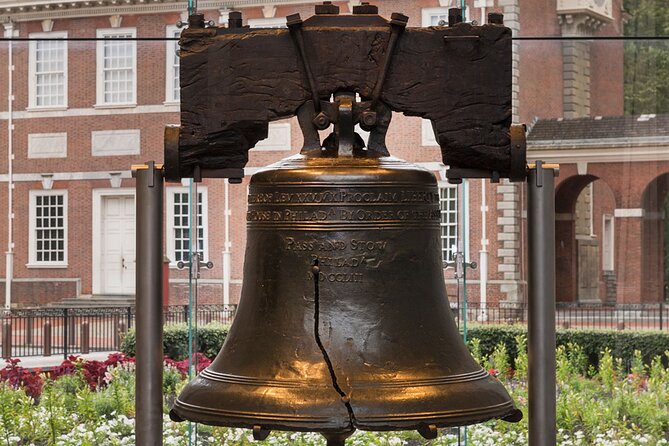
The route begins with the Liberty Bell, probably the most familiar symbol in Philadelphia. You’ll view it from outside the pavilion and learn how it was commissioned in 1752, cracked on its first test ring, and recast by local workers John Pass and John Stow.
The guide also explains the inscription from the Book of Leviticus, which calls for liberty throughout the land. Its original meaning involved the jubilee year, when enslaved people were freed and debts were forgiven. That context makes the bell more complicated and more interesting than the simple patriotic image often presented in souvenir shops.
During busy periods, the line for the pavilion can take close to an hour. This tour does not include that wait or the interior visit. That is a drawback if your main goal is to stand beside the bell, but it is also a sensible use of time if you want a broader introduction to Philadelphia first.
You’ll receive clear directions for returning to the pavilion later. Plan that extra visit separately if the bell is a priority, since the interior is free but can require about an additional hour.
Independence Hall and the birth of American government
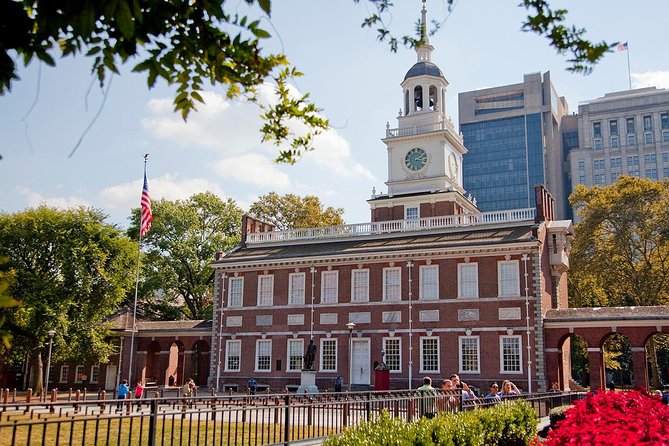
Independence Hall is the emotional center of the walk. This is where the Declaration of Independence and the Constitution were debated and adopted, making the building central to both the Revolution and the creation of the federal government.
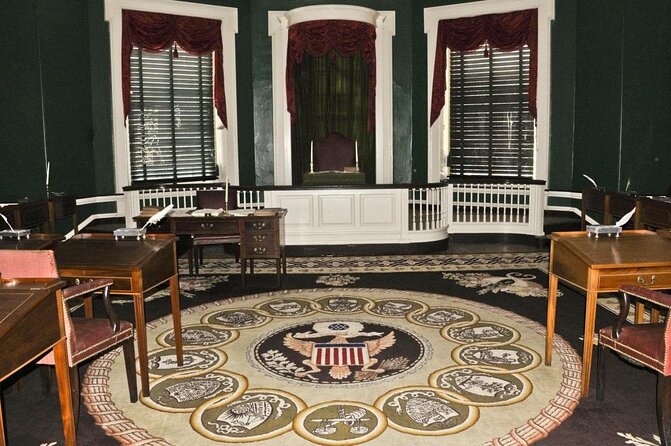
The tour focuses on the essential exterior views and the larger setting. Depending on crowds and closures, the group may make a brief stop inside the East Wing of the complex, including the old Supreme Court Chambers. Do not treat that possibility as a guaranteed full interior tour.
To enter the main historic rooms, you need free timed tickets and should allow roughly two more hours for the complex. The tour’s value is that it helps you understand what you are looking at before you return for a longer visit. You’ll know why the rooms matter instead of simply walking through an old building with a famous name.
The outdoor format also keeps the route moving. If you have only one day in Philadelphia, that can be useful. You get the major context, then choose later whether to spend more time inside Independence Hall or at nearby museums.
The first presidential home and Congress Hall

The route continues to the site of the President’s House, where George Washington and John Adams served while Philadelphia was the national capital from 1790 to 1800. Foreign officials, members of Congress, and political allies passed through this building, which gives the stop a strong sense of the young government finding its footing.
You’ll also hear that Benedict Arnold lived there as military governor after the British left Philadelphia. That detail adds a reminder that the city’s political and military stories were closely linked, and that loyalties were not always fixed.
Congress Hall is another key stop. The building housed Congress from 1790 to 1800 and hosted the presidential inaugurations of Washington and Adams. It helps you shift from the wartime story of independence to the practical work of running a new republic.
These locations are easy to pass without context. A guide turns them into part of a sequence: revolution, independence, temporary government, and the eventual creation of a more permanent political system.
Same streets, a different century:
- Beneath The Streets Underground History Tour
★ 4.5 · 8,006 reviews - Big Island in a Day: Volcanoes Waterfalls Sightseeing and History
★ 5.0 · 6,569 reviews - Boston: Freedom Trail History Small Group Walking Tour
★ 5.0 · 6,450 reviews - Historic Charleston Guided Sightseeing Walking Tour
★ 5.0 · 6,216 reviews
Franklin Court and Benjamin Franklin’s many careers
Franklin Court focuses on Benjamin Franklin, one of the tour’s main figures. The site includes museums, structures, and historic locations associated with Franklin’s Philadelphia home and his work during the Constitutional Convention.
You’ll hear about his electrical experiments, printing and publishing work, diplomacy, and political service. That broad range is important because Franklin was not just an inventor or a founding statesman. His career crossed science, business, journalism, international diplomacy, and public life.
The guide also connects Franklin to the famous call for unity among the delegates: they had to hang together or be hanged separately. The point is not simply the clever line. It shows the danger and uncertainty surrounding the revolutionary cause, and the need for cooperation among colonies that often disagreed.
The Benjamin Franklin Post Office and Museum adds a charming, specific detail. It is a colonial-themed post office still operated by the United States Postal Service. It does not fly the American flag because Franklin became postmaster general in 1775, before there was an American flag to display, and the postmark B. Free Franklin is still used.
That stop is especially good for readers who like small, living pieces of history rather than only grand landmarks. The second-floor museum covers postal history and related objects, but the tour itself does not promise an extended interior visit.
Carpenters’ Hall and the foreign help that changed the war
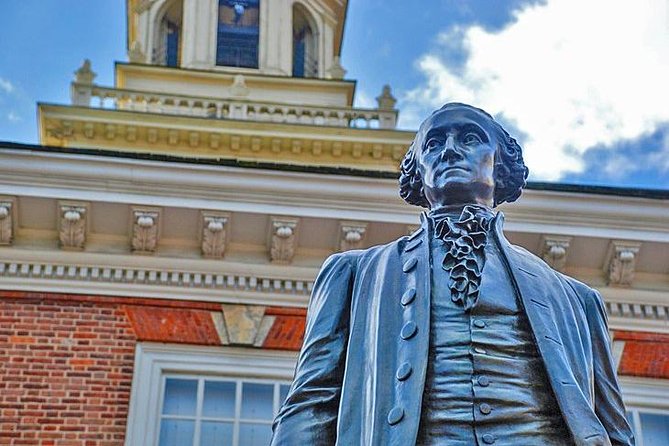
Carpenters’ Hall hosted the First Continental Congress in 1774, before the Declaration of Independence. The building also connects to secret meetings held by Franklin in December 1775 with John Jay, Francis Daymon, and the French agent Julien Achard de Bonvouloir.
Those meetings helped lead to French support for the American colonists. That support was crucial to the eventual American victory, and this stop is a useful correction to the idea that independence was won by the colonies alone.
The building was also occupied by British forces during the winter of 1777, when the British held Philadelphia. In a small area, you get a compact lesson in colonial politics, diplomacy, wartime occupation, and foreign aid.
Banks, political arguments, and the financial side of independence
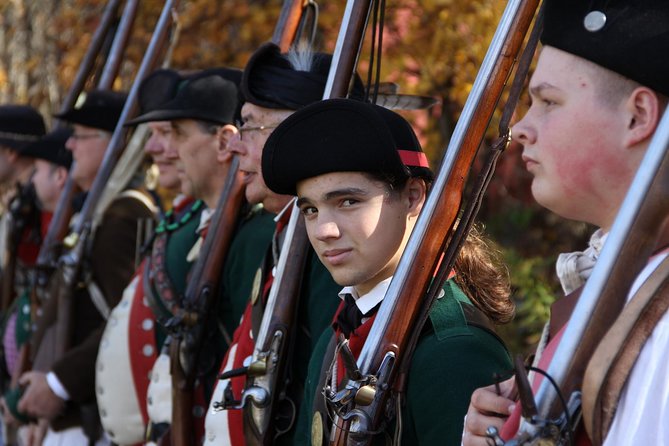
The First Bank of the United States brings Alexander Hamilton into the story. The tour discusses the bank’s creation and its striking design, then connects it to the Second Bank of the United States nearby.
The Second Bank was modeled on Hamilton’s institution, received its charter under President James Madison in 1816, and lost that charter during Andrew Jackson’s presidency in 1834. This portion moves beyond battlefields and speeches into arguments over federal power, finance, and the direction of the new country.
You’ll also hear about Hamilton and Jackson, including famous duels associated with both men. These stories add personality to what might otherwise be a dry lesson about banks and charters.
The intellectual city behind the revolution

The American Philosophical Society and the Library Company show that Philadelphia’s importance was not only political. Franklin founded the Philosophical Society in 1743, and early members included Washington, Adams, Jefferson, Hamilton, Thomas Paine, James Madison, and other major figures.
The society’s link with the University of Pennsylvania and nearby medical institutions helps explain how ideas, education, science, and public life overlapped in the city. The walk also points out the location of an early surgical center.
The Library Company, founded by Franklin in 1731, was the first institution in the world to lend materials to members of the public. You’ll learn how the site served early statesmen and how access to books helped shape civic life.
These are usually passing stops rather than long museum visits. That is fine for an introductory walk. You gain a map of Philadelphia’s intellectual world and can return later if one subject catches your interest.
Dolley Madison and everyday life in the eighteenth century
The Dolley Todd House site offers a welcome change of scale. Before she became a first lady, Dolley Madison lived here with her first husband, John Todd, from 1791 to 1793.
Built in 1775, the house reflects the life of a middle-class Philadelphia household. The stop gives the tour a domestic angle, showing that the city’s past was not made only in government chambers. It also creates a personal link to James and Dolley Madison, a pairing that guides may use to tell a more intimate story amid the larger political events.
What two hours feels like on foot
The route covers a lot of ground, and much of the time is spent outdoors listening at historic sites. Comfortable shoes are essential. You should also dress for the forecast, since the tour runs in rain or shine unless poor weather causes cancellation.
Cold weather can be a real issue. Some groups have enjoyed the experience even in freezing conditions because guides kept the pace lively and looked for indoor pauses when possible. Still, one stop in a fixed location can feel long when the temperature drops, so spring, fall, and mild summer mornings may be easier.
The maximum group size is 24. That is large enough to create a social group but small enough for a guide to answer questions and make eye contact. Most people can take part, children must be with an adult, and service animals are allowed. The tour is offered in English and runs in both morning and afternoon sessions.
The meeting point is at 523 Market Street. The walk ends near the Merchant Exchange Building at 143 South Third Street, behind City Tavern. From there, you are well placed to continue around Old City, eat nearby, or visit another historic site.
Is $29 a fair price?
At $29 per person, this is a reasonable price for a two-hour guided orientation, especially if Philadelphia is new to you. The guide’s preparation and the route’s breadth are the main value. You see far more than you would by simply walking from the Liberty Bell to Independence Hall and back.
The price does not include timed entry to Independence Hall or the interior of the Liberty Bell pavilion. Both are free, but they cost you extra time and require planning. Think of this tour as a guided foundation, not a substitute for those visits.
I would book it early if your schedule is fixed. It is typically reserved about 16 days ahead, and the morning or afternoon choice makes it easy to fit around other plans.
You can cancel for a full refund up to 24 hours before the start time. Changes or cancellations inside that window are not refunded. If the weather is poor or the minimum group size is not met, the operator offers another date or experience, or a full refund.
Who should book this walk?
Book it if you want a clear first look at Philadelphia’s founding sites, enjoy stories more than audio guides, and like moving through a city on foot. It is particularly useful for first-time visitors, families with school-age children, solo sightseers, and anyone who wants to decide which museums deserve a longer visit.
It suits history fans who enjoy Benjamin Franklin, the founders, the Constitution, and the political arguments of the early republic. It also works well for people with only a few hours to spare.
Think twice if you want extensive interior access, a slow architectural study, or shelter from the weather. The strongest feature is the guide’s storytelling. The main weakness is that the most famous buildings are often viewed from outside, with separate tickets and extra time needed for the interiors.
FAQ
How long is the Revolution and the Founders tour?
The walking tour lasts approximately two hours.
How much does the tour cost?
The listed price is $29 per person.
Is the tour offered in English?
Yes. The tour is offered in English.
Where does the tour begin?
The meeting point is Grim Philly Twilight Tours at 523 Market Street in Philadelphia.
Where does the tour end?
The tour ends at the Merchant Exchange Building at 143 South Third Street, near City Tavern.
Does the tour include entry to Independence Hall?
No. Free timed entry tickets for Independence Hall are not included. You need to allow about two additional hours if you want to explore the interior.
Does the tour include entry to the Liberty Bell pavilion?
No. The tour discusses the Liberty Bell from outside and provides directions for returning to the pavilion. The interior visit is free but can require about an additional hour.
Are morning and afternoon departures available?
Yes. The tour runs every morning and every afternoon.
What happens if I need to cancel?
You can receive a full refund if you cancel at least 24 hours before the start time. Cancellations or changes made less than 24 hours before the tour are not refunded. If poor weather or an insufficient number of bookings cancels the tour, you are offered another date or a full refund.
Should you book it?
I would book this tour as your first Philadelphia history stop, especially if you want the city to make sense before choosing museums and historic interiors. The combination of major landmarks, lesser-known sites, and guides such as Josh, Kyle, Vince, Ted, and Joseph gives the walk more life than a basic sightseeing loop.
Go in expecting an outdoor story-led introduction, not full access to every building. Wear good shoes, check the weather, and save time afterward for Independence Hall or the Liberty Bell pavilion. If those conditions suit you, $29 buys a useful, lively start in America’s birthplace of independence.
Newest history tours we have reviewed in the USA
- Nashville: Belle Meade Historic Mansion Tour★ 4.8 · 63 reviews
- Beaufort: Local History and Film Sites Tour by golf cart★ 4.9 · 102 reviews
- Boston: Guided Seafood Tasting and History Tour★ 4.9 · 90 reviews
- Beaufort: Gullah Heritage Tour★ 4.8 · 26 reviews
- Beaufort: Historic City Tour by Bus★ 4.9 · 228 reviews
- Austin: Downtown Austin Haunted History Tour★ 4.4 · 31 reviews
- Austin: Morning History Walking Tour of Downtown Austin★ 4.9 · 71 reviews
- Atlanta: Beltline Food, Street Art, and History Walking Tour★ 5.0 · 47 reviews
Philadelphia History Tours, compared.
Philadelphia Old City Historic Walking Tour with 10+ Top Sites
Read our review →
2.5 Hour Philadelphia History Tour with Washington War Tent Show
Read our review →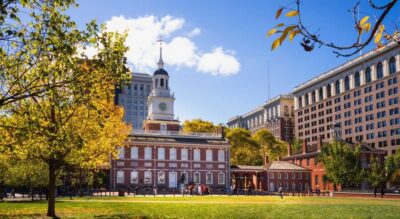
Browse the lists this tour appears in