
Review · INDIA HISTORY TOURS
Madurai: Heritage & Cultural Trails Guided Walking Tour
Madurai’s best introduction may be on foot, moving from a Gothic cathedral through old markets to the sculpted towers of Meenakshi Amman Temple. This two-hour private walk gives you a quick sense of how the city’s religious life, shopping streets, palace architecture, and daily routines fit together.
I like the clear route from St Mary’s Cathedral to the temple, and I like the chance to see Madurai at street level rather than from a vehicle. The guide can also help you make sense of details you could easily miss alone. The main caution is consistency: some bookings have had excellent guiding, while others faced missed meetings, poor phone response, or a guide distracted by a phone.
Key points to know before booking
- A useful first look at Madurai: The route links the cathedral, palace area, markets, and Meenakshi Temple in two hours.
- The palace is viewed from outside: You see Thirumalai Nayaka Palace and hear about its Dravidian and Rajput design, but palace admission is not part of the stated plan.
- Temple views come before the temple finish: The route includes a 360-degree view and glimpses from the Nandi Statue before ending at Meenakshi Temple.
- Private English or Hindi guiding: The tour is arranged for a private group, with guides such as Prakash and Balasubramanian named in customer feedback.
- No hotel pickup, food, or water: Meet at St Mary’s Cathedral and bring your own bottle and spending money.
- Service needs a little care: The overall score is 4.3 from 21 ratings, but several low scores concern meeting-point communication and uneven guiding.
Starting at St Mary’s Cathedral
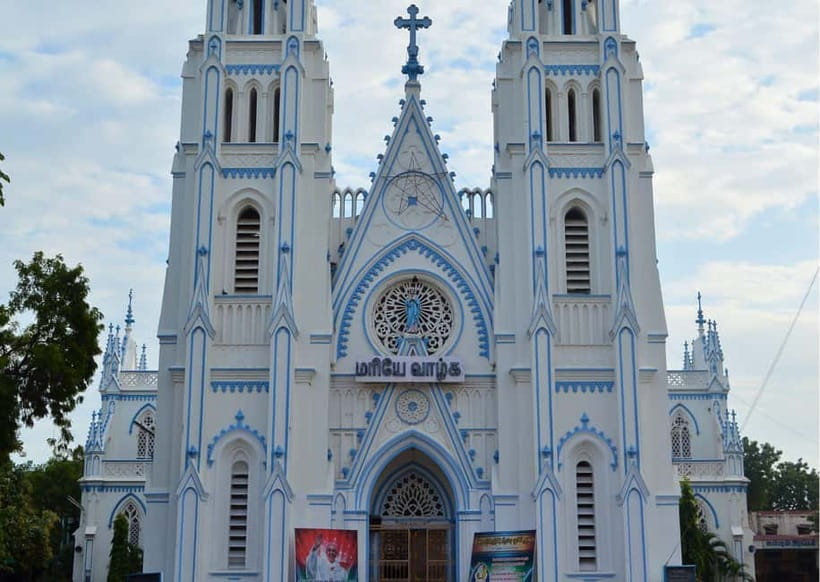
The walk begins at St Mary’s Cathedral, a Gothic-style church that gives you an unexpected opening to Madurai. Instead of starting directly at the famous Hindu temple, you begin with a Christian landmark and then move into the city’s older streets.
That contrast is useful. Madurai is not just a temple town placed around one monument. Its streets reflect several faiths, periods, and trades, and the opening stop helps set that wider frame. You can look at the cathedral’s architecture, meet your guide, and get oriented before the traffic and market activity take over.
The starting point also matters for practical reasons. Hotel pickup and drop-off are not included, so you need to reach the cathedral yourself. Confirm the exact meeting spot and starting time before setting out. Two people had serious trouble finding the meeting point, and one waited from 2:50 to 3:10 p.m. without reaching anyone by phone. That is a real concern, not a minor booking wrinkle.
Once you are face to face with the guide, the walk should feel straightforward. English and Hindi are offered, and the private-group format may make it easier to ask questions about buildings, customs, and the route.
More History Walking Tours in India
- Fontainhas Heritage Walk by Make It Happen
★ 5.0 · 2,834 reviews - The Great Indian Food Tour: Old Delhi Food and Heritage Walk
★ 5.0 · 1,698 reviews - Old Goa Heritage Walk by Make It Happen
★ 5.0 · 797 reviews
Thirumalai Nayaka Palace from the street
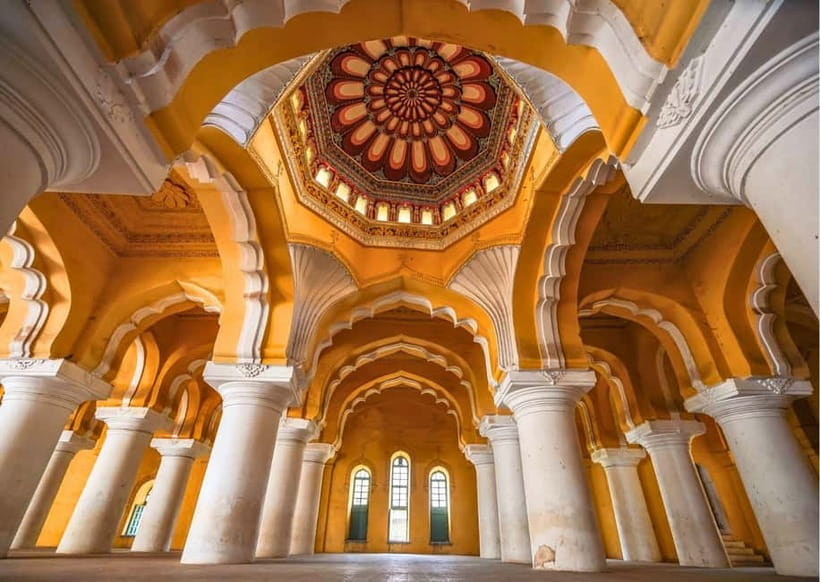
The next major stop is Thirumalai Nayaka Palace, built in the 17th century by King Tirumala Nayaka. The palace is described as a fusion of Dravidian and Rajput styles, an important clue to its appearance and place in Madurai’s story.
You view the palace from outside on this tour. That makes the stop valuable as an architectural explanation, but it also sets a clear limit. If you want a proper interior visit, this walk may not be enough on its own. The palace is not presented as an included admission stop.
One customer specifically asked to add the Nayakkar Palace for a group of five. The guide eventually took the group there, but the customer felt the stop was reluctant and the explanation too general. That tells you to ask before booking if a palace interior or extended palace visit is essential. Do not assume that a mention of the palace means a full palace tour.
For a short city orientation, an exterior look can still work well. You get a visual pause between the cathedral and the market streets, and the building gives the guide something concrete to explain. I would treat it as a brief architectural stop, not the central attraction.
Reading Madurai through its markets
After the palace area, the route turns toward Madurai’s old commercial streets. This is where the tour shifts from royal architecture to ordinary city life.
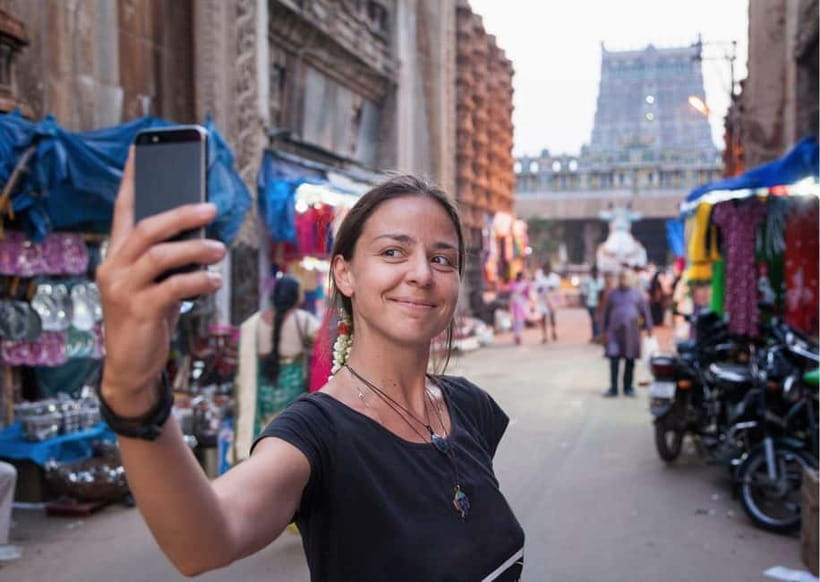
You pass eateries, craft sellers, apparel shops, temples, and colorful storefronts. The appeal is not one single sight. It is the changing rhythm of the streets, with shops opening onto narrow roads and religious buildings appearing amid everyday commerce. A guide can point out details that blur together when you are walking alone, especially if you are new to India or visiting Madurai for only a short time.
The market section is also where the two-hour schedule becomes important. You are not getting a slow, extended food walk or a shopping tour. You are moving through several parts of the city, stopping for explanations, views, and orientation. If you want to browse every stall, eat along the way, or shop for crafts, you will need to do that after the tour.
Food is not included. Water is not included either, so bring a bottle. One customer described being taken to a shop for a midday snack, where the seller was friendly, but did not want to buy anything. You should be comfortable with the possibility that a market stop may include commercial contact. If you prefer an entirely purchase-free walk, say so clearly at the start.
Still, this part may be the most useful for first-time visitors. A temple visit shows you one important face of Madurai. The streets show you how the city operates around it.
Seeing Meenakshi Temple from the Nandi Statue
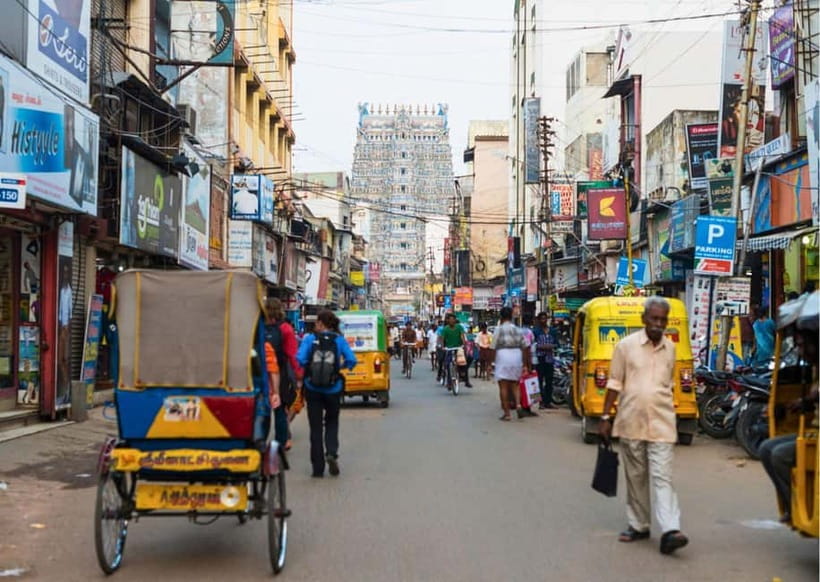
The route then gives you a 360-degree view and glimpses of Meenakshi Amman Temple from the Nandi Statue. This is a smart transition because it lets you see the temple as part of the city before reaching its entrance area.
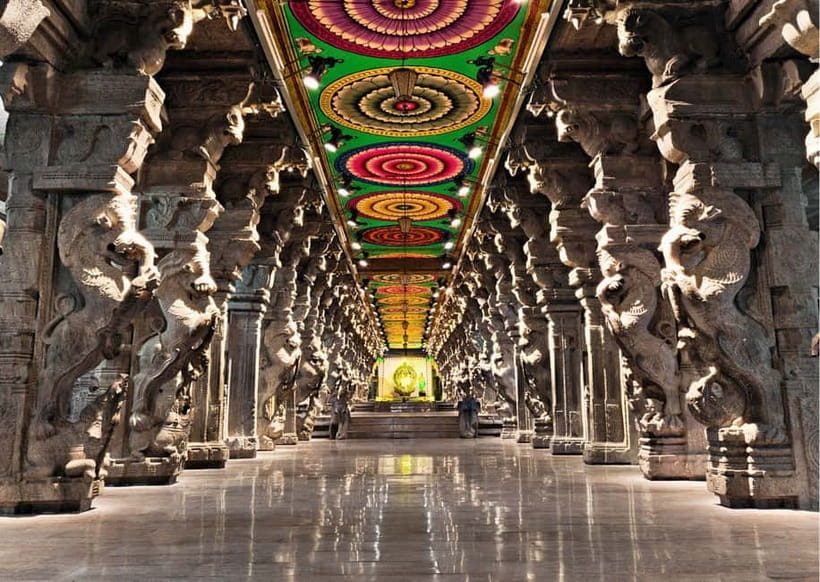
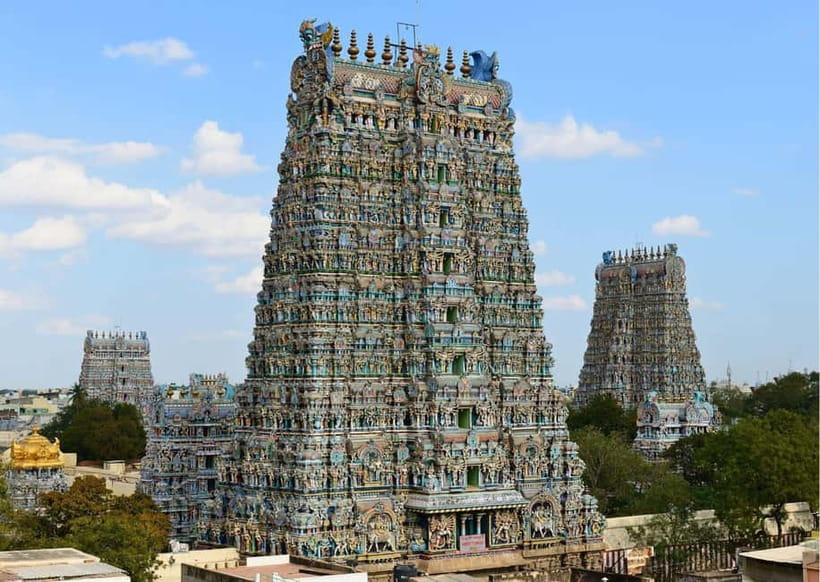
The temple’s sculpted gateway towers are the visual signature of Madurai. From the approach, you can begin to understand the scale of the walled Hindu place of worship, its sacred water tank, and its many layers of painted and carved decoration.
The Nandi Statue viewpoint is not the same as a full temple tour. The description promises views and glimpses from this point, then says the walk ends at Meenakshi Temple after covering different aspects of the complex. It does not clearly promise temple entry, a detailed interior circuit, or a formal temple guide inside. Ask your guide exactly where the walking portion ends and what access is included.
That distinction matters because one customer who had visited the temple before wanted more specific architectural and historical explanation. The guide on that booking was described as less informed about certain areas. If temple architecture is your main reason for booking, tell the guide that at the beginning and ask focused questions.
More Local Culture and Traditions Tours in India
- Old Delhi Food, Heritage&Cultural Walk with Rickshaw ride to Masterji Kee Haveli
★ 5.0 · 742 reviews - The Cultural And Historical Walking Tour in Margao
★ 5.0 · 280 reviews - Experience Bangalore – City Tour, Authentic Food & market (Food/Culture/History)
★ 5.0 · 156 reviews - Old Delhi Walking Tour: Food, Culture & Spice Bazaars
★ 5.0 · 94 reviews
Finishing at Meenakshi Amman Temple
The tour ends at Meenakshi Temple, one of Madurai’s defining sights. Even if your visit covers only the approach and exterior aspects, finishing here gives the route a strong sense of place.
The temple is described through its walled form, sacred water tank, and colorful sculpted gateway towers. Those details are worth noticing slowly. Look at how the entrance towers rise above the surrounding streets, how the temple shapes the nearby businesses, and how the approach changes from ordinary shopping roads to a major religious center.
This final stop is also practical. You are left at the city’s best-known landmark, so you can continue with your own temple visit if your plans and admission arrangements allow. The tour itself does not include food, water, or hotel transport, so plan your next move before the walk begins.
Do not expect the guide to turn two hours into a full specialist temple study. The tour’s strength is the connection between several city sites. You get a broad picture rather than a long examination of every shrine, carving, and courtyard.
What the guide can add
The guide makes or breaks a walking tour. On the strongest booking, Prakash led the group from the cathedral to the palace, through crowded streets and markets, and on to Meenakshi Temple. The customer praised his explanations and said the route gave a good understanding of each place.
That is the ideal use of this experience. You are not paying only to be led from one landmark to another. You are paying for the links between them: why the palace matters, how the market streets connect to the temple, and what to notice in the architecture.
Guiding quality has not been uniform. Balasubramanian was described by one customer as educated but not sufficiently informed about some specific temple features. Another customer found the guide distracted by a phone. These comments do not prove that every booking will have the same problem, but they show why you should take an active role.
Before the walk starts, tell the guide what interests you most. You might ask for more temple architecture, more local history, or more explanation of market life. If the group is private, use that flexibility. Ask for names, dates, design features, and clarification when an explanation feels thin.
The two-hour length also means the guide must keep the pace moving. A good guide will explain enough without letting one stop consume the whole walk.
Is the $13 price fair?
At $13 per person, the tour is reasonably priced for a private two-hour introduction, especially if you are new to Madurai and want a planned route with an English or Hindi guide. You also receive local recommendations and practical orientation, which can be useful during the rest of your stay.
The value depends heavily on what you expect. If you want a broad first look at the city, the price can make sense. You cover several different settings without arranging each stop yourself, and the route ends at Meenakshi Temple.
If you mainly want detailed temple interpretation, compare the cost with the official temple guide option mentioned by one customer, which was available at about 300 rupees per hour for groups of up to 15 people. That option may be cheaper for a large group focused only on the temple, though it would not necessarily provide this tour’s cathedral, palace, and market route.
One person considered the cost high for a five-person booking and felt the information could be found online. I would not dismiss that concern. A walking tour earns its price through clear explanations, dependable meeting arrangements, and attention to the group. If those pieces fail, the value drops quickly.
The private format is a benefit if your guide is engaged and you use the chance to ask questions. It is less valuable if you are simply walked between landmarks without much explanation.
Timing, comfort, and what to bring
The walk lasts two hours, with starting times available according to the booking calendar. Since the route passes through markets and crowded streets, wear comfortable shoes and leave room in your schedule if you want to continue at the temple afterward.
Bring water because it is not supplied. Bring some cash if you plan to buy food or crafts, but do not feel obliged to purchase anything during a market stop. A small bag is easier to manage than bulky luggage on narrow, busy streets.
The tour does not include hotel pickup or drop-off. It begins at St Mary’s Cathedral and ends at Meenakshi Temple, so plan your transport to the start and your onward journey from the finish.
Free cancellation is available up to 24 hours before the activity for a full refund. You can also reserve now and pay later, which helps if your Madurai schedule is still shifting.
Who should book this walk?
I would recommend it most strongly to first-time visitors who want quick orientation. The route brings together several important parts of Madurai and gives you a useful mental map before you explore further.
It also suits visitors who prefer a private group and want to ask questions in English or Hindi. The market streets and cathedral offer a broader look at the city than a temple-only visit.
You should think twice if your main goal is a detailed temple study, a palace interior visit, or a food-focused walk. Those needs are not clearly covered. You should also confirm the meeting point carefully, since communication failures have caused serious problems for some bookings.
Should you book the Madurai Heritage and Cultural Trails walk?
Book it if you want a short, affordable introduction that links St Mary’s Cathedral, Thirumalai Nayaka Palace, the market streets, the Nandi Statue viewpoint, and Meenakshi Temple. The best experience will come from a guide who explains the connections between those places, as Prakash did for one booking.
Before paying, confirm the meeting point, starting time, guide language, and whether your plan includes only exterior palace viewing and temple approach views. If you want detailed temple architecture, ask for that specifically. At $13, this is a fair orientation walk, but its value rests on reliable coordination and an engaged guide.
FAQ
Where does the walking tour start?
The tour starts at St Mary’s Cathedral, a Gothic-style church in Madurai.
Where does the tour end?
The walk ends at Meenakshi Temple after passing through the city’s markets and viewing the temple from the Nandi Statue.
How long does the tour last?
The guided walking tour lasts two hours.
What languages can the guide speak?
Guides are available in English and Hindi.
Is this a private tour?
Yes. The activity is arranged for a private group.
Is Thirumalai Nayaka Palace included?
The route covers the palace from outside. A full interior visit is not stated as part of the standard tour.
Are hotel pickup and drop-off included?
No. You need to reach St Mary’s Cathedral yourself, and hotel transport is not included.
Are food and water included?
No. Food and a water bottle are not included, so bring your own water and pay separately for anything you choose to eat.
Newest history tours we have reviewed in India
- Historical Tour including Unesco Kangra fort & Rock cut temple from Dharamshala★ 5.0 · 27 reviews
- Colonial Heritage Walking Tour in Darjeeling★ 5.0 · 55 reviews
- Georgetown heritage walking tour in Chennai about the founding of Chennai★ 5.0 · 144 reviews
- Private Chennai Day Tour – Art History and Contemporary Chennai★ 5.0 · 21 reviews
- Chennai Heritage & Cultural Walk (2 Hours Guided Walking Tour)★ 3.5 · 32 reviews
- Exploring Mylapore: A Cultural & Historical Walking Tour★ 5.0 · 42 reviews
- See Bangalore through my eyes (Cultural / Historical / Walking Tour)★ 5.0 · 60 reviews
- Bangalore: Walk In the Footsteps of Maharajas & Sultans★ 5.0 · 18 reviews
Local Culture & Traditions Tours, compared.

Amsterdam Food and Cultural Tour with Tastings
Read our review →
Sevilla Food Tour: Tapas, Wine, History & Traditions
Read our review →
Tromsø: Reindeer Camp and Sami Cultural Tour with Lunch
Read our review →
Half Day Dominican Republic Cultural Tour : Small Group
Read our review →
Ultimate Melbourne Walking Tour: History, Laneways & Culture
Read our review →
Tromsø: Sámi Reindeer Sledding and Sami Cultural Tour
Read our review →
Kyoto Gion: 2-Hour Geisha Culture & History Walking Tour
Read our review →
Marrakech Historical and Cultural Tour – Half Day City Tour
Read our review →Browse the lists this tour appears in