
Review · SAVANNAH HISTORY TOURS
Heart of Savannah History Walking Tour – 2hr
Savannah’s past is packed into its squares, and this tour makes those green spaces your classroom. You begin at Wright Square, trace the city’s founding and wartime story, then finish at the Forsyth Park fountain. Along the way, you’ll see Forrest Gump’s famous sitting spot and homes tied to Girl Scouts founder Juliette Gordon Low and Midnight in the Garden of Good and Evil.
I like the way the route gives you a useful sense of direction early in a Savannah visit, and I like the mix of major sights with small details, such as fingerprints in old Savannah gray brick. The main consideration is pace: the tour covers a lot in two hours, and a few sections may feel hurried or run long if the guide follows an interesting side story.
Key points to know before booking

- Starts at Wright Square: Learn why Savannah was founded on a 40-foot bluff and how its famous squares were planned.
- Ends at Forsyth Park: The final stop is the city’s best-known park and its catalog-ordered fountain from France.
- Includes Forrest Gump’s filming site: Chippewa Square is where Forrest sat with his box of chocolates while waiting for a bus.
- Covers about one mile: Benches along the way help, but comfortable shoes and water matter in Savannah’s heat.
- Outdoor tour only: The Juliette Gordon Low Birthplace and several private homes are admired from the street.
- Guide quality matters: Past departures have featured Rick, Rose, Mark, and Crystal, all praised for humor, storytelling, and local knowledge.
Why this two-hour walk works as a first look at Savannah
Savannah can feel easy to wander, but its squares do not explain themselves. A guide helps you see the plan behind the city: the relationship between squares, streets, churches, homes, and the bluff above the Savannah River.
This route is also a useful orientation walk. You start near the center of the historic district and finish south of the main group of squares, at Forsyth Park. Afterward, you’ll have a better idea of where to return for a house museum, lunch, photographs, or a slower stroll.
The walk covers about one mile, with benches along the way. That is not a strenuous distance, but the tour can feel full because the guide stops often and layers in stories about the American Revolution, Civil War, architecture, local figures, movies, and ghost lore.
The group can include up to 30 people. That is small enough for a normal walking tour, though not the same as a private outing. One practical concern is sound. Savannah’s streets can be active, and one past participant wished for ear microphones after finding a guide’s voice difficult to hear. Stay near the guide and ask for clarification if needed.
More History Walking Tours in Savannah
- Savannah History and Haunts Candlelit Ghost Walking Tour
★ 5.0 · 3,235 reviews - Historic Savannah Guided Walking Tour
★ 5.0 · 2,918 reviews - Southern Flavors Food, Pub Crawl, and History Walking Tour
★ 4.5 · 1,623 reviews
Wright Square explains Savannah’s original plan
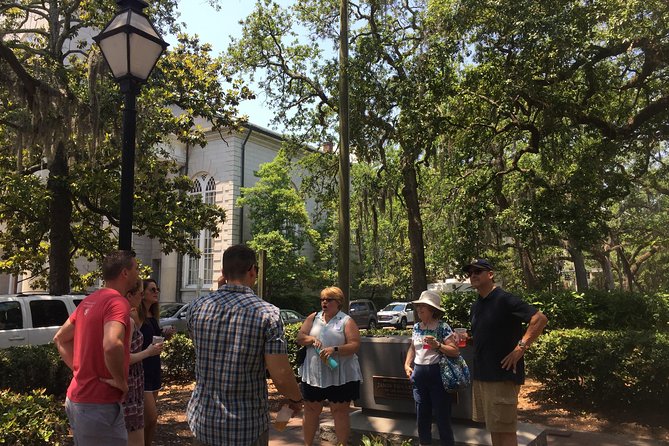
The tour begins in the center of Wright Square, in front of the Gordon Monument. This is a strong starting point because the guide first explains why General James Oglethorpe established Savannah on a 40-foot bluff.
You’ll learn how Savannah’s squares were designed and why the layout still shapes the city today. The discussion also connects the city to the Port of Savannah, identified here as the third-largest port in the nation.
The Gordon Monument brings in Tomochichi, chief of the Yamacraw Indians. The monument marks his burial place, giving the opening stop a human focus beyond dates and planning. This is the kind of detail that makes the square more than a pretty patch of lawn.
Allow about 15 minutes here. It is an information-heavy start, so listen for the broad pattern rather than trying to retain every name. You can always return to Wright Square later for a quieter look.
Juliette Gordon Low’s home is an exterior stop
The next stop is the birthplace of Juliette Gordon Low, founder of the Girl Scouts. She was born in the house on October 31, 1860, and the guide explains the Gordon family’s connection to Savannah and the building’s present use.
You do not enter the home. The value here is the setting and the story, not an interior visit. If you want to tour the birthplace, that requires a separate admission and more time.
The stop lasts about 10 minutes. It works well for visitors who want to connect Savannah’s grand houses with people who shaped American life, not just admire the architecture.
Churches, presidents, and the view from the street
At Independent Presbyterian Church, the guide explains how the congregation moved through several locations. It began in 1755 on Ellis Square, originally called Market Square, before fire destroyed the building. A later church on Telfair Square was destroyed by a hurricane, and the present building was constructed at Bull Street and Oglethorpe Avenue in 1855.
You’ll hear which United States president married there in 1885 and why the steeple became famous. The stop is brief, about five minutes, so expect a concise story rather than a church visit.
This is a pattern throughout the walk: you see the exterior, then let the guide supply the backstory. That keeps the tour moving, but it also means you should not book this experience expecting indoor access to every landmark.
More History Walking Tours in the USA
- Genteel and Bard’s Savannah Dark History and Ghost Encounter Walking Tour
★ 5.0 · 1,546 reviews - Creepy Crawl Night-Time Haunted Pub Walking Tour of Savannah’s Historic District
★ 4.5 · 802 reviews - Genteel and Bard’s Savannah History Walking Tour
★ 5.0 · 684 reviews - Savannah: Historic District Foodie Walking Tour
★ 4.8 · 613 reviews
Chippewa Square brings pop culture into the history
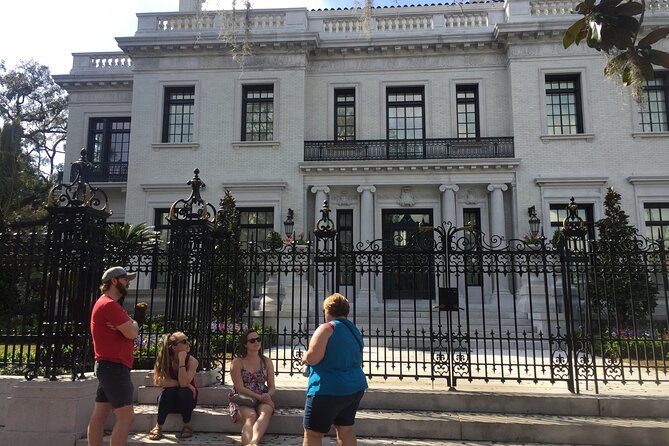
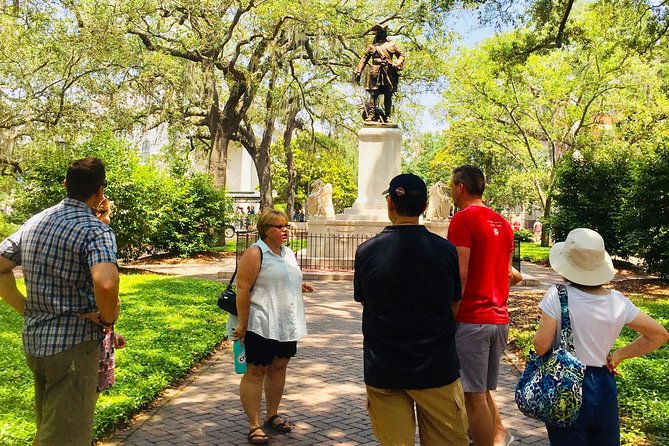
Chippewa Square is the tour’s most obvious movie stop. This is where Forrest Gump sat with his box of chocolates while waiting for the bus.
The film reference is fun, but the square has older layers too. The monument in the middle honors General James Oglethorpe, not Captain Morgan. The guide uses the visual resemblance as a joke, then explains the man behind Savannah’s founding and what the monument represents.
This is a good example of the tour’s tone. You get serious history, but it is mixed with humor and small local observations, including Savannah’s allowance for to-go cups. If you have watched Forrest Gump, the stop gives you a recognizable image. If you have not, the square still works as one of Savannah’s handsome public spaces.
Sorrel Weed House adds brickwork and ghost lore
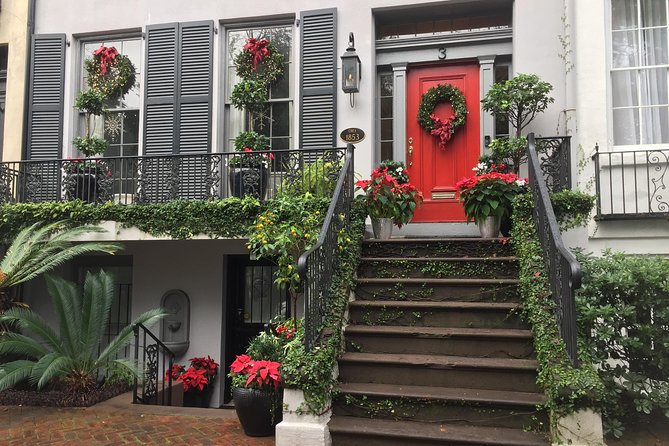
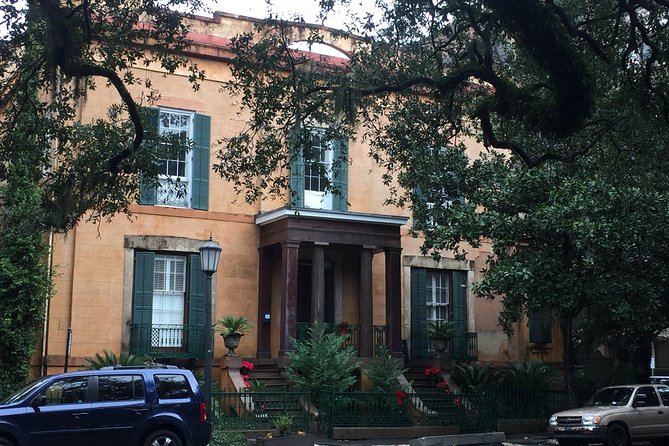
The group passes the Old Sorrel Weed House, one of Savannah’s best-known haunted homes. You do not tour the interior on this walk, but the guide points out the Savannah gray brick wall around the courtyard.
The interesting detail is why fingerprints appear in the brick and where the brick came from. This is the sort of small construction story that can stay with you longer than a list of owners.
The stop takes only about two minutes. You should see it as a quick exterior explanation, not a haunted-house experience. Ghost stories are part of Savannah’s tourism identity, and this tour includes some of that atmosphere. If you prefer strictly political or military history, you may find the supernatural material a little heavy in places.
Madison Square recalls the Siege of Savannah
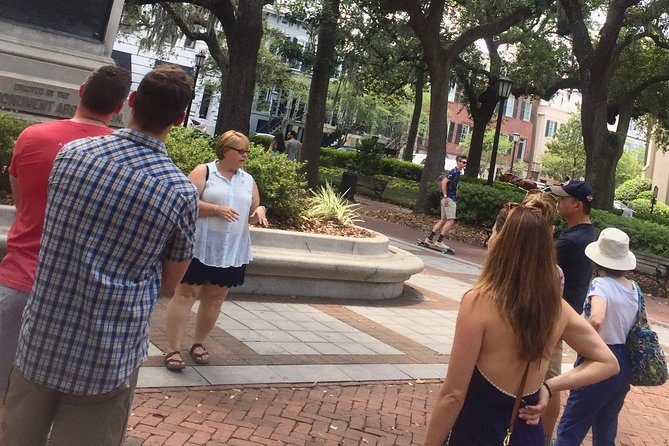
Madison Square looks peaceful today, but the site was once the scene of one of the bloodiest battles of the American Revolution, the Siege of Savannah.
The contrast is the point. Savannah’s squares invite you to sit beneath trees and admire buildings, yet many of them occupy ground marked by war, loss, and political change. A guide can make that connection quickly, especially when you would otherwise pass through the square without knowing what happened there.
Plan on about 10 minutes. The stop is especially useful for anyone who wants more than architecture from a Savannah walk. It places the city within the larger story of the Revolution rather than treating it as a collection of beautiful streets.
Green-Meldrim House links architecture to Sherman
The Green-Meldrim House is one of the major architectural stops. Completed in 1853, it is described as the finest example of Gothic architecture in the South. Its original cost was $93,000, equal to about $3.2 million today, making it the most expensive home in Savannah during the 1800s.
The house also played a role in the Civil War. General Sherman used it as his headquarters during his March to the Sea and his occupation of Savannah.
That combination makes the stop worthwhile even if you are not an architecture fan. You get a sense of wealth, design, wartime command, and the way a private house can become part of national history.
The visit is from the outside, so check your expectations. The story is the main attraction, along with the façade and its place on the square.
Passing SCAD, the Gryphon Tea Room, and Mercer-Williams House
The route continues past the former Savannah Volunteer Guard building, now owned by the Savannah College of Art and Design. It is a short exterior pass, but it adds another chapter to the city’s changing use of old buildings.
You also pass the Gryphon Tea Room, located in the former Shriner’s Building. The interior includes original mahogany cabinetry and medicine cubbies from its earlier life as Solomon’s Apothecary. It is suggested as a place for lunch, dinner, or tea, but the walking tour does not turn this into a meal stop.
The Mercer-Williams House is one of the most recognizable addresses in Savannah because of John Berendt’s book Midnight in the Garden of Good and Evil. The guide explains the house’s connection to Jim Williams, who bought it in 1969, and the 1981 shooting of his assistant, Danny.
The book appeared in 1993 and remained on the New York bestseller list for 216 weeks. The later movie helped bring Savannah to a much wider tourist audience. If you plan to visit, reading the book or watching the film first will give this stop more meaning. Again, you see the home from outside rather than taking an interior tour.
Armstrong-Kessler House is the grand finale before the park
The Armstrong-Kessler House is a private home of more than 26,000 square feet. The guide explains its history and who lives there today, while giving you time to admire the scale and design from the street.
This is the sort of stop where the guide’s storytelling helps. A private house is not open for casual touring, so the walk offers context you could not get from a photograph alone. You will likely want a moment to stop and look closely.
The stop lasts about 10 minutes. It is a good reminder that Savannah’s architectural drama is not limited to formal museums. Some of the city’s most striking homes remain private, and respectful viewing from the sidewalk is the only option.
Forsyth Park finishes the route with Savannah’s postcard view
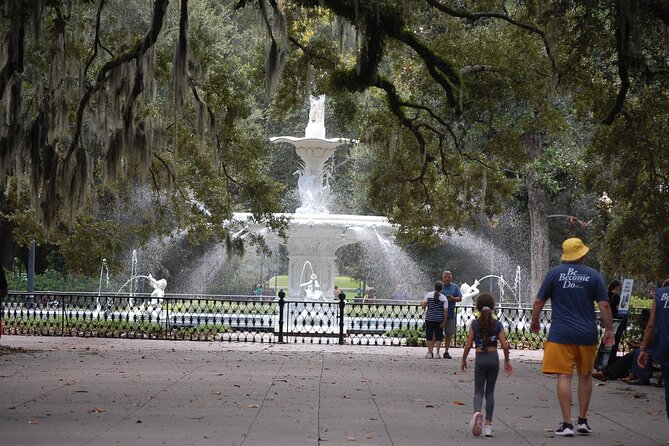
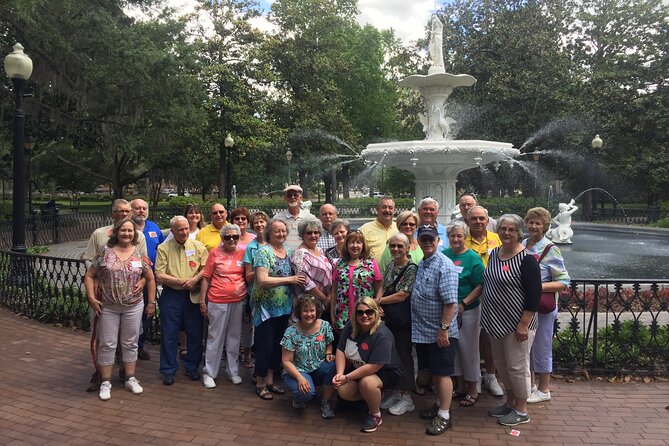
The tour ends at Forsyth Park, beside the fountain. The park began in 1848 with 10 acres and now covers 30 acres. It is often treated as Savannah’s version of Central Park, with space for both quiet sitting and everyday city life.
The fountain is the visual payoff. It was ordered from a catalog in France and installed in 1858. Plan to take your photograph here, since this is one of Savannah’s most familiar views and the official end of the walk.
Ending here is practical. You can stay in the park, explore nearby streets, or use the location as a base for lunch and further sightseeing. The route begins in the northern part of the historic district and finishes in a different area, so you gain a useful sense of the city’s scale.
Guides, pace, weather, and value
The strongest part of this experience is the guide. Departures have been led by Rick, Mark, Rose, and Crystal. The descriptions of their approach point to humor, personal warmth, clear storytelling, and a willingness to answer questions. That matters in Savannah, where the same building can support several stories and where folklore is not always fact.
The pace depends on the guide and the group. Some sections may run long because a good question opens another story. One past departure started about 45 minutes late after a guide had an emergency, and the operator provided partial refunds to those who stayed and a full refund to a person who had to leave. That was an unusual disruption, but it is worth allowing some flexibility if your day is tightly scheduled.
The tour runs in rain or shine. In severe weather, you may be offered a new date, and a cancellation by the operator can bring a full refund. You can cancel for a full refund up to 24 hours before the start time. Within 24 hours, refunds are not provided.
Wear comfortable walking shoes. Bring water in summer, when Savannah can be hot and humid, and carry an umbrella if rain is possible. Service animals are allowed, public transportation is nearby, and most people can take part. Morning and afternoon departures let you fit the walk around other plans.
No tour price is provided here, so I cannot judge the exact dollar amount. In value terms, you are paying for two hours of local explanation, not admission to house museums or a private vehicle. That makes the tour a sensible purchase if you want orientation and stories before exploring alone. It is less useful if you mainly want indoor access, long photo stops, or a slow architectural sketching pace.
Who should book the Heart of Savannah walk?
Book it if you are visiting Savannah for the first time, want a clear introduction to the historic district, or enjoy learning why a place looks the way it does. It suits couples, families, solo visitors, and history fans, provided everyone is comfortable walking about a mile.
I especially recommend taking it near the start of your stay. You can use the route to mark places for a return visit, including the Juliette Gordon Low Birthplace, Mercer-Williams House, Gryphon Tea Room, and Forsyth Park.
Skip it if you want a full interior tour of historic homes or a specialized military, architecture, or ghost tour. The route samples all of those subjects without going deeply into just one.
For most first-time visitors, I would book it. The walk connects Savannah’s planned squares with real people, wars, movies, private homes, and local oddities. Just wear good shoes, stay close enough to hear the guide, and leave room in your schedule for the stories to take their time.
FAQ
How long is the Heart of Savannah History Walking Tour?
The tour lasts approximately two hours.
Where does the tour begin?
It begins in the center of Wright Square, in front of the Gordon Monument, in Savannah, Georgia.
Where does the tour end?
The tour ends at the fountain in Forsyth Park.
How much walking is involved?
The route covers approximately one mile. Benches are available along the way.
Does the tour enter the historic homes?
No. The Juliette Gordon Low Birthplace, Sorrel Weed House, Mercer-Williams House, Green-Meldrim House, and Armstrong-Kessler House are viewed or discussed from outside.
Is the tour offered in English?
Yes. The tour is offered in English and uses a mobile ticket.
What happens if the weather is severe?
The tour operates rain or shine. If severe weather causes a cancellation, you will be offered a chance to reschedule or receive a full refund.
Newest history tours we have reviewed in Savannah
- Savannah Historic District Walking Tour★ 5.0 · 223 reviews
- Historic Downtown Savannah: Guided Segway Tour★ 4.9 · 276 reviews
- 90-Minute Segway History Tour of Savannah★ 5.0 · 365 reviews
- Historical Bike Tour of Savannah and Keep Bikes After Tour★ 5.0 · 345 reviews
- Savannah Slavery to Freedom Guided History Tour★ 5.0 · 407 reviews
- Private Tour of Savannah’s Historic/Victorian Districts & Bonaventure Cemetery★ 5.0 · 418 reviews
- Guided Savannah Civil War History Walking Tour★ 5.0 · 492 reviews
- Savannah: Historic District Foodie Walking Tour★ 4.8 · 613 reviews
History Walking Tours, compared.
History and Hauntings of Salem Guided Walking Tour
Read our review →

Freedom Trail History Small Group Walking Tour
Read our review →
Historic Charleston Guided Sightseeing Walking Tour
Read our review →
Tapas Walking Tour with Food, Wine, and History
Read our review →
Savannah History and Haunts Candlelit Ghost Walking Tour
Read our review →
A History of Terror – Belfast City Centre Walking Tour
Read our review →Browse the lists this tour appears in