Review · ITALY HISTORY TOURS
Guided Tour, Historic Center Sassi Rock Churches and Cave House
Matera’s Sassi make much more sense once someone points out how the cave homes, churches, courtyards, and lanes fit together. This walking tour takes you from Piazza Vittorio Veneto through Sasso Barisano and Sasso Caveoso, then inside Santa Maria de Idris and a furnished cave house.
I like the tour’s local focus, with guides such as Patrizia, Lorenza, and Anna Maria explaining how people lived in the rock dwellings until the 1950s. I also like the included entrances, which save you from arranging separate tickets for the rock church and cave home. The main caution is simple: expect steps, uneven cobbles, and some rugged ground, so this is not a good match for limited mobility.
Key points to know before booking
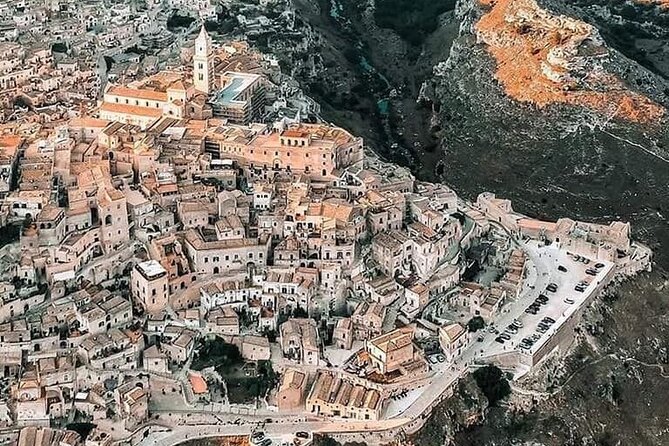
- A clear introduction to both Sassi districts: See Sasso Barisano from above, then walk through the more iconic Sasso Caveoso.
- Two useful interior visits included: Enter Santa Maria de Idris and a traditional cave house furnished with period objects.
- Local English-speaking guidance: Guides including Patrizia, Lorenza, and Anna Maria have been praised for clear explanations and patience with questions.
- A small-group format: The tour allows up to 20 people, with some departures forming groups of only 8 to 12.
- Expect a real walking tour: The route lasts about two hours, and some groups have taken closer to two and a half hours.
- Plan your arrival carefully: Meet at Via Don Giovanni Minzoni 13, while the tour finishes at Piazzetta Pascoli. Parking near the start can be difficult.
Why a guided walk helps in Matera
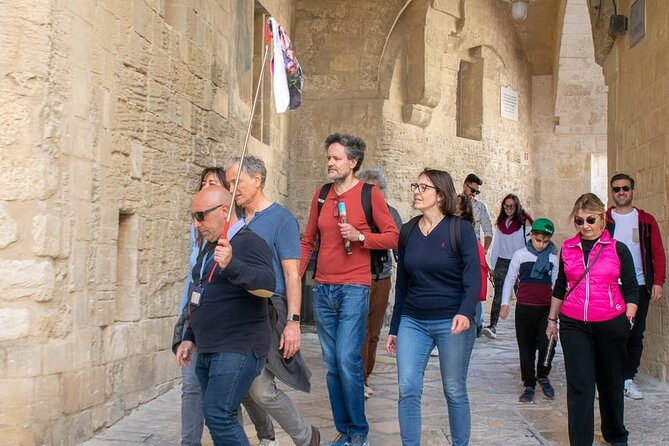
Matera can look straightforward on a map, but the old town is a maze of stairs, lanes, courtyards, and sudden viewpoints. A guide gives the stone city a useful order. Instead of seeing a line of cave fronts, you learn how homes, places of worship, work areas, and shared spaces once worked together.
That context matters because the Sassi are not just attractive old streets. They were living districts where families occupied rooms carved into the rock and shared courtyards and facilities. The tour explains the practical side of that life, including domestic routines, farming traditions, oil production, and the way the city changed over time.
I also like the fact that the route is on foot rather than built around a quick photo stop. You have time to look up at the rock facades, pause for views, and ask questions. Guides have adjusted their pace for hot weather and for older members of the group, though the terrain itself remains demanding in places.
The English is generally clear, with several guides praised for easy-to-follow explanations. One guide was reported to speak quickly with a strong accent, so the quality of delivery can vary by departure. That is a fair consideration if you need slow, very simple English.
More Architecture and Landmark Tours in Italy
- Venice: St. Mark’s Basilica Guided Tour & VR History Intro
★ 3.9 · 4,880 reviews - Venice’s Best: Basilica, Doge’s Palace, Gondola & History Gallery
★ 4.5 · 2,478 reviews - Pantheon Elite Guided Tour – Rome’s Iconic Ancient Temple
★ 5.0 · 1,447 reviews
Starting in Piazza Vittorio Veneto
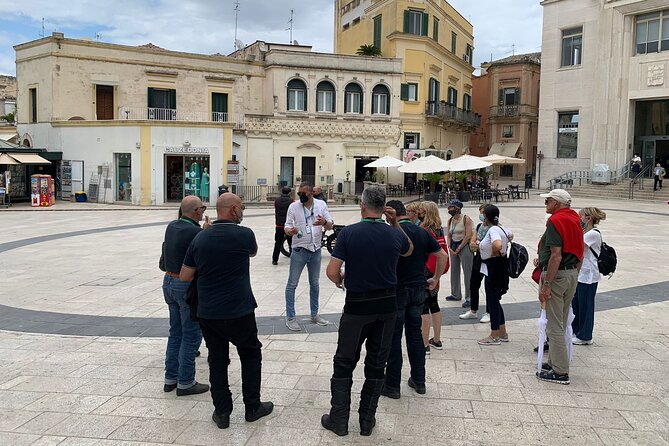
The walk begins from the central office at Via Don Giovanni Minzoni 13, then moves toward Piazza Vittorio Veneto, one of Matera’s main public squares. This is a good starting point because it places you at the edge of the old city, where ordinary urban life meets the older stone districts.
From the square, the guide leads you through historic buildings, portals, lanes, and small public spaces. You will see how Matera’s architecture changed over the centuries, rather than viewing the Sassi as one frozen block of stone. The guide also points out details that are easy to miss when you are watching your footing or trying to navigate with a phone.
The meeting instructions deserve attention. One person had difficulty finding the starting point, while the guide’s colleagues helped locate the group. I would arrive early and use the exact street address rather than relying only on a general map pin.
If you drive to Matera, plan extra time. Parking is limited and the town can be hard to approach by car, so this tour is easier if you are already staying in or near the center. Public transportation is nearby, but the tour itself is a walking experience from start to finish.
Seeing Sasso Barisano from above
The first major view is Sasso Barisano from a higher viewpoint. From here, the Sassi’s structure becomes easier to read. You can see cave homes, rock churches, stairways, and narrow routes layered across the slope.
This ten-minute stop is brief, but it does useful work. Before you enter the lanes, you get a broad picture of the district and a chance to take photographs without squeezing into a tight passage. The guide explains how people used the spaces and where daily life took place.
I find this kind of opening helpful because Matera’s scale can be hard to grasp from ground level. In a lane, you see one doorway or one wall. From above, you understand that the homes and churches form a connected neighborhood rather than a collection of isolated sights.
The viewpoint is also a practical break early in the walk. You can settle into the pace, listen to the guide, and get your bearings before the steps and uneven surfaces become more frequent.
Entering Santa Maria de Idris
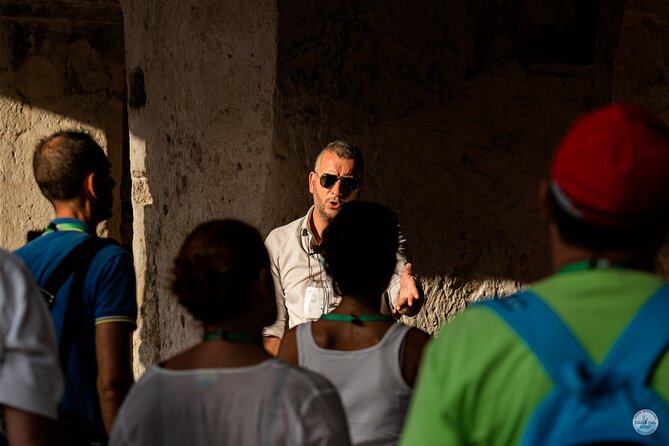
The visit inside Santa Maria de Idris is one of the tour’s strongest features. This rock church, located in the San Giovanni in Monterrone area, is carved into the stone and offers a direct look at Matera’s religious architecture.
You should not expect a large conventional church with wide aisles and bright open rooms. The appeal here comes from the way worship space was shaped from the rock. The guide provides the setting and meaning, helping you notice the relationship between the church and the surrounding caves.
The entrance is included in the price, which makes the tour more useful than a basic outside walk. You do not just photograph the Sassi from a street. You step inside one of the places that gives the district its character.
The visit lasts about 20 minutes. The exact pace may depend on the size of the group and the guide’s explanation, but there is enough time to look around rather than simply pass through. Comfortable shoes are important, since the wider route includes slopes, steps, and surfaces that may be slippery.
More Old Town and Historic Centre Walks in Italy
- Rome in a Day Tour with Vatican, Colosseum and Historic Center
★ 4.5 · 1,042 reviews - Rome Food Tour in the Historic Centre with 8+ Food Tastings
★ 5.0 · 1,000 reviews - Genoa: 2-Hour Guided Walking Tour of the Historical Center
★ 4.2 · 605 reviews - Naples: Historic Center and Sansevero Chapel Walking Tour
★ 4.8 · 208 reviews
Walking through Sasso Caveoso
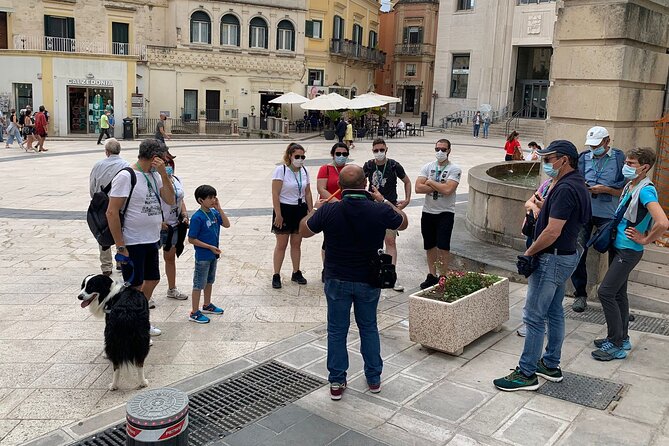
Sasso Caveoso is the heart of the walk. Here, the guide takes you through old residential areas where families once shared courtyards and common spaces. The stories focus less on grand monuments and more on how people actually used the rooms and lanes.
That is where the tour earns its price. Without explanation, a cave dwelling can seem empty and abstract. With a guide, you begin to understand the practical choices behind the layout: where people worked, where they stored supplies, how households shared space, and how the rock itself became part of daily life.
The route also includes old underground oil mill areas. These are reminders of local work and food production, showing how residents used the stone environment for more than shelter. The guide links these spaces to the ingenuity required to make a living in a difficult setting.
Another stop is the so-called barbarian cemetery, an archaeological site connected with older burial practices. It adds another layer to the walk, taking you beyond the familiar cave-house image and into Matera’s earlier past.
Sasso Caveoso is also where you will notice the physical demands most clearly. There are many steps up and down, and some ground is rugged. The pace is generally unhurried, with opportunities for photographs and questions, but you should still wear shoes with good grip and carry water.
Inside a furnished cave house
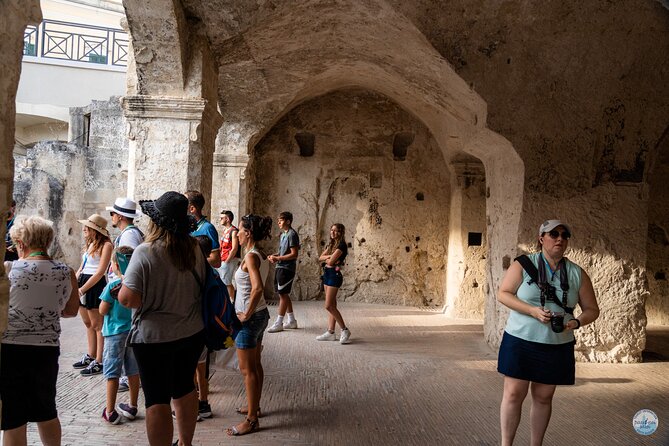
The Casa Grotta is the most immediate part of the tour for many people. Unlike an empty rock chamber, this cave house is furnished with original objects and traditional tools, giving you a sense of how a household functioned.
You move through rooms, kitchens, and inner courtyard areas while the guide explains domestic habits and survival strategies. The focus is on everyday life up to the 1950s, when families still lived in these cramped rock homes.
This visit helps correct a common misunderstanding. The cave homes were not simply quaint dwellings made for tourists. They were demanding places to live, shaped by limited space and shared facilities. Seeing the furniture and tools makes that reality easier to picture.
The interior visit lasts about 15 minutes and is included with the church entrance. It is not a long museum visit, but it adds a human scale to the rest of the walk. After viewing the Sassi from above and hearing about old neighborhoods, you see the small rooms where those stories played out.
If you want detailed time inside every room, this may feel brief. The value is in the combination of the house with the wider walk, not in treating the Casa Grotta as a stand-alone attraction.
Guide quality and group size
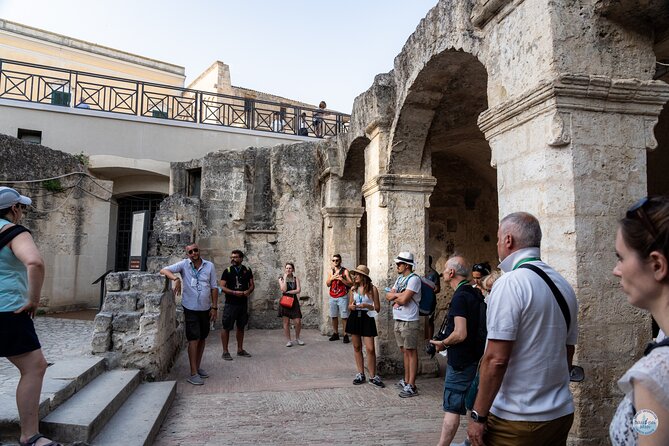
The guide is central to this experience. Patrizia has been praised for explaining Matera clearly, answering questions patiently, and slowing the pace in hot weather. Lorenza has also been singled out for her strong command of the city’s history and culture. Anna Maria, who was born in Matera and has lived there for most of her life, brings especially direct local knowledge.
Those names do not guarantee which guide you will get, but they show the kind of guiding style to expect: local background, historical explanation, and a willingness to respond to questions. Some guides have also helped groups move efficiently into the church and cave house.
The maximum group size is 20. That is not tiny, but several departures have had only 8 or 12 people. A smaller group makes it easier to hear in narrow lanes and to ask questions. It also allows the guide to notice if someone is struggling with the heat or the steps.
The tour can run beyond its advertised two hours. Some groups finished in about two hours, while others walked for roughly two and a half. I would not schedule a tight lunch reservation immediately afterward.
Price, timing, and what you receive
At $26.60 per person, the tour offers reasonable value if you want more than a self-guided stroll. You are paying for roughly two hours of guiding, an organized route through both Sassi districts, and admission to Santa Maria de Idris and the cave house.
The included tickets matter. You avoid finding the entrances yourself, and the guide can place the interiors into the larger story of Matera. The price does not include bottled water or snacks, so bring your own, especially in warm weather.
The tour is offered in English and uses a mobile ticket. It is booked an average of 16 days ahead, which suggests that planning early is sensible during busy periods. The experience is recommended by 97 percent of participants and carries a 4.8 rating from 461 ratings, but the practical details matter more than the numbers: guide quality is usually a strength, while parking, meeting directions, heat, and steep ground are the main concerns.
Free cancellation is available until 24 hours before the start time. Changes or cancellations inside that window are not refunded. Poor weather or failure to meet the minimum group size can lead to a new date or a full refund.
Who should book this walk
I would choose this tour if you are visiting Matera for the first time and want the Sassi explained rather than simply photographed. It suits couples, families with older children, and adults who enjoy local stories, architecture, and history while walking at a steady pace.
It is also a good first activity in Matera. Afterward, you can return to places that caught your attention, now knowing how the districts connect. The finish at Piazzetta Pascoli leaves you in a useful central area for continuing on foot.
I would think twice if you have limited mobility or dislike uneven surfaces. The route includes many stairs and cobbled paths, and there is no promise of a step-free alternative. Anyone sensitive to heat should consider a cooler part of the day and bring water.
Independent walkers can certainly see the Sassi without a guide, but they may miss the meaning of the oil mills, shared courtyards, cave churches, and domestic spaces. The route is especially worthwhile if you want those connections made clear.
Is this Matera Sassi tour worth booking?
Yes, for most first-time visitors. The price is modest for a guided route through both Sasso Barisano and Sasso Caveoso, with two interior admissions included. The strongest part is the mix of broad views, local stories, a rock church, and a furnished cave home.
Book it if you value context and want help finding your way through Matera’s maze. Wear grippy shoes, carry water, arrive early at Via Don Giovanni Minzoni 13, and allow more than two hours if you prefer not to rush. Skip it only if steep steps and rough ground would make the walk uncomfortable, or if you plan to explore the Sassi entirely at your own pace.
FAQ
How long does the Matera Sassi tour last?
The advertised duration is about two hours. Some departures have lasted closer to two and a half hours, so allow extra time after the scheduled finish.
What is included in the tour price?
Admission to the Church of Santa Maria de Idris in San Giovanni in Monterrone and a traditional cave house is included. Bottled water and snacks are not included.
Where does the tour start and finish?
The meeting point is Via Don Giovanni Minzoni 13 in Matera. The tour ends at Piazzetta Pascoli.
Is the tour offered in English?
Yes. The experience is offered in English, with local guides such as Patrizia, Lorenza, and Anna Maria leading some departures.
Is the walk suitable for people with limited mobility?
The route includes many steps, cobbled lanes, and some rugged ground. It is not recommended for people with limited mobility.
Can I cancel for a full refund?
You can cancel at least 24 hours before the local start time for a full refund. Cancellations or changes made less than 24 hours before the start are not refunded. If poor weather or an insufficient number of bookings cancels the tour, you will be offered another date or a full refund.
Newest history tours we have reviewed in Italy
- Bologna: Street Food Tour in the Historic Center★ 4.8 · 125 reviews
- Asti Historic Town Walking Tour★ 4.5 · 82 reviews
- Ancient Rome: Archeological area Largo Argentina★ 3.9 · 49 reviews
- Ancient Rome Half-Day Segway Tour★ 4.8 · 25 reviews
- Alghero: Historic Center Walking Tour with A Local Guide★ 4.8 · 120 reviews
- Alghero: walking tours around the ancient city★ 4.6 · 30 reviews
- Amalfi Organic Lemon Tour & Tasting in the Historical Garden★ 4.9 · 46 reviews
- Alba: History Walking Tour and Food Tasting with a Local★ 4.8 · 20 reviews
Old Town & Historic Centre Walks, compared.
Madrid Essential: Historic Center, Plaza Mayor & Royal Palace
Read our review →
Live Fado Show with Port Wine in Historic Center
Read our review →
Valencia Old Town Tour with Wine & Tapas in 11th Century Historic Monument
Read our review →
Prague Old Town, Medieval Underground and Dungeon Historical Tour
Read our review →
Cartagena: Historic Center and Getsemaní Shared Walking Tour
Read our review →
Old Town Walking Tour History and Tales in Edinburgh
Read our review →