
Review · ITALY HISTORY TOURS
Private or semi-private tour of the historic center of Bologna
Bologna’s old center packs papal power, medieval towers, Europe’s oldest university, and some of Italy’s best food streets into an easy walking route. This small-group tour of up to 10 people gives you a guide to connect the sights instead of leaving you to decode a city map on your own.
I like the stop at Piazza Maggiore, where the guide can tie together the fountain, palaces, city government, and old excavations in one clear story. I also like the mix of major monuments and everyday Bologna, especially the Via Pescherie Vecchie market lanes and the food advice that guide Isadora has shared with past groups. The main consideration is price: at $132.15 per person for about two hours, it is a serious outlay, and the basilica’s audio guide is extra for groups larger than two.
Key points to know before booking
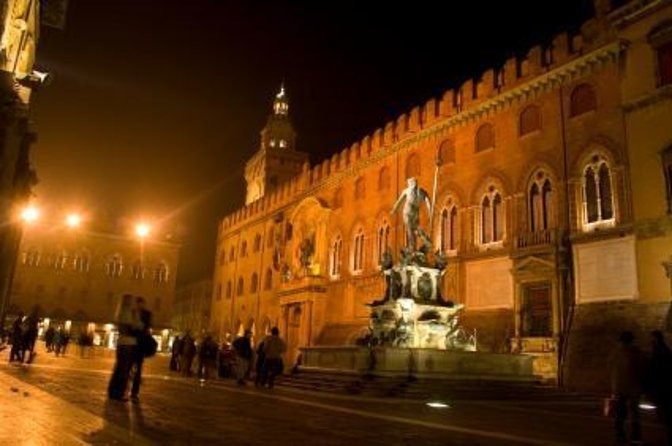
- Piazza Maggiore anchors the walk: You spend about an hour around Bologna’s main square and its surrounding palaces.
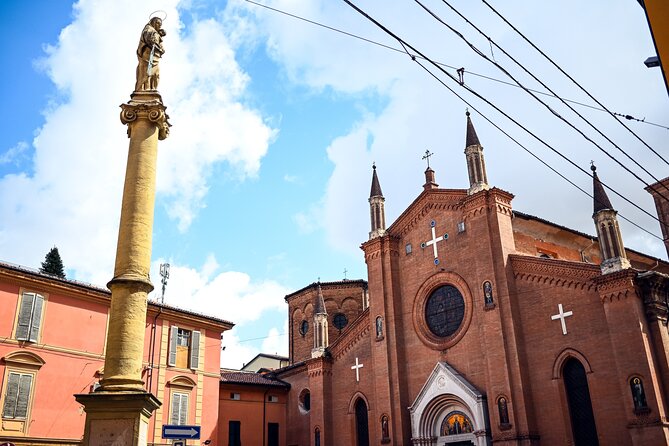
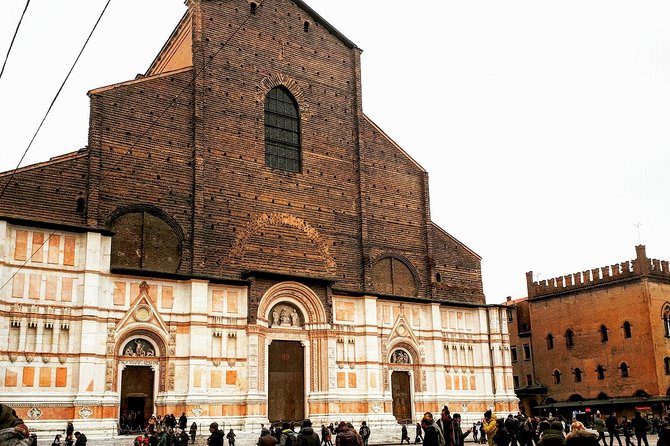
- San Petronio is the visual centerpiece: The tour covers the church’s unusual appearance, Bolognini Chapel, giant sundial, and four crosses.
- The Archiginnasio adds university history: See a former university seat with heraldic decoration, old books, and a wooden anatomical theater.
- Food enters the route naturally: Via Pescherie Vecchie brings you through the old central market, historic shops, wine spots, and street food.
- The group stays small: The maximum is 10 people, with private or semi-private arrangements available.
- Plan for extra basilica costs: Entry is not included, and groups of more than two need to rent an audio guide at San Petronio.
Bologna in two hours, with the city’s big stories connected
I like this walk because Bologna makes more sense when you understand how its buildings relate to one another. Piazza Maggiore is not just a pretty square for photographs. It is the setting for the old municipal buildings, papal ambition, public ceremonies, and the city’s long political life.
The route lasts about two hours, though one past account describes closer to three hours of easy walking. That difference matters. You should treat two hours as the planned duration, but allow some flexibility if the guide spends extra time explaining the buildings or answering questions.
You meet at Libreria Giannino Stoppani on Via Rizzoli, 1/f, and return to the same point at the end. The route involves light walking and is near public transportation. Most people can take part, and service animals are allowed.
The guide works in English. Isadora is the named guide associated with this experience, and the strongest praise centers on her storytelling, local background, friendly manner, and ability to balance city history with food suggestions. One English-language account found her communication occasionally difficult, so if completely fluent English is essential for you, keep that small reservation in mind.
More Old Town and Historic Centre Walks in Italy
- Rome in a Day Tour with Vatican, Colosseum and Historic Center
★ 4.5 · 1,042 reviews - Rome Food Tour in the Historic Centre with 8+ Food Tastings
★ 5.0 · 1,000 reviews - Genoa: 2-Hour Guided Walking Tour of the Historical Center
★ 4.2 · 605 reviews
Piazza Maggiore and the secrets of Bologna’s main square
The opening hour around Piazza Maggiore gives you the best sense of the city’s center. Locals may call it simply the Piazza, while singer Lucio Dalla used the name Piazza Grande. Either way, this is Bologna’s civic heart.
The square brings together several layers of the city. Palazzo d’Accursio, also called Palazzo Comunale, has served as Bologna’s municipal seat since 1336. It grew over time from an older core, so the building is less a single grand design than a group of structures joined across the centuries.
Inside, the sixteenth-century cordoned staircase attributed to Bramante is a notable detail. It was designed for a grand ascent on horseback by city officials, a reminder that old civic buildings were built for ceremony as much as administration.
Another part of the complex presents Bologna’s earlier settlements through excavations and layers of occupation. You can trace the story from Villanovan huts of the seventh century BC to Etruscan Felsina and Roman Bononia, founded in 189 BC. That sequence gives the square a useful sense of time, from small settlements to a major Roman city and then a medieval commune.
The nearby Palazzo Re Enzo has a more dramatic tale. Built between 1244 and 1246 as an extension of the municipal buildings, it became the residence of King Enzo of Sardinia after he was captured at the Battle of Fossalta. He remained a prisoner, and the building took his name.
The ground floor once held war machines, while popular councils met in the loggia above. These details help you picture the square as a working center of power, not simply a backdrop for modern cafés and photographs.
Neptune, papal power, and a statue called Il Gigante
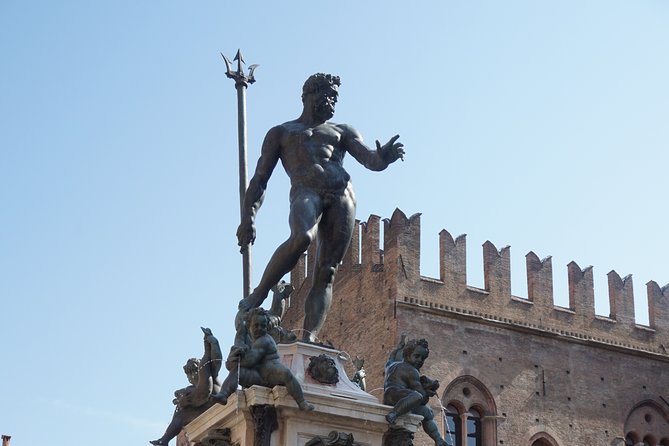
The Fountain of Neptune is Bologna’s other great symbol. Locals call the god Il Gigante, and the statue makes a strong impression even before you know the political message behind it.
Flemish sculptor Giambologna created the marble and bronze work from 1563 to 1566, following a project by Tommaso Laureti. Pope Pius IV commissioned it, and its meaning was direct: Neptune controls the waters, just as the pope claimed authority over the world.
At Neptune’s feet, four putti represent the Ganges, Nile, Amazon, and Danube. These rivers stood for the continents known at the time. A good guide can turn the fountain from a quick photo stop into a compact lesson in sixteenth-century power, religion, and geography.
This section is especially useful early in your stay. You get the basic names and stories of the center before exploring Bologna on your own. The guide also points out the city’s little Pulcinella secrets, local curiosities that are easy to miss if you move through the square without context.
San Petronio, Bologna’s unusual main church

San Petronio is the principal place of worship on the route, and its position beside Piazza Maggiore can surprise you. Bologna’s most important church is not the cathedral, a distinction that often puzzles first-time visitors.
The basilica’s exterior helps explain why. Its appearance is not fully canonical or neatly finished, and the guide explains why the church took this unusual form. Inside, the route includes the Bolognini Chapel, the enormous sundial, and the four crosses.
The sundial is described as the longest in the world. It is not a small decorative instrument, but a major scientific feature built into the church floor. This is the kind of detail that rewards a guided visit because you might otherwise walk past it without grasping its scale or purpose.
Admission to San Petronio is not included. For groups of more than two, you must rent an audio guide at the entrance, also at your own expense. That extra step is worth noting when you compare the $132.15 tour price with a simple outdoor city walk. If your group has only one or two people, the stated audio-guide requirement does not apply, though entry still is not included.
The church stop lasts about 30 minutes. That is enough for the main points, but not for a long, unhurried examination of every chapel and work of art. If San Petronio is your main reason for visiting Bologna, you may want to return independently.
More Private History Tours in Italy
- Ancient Ostia Antica Semi-Private Day Trip from Rome by Train with Guide
★ 4.5 · 579 reviews - Colosseum & Ancient Rome Semi-Private Tour
★ 5.0 · 208 reviews - Ancient Pompeii Private Tour: Skip the Line & Kid-Friendly Option
★ 5.0 · 167 reviews - Skip-the-Line Half-Day Private Tour Ancient Pompeii Highlights with Native Guide
★ 5.0 · 146 reviews
The Archiginnasio and three centuries of university life
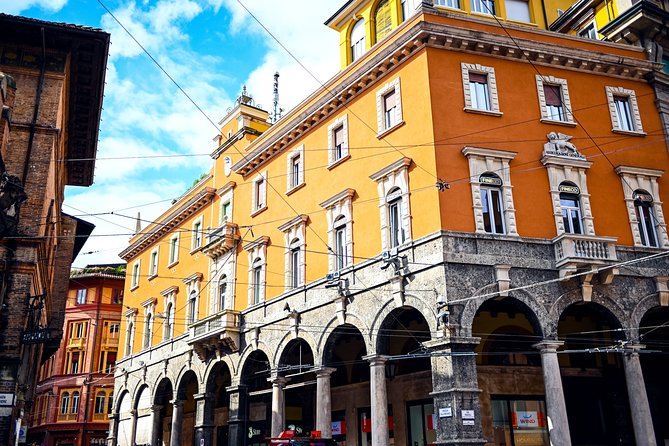
Bologna is home to the oldest university in the world, and the Archiginnasio gives that claim a physical setting. The building served as the University of Bologna for three centuries and still feels closely tied to student and academic life.
Inside, you can see heraldic coats of arms, illuminated manuscripts, old books, and the wooden anatomical theater. These are not random museum pieces. Together, they show how students and professors worked, studied, and presented knowledge in earlier centuries.
The anatomical theater is one of the most memorable parts of the route. Its woodwork and statues create a formal room built for teaching anatomy, while the coats of arms record the people and institutions linked to the university.
I would pay close attention here even if you are not a university enthusiast. Bologna’s identity is shaped by students, scholars, and the movement of people who came to study. The Archiginnasio gives that side of the city a clear face.
The tour does not promise a long interior visit at every stop, so ask the guide how much time is available if you want to focus on the building’s books, decorations, or anatomical theater.
Via Pescherie Vecchie and Bologna’s food side
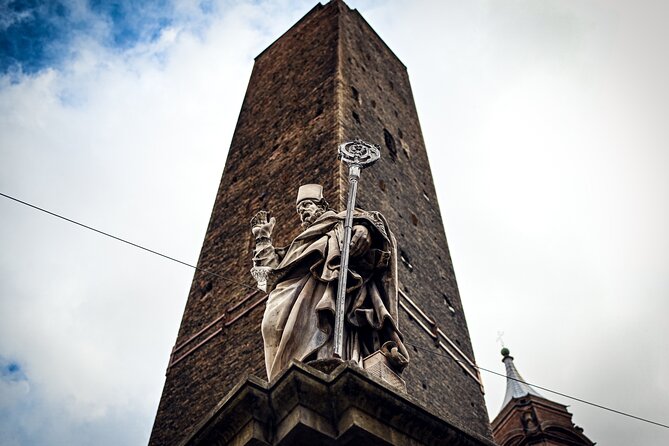
After the grand squares and public buildings, Via Pescherie Vecchie brings the scale down to narrow market lanes. This was Bologna’s central market from the Middle Ages, and it remains a picturesque area of old shops, wine places, and street food.
This is one of my favorite parts of the route in practical terms. A history tour can leave you with dates and façades but no idea where to eat. Here, the guide can point you toward local food areas and suggest places to find particular foods. Past accounts especially praise the balance between history and food advice.
The stop lasts about 15 minutes, so do not expect a full tasting tour. Snacks are not included. Think of this section as a useful introduction to Bologna’s food culture and a chance to note places for a later meal or aperitivo.
You may want to return after the walk when you have more time. The route is short, and the market district deserves a slower look if you want to browse shops or try street food.
Bologna’s towers and the medieval skyline
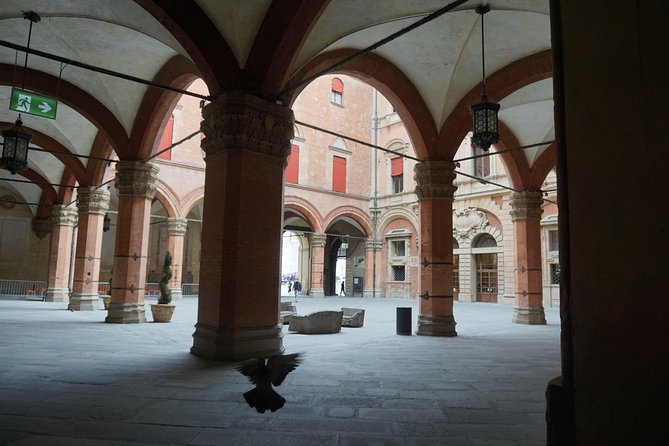
The final subject is Bologna’s medieval towers. The city’s horizon was once marked by more than 100 towers, though far fewer remain today.
The tour approaches the subject from the city gate and covers why so many towers were built and what happened to them. The stories connect family power, defense, competition, and urban change, though the exact amount of time spent at individual towers depends on the guide and pace.
This is another place where a local guide helps. You can see a tall medieval tower, but the more useful question is why Bologna once had so many of them and why the skyline changed. The tour offers that context without asking you to spend half a day on a tower climb.
Is $132.15 a fair price?
At $132.15 per person, this is not a budget introduction to Bologna. The value depends heavily on your group size and the guide’s performance.
For a private pair, the cost buys personal attention, a relaxed pace, and the chance to ask questions. For a larger party of up to 10, the per-person price is easier to justify if you want a private setting rather than a large public tour. Group discounts may also be available, though the exact reduction is not specified.
You are paying for more than a route between famous buildings. The useful part is the connection between the monuments: papal symbolism at Neptune, municipal power around Palazzo d’Accursio, the prisoner king at Palazzo Re Enzo, university life at the Archiginnasio, and food culture in the old market.
Still, the walk is only about two hours, and several costs are separate. San Petronio admission is not included, nor is the required audio guide for groups larger than two. Snacks also cost extra. One direct assessment called the tour slightly expensive, while still finding no regret in booking it. That feels like the right way to frame the price.
Who will get the most from this walk?
I would choose this tour for a first visit to Bologna, especially if you want orientation before exploring alone. The route covers the main historic center without trying to cram every church and museum into one morning.
It also suits you if you value stories over a checklist. Isadora’s approach, as described in the supplied information, includes background, anecdotes, local secrets, and food suggestions. That combination can make a short tour feel more personal than a simple monument-by-monument explanation.
The walk is a good fit for couples, families, and small groups who prefer conversation and a slower rhythm. The maximum group size is 10, and private arrangements are available.
I would hesitate if you are seeking a low-cost walk, a long food tasting, or an in-depth church and museum tour. The experience gives you an overview, not a full day of interior visits. You should also allow for the extra basilica expense and the possibility that the tour takes longer than the advertised two hours when the conversation runs well.
You can cancel for a full refund up to 24 hours before the start time. Changes or cancellations inside that window are not accepted for a refund. The activity depends on good weather and a minimum number of participants. If the operator cancels for either reason, you are offered another date or experience, or a full refund.
Should you book the Bologna historic-center tour?
Book it if you want Bologna explained by a local guide, with the main square, San Petronio, the university quarter, market lanes, and medieval towers tied into one route. It is especially useful on your first day, when a local food tip or a clear map of the center can shape the rest of your visit.
Skip it if you already know Bologna well or prefer to explore independently with more time inside each building. At $132.15 per person, this is best viewed as a focused orientation with personal guidance, not a cheap walk or a full food tour.
FAQ
How long does the Bologna historic-center tour last?
The planned duration is about two hours. The route includes light walking, and some past outings have taken longer when the guide allowed extra time for explanation and questions.
What is the price of the tour?
The listed price is $132.15 per person. Group discounts may be available, but the exact discount is not specified.
How many people can join the tour?
The activity has a maximum of 10 participants. It is offered as a private or semi-private experience.
What language is the tour offered in?
The tour is offered in English. Isadora is the named guide associated with the experience.
Where does the tour begin and end?
You meet at Libreria Giannino Stoppani, Via Rizzoli, 1/f, 40125 Bologna. The tour ends back at the same meeting point.
What is included in the price?
The price includes a guided tour with a licensed guide and RC insurance.
Is the San Petronio audio guide included?
No. For groups of more than two, an audio guide must be rented at the basilica entrance, and it is not included in the tour cost. Admission to the basilica is also not included.
Is this tour suitable for most people?
Most people can participate, and the tour involves light walking. Service animals are allowed, and the meeting area is near public transportation.
Can I cancel for a full refund?
Yes. You must cancel at least 24 hours before the local start time for a full refund. Poor weather or failure to meet the minimum number of participants can lead to a rescheduled experience or full refund.
Newest history tours we have reviewed in Italy
- Guided Cultural Tour of the Godfather Film in Messina★ 5.0 · 31 reviews
- SU NURAXI BARUMINI Unesco World Heritage Site★ 5.0 · 129 reviews
- Picnic aperitif in the vineyard of an ancient trullo in Martina Franca★ 5.0 · 21 reviews
- Brescia the Unexpected: History, Local Stories & a drink★ 5.0 · 31 reviews
- Bologna historical art walking tour with hidden gems and tastings★ 5.0 · 108 reviews
- Bolognese Cooking Class with Margherita in the Historic Center★ 5.0 · 26 reviews
- Best of Bologna in one day : Food, architecture, art and history★ 5.0 · 27 reviews
- Tuk Tuk tour in Bergamo, Città Alta and the ancient Venetian walls★ 5.0 · 32 reviews
Old Town & Historic Centre Walks, compared.
Madrid Essential: Historic Center, Plaza Mayor & Royal Palace
Read our review →
Live Fado Show with Port Wine in Historic Center
Read our review →
Valencia Old Town Tour with Wine & Tapas in 11th Century Historic Monument
Read our review →
Prague Old Town, Medieval Underground and Dungeon Historical Tour
Read our review →
Cartagena: Historic Center and Getsemaní Shared Walking Tour
Read our review →
Old Town Walking Tour History and Tales in Edinburgh
Read our review →
Philadelphia Old City Historic Walking Tour with 10+ Top Sites
Read our review →Browse the lists this tour appears in